
Smart Home Appliances Market Outlook (2022-2033)

Historic Data: 2022-2024   |   Base Year: 2025   |   Forecast Period: 2026-2033
Report Content: Market Scope, Market Segmentation, Market Dynamics, and Competitive Analysis

Report Coverage:
  • Product (Smart Washing Machines, Smart Air Purifiers, Smart TV, Others)
  • Distribution Channel (Online, Offline)
  • Technology (Bluetooth, WiFi, Zigbee, ZWave, NFC)

No. of Pages: 400
Report Code: BMIPUB00032669
Category: Electronics and Semiconductor
Smart Home Appliances Market
Buy Now

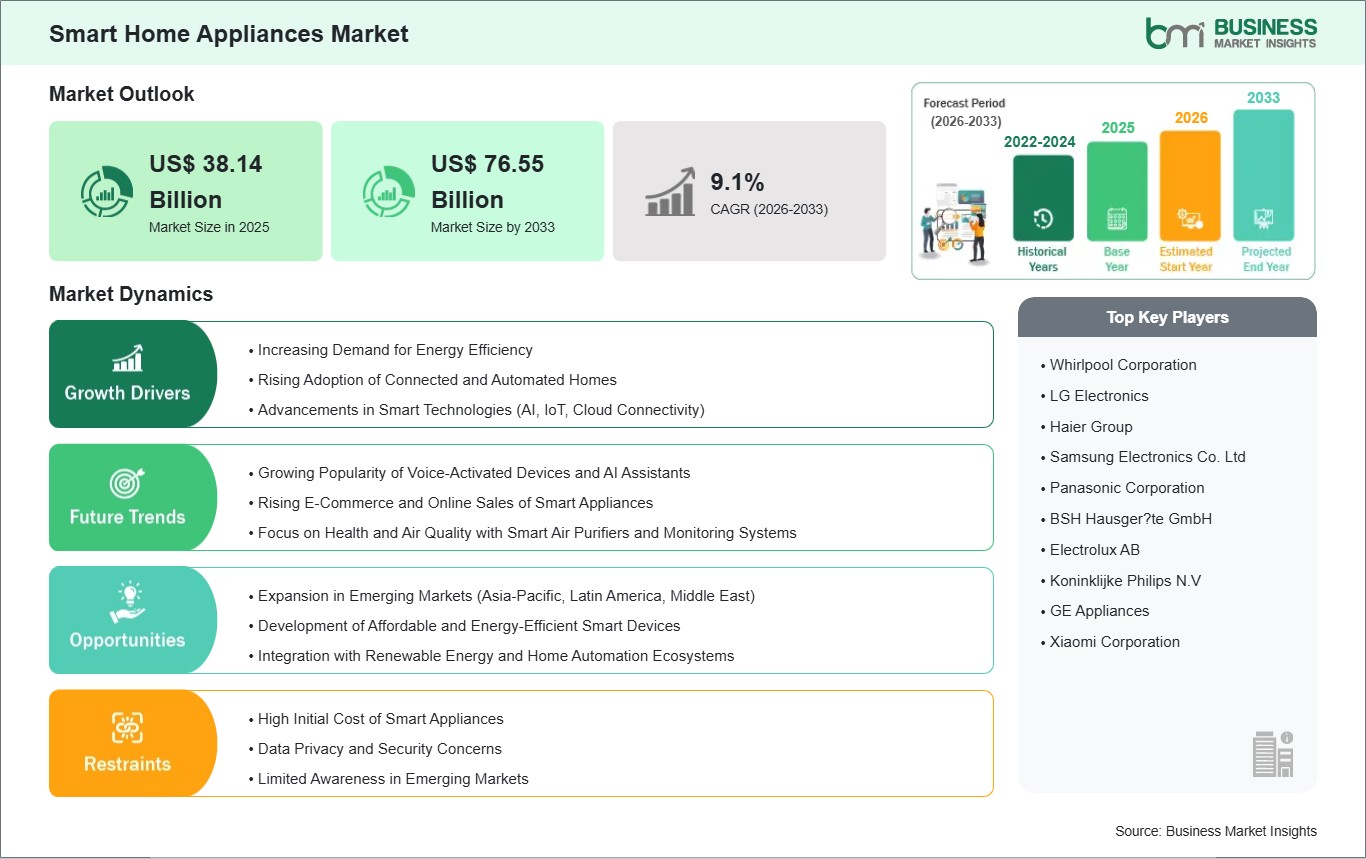
The smart home appliances market size is expected to reach US$ 76.55 billion by 2033 from US$ 38.14 billion in 2025. The market is estimated to record a CAGR of 9.1% from 2026 to 2033.

Executive Summary and Global Market Analysis:

Smart home appliances are basically devices that aim to make life easier, more energy, efficient, and more socially connected at home. Such appliances as smart washing machines, smart air purifiers, smart TVs, and other connected devices, all these technologies like Wi, Fi, Bluetooth, Zigbee, Z, Wave, and NFC are used to facilitate remote monitoring, automation, and intelligent operation of the devices. In this way, users get to control their energy consumption, increase comfort levels, keep the indoor air clean, and make everyday tasks easier. The advantages led by smart home appliances to energy savings, time efficiency, enhanced convenience, improved safety, and seamless integration with smart home systems, thus they are becoming more and more significant in modern households.

The smart home appliances market is influenced by the increasing consumer demand for convenience, energy, efficient products, and connected home solutions. The adoption of smart devices, the progress in wireless technologies, and the integration with mobile and voice, controlled platforms are some of the factors that are leading to further market expansion. The market is rife with opportunities in emerging markets, innovative product offerings, and the expansion of smart home ecosystems, whereas high costs and data security concerns are some of the challenges facing the market.

Smart Home Appliances Market - Strategic Insights:

global-market-strategic-framework
Get more information on this report

Smart Home Appliances Market Segmentation Analysis:

Key segments that contributed to the derivation of the smart home appliances market analysis are product, distribution channel, and technology.

  • By product, the smart home appliances market is segmented into Smart Washing Machines, Smart Air Purifiers, Smart TV, and Others. The Smart Washing Machines segment held a significant share of the market in 2024.
  • By distribution channel, the market is categorized into Online and Offline. The Online segment accounted for the largest share of the market in 2024.
  • By technology, the market is segmented into Bluetooth, Wi-Fi, Zigbee, Z-Wave, and NFC. The Wi-Fi segment dominated the market in 2024.
Smart Home Appliances Market Drivers and Opportunities:

Rising Demand for Energy-Efficient and Connected Homes

The smart home appliances market is largely influenced by the rising demand for convenience, energy savings, and connected living. Homeowners are increasingly adopting smart washing machines, air purifiers, TVs, and other devices to benefit from automation, remote control, and real-time monitoring. These appliances not only reduce energy consumption but also optimize performance and improve daily comfort. Advanced technologies such as Wi-Fi, Bluetooth, and AI enhance the user experience further. Government initiatives promoting energy efficiency and eco-friendly practices are also encouraging consumers to embrace smart home appliances, driving global market growth.

Expansion in Emerging Markets

Emerging markets present a significant growth opportunity for the smart home appliances industry. Rising urbanization, increasing disposable incomes, and growing awareness of connected home technologies are driving consumer adoption in regions such as Asia-Pacific, Latin America, and the Middle East. Both local manufacturers and international brands can introduce affordable, energy-efficient, and easy-to-use products tailored to these markets. Strategic partnerships, government incentives, and expanding e-commerce platforms further support adoption, positioning emerging markets as a key area of growth for the smart home appliances sector.

Smart Home Appliances Market Size and Share Analysis:

By product, the smart home appliances market is segmented into Smart Washing Machines, Smart Air Purifiers, Smart TV, and Others. The Smart Washing Machines segment held a significant share in 2024 due to their widespread adoption in households seeking energy efficiency, convenience, and advanced features such as automated cycles, remote control, and integration with smart home systems.

By distribution channel, the market is segmented into Online and Offline. The Online segment held the largest share in 2024, driven by increasing e-commerce penetration, ease of product comparison, home delivery services, and growing consumer preference for online shopping.

By technology, the market is segmented into Bluetooth, Wi-Fi, Zigbee, Z-Wave, and NFC. The Wi-Fi segment dominated the market in 2024 due to its high-speed connectivity, reliability, wide compatibility with smart home platforms, and seamless integration with mobile apps and voice-controlled devices.

Smart Home Appliances Market Report Highlights:

Report Attribute Details
Market size in 2025 US$ 38.14 Billion
Market Size by 2033 US$ 76.55 Billion
Global CAGR (2026 - 2033)9.1%
Historical Data 2022-2024
Forecast period 2026-2033
Segments Covered By Product
  • Smart Washing Machines
  • Smart Air Purifiers
  • Smart TV
  • Others
By Distribution Channel
  • Online
  • Offline
By Technology
  • Bluetooth
  • WiFi
  • Zigbee
  • ZWave
  • NFC
Regions and Countries Covered North America
  • US
  • Canada
  • Mexico
Europe
  • Belgium
  • Austria
  • Finland
  • Denmark
  • Greece
  • Poland
  • Romania
  • Russia
  • Ukraine
  • Czech Republic
  • Slovakia
  • Bulgaria
  • Italy
  • Luxembourg
  • Germany
  • Switzerland
  • France
  • Netherlands
  • Norway
  • Portugal
  • Spain
  • Sweden
  • United Kingdom
Asia-Pacific
  • Australia
  • China
  • India
  • Japan
  • South Korea
  • Indonesia
  • Malaysia
  • Philippines
  • Singapore
  • Thailand
  • Vietnam
  • Bangladesh
  • New Zealand
  • Taiwan
South and Central America
  • Brazil
  • Argentina
  • Peru
  • Chile
  • Colombia
Middle East and Africa
  • Bahrain
  • Kuwait
  • Oman
  • Qatar
  • Saudi Arabia
  • United Arab Emirates
  • Turkiye
  • South Africa
  • Egypt
  • Algeria
  • Nigeria
Market leaders and key company profiles
  • Whirlpool Corporation
  • LG Electronics
  • Haier Group
  • Samsung Electronics Co. Ltd
  • Panasonic Corporation
  • BSH Hausgeräte GmbH
  • Electrolux AB
  • Koninklijke Philips N.V
  • GE Appliances
  • Xiaomi Corporation
Get more information on this report

Smart Home Appliances Market Report Coverage and Deliverables:

The Smart Home Appliances Market Size and Forecast (2022–2033) report provides a detailed analysis of the market covering below areas:

  • Smart home appliances market size and forecast at global, regional, and country levels for all the key market segments covered under the scope
  • Smart home appliances market trends, as well as market dynamics such as drivers, restraints, and key opportunities
  • Smart home appliances market analysis covering key market trends, global and regional framework, major players, regulations, and recent market developments
  • Industry landscape and competition analysis covering market concentration, heat map analysis, prominent players, and recent developments for the smart home appliances market
  • Detailed company profiles, including SWOT analysis

Smart Home Appliances Market Geographic Insights:

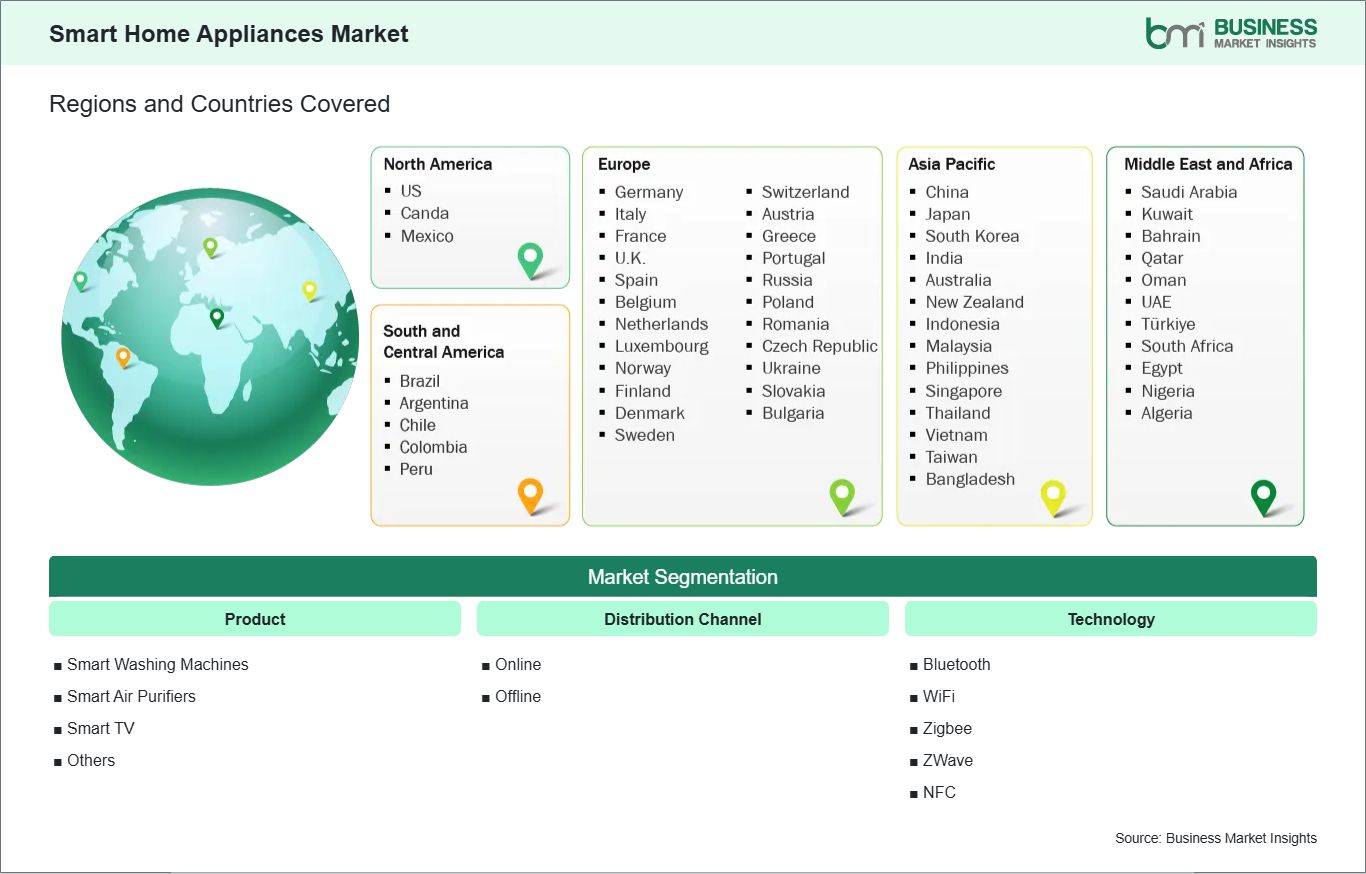
The geographical scope of the smart home appliances market report is divided into five regions: North America, Asia Pacific, Europe, Middle East & Africa, and South & Central America. The smart home appliances market in Asia Pacific is expected to grow significantly during the forecast period.

The Asia-Pacific smart home appliances market is segmented into China, Japan, South Korea, India, Australia, New Zealand, Indonesia, Malaysia, the Philippines, Singapore, Thailand, Vietnam, Taiwan, Bangladesh, and the Rest of Asia. China, Japan, and India held the largest share in 2024, driven by rapid urbanization, expansion of commercial infrastructure, and rising adoption of smart home appliances across residential and commercial spaces.

The region is witnessing strong growth in Wi-Fi, Bluetooth, Zigbee, Z-Wave, and NFC-enabled appliances. Adoption of mobile-based control, cloud connectivity, and automation features is driving higher usage across households, offices, and commercial buildings. Increasing awareness of convenience, energy efficiency, and home security, along with government initiatives supporting smart city development, digital transformation, and infrastructure modernization, is further boosting demand for smart home appliances in the Asia-Pacific region.

global-market-geography
Get more information on this report

Smart Home Appliances Market Research Report Guidance:

  • The report includes qualitative and quantitative data in the smart home appliances market across product, distribution channel, technology, and geography.
  • The report starts with the key takeaways (chapter 2), highlighting the key trends and outlook of the smart home appliances market.
  • Chapter 3 includes the research methodology of the study.
  • Chapter 4 further includes ecosystem analysis.
  • Chapter 5 highlights the major industry dynamics in the smart home appliances market, including factors that are driving the market, prevailing deterrents, potential opportunities, as well as future trends. Impact analysis of these drivers and restraints is also covered in this section.
  • Chapter 6 discusses the smart home appliances market scenario, in terms of historical market revenues, and forecast till the year 2031.
  • Chapters 7 to 10 cover smart home appliances market segments by product, distribution channel, and technology, and geography across North America, Europe, Asia Pacific, Middle East and Africa, and South and Central America. They cover the market volume revenue forecast and factors driving the market.
  • Chapter 11 describes the competitive analysis along with the heat map analysis for the key players operating in the market.
  • Chapter 12 describes the industry landscape analysis. It provides detailed descriptions of business activities such as market initiatives, new developments, mergers, and joint ventures globally, along with a competitive landscape.
  • Chapter 13 provides detailed profiles of the major companies operating in the smart home appliances market. Companies have been profiled on the basis of their key facts, business descriptions, products and services, financial overview, SWOT analysis, and key developments.
  • Chapter 14, i.e., the appendix is inclusive of a brief overview of the company, list of abbreviations, and disclaimer.

Smart Home Appliances Market News and Key Development:

The smart home appliances market is evaluated by gathering qualitative and quantitative data post primary and secondary research, which includes important corporate publications, association data, and databases. A few of the key developments in the smart home appliances market are:

  • In April 2025, Panasonic in India, a diversified technology company, announced the launch of its state-of-the-art Smart Home Experience Centre - a one-stop solution for Panasonic offerings aimed at redefining smart living. To address the rise in demand for smart homes, Panasonic’s Experience Centre has been designed around three key themes: wellness, security, and convenience. It features Panasonic’s Miraie (IoT platform) enabled solutions for health and well-being, safety & security, and comfort & convenience.
  • In September 2025, Samsung, India’s largest consumer electronics brand, unveiled its vision for “AI Home: Future Living, Now” at its flagship BKC store in Mumbai. Samsung AI Home is a next-generation connected living ecosystem that unites appliances, devices, and services to deliver unmatched convenience, energy efficiency, and personalised experiences — all with security and privacy at the core.
  • In December 2024, Universal Electronics Inc. (UEI), a global leader in smart home technology, announced the launch of its groundbreaking QuickSet homeSense technology at the upcoming International Consumer Electronics Show (CES) in Las Vegas January 2025. QuickSet homeSense adds a layer of on-device intelligence that learns from the home environment and connected devices, adapts to user behavior and environment changes, making homes more intuitive and efficient.

Key Sources Referred:

  • World Bank – Global Trade Indicators
  • World Trade Organization (WTO)
  • (International Monetary Fund )IMF
  • International Trade Administration (ITA)
  • Company website
  • Company annual reports
  • Company investor presentations

The List of Companies - Smart Home Appliances Market

  • Whirlpool Corporation
  • LG Electronics
  • Haier Group
  • Samsung Electronics Co. Ltd
  • Panasonic Corporation
  • BSH Hausger?te GmbH
  • Electrolux AB
  • Koninklijke Philips N.V
  • GE Appliances
  • Xiaomi Corporation
Frequently Asked Questions
How big is the Smart Home Appliances Market?

The Smart Home Appliances Market is valued at US$ 38.14 Billion in 2025, it is projected to reach US$ 76.55 Billion by 2033.

What is the CAGR for Smart Home Appliances Market by (2026 - 2033)?

As per our report Smart Home Appliances Market, the market size is valued at US$ 38.14 Billion in 2025, projecting it to reach US$ 76.55 Billion by 2033. This translates to a CAGR of approximately 9.1% during the forecast period.

What segments are covered in this report?

The Smart Home Appliances Market report typically cover these key segments-

  • Product (Smart Washing Machines, Smart Air Purifiers, Smart TV, Others)
  • Distribution Channel (Online, Offline)
  • Technology (Bluetooth, WiFi, Zigbee, ZWave, NFC)

What is the historic period, base year, and forecast period taken for Smart Home Appliances Market?

The historic period, base year, and forecast period can vary slightly depending on the specific market research report. However, for the Smart Home Appliances Market report:

  • Historic Period : 2022-2024
  • Base Year : 2025
  • Forecast Period : 2026-2033
  • Who are the major players in Smart Home Appliances Market?

    The Smart Home Appliances Market is populated by several key players, each contributing to its growth and innovation. Some of the major players include:

  • Whirlpool Corporation
  • LG Electronics
  • Haier Group
  • Samsung Electronics Co. Ltd
  • Panasonic Corporation
  • BSH Hausgeräte GmbH
  • Electrolux AB
  • Koninklijke Philips N.V
  • GE Appliances
  • Xiaomi Corporation
  • Who should buy this report?

    The Smart Home Appliances Market report is valuable for diverse stakeholders, including:

    • Investors: Provides insights for investment decisions pertaining to market growth, companies, or industry insights. Helps assess market attractiveness and potential returns.
    • Industry Players: Offers competitive intelligence, market sizing, and trend analysis to inform strategic planning, product development, and sales strategies.
    • Suppliers and Manufacturers: Helps understand market demand for components, materials, and services related to concerned industry.
    • Researchers and Consultants: Provides data and analysis for academic research, consulting projects, and market studies.
    • Financial Institutions: Helps assess risks and opportunities associated with financing or investing in the concerned market.

    Essentially, anyone involved in or considering involvement in the Smart Home Appliances Market value chain can benefit from the information contained in a comprehensive market report.

    Available Report Formats

    pdf-format excel-format pptx-format
    Buy Now

    Customization Form

    Please tell us your area of interest
    (Market Segments/ Regions and Countries/ Companies)