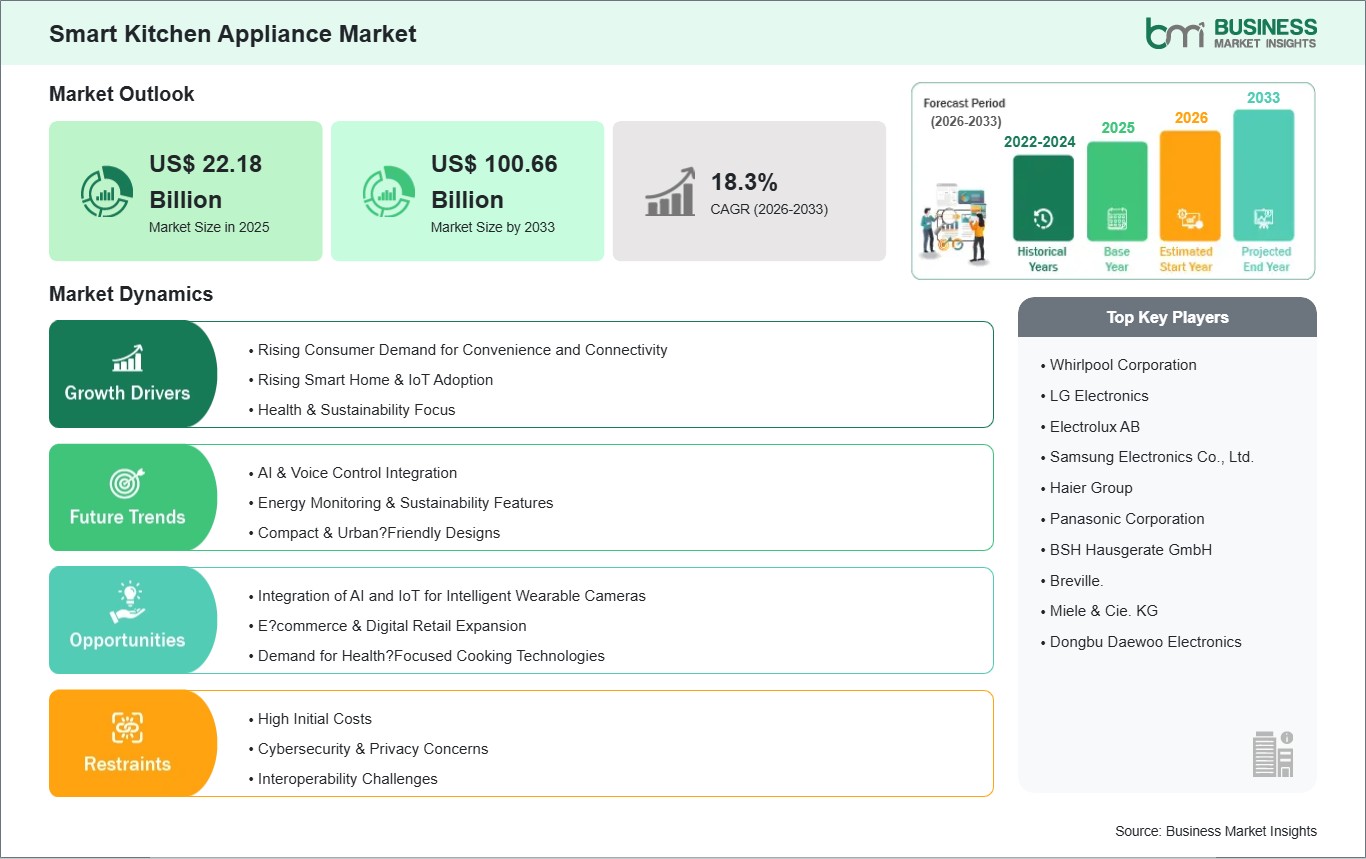
The smart kitchen appliance market size is expected to reach US$ 100.66 billion by 2033 from US$ 22.18 billion in 2025. The market is estimated to record a CAGR of 18.3% from 2026 to 2033.
Smart kitchen appliances refer to digitally connected cooking and food-preparation devices that use technologies such as the Internet of Things (IoT), artificial intelligence, sensors, and mobile applications to automate and enhance kitchen tasks. These appliances, including smart refrigerators, ovens, dishwashers, coffee makers, and cooking assistants, allow users to monitor, control, and customize operations remotely through smartphones or voice assistants. Their usage focuses on improving convenience, efficiency, and accuracy in daily cooking, meal planning, and food management. The benefits of smart kitchen appliances include time savings, energy efficiency, reduced food waste, improved safety, and personalized cooking experiences, making them highly attractive to modern consumers. In the smart kitchen appliance market, key drivers include rising adoption of smart homes, increasing consumer preference for convenience, growing urbanization, and advancements in connectivity and AI technologies.
However, market growth faces restraints such as high initial costs, data privacy concerns, lack of technical awareness, and compatibility issues across platforms. Despite these challenges, significant opportunities exist due to increasing disposable incomes, expansion of e-commerce channels, demand for energy-efficient appliances, and integration with voice-controlled virtual assistants. Current market trends include the growing popularity of multifunctional appliances, sustainability-focused designs, AI-powered cooking recommendations, and seamless integration with broader smart home ecosystems, positioning smart kitchen appliances as a rapidly evolving and influential segment of the global appliance industry.

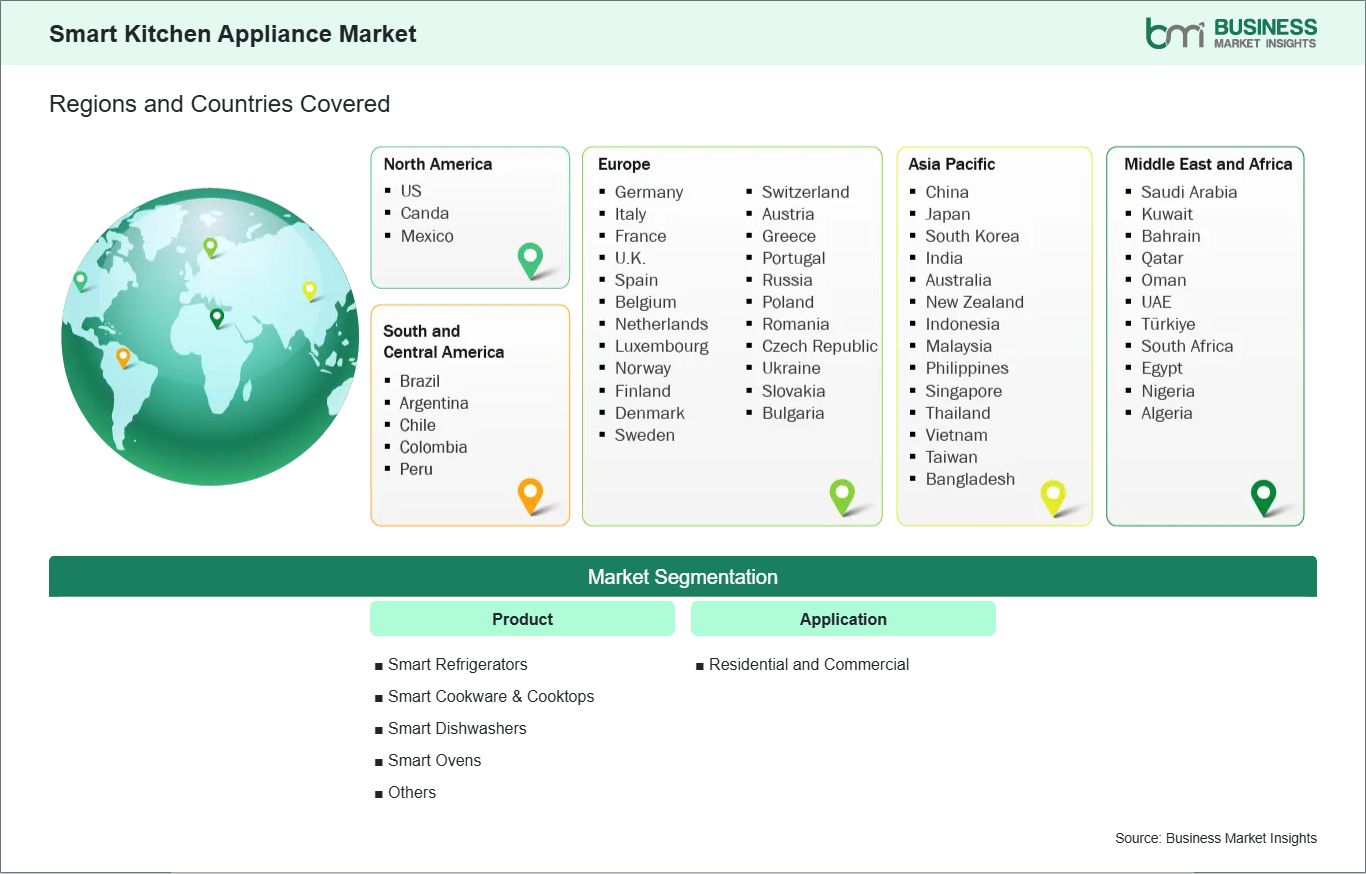
Key segments that contributed to the derivation of the smart kitchen appliance market analysis are product and application.
The smart kitchen appliance market is being significantly propelled by rapidly growing consumer demand for convenience, connectivity, and time-saving solutions. Modern lifestyles are more fast-paced than ever, with consumers—especially working professionals, young families, and tech-savvy millennials—seeking appliances that streamline routine kitchen tasks without compromising quality. Smart kitchen devices such as connected refrigerators, app-enabled ovens, robotic cooking assistants, and intelligent dishwashers offer features like remote monitoring, automated cooking presets, voice command integration, and real-time notifications. These functions reduce manual involvement, save valuable time, and enhance the overall user experience. Another core aspect driving adoption is the seamless integration of these appliances into broader smart home ecosystems. Through Wi-Fi, Bluetooth, and IoT connectivity, users can control their kitchen devices using smartphones, virtual assistants like Alexa and Google Assistant, and even pre-set scenarios (for example, pre-heating an oven while returning home from work). The proliferation of high-speed internet and advancements in cloud computing have further lowered barriers to entry, enabling real-time software updates and predictive maintenance alerts that reduce downtime and increase appliance lifespan. Moreover, the growth in remote work and home-centric lifestyles post-pandemic has amplified interest in healthier, home-cooked meals—fueling demand for intelligent tools that support culinary creativity while enhancing efficiency. This shift toward digitally connected, user-centric kitchen experiences continues to be a fundamental driver shaping market expansion and consumer investment in smart kitchen innovation.
A compelling opportunity for the smart kitchen appliance market lies in the integration of advanced artificial intelligence (AI) and data-driven personalization to transform how households plan, prepare, and consume food. AI enables appliances to learn user preferences over time and deliver tailored recommendations—such as suggesting recipes based on eating habits, monitoring nutritional goals, or automatically adjusting cooking parameters for perfect results. For example, a smart oven empowered with machine learning can recognize frequently prepared dishes and optimize temperature profiles to enhance taste and texture, while connected refrigerators can analyze inventory to recommend shopping lists, reduce food waste, and even suggest recipes that use soon-to-expire ingredients.
The continued rise of big data analytics and improved sensor technologies enhances these capabilities, creating intelligent systems capable of predictive and adaptive behavior. This convergence of AI and kitchen appliances not only elevates user convenience but also opens avenues for service-based revenue models, such as subscription platforms for personalized recipe content, wellness integration, and remote diagnostics. Furthermore, AI-driven appliances can support sustainability goals by optimizing energy consumption and reducing waste—an increasingly important consideration for eco-conscious consumers and policy makers. With increasing consumer interest in health, customization, and sustainable living, manufacturers that harness AI to deliver highly personalized, context-aware kitchen experiences are positioned to differentiate themselves and capture substantial market share. As AI and IoT technologies continue to evolve, their intersection within smart kitchen ecosystems represents a transformative growth frontier for the industry.

By product, the market is segmented into smart refrigerators, smart cookware & cooktops, smart dishwashers, smart ovens, and others. Smart refrigerators mean internet-connected appliances that monitor food, manage temperature automatically, reduce energy use, and support users through apps and AI features. Their worldwide demand is rising because of busy lifestyles, smart homes, energy efficiency awareness, food waste reduction, and rapid technological advancements.
By application, the market is segmented into residential and commercial. The residential segment held the largest share of the market in 2025. The demand for smart kitchen appliances in residential homes is increasing due to busy lifestyles, rising disposable income, and growing adoption of smart home technology. These appliances offer convenience, energy efficiency, remote control, and time savings, making daily cooking and kitchen management easier and more efficient for households.
| Report Attribute | Details |
|---|---|
| Market size in 2025 | US$ 22.18 Billion |
| Market Size by 2033 | US$ 100.66 Billion |
| Global CAGR (2026 - 2033) | 18.3% |
| Historical Data | 2022-2024 |
| Forecast period | 2026-2033 |
| Segments Covered | By Product
|
|
Regions and Countries Covered
| |
| North America | US, Canada, Mexico |
| Europe | Belgium, Austria, Finland, Denmark, Greece, Poland, Romania, Russia, Ukraine, Czech Republic, Slovakia, Bulgaria, Italy, Luxembourg, Germany, Switzerland, France, Netherlands, Norway, Portugal, Spain, Sweden, United Kingdom |
| Asia-Pacific | Australia, China, India, Japan, South Korea, Indonesia, Malaysia, Philippines, Singapore, Thailand, Vietnam, Bangladesh, New Zealand, Taiwan |
| South and Central America | Brazil, Argentina, Peru, Chile, Colombia |
| Middle East and Africa | Bahrain, Kuwait, Oman, Qatar, Saudi Arabia, United Arab Emirates, Turkiye, South Africa, Egypt, Algeria, Nigeria |
| Market leaders and key company profiles |
|
The Smart Kitchen Appliance Market Size and Forecast (2022–2033) report provides a detailed analysis of the market covering below areas:
The geographical scope of the smart kitchen appliance market report is divided into five regions: North America, Asia Pacific, Europe, Middle East & Africa, and South & Central America. The smart kitchen appliance market in Asia Pacific is expected to grow significantly during the forecast period.
The North America smart kitchen appliance market is segmented into United State, Canada, and Mexico. The demand and adoption of smart kitchen appliances in North America have increased significantly in recent years due to a combination of technological, economic, and lifestyle-related factors. One of the primary drivers is the rapid advancement in Internet of Things (IoT), artificial intelligence, and connectivity technologies, which has enabled kitchen appliances to become more intelligent, efficient, and user-friendly. Consumers are increasingly attracted to features such as remote monitoring, voice control, predictive maintenance, and personalized cooking settings, which enhance convenience and efficiency in daily household tasks. The widespread use of smartphones and smart home ecosystems, including platforms like Amazon Alexa, Google Assistant, and Apple HomeKit, has further accelerated adoption by allowing seamless integration of kitchen appliances with other connected devices. Another important factor is the growing emphasis on energy efficiency and sustainability. Smart kitchen appliances often come equipped with energy-saving modes, real-time energy consumption tracking, and automated optimization functions, which appeal to environmentally conscious consumers and those seeking to reduce utility costs.
Additionally, rising disposable incomes and a strong preference for premium and technologically advanced home products in North America support market growth. Changing lifestyles, particularly busy work schedules and an increasing number of dual-income households, have also fueled demand for appliances that save time and reduce manual effort, such as smart ovens, refrigerators, and dishwashers. The expansion of e-commerce and improved retail distribution channels have made smart kitchen appliances more accessible, allowing consumers to compare features, prices, and reviews easily. Furthermore, the COVID-19 pandemic heightened interest in home cooking and kitchen upgrades, reinforcing long-term demand for smart solutions that improve cooking accuracy, food management, and overall convenience. Together, these factors continue to drive strong demand and widespread adoption of smart kitchen appliances across North America.

The smart kitchen appliance market is evaluated by gathering qualitative and quantitative data post primary and secondary research, which includes important corporate publications, association data, and databases. A few of the key developments in the smart kitchen appliance market are:
The Smart Kitchen Appliance Market is valued at US$ 22.18 Billion in 2025, it is projected to reach US$ 100.66 Billion by 2033.
As per our report Smart Kitchen Appliance Market, the market size is valued at US$ 22.18 Billion in 2025, projecting it to reach US$ 100.66 Billion by 2033. This translates to a CAGR of approximately 18.3% during the forecast period.
The Smart Kitchen Appliance Market report typically cover these key segments-
The historic period, base year, and forecast period can vary slightly depending on the specific market research report. However, for the Smart Kitchen Appliance Market report:
The Smart Kitchen Appliance Market is populated by several key players, each contributing to its growth and innovation. Some of the major players include:
The Smart Kitchen Appliance Market report is valuable for diverse stakeholders, including:
Essentially, anyone involved in or considering involvement in the Smart Kitchen Appliance Market value chain can benefit from the information contained in a comprehensive market report.
Please tell us your area of interest
(Market Segments/ Regions and Countries/ Companies)