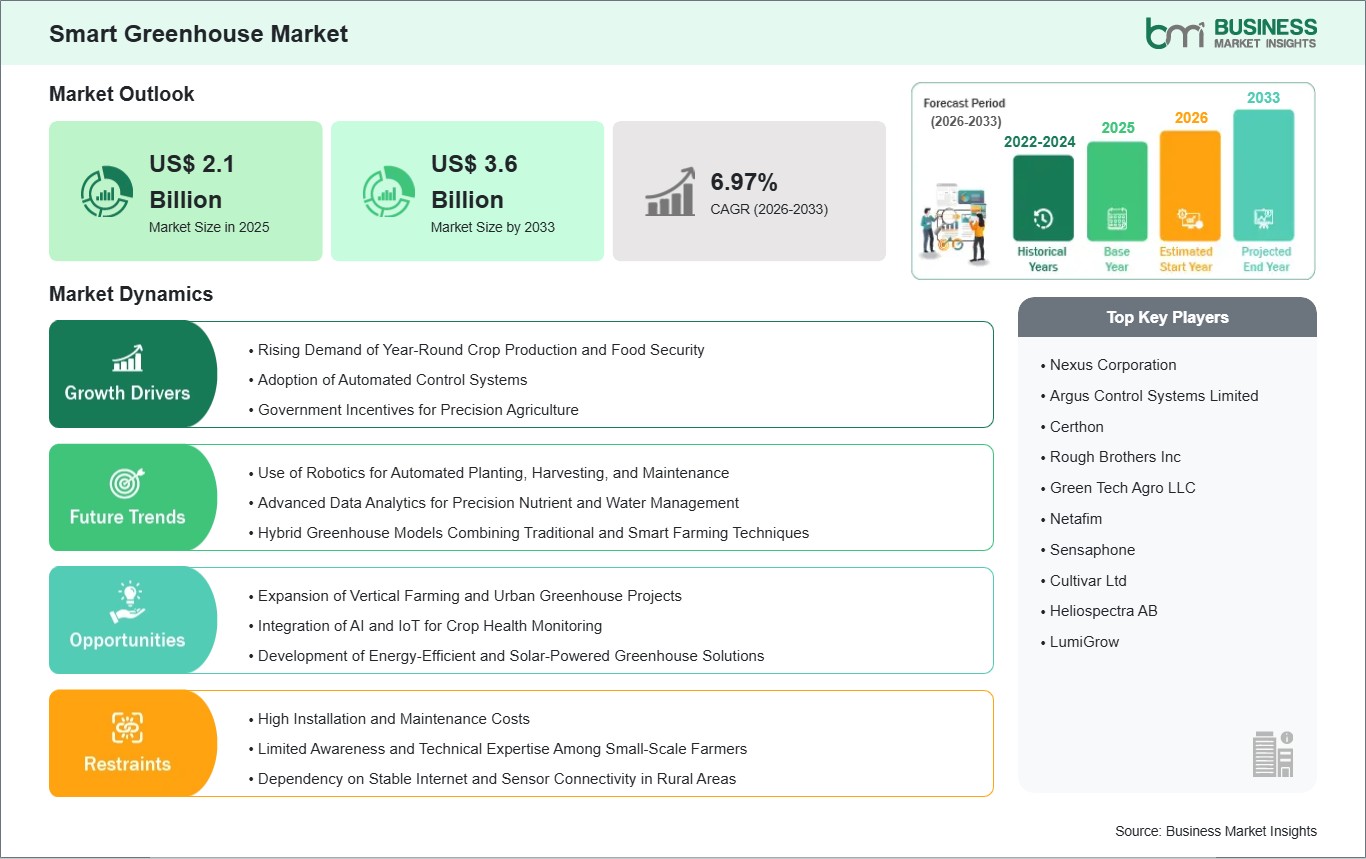
The Smart Greenhouse Market size is expected to reach US$ 3.6 billion by 2033 from US$ 2.1 billion in 2025. The market is estimated to record a CAGR of 6.97% from 2026 to 2033.
The global smart greenhouse market is centered on the use of advanced technologies to optimize crop production, enhance resource efficiency, and ensure sustainability in agriculture. Smart greenhouses leverage IoT sensors, automated climate control, AI-driven analytics, hydroponic or aeroponic systems, and remote monitoring platforms to create highly controlled environments for plant growth. These systems help farmers manage temperature, humidity, light exposure, irrigation, and nutrient supply in real time, enabling higher yields, better quality crops, and reduced environmental impact. Growing global demand for food security, sustainable agriculture, and precision farming solutions are key driver of this market, along with increasing adoption of technology-driven agriculture practices across commercial and research-focused operations.
Despite these advantages, adoption is constrained by factors such as high initial investment costs, technical complexity, and the need for skilled personnel to operate and maintain smart greenhouse systems. Integration challenges with existing farming practices, particularly in small-scale or traditional farms, can also slow widespread implementation. Nevertheless, innovations in automation, energy-efficient systems, AI-powered crop management tools, and remote monitoring are making smart greenhouses increasingly accessible and practical.
The market is gradually transforming traditional agriculture into a more data-driven, sustainable, and efficient industry, providing solutions that address food security, environmental concerns, and operational productivity on a global scale.

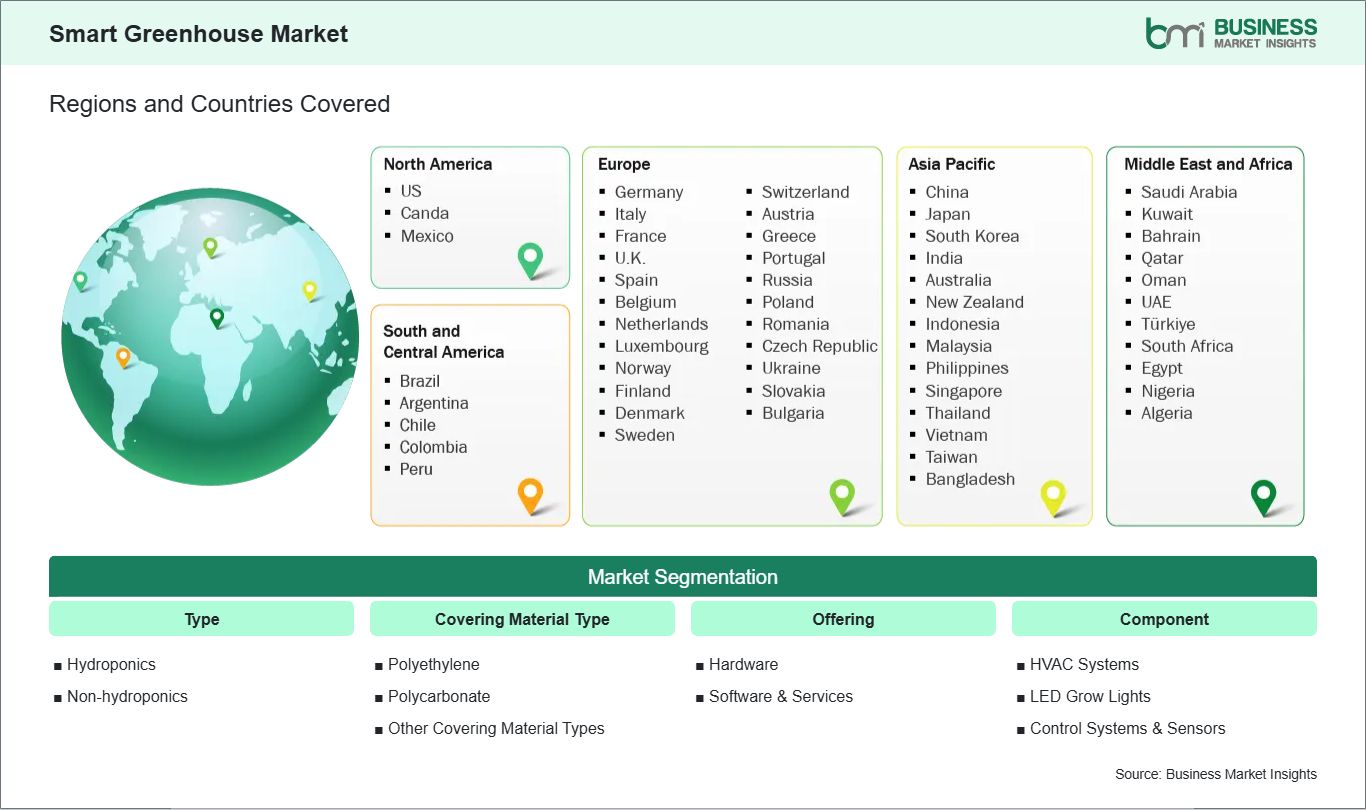
Key segments that contributed to the derivation of the smart greenhouse market analysis are type, covering material type, offering, component, and end user.
The growing need for reliable, year‑round crop production is driving the adoption of smart greenhouses around the world. By creating controlled environments, these systems allow farmers to grow vegetables, fruits, and herbs regardless of season or weather, ensuring a steady supply of fresh produce. This ability to manage temperature, humidity, light, and water precisely helps protect crops from extreme conditions and pests, supporting food security in an increasingly unpredictable climate.
Smart greenhouses are also reshaping the way people think about agriculture. No longer limited to traditional fields, farming can now be optimized through data-driven decisions. Sensors, automated irrigation, and climate control systems work together to create the ideal conditions for each crop, reducing waste and enhancing yield. The result is not just more food, but higher-quality produce that can reach consumers more efficiently.
Beyond production efficiency, smart greenhouses contribute to global food resilience. With the world’s population continuing to grow, the pressure on traditional agriculture increases. These technologies help ensure that communities have access to consistent, fresh food year-round, while also reducing reliance on long-distance imports. In this way, smart greenhouses are becoming a key solution to feeding more people sustainably in the face of climate change and urbanization.
Smart greenhouses are at the heart of a broader transformation in agriculture, where vertical farming and urban greenhouse projects are turning previously unused spaces into productive landscapes. By stacking layers of crops indoors or integrating greenhouses into city environments, growers can maximize space efficiency and bring fresh produce closer to where people live. Automation and environmental monitoring systems ensure each layer receives optimal light, water, and nutrients, making these farms highly efficient.
These technologies also allow farming to be more precise and sustainable. Artificial lighting, automated irrigation, and climate control work together to reduce water consumption and energy use compared to traditional agriculture. Smart greenhouses can continuously adjust conditions in response to plant needs, preventing overuse of resources and minimizing crop loss due to environmental stress.
Beyond sustainability, smart greenhouses are changing how people engage with food production. Urban farms can become educational hubs, community projects, or even local markets, connecting people to the source of their food. By combining technology, efficiency, and accessibility, smart greenhouses are redefining agriculture on a global scalehelping humanity grow more food with less environmental impact, all while creating spaces that inspire innovation and connection.

The smart greenhouse market is experiencing steady growth, with market size and share analysis reflecting evolving treatment preferences and competitive dynamics among key players. The report evaluates important subsegments categorized within type, covering material type, offering, component, and end user, highlighting their respective contributions to overall market performance.
By type, the hydroponics subsegment dominated the Smart Greenhouse market in 2025. Hydroponic systems are favored for their efficient use of water and nutrients, higher crop yields, and ability to support year-round cultivation, driving widespread adoption in controlled-environment agriculture.
By covering material type, the polyethylene subsegment dominated the Smart Greenhouse market in 2025. Polyethylene coverings are cost-effective, durable, and provide optimal light transmission, making them the preferred choice for both commercial and research-oriented greenhouses.
Based on offering, the hardware subsegment dominated the Smart Greenhouse market in 2025. Hardware components, including climate control systems, sensors, and lighting solutions, are essential for precise environmental management and automation, fueling high demand in modern greenhouses.
In terms of component, the LED grow lights subsegment dominated the Smart Greenhouse market in 2025. LED grow lights enable efficient photosynthesis, energy savings, and customizable lighting conditions, making them critical for maximizing crop productivity and quality.
On the basis of end user, the research & educational institutes subsegment dominated the Smart Greenhouse market in 2025. These institutes rely on smart greenhouses for experimentation, controlled studies, and training, which drives the adoption of advanced greenhouse technologies.
| Report Attribute | Details |
|---|---|
| Market size in 2025 | US$ 2.1 Billion |
| Market Size by 2033 | US$ 3.6 Billion |
| Global CAGR (2026 - 2033) | 6.97% |
| Historical Data | 2022-2024 |
| Forecast period | 2026-2033 |
| Segments Covered | By Type
|
|
Regions and Countries Covered
| |
| North America | US, Canada, Mexico |
| Europe | Belgium, Austria, Finland, Denmark, Greece, Poland, Romania, Russia, Ukraine, Czech Republic, Slovakia, Bulgaria, Italy, Luxembourg, Germany, Switzerland, France, Netherlands, Norway, Portugal, Spain, Sweden, United Kingdom |
| Asia-Pacific | Australia, China, India, Japan, South Korea, Indonesia, Malaysia, Philippines, Singapore, Thailand, Vietnam, Bangladesh, New Zealand, Taiwan |
| South and Central America | Brazil, Argentina, Peru, Chile, Colombia |
| Middle East and Africa | Bahrain, Kuwait, Oman, Qatar, Saudi Arabia, United Arab Emirates, Turkiye, South Africa, Egypt, Algeria, Nigeria |
| Market leaders and key company profiles |
|
The "Smart Greenhouse Market Size and Forecast (2022 - 2033)" report provides a detailed analysis of the market covering below areas:
The geographical scope of the Smart Greenhouse market report is divided into five regions: North America, Asia Pacific, Europe, Middle East & Africa, and South & Central America. The Smart Greenhouse market in North America is expected to grow during the forecast period.
North America leads the global smart greenhouse market, driven by technological innovation, large-scale commercial agriculture, and a focus on sustainable farming practices. Farmers, agribusinesses, and research institutions in the United States and Canada are increasingly adopting automated climate control systems, IoT-based monitoring, and AI-powered crop management solutions to optimize production and reduce resource consumption. The region’s emphasis on innovation, sustainability, and precision agriculture encourages investment in high-tech greenhouse systems capable of maximizing yield while minimizing energy, water, and nutrient use.
North American smart greenhouses often integrate advanced technologies such as hydroponics, aeroponics, LED lighting systems, and predictive analytics for crop performance, creating highly controlled environments tailored to the needs of specific crops. Additionally, environmental regulations, consumer demand for locally grown and sustainably produced food, and the need for consistent crop supply in urban and peri-urban areas further drive adoption. Challenges remain, including managing system complexity, high upfront costs, and ensuring technical expertise is available for ongoing operations. Nevertheless, North America sets a benchmark for the global smart greenhouse industry, demonstrating how technology can transform agriculture into a sustainable, efficient, and highly productive enterprise while meeting modern food security and environmental priorities.

The smart greenhouse market is evaluated by gathering qualitative and quantitative data post primary and secondary research, which includes important corporate publications, association data, and databases. A few of the key developments in the smart greenhouse market are:
The Smart Greenhouse Market is valued at US$ 2.1 Billion in 2025, it is projected to reach US$ 3.6 Billion by 2033.
As per our report Smart Greenhouse Market, the market size is valued at US$ 2.1 Billion in 2025, projecting it to reach US$ 3.6 Billion by 2033. This translates to a CAGR of approximately 6.97% during the forecast period.
The Smart Greenhouse Market report typically cover these key segments-
The historic period, base year, and forecast period can vary slightly depending on the specific market research report. However, for the Smart Greenhouse Market report:
The Smart Greenhouse Market is populated by several key players, each contributing to its growth and innovation. Some of the major players include:
The Smart Greenhouse Market report is valuable for diverse stakeholders, including:
Essentially, anyone involved in or considering involvement in the Smart Greenhouse Market value chain can benefit from the information contained in a comprehensive market report.
Please tell us your area of interest
(Market Segments/ Regions and Countries/ Companies)