Small Arms Market Regional Highlights
North America Small Arms Market
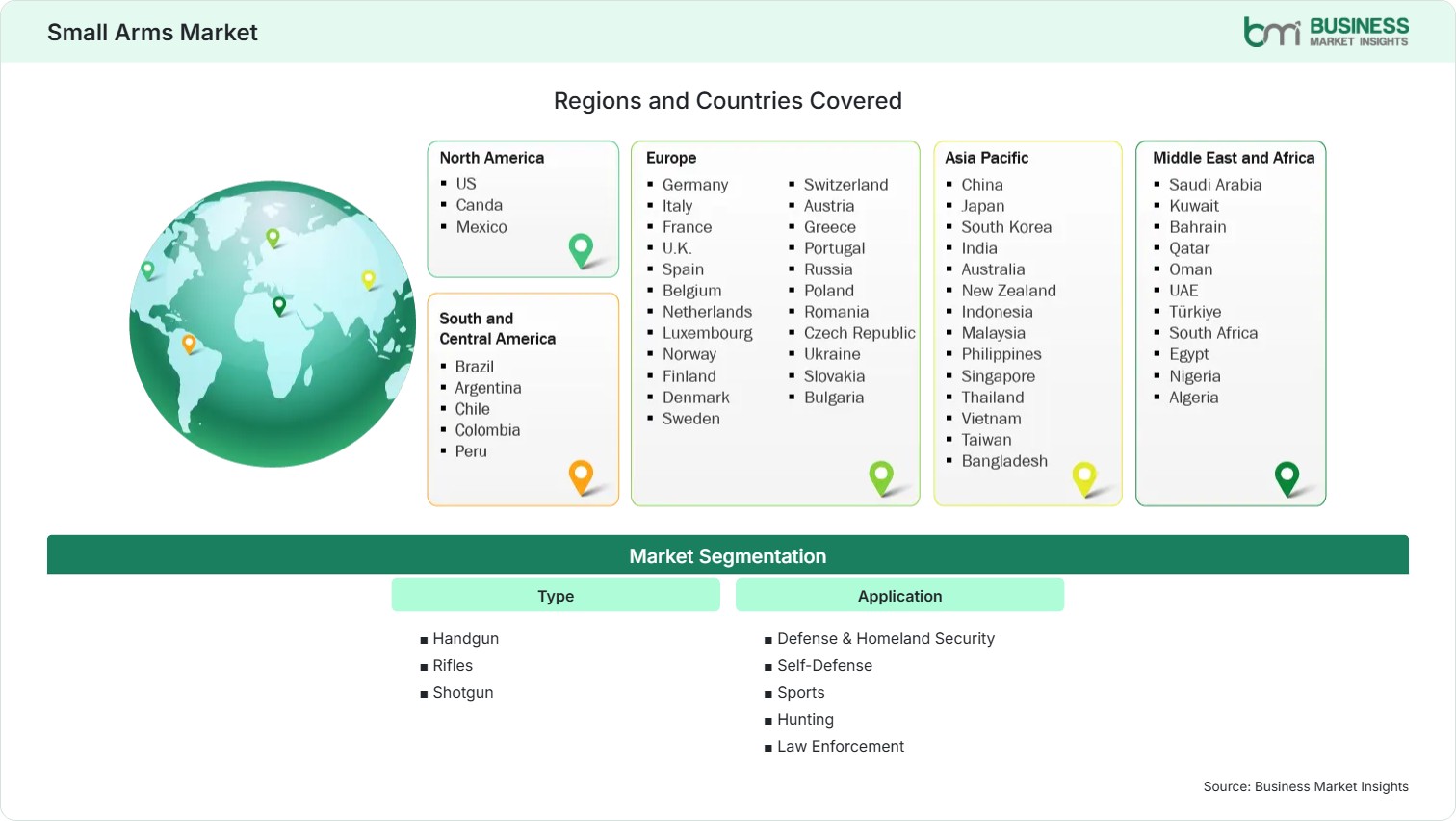
North America accounts for 35%–38% Small Arms Market share in 2025 and records a 3.8%–4.3% CAGR through 2033. The region benefits from mature manufacturing, established distribution networks, institutional procurement, and replacement demand.
- Modernization of the defense sector is still leading to the acquisition of rifles, handguns, and modular systems, and the replacement programs result in ongoing demand within military and law enforcement organizations.
- Demand from civilians is still varied among the areas of sport shooting, hunting, training, and those involving regulated self-defense, which gives resilience to the market when government procurement cycles temporarily ease.
- Production flexibility in the field of advanced manufacturing is being achieved through the use of automation, precision machining, polymer components, better quality assurance, and shorter development cycles for specialized platforms.
- Although Canada has a smaller addressable market, demand for its products in the fields of sports, hunting, and institutional use remains steady within a regulatory environment that is relatively restrictive.
US Small Arms Market
The United States represents approximately 31%–34% of global Small Arms Market demand in 2025 and expands at a 3.7%–4.2% CAGR through 2033. Institutional procurement, civilian replacement purchases, sporting applications, and hunting create a diversified demand structure.
- The fact that government procurement supports demand for standardized platforms, replacement components, training systems, and maintenance services results in revenue that is visible over a period longer than individual consumer purchasing cycles.
- The civilian market is still very segmented, with manufacturers dealing with sport shooting, hunting, personal protection, collecting, and training by using different product configurations and distribution methods.
- The availability of components for domestic use helps to ensure manufacturing resilience, but changes in regulations, adjustments to inventory, and varying consumer buying patterns can lead to inconsistent quarterly production requirements.
Europe Small Arms Market
Europe Small Arms Market represents 21%–24% share in 2025 and records a 4.8%–5.3% CAGR through 2033. Germany and France remain important defense manufacturing centers, while Poland is among the higher-growth markets at 6.0%–6.6% CAGR. Germany is projected at 4.9%–5.4% CAGR, while France advances at 4.6%–5.1%.
- In 2025, military spending in Europe amounted to about US$864 billion, which produced a wider procurement environment conducive to the modernization of equipment, even though the purchase of small arms only accounted for part of these funds.
- Germany meets the requirements of military modernization by combining its domestic industrial capabilities, thus satisfying the demand for qualified rifles, handguns, components, and lifecycle support services.
- Poland has greater growth potential since rising defense spending and the modernization of its forces are increasing the need for equipment that is locally supported and for systems that are interoperable.
- France has well-developed capabilities in the manufacture of defense equipment and in the export of such equipment, since demand from institutions places a strong emphasis on reliability, qualification, maintainability, and compatibility with other equipment systems.
Asia Pacific Small Arms Market
Asia Pacific Small Arms Market holds 22%–25% share in 2025 and posts the fastest regional growth at 5.1%–5.7% CAGR. China, India, Japan, South Korea, and Australia represent major demand centers, while India and South Korea offer particularly strong industrial opportunities. India is projected at 6.1%–6.7% CAGR, while South Korea records 5.8%–6.4% CAGR as domestic capabilities develop.
- India has large defense needs along with a number of localization measures, which promote domestic production, technology partnerships, component manufacturing, and the qualification of locally developed platforms.
- South Korea is enhancing its capabilities in defense manufacturing and its competitiveness in exports, which is opening up opportunities for companies that take part in advanced production, engineering, components, and integrated procurement programs.
- Both Japan and Australia have well-developed institutional requirements that stress interoperability, reliability, lifecycle support, and conformity with wider regional security strategies.
- In the Southeast Asian markets, there are certain growth opportunities, since demands for procurement are supported by measures involving border protection, the modernization of the police, maritime security, and domestic industrial development.
Rest of World Small Arms Market
South and Central America Small Arms Market accounts for 8%–10% share in 2025 and grows at 4.0%–4.6% CAGR, led by Brazil and Mexico. The Middle East and Africa represent 9%–11%, advancing at 4.5%–5.1%. Brazil remains a key manufacturing center, while Saudi Arabia and the UAE emphasize security modernization.
- Brazil has access to expertise in domestic manufacturing and is used for a wide range of sporting, hunting, security, and institutional purposes, which in turn supports large-scale production and opportunities for regional distribution.
- Although there are institutional security requirements and the need for replacement, demand in Mexico is affected by regulatory complexity and procurement controls.
- Saudi Arabia and the UAE are still investing in their security capabilities, which provide opportunities for capable suppliers who can provide local support, training, maintenance, and technology partnerships.
- South Africa has existing industrial capabilities together with potential for exporting to the region, but variations in economic conditions and procurement priorities can lead to uneven demand among different customer groups.