Market Summary
Executive Summary and Global Market Analysis
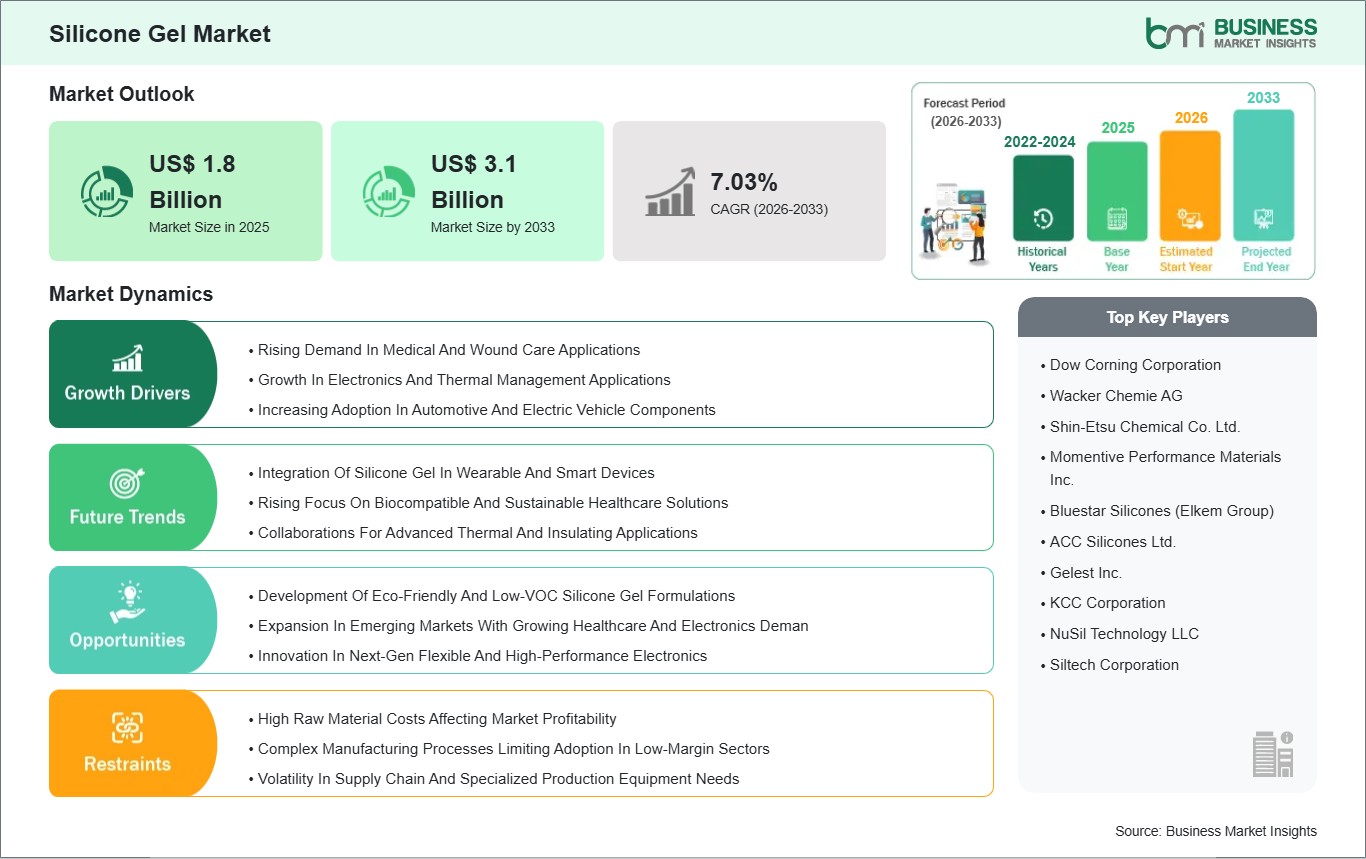
The worldwide market for silicone gel products is growing rapidly. Industries now select materials which provide both flexible performance and thermal stability and biocompatibility and protection against environmental elements. Silicone gels function as soft elastomeric materials which contain silicone polymers and special fillers to create a material with soft mechanical properties and strong chemical resistance. Their exceptional properties make them essential components which medical devices and wound care products and consumer healthcare items and electronics and automotive parts and adhesives and sealants depend on. The material has become applicable in various industries worldwide because it provides protection against extreme weather conditions while delivering safe performance.
The healthcare sector demands medical products and wound care supplies which drive worldwide market demand. People use silicone gels to treat scars and burns and skin healing because the gels do not irritate the skin and they provide a moist environment for healing. The materials offer biocompatibility together with a decreased chance of allergic reactions which makes them suitable for patient-facing medical equipment. Medical devices use silicone gel for component production which includes soft seals and cushioning interfaces and flexible connectors because the material provides both durability and safety.
Silicone gel serves as a potting compound and an encapsulation material and a thermal interface material for high-performance applications in the electronics and electrical equipment industry. The gels deliver outstanding electrical insulation properties together with effective thermal management capabilities, which enable them to shield delicate components from extreme operating conditions. The increasing demand for advanced consumer electronics and electric vehicles and renewable energy systems has resulted in a stronger requirement for silicone gel to provide dependable protection of components.
The silicone gel market experiences growth from various market drivers, but it encounters multiple market restrictions. Budget-restricted industries find it hard to use silicone gel products because raw material price changes and production challenges increase product costs for them. The need for specialized processing tools and skilled workers to create and use silicone gel products results in higher operational costs for businesses that produce customized medical and industrial-grade products.
Global silicone gel application expansion receives continuous support from current innovations and demand between different industries.
Segment Analysis
Silicone Gel Market Segmentation
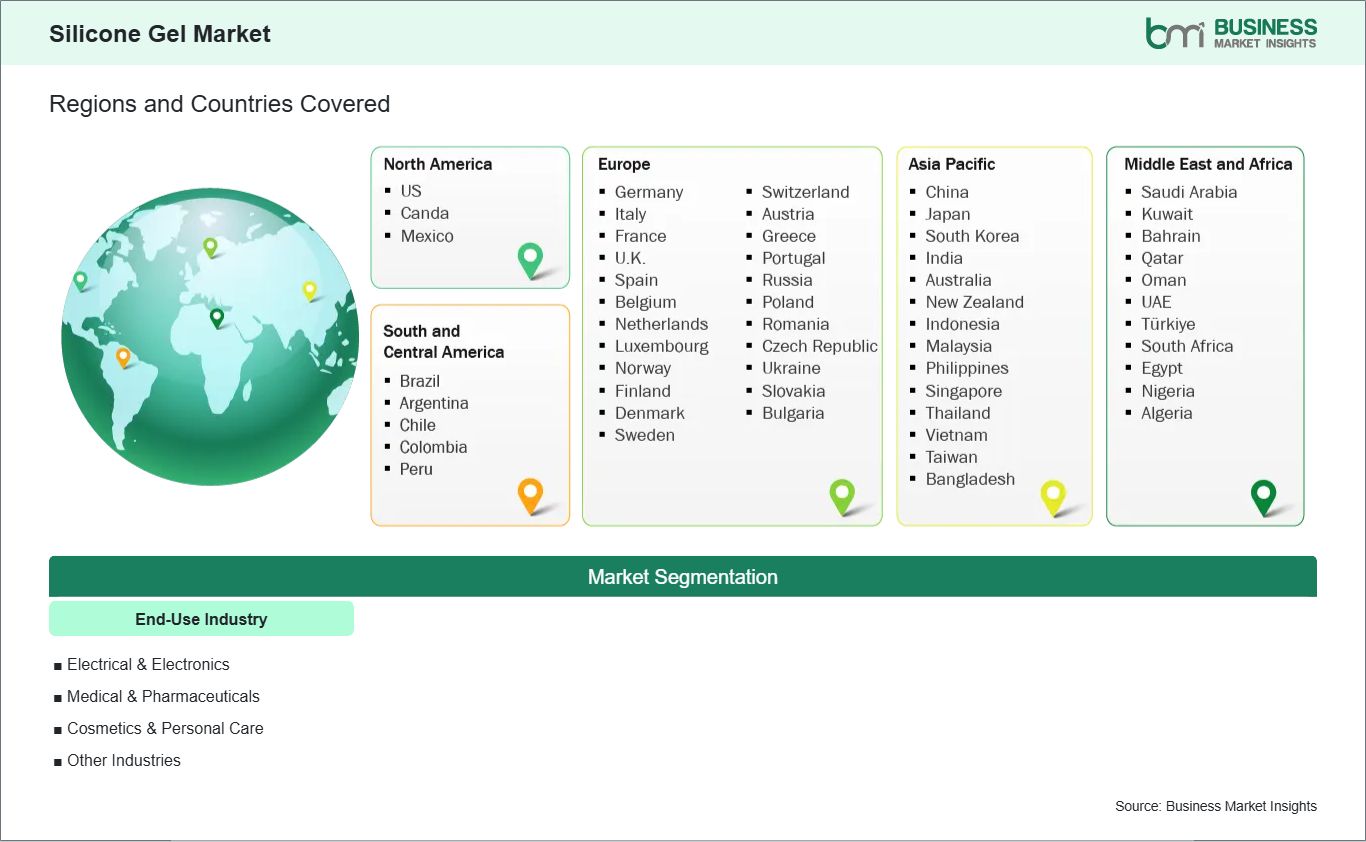
Key segment that contributed to the derivation of the silicone gel market analysis is end-use industry.
- Based on end-use industry, the silicone gel market is categorized into electrical & electronics, medical & pharmaceuticals, cosmetics & personal care, and other industries. The electrical & electronics segment dominated the market in 2025.
Market Forces
Silicone Gel Market Drivers and Opportunities
Rising Demand In Medical And Wound Care Applications
The global silicone gel market experiences substantial growth because its medical applications and wound care functions require its biocompatible and non-toxic silicone gel properties which gently touch skin areas to produce patient-friendly medical devices. The medical field uses silicone gels to create scar treatment sheets and burn care dressings and pressure ulcer prevention products and post-surgical healing aids because these materials provide a moist healing environment while decreasing skin irritation and enabling natural tissue regeneration. The North American and European hospital and outpatient care centers utilize silicone gel products in their clinical protocols because these products meet the rigorous healthcare quality requirements and safety standards which they must adhere to. Healthcare facilities in the Asia Pacific and Latin America regions are expanding their healthcare operations because medical professionals and caregivers increasingly understand how silicone gel helps with chronic wound treatment and rehabilitation.
The healthcare industry demands growing silicone gel-based dressings because hospitals acquire advanced wound care technologies which include diabetic ulcer and trauma treatment solutions. The applications of this technology utilize silicone gel because it protects delicate skin areas while reducing discomfort that patients experience during dressing changes, which makes it superior to conventional adhesive-based products. Silicone gels now serve additional purposes beyond their traditional role in wound care because they provide both cushioning and biocompatible properties which make them suitable for use in implantable medical devices and prosthetic interfaces. The use of silicone gel layers in orthopedic and cardiovascular medicine serves to shield implants from impact while simultaneously decreasing body tissue friction.
Development Of Eco‑Friendly And Low‑VOC Silicone Gel Formulations
The silicone gel market is experiencing increased demand for eco-friendly products because environmental sustainability has become a global priority. The production and application of traditional silicone gels generate VOC emissions because they use solvents and processing aids. North American and European manufacturers are developing green production technologies which decrease emissions and protect the environment while maintaining their products' flexible performance and thermal resistance and adhesion capabilities. The new formulations meet environmental regulations and green building certification requirements which mandate reduced solvent usage and better indoor air quality. Local producers in Asia Pacific industrial areas use water-based silicone gel systems and solvent-free methods to create sustainable products that meet customer demands and regulatory standards.
The eco-friendly alternatives are becoming popular in adhesive and sealant and protective coating applications because customers value products that have low environmental impact and meet new VOC emission regulations. Sustainability has become the main factor driving product development in consumer electronics and automotive interior segments because manufacturers want to use materials that create lower environmental damage. Eco-friendly silicone gels which include bio-derived precursors and improved recyclability are starting to replace traditional gels that are used in flexible displays and protective encapsulants and cushioning layers.
Size and Share Analysis
Silicone Gel Market Size and Share Analysis
The silicone gel market demonstrates steady growth, with size and share analysis highlighting evolving trends and competitive dynamics among key players. The report examines subsegments categorized within end-use industry, offering insights into their contribution to overall market performance.
Based on end-use industry, the electrical & electronics subsegment dominated the market in 2025, driven by extensive use of silicone gel for insulation, encapsulation, and protective coating in electronic components.
Report Coverage
Silicone Gel Market Report Coverage and Deliverables
The "Silicone Gel Market Size and Forecast (2022 - 2033)" report provides a detailed analysis of the market covering below areas:
- Silicone Gel Market size and forecast at global, regional, and country levels for all the key market segments covered under the scope
- Silicone Gel Market trends, as well as drivers, restraints, and opportunities
- Silicone Gel Market analysis covering key trends, global and regional framework, major players, regulations, and recent developments
- Industry landscape and competition analysis covering market concentration, heat map analysis, prominent players, and recent developments for the Silicone Gel Market
- Detailed company profiles, including SWOT analysis
Geographic Insights
Silicone Gel Market Geographic Insights
The geographical scope of the Silicone Gel Market report is divided into North America, Asia Pacific, Europe, Middle East & Africa, and South & Central America. North America held the largest share in 2025.
The global silicone gel market displays distinct regional dynamics, with North America standing out as the dominant region because its advanced industrial infrastructure and strong healthcare sector and its early adoption of high-performance materials developed for various end-use industries. The United States leads demand in North America because medical and wound care applications require silicone gel which is used in scar management sheets and burn dressings and medical device interfaces that need biocompatibility and patient safety. The region's strict regulatory framework together with its high product performance requirements drives manufacturers to develop innovative silicone gel formulations that satisfy demanding quality and safety standards.
North America's strong electronics and semiconductor industries use silicone gel for various applications which include encapsulation and potting and thermal interface materials used in consumer electronics and telecommunications and automotive systems. The surge in electric vehicle adoption together with the rise of renewable energy technologies creates increased demand for silicone gel which functions as a thermal management and protective solution.
The Asia Pacific region experiences rapid growth because of improved healthcare facilities and increased consumer electronics production and industrial development activities in China and India and Japan and South Korea. The markets show increasing demand for silicone gel because of rising disposable incomes and healthcare modernization and higher spending on advanced manufacturing technologies.
The European market shows consistent adoption of medical devices and automotive components and industrial protection equipment which has been particularly strong in Germany and France and the UK because of their robust engineering industries and their environmental regulations which promote the use of strong performance materials.
The Middle East and Africa region shows increasing use of silicone gel in oil and gas operations and industrial machinery and infrastructure development projects which require protection against high temperatures and environmental conditions. T
he use of silicone gel products is growing in South and Central America especially in Brazil and Mexico because of the expanding automotive assembly and healthcare services in those countries.
The global adoption of silicone gel materials continues to increase because all regions require materials that provide high reliability and performance and extended durability.
Industry Activity
Recent Developments
The Silicone Gel Market is evaluated by gathering qualitative and quantitative data post primary and secondary research, which includes important corporate publications, association data, and databases. A few of the key developments in the silicone gel market are:
- In November 2023, Wacker Chemie AG announced that it presented the new highly adhesive silicone gel SILPURAN® 2124 at COMPAMED 2023, designed for medical applications such as atraumatic wound dressings and skin fixation devices, expanding its silicone gel portfolio for healthcare and wearable markets.
- In April 2025, Momentive Performance Materials announced that it launched Harmonie™ NatuVel gel, a 100 % biobased elastomer gel, at in‑cosmetics Global 2025, highlighting innovation in sustainable silicone gel solutions tailored for personal care and skin applications.
Trust & Transparency
Research Methodology
The market analysis combines proprietary research with secondary data from government agencies, company disclosures, regulatory filings, industry databases and expert interviews. Market estimates are validated through data triangulation, cross-market benchmarking and analyst
review.
View Full Research Methodology
Key Sources Referred:
World Health Organization (WHO) Organisation for Economic Cooperation and Development (OECD) The World Bank Group Worldometer The Lancet International Bar Association International Trade Administration