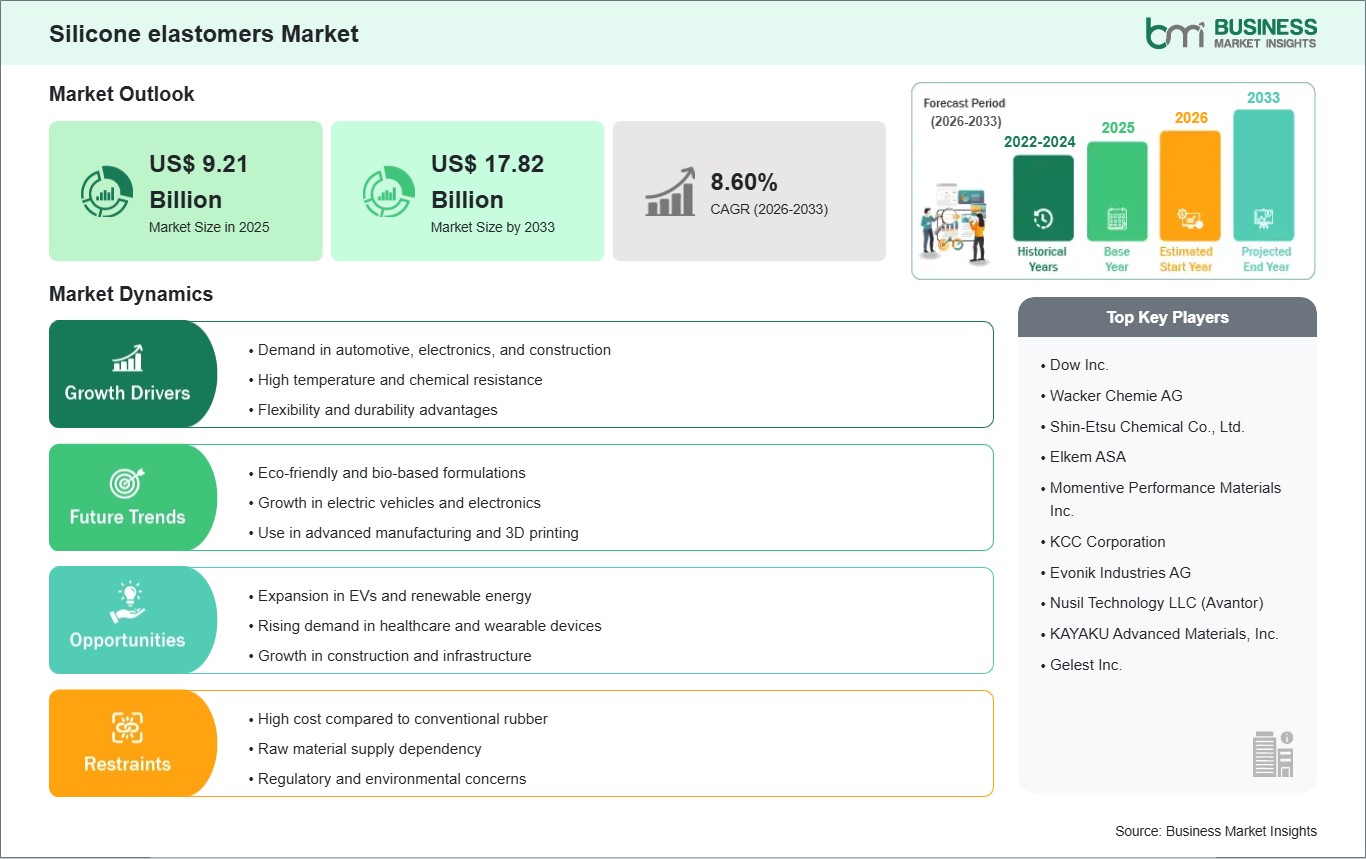
The Silicone elastomers Market size is expected to reach US$ 17.82 billion by 2033 from US$ 9.21 billion in 2025. The market is estimated to record a CAGR of 8.60% from 2026 to 2033.
The global silicone elastomers market is a dynamic segment within the advanced materials industry, characterized by its wide applicability across automotive, healthcare, electronics, construction, and consumer goods sectors. Silicone elastomers are valued for their exceptional properties, including flexibility, biocompatibility, thermal stability, weather resistance, and electrical insulation. These characteristics make them highly suitable for demanding environments, such as medical implants, automotive gaskets, electronic components, and sealing applications. The market is primarily driven by the increasing demand for durable and high-performance materials that can withstand extreme temperatures and harsh operating conditions.
Growth in electric vehicles, wearable medical devices, and advanced electronics has further accelerated the adoption of silicone elastomers, particularly in applications requiring precision and reliability. Additionally, the rising focus on lightweight and long-lasting materials in construction and industrial manufacturing contributes to market expansion. However, the market faces restraints such as relatively high production and raw material costs compared to conventional elastomers, which can limit adoption in cost-sensitive applications. Moreover, processing complexities and the need for specialized manufacturing techniques may present challenges for new entrants or smaller manufacturers aiming to compete in this technologically advanced market.
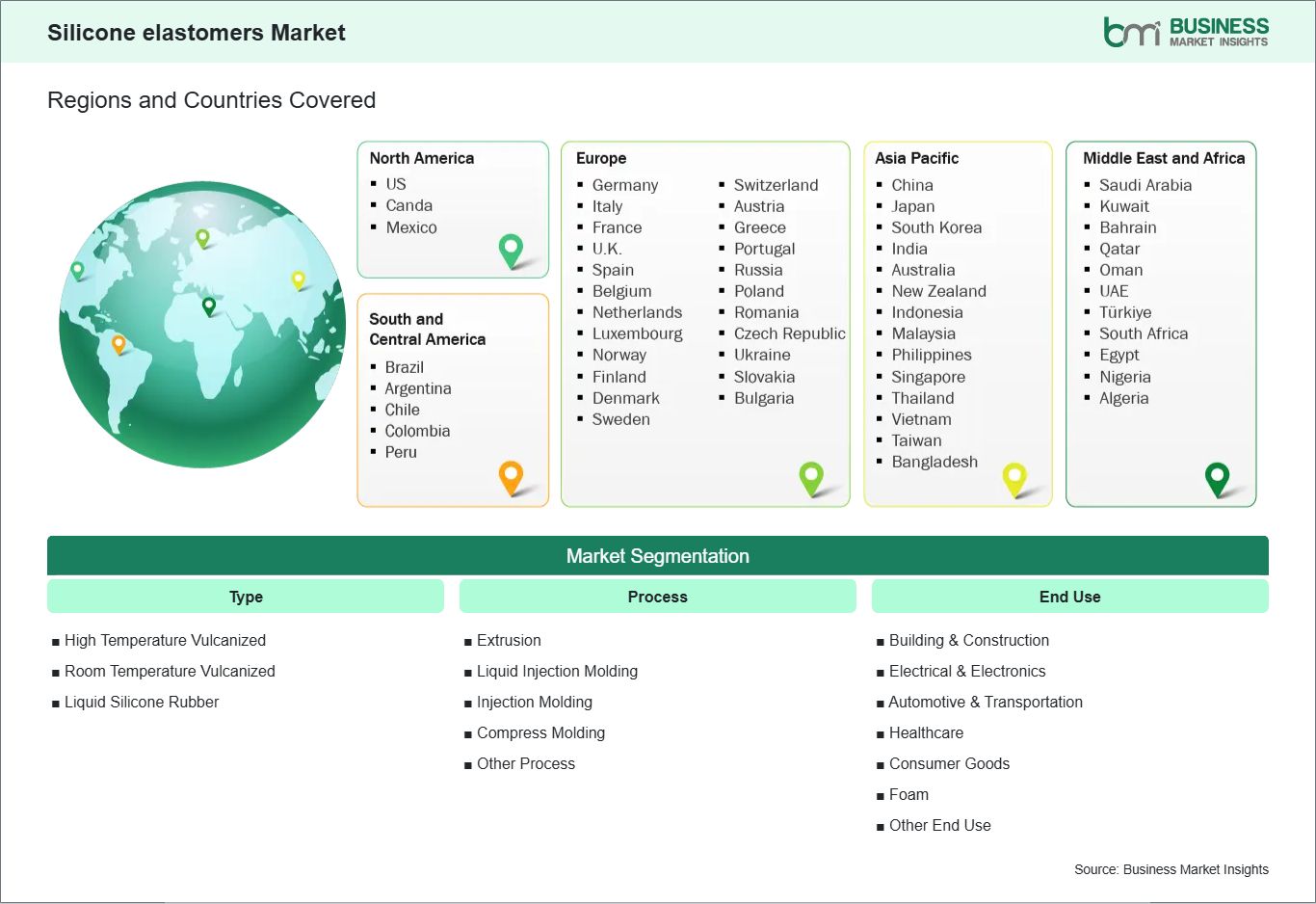
Key segments that contributed to the derivation of the silicone elastomers market analysis are type, process, and end use.
The Western Europe silicone elastomers market is largely driven by demand from key industries such as automotive, electronics, and construction. Countries such as Germany, France, and Italy are known for their high-end automotive manufacturing facilities, where silicone elastomers are used in a variety of applications such as gaskets, seals, hoses, and insulation parts. Their high temperature, mechanical, and oil, as well as chemical, resistance properties make them ideal for both conventional and electric vehicles. As automotive design becomes more complex and compact, so is the requirement for high-end, long-lasting materials, which further emphasizes their role in automotive engineering.
In the electronics industry, silicone elastomers are now being used for insulation, encapsulation, and protection of sensitive parts in electronic equipment. Their electrical insulation properties, high temperature, and environmental exposure resistance make them suitable for applications such as electrical connectors, protection circuits, and LED parts. As Western Europe is known for its high-end electronic equipment in industrial automation and telecom, silicone elastomers are required to ensure equipment reliability under continuous exposure to operating conditions.
The construction industry is also a major contributor to the market’s growth. Silicone elastomers are also used for sealants, expansion joints, and facade systems. In these systems, flexibility and resistance to weather conditions are of major concern. The ability of silicone elastomers to withstand temperature changes and other weather conditions is a major advantage for the construction industry in the region, which adheres to very strict construction codes. The development and renovation of urban infrastructure will always require silicone elastomers.
The healthcare industry is another major sector driving the demand for silicone elastomers in Western Europe. The Western European countries, such as Germany, Switzerland, and the Netherlands, have a strong base for the production of medical devices. The use of silicone elastomers is high in the production of medical devices due to the biocompatibility of these materials and their resistance to sterilization methods. The demand for silicone elastomers is also increasing due to the use of wearable health devices. The wearable health devices include fitness devices and smartwatches. The use of silicone elastomers is high in wearable health devices due to the comfort and durability of these materials. The use of wearable health devices is increasing among consumers due to their health benefits and lifestyle needs. The increasing demand for wearable health devices is driving the demand for silicone elastomers in Western Europe.
Innovation in the field of material science is further enhancing the role of silicone elastomers in healthcare applications. Manufacturers are developing advanced materials with improved softness, transparency, and antimicrobial properties to meet the growing requirements in the medical field. Moreover, the growing demand for home healthcare and remote patient monitoring is also fueling the demand for these materials. It is evident that the role of silicone elastomers is growing with the expansion of the healthcare sector and the advancement of technology.

The silicone elastomers market is experiencing steady growth, with market size and share analysis reflecting evolving treatment preferences and competitive dynamics among key players. The report evaluates important subsegments categorized within type, process, and end use, highlighting their respective contributions to overall market performance.
By type, the high temperature vulcanized subsegment dominated the Silicone elastomers market in 2025 because they provide superior mechanical strength, thermal resistance, and durability compared to RTV and LSR. These properties make them ideal for demanding applications like automotive seals, electrical insulation, and industrial components.
Based on process, the liquid injection molding subsegment dominated the silicone elastomers market in 2025 due to its high precision, automation capability, and suitability for mass production of complex parts. It is especially important for miniaturized and high-volume components used in electronics, automotive, and healthcare sectors.
Based on end use, the electrical & electronics subsegment dominated the silicone elastomers market in 2025 because because silicone elastomers offer excellent insulation properties, thermal stability, and resistance to moisture and chemicals, which are critical for modern electronic devices. With rapid growth in consumer electronics, EV electronics, and power systems, this segment consumes a large volume of silicone elastomers for connectors, encapsulation, and insulation applications.
| Report Attribute | Details |
|---|---|
| Market size in 2025 | US$ 9.21 Billion |
| Market Size by 2033 | US$ 17.82 Billion |
| Global CAGR (2026 - 2033) | 8.60% |
| Historical Data | 2022-2024 |
| Forecast period | 2026-2033 |
| Segments Covered | By Type
|
|
Regions and Countries Covered
| |
| North America | US, Canada, Mexico |
| Europe | Belgium, Austria, Finland, Denmark, Greece, Poland, Romania, Russia, Ukraine, Czech Republic, Slovakia, Bulgaria, Italy, Luxembourg, Germany, Switzerland, France, Netherlands, Norway, Portugal, Spain, Sweden, United Kingdom |
| Asia-Pacific | Australia, China, India, Japan, South Korea, Indonesia, Malaysia, Philippines, Singapore, Thailand, Vietnam, Bangladesh, New Zealand, Taiwan |
| South and Central America | Brazil, Argentina, Peru, Chile, Colombia |
| Middle East and Africa | Bahrain, Kuwait, Oman, Qatar, Saudi Arabia, United Arab Emirates, Turkiye, South Africa, Egypt, Algeria, Nigeria |
| Market leaders and key company profiles |
|
The "Silicone elastomers market Size and Forecast (2022 - 2033)" report provides a detailed analysis of the market covering below areas:
The geographical scope of the Silicone elastomers market report is divided into five regions: North America, Asia Pacific, Europe, Middle East & Africa, and South & Central America. The Silicone elastomers market in North America is expected to grow during the forecast period.
North America holds the highest share in the silicone elastomers market due to its strong industrial base, technological advancements, and high demand from major industries. The region’s well-established healthcare sector plays a major role in promoting the use of medical-grade silicone elastomers in medical devices such as implants, prosthetics, and medical tubing. Furthermore, the automobile and aerospace industries in the region use silicone elastomers for gasketing, insulation, and vibration control, especially in electric cars.
The region is home to some of the world’s most prominent material science companies, which have helped to advance innovation in the formulation of different types of silicone elastomers such as high consistency rubber (HCR), liquid silicone rubber (LSR), and other specialty elastomers for specific industries. Sustainability is also emphasized in the region, which has helped to develop new types of silicone elastomers that are not only eco-friendly but also have minimal emissions. Although the region holds the highest market share in the silicone elastomers market, there are challenges such as high production costs, stringent environmental regulations, and competition from other materials. These factors drive ongoing investment in process optimization, advanced material development, and customized solutions to maintain competitive advantage and meet evolving industry requirements.
The silicone elastomers market is evaluated by gathering qualitative and quantitative data post primary and secondary research, which includes important corporate publications, association data, and databases. A few of the key developments in the silicone elastomers market are:
The Silicone elastomers Market is valued at US$ 9.21 Billion in 2025, it is projected to reach US$ 17.82 Billion by 2033.
As per our report Silicone elastomers Market, the market size is valued at US$ 9.21 Billion in 2025, projecting it to reach US$ 17.82 Billion by 2033. This translates to a CAGR of approximately 8.60% during the forecast period.
The Silicone elastomers Market report typically cover these key segments-
The historic period, base year, and forecast period can vary slightly depending on the specific market research report. However, for the Silicone elastomers Market report:
The Silicone elastomers Market is populated by several key players, each contributing to its growth and innovation. Some of the major players include:
The Silicone elastomers Market report is valuable for diverse stakeholders, including:
Essentially, anyone involved in or considering involvement in the Silicone elastomers Market value chain can benefit from the information contained in a comprehensive market report.
Please tell us your area of interest
(Market Segments/ Regions and Countries/ Companies)