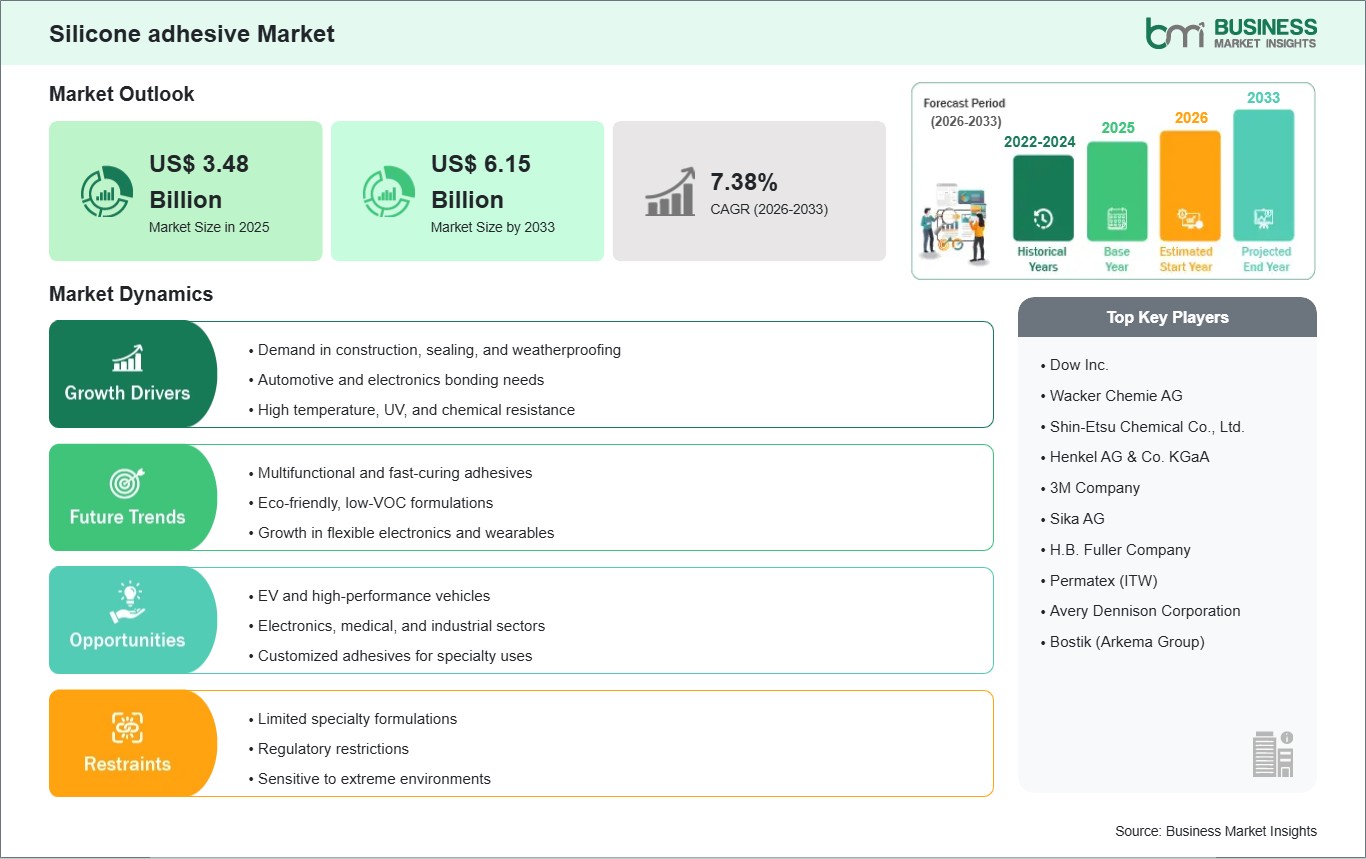
The Silicone adhesive Market size is expected to reach US$ 6.15 billion by 2033 from US$ 3.48 billion in 2025. The market is estimated to record a CAGR of 7.38% from 2026 to 2033.
The global silicone adhesive market is a key segment within the broader adhesives and sealants industry, known for its versatility and superior performance across a wide range of industrial, construction, automotive, electronics, and healthcare applications. Silicone adhesives are prized for their excellent thermal stability, chemical resistance, flexibility, and strong bonding capabilities to diverse substrates, including glass, metals, plastics, and ceramics. The market is driven by increasing demand for high-performance adhesives in industries requiring durability under extreme conditions, such as automotive powertrain components, electronic assemblies, and building construction where weatherproofing is critical.
The rising trend toward lightweight materials and miniaturized devices further enhances the need for silicone adhesives, which can maintain strong adhesion while accommodating thermal expansion and mechanical stress. However, the market faces certain challenges, including relatively higher costs compared to conventional adhesives and the need for specialized application expertise to ensure optimal curing and bonding. Additionally, regulatory compliance for chemical safety and environmental sustainability can present hurdles, particularly for industrial and consumer-facing applications, necessitating innovation in low-VOC and eco-friendly formulations.
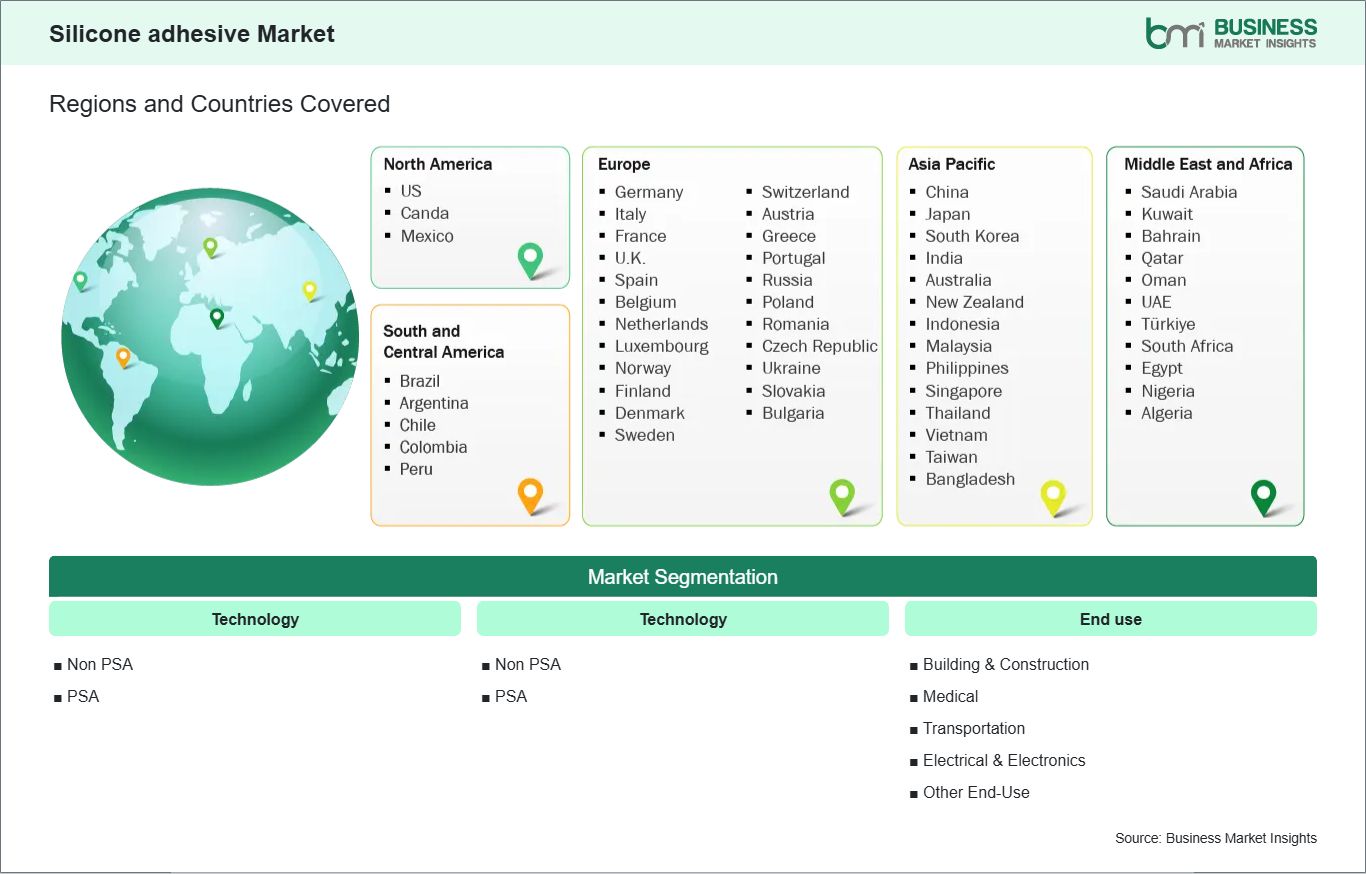
Key segments that contributed to the derivation of the silicone adhesive market analysis are technology, type,and end use.
The Western Europe silicone adhesive market is being driven by high demand in construction activities, sealing operations, and weatherproofing activities. Countries like Germany, France, and the UK are actively participating in construction activities like residential and commercial buildings, wherein silicone adhesives are in high demand due to their flexibility, resistance to UV rays, and durability in different weather conditions. These types of adhesives are highly used in sealing windows, façade panels, joints, and expansion gaps in buildings, which are exposed to different types of adverse weather conditions.
Urban development activities in Western Europe are also contributing significantly towards the growth of the silicone adhesive market in the region. These types of adhesives are highly demanded in modern construction activities due to their high performance in sealing operations, as they can withstand movements in buildings and create airtight and waterproof barriers. These types of adhesives can withstand extreme temperatures, moisture, and chemical exposure in different types of applications, including roofs, façades, and bathroom and kitchen areas. Manufacturers are highlighting these advantages in modern construction activities as part of sustainable construction activities.
Furthermore, public infrastructure projects such as construction of tunnels, bridges, and terminals are also utilizing silicone adhesives for sealing and bonding purposes. Their ability to bond a variety of materials such as glass, metal, concrete, and plastics while maintaining flexibility over a period of time makes them an important adhesive for such critical applications. The mechanical and environmental resistance of these adhesives make them a key material for the construction and sealing industry in Western Europe.
The demand for customized silicone adhesives is on the rise in Western Europe, where industries are looking for solutions for specialty use. Automotive, electronic, and aerospace industries are adopting silicone adhesives for use in specialty applications. Automotive manufacturers in Germany and France are adopting specialty adhesives for use in electric vehicle assembly. The use of these adhesives is for bonding in electric vehicle assembly, where there is high thermal exposure and mechanical stresses. The adhesives are specifically designed to meet safety standards for use in these industries, which are known for precision engineering.
The electronics and industrial equipment industries are also driving the demand for application-specific adhesives. Adhesives possessing thermal conductivity and electrical insulation properties are being used in semiconductor packaging, LED modules, and industrial machinery. European companies are investing in research and development activities to develop adhesives that are compatible with new materials and complex processing techniques. This ensures that the adhesives’ performance is not impaired over the product lifecycle.
Moreover, application-specific adhesives are also finding new opportunities in the renewable energy sector. The adhesives are being used for solar panels, wind turbine components, and energy storage devices. The adhesives are required to have high durability and resistance to UV rays, moisture, and temperature fluctuations. The Western European market for silicone adhesives is expanding by catering to the demand for application-specific adhesives for niche markets.

The silicone adhesive market is experiencing steady growth, with market size and share analysis reflecting evolving treatment preferences and competitive dynamics among key players. The report evaluates important subsegments categorized within technology, type, and end use highlighting their respective contributions to overall market performance.
By technology, the non-PSA subsegment dominated the Silicone adhesive market in 2025 because they offer stronger permanent bonding, higher temperature resistance, and superior environmental durability compared to pressure‑sensitive adhesives. In applications like electronics assembly, structural sealing, and industrial bonding where long‑term performance is critical, non‑PSA formulations are preferred.
Based on type, the one component subsegment dominated the silicone adhesive market in 2025 due to their ease of use, no mixing requirement, and consistent curing when exposed to moisture in the air. For high‑volume industries like construction and electrical & electronics, the simplicity of one‑component systems reduces labor time and error, making them the most widely adopted type.
In term of end use, the building & construction subsegment dominated the silicone adhesive market in 2025 because silicone adhesives are widely used for sealants, glazing, façade bonding, and joint filling — where flexibility and weather resistance are crucial. Global infrastructure projects and renovation demand sustain high consumption, outpacing smaller volume sectors like medical or transportation.
| Report Attribute | Details |
|---|---|
| Market size in 2025 | US$ 3.48 Billion |
| Market Size by 2033 | US$ 6.15 Billion |
| Global CAGR (2026 - 2033) | 7.38% |
| Historical Data | 2022-2024 |
| Forecast period | 2026-2033 |
| Segments Covered | By Technology
|
|
Regions and Countries Covered
| |
| North America | US, Canada, Mexico |
| Europe | Belgium, Austria, Finland, Denmark, Greece, Poland, Romania, Russia, Ukraine, Czech Republic, Slovakia, Bulgaria, Italy, Luxembourg, Germany, Switzerland, France, Netherlands, Norway, Portugal, Spain, Sweden, United Kingdom |
| Asia-Pacific | Australia, China, India, Japan, South Korea, Indonesia, Malaysia, Philippines, Singapore, Thailand, Vietnam, Bangladesh, New Zealand, Taiwan |
| South and Central America | Brazil, Argentina, Peru, Chile, Colombia |
| Middle East and Africa | Bahrain, Kuwait, Oman, Qatar, Saudi Arabia, United Arab Emirates, Turkiye, South Africa, Egypt, Algeria, Nigeria |
| Market leaders and key company profiles |
|
The "Silicone Adhesive Market Size and Forecast (2022 - 2033)" report provides a detailed analysis of the market covering below areas:
The geographical scope of the Silicone adhesive market report is divided into five regions: North America, Asia Pacific, Europe, Middle East & Africa, and South & Central America. The Silicone adhesive market in North America is expected to grow during the forecast period.
North America dominates the silicone adhesive market, supported by a mature industrial base, advanced construction sector, and strong adoption in high-value applications such as automotive, aerospace, and electronics. The region benefits from a robust presence of leading silicone adhesive manufacturers and extensive R&D facilities, driving innovation in high-performance, specialized formulations tailored for thermal, chemical, and mechanical resilience. North American construction and infrastructure projects increasingly rely on silicone adhesives for sealing, bonding, and weatherproofing applications, while the electronics and semiconductor industries utilize them for encapsulation and thermal management.
In the automotive sector, silicone adhesives are favored for lightweighting initiatives and electric vehicle assembly, where thermal and chemical resistance are critical. The region also emphasizes environmentally conscious production, encouraging the adoption of low-emission, sustainable adhesive solutions. Despite North America’s leadership, challenges such as high raw material costs, technical complexities in application, and stringent environmental regulations persist. These factors incentivize manufacturers to invest in advanced formulations, application technologies, and training programs to maintain performance standards and market leadership while meeting evolving industry requirements.
The silicone adhesive market is evaluated by gathering qualitative and quantitative data post primary and secondary research, which includes important corporate publications, association data, and databases. A few of the key developments in the silicone adhesive market are:
The Silicone adhesive Market is valued at US$ 3.48 Billion in 2025, it is projected to reach US$ 6.15 Billion by 2033.
As per our report Silicone adhesive Market, the market size is valued at US$ 3.48 Billion in 2025, projecting it to reach US$ 6.15 Billion by 2033. This translates to a CAGR of approximately 7.38% during the forecast period.
The Silicone adhesive Market report typically cover these key segments-
The historic period, base year, and forecast period can vary slightly depending on the specific market research report. However, for the Silicone adhesive Market report:
The Silicone adhesive Market is populated by several key players, each contributing to its growth and innovation. Some of the major players include:
The Silicone adhesive Market report is valuable for diverse stakeholders, including:
Essentially, anyone involved in or considering involvement in the Silicone adhesive Market value chain can benefit from the information contained in a comprehensive market report.
Please tell us your area of interest
(Market Segments/ Regions and Countries/ Companies)