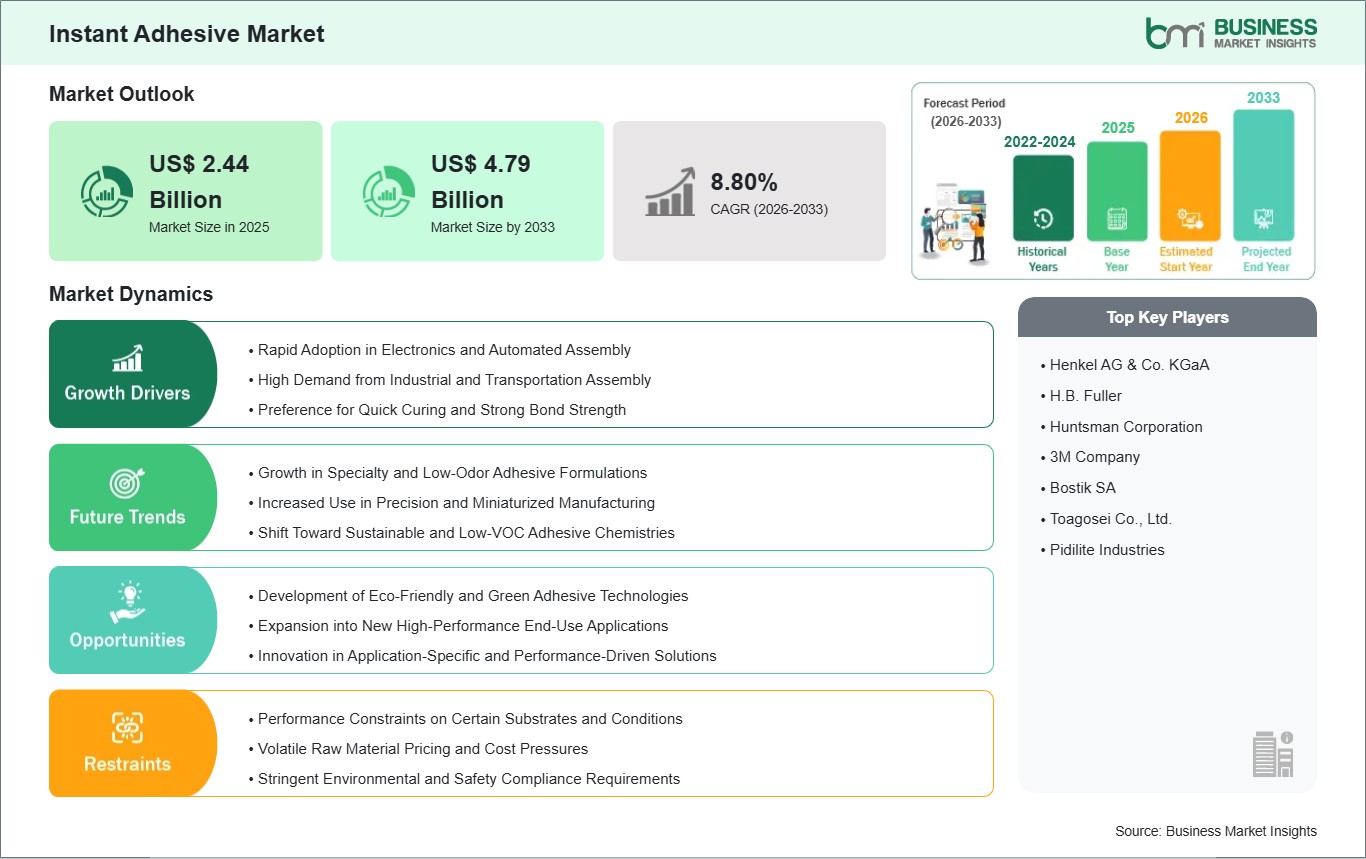
Rapid Adoption in Electronics and Automated Assembly
The global instant adhesive market has witnessed remarkable growth due to its critical role in electronics manufacturing and automated assembly operations. As electronic devices continue to evolve toward smaller, more intricate, and multifunctional designs, manufacturers are increasingly relying on instant adhesives to deliver reliable, high-strength bonds that can be applied quickly. These adhesives are particularly valued in applications where traditional fastening methods or slower-curing adhesives cannot meet the precision, speed, and consistency required. Instant adhesives offer the ability to cure rapidly under ambient conditions, allowing components to be bonded efficiently without slowing down production cycles, which is essential in high-volume and fast-paced manufacturing environments.
Automation has become a central factor driving the adoption of instant adhesives in modern assembly lines. In automated operations, robotic dispensing systems require adhesives that maintain uniform viscosity, predictable curing times, and consistent bonding performance. Instant adhesives excel in these scenarios by providing precise application in controlled amounts, reducing material waste while ensuring each assembly meets stringent quality standards. Their compatibility with high-speed manufacturing processes makes them an integral tool for industries that demand both precision and efficiency. This combination of speed, accuracy, and reliability has positioned instant adhesives as a preferred solution for bonding electronic components, sensors, connectors, and miniaturized parts across a wide range of applications.
Beyond assembly efficiency, the use of instant adhesives contributes significantly to product durability and reliability. These adhesives form strong, resilient bonds capable of withstanding mechanical stress, thermal cycling, and vibration over time, which is particularly important in high-performance devices that experience continuous usage or harsh conditions. Their ability to enhance long-term structural integrity while supporting rapid production workflows has led to widespread adoption across multiple sectors. As technology continues to advance and products become more sophisticated, instant adhesives are expected to play an increasingly pivotal role in ensuring both high-quality manufacturing and efficient automated assembly processes globally.
Development of Eco-Friendly and Green Adhesive Technologies
Cyanate ester resins are increasingly being recognized for their potential in advanced composite materials. This is opening up opportunities for sustainability in the global instant adhesive market. Sustainability has now become a key driver in the global instant adhesive market. This has led to the development of eco-friendly and green adhesive technology. With growing environmental awareness and the need for safe and responsible manufacturing practices, there is now an increased focus on developing adhesives that contain fewer volatile organic compounds, are non-toxic, and have minimal environmental impact. This is being achieved through the use of bio-based and renewable materials, as well as non-hazardous curing agents.
Eco-friendly adhesives are also helping in the achievement of circular economy principles by enhancing recyclability and reducing waste during the end-of-life of the product. Some of them have also been developed to facilitate easier disintegration of materials during the recycling process, which in turn reduces waste and makes recycling more efficient. Others have also concentrated on the use of water and solvents in their composition, which reduces environmental pollution during the manufacturing process. This ensures that manufacturers are in a position to balance their commitment to environmental conservation with their manufacturing processes and product innovation.
The development of green instant adhesives is also stimulating broader technological advancements in the industry. As manufacturers experiment with renewable feedstocks, low-energy curing methods, and biodegradable polymers, they are creating products that maintain or even enhance bonding strength while reducing environmental impact. These solutions allow companies to innovate in product design, including lightweight and energy-efficient assemblies, without sacrificing performance. As sustainability continues to be a global priority, eco-friendly adhesive technologies are poised to become a key differentiator in the market, driving adoption across industries and encouraging ongoing investment in research, development, and sustainable manufacturing practices worldwide.