Market Summary
Executive Summary and Global Market Analysis
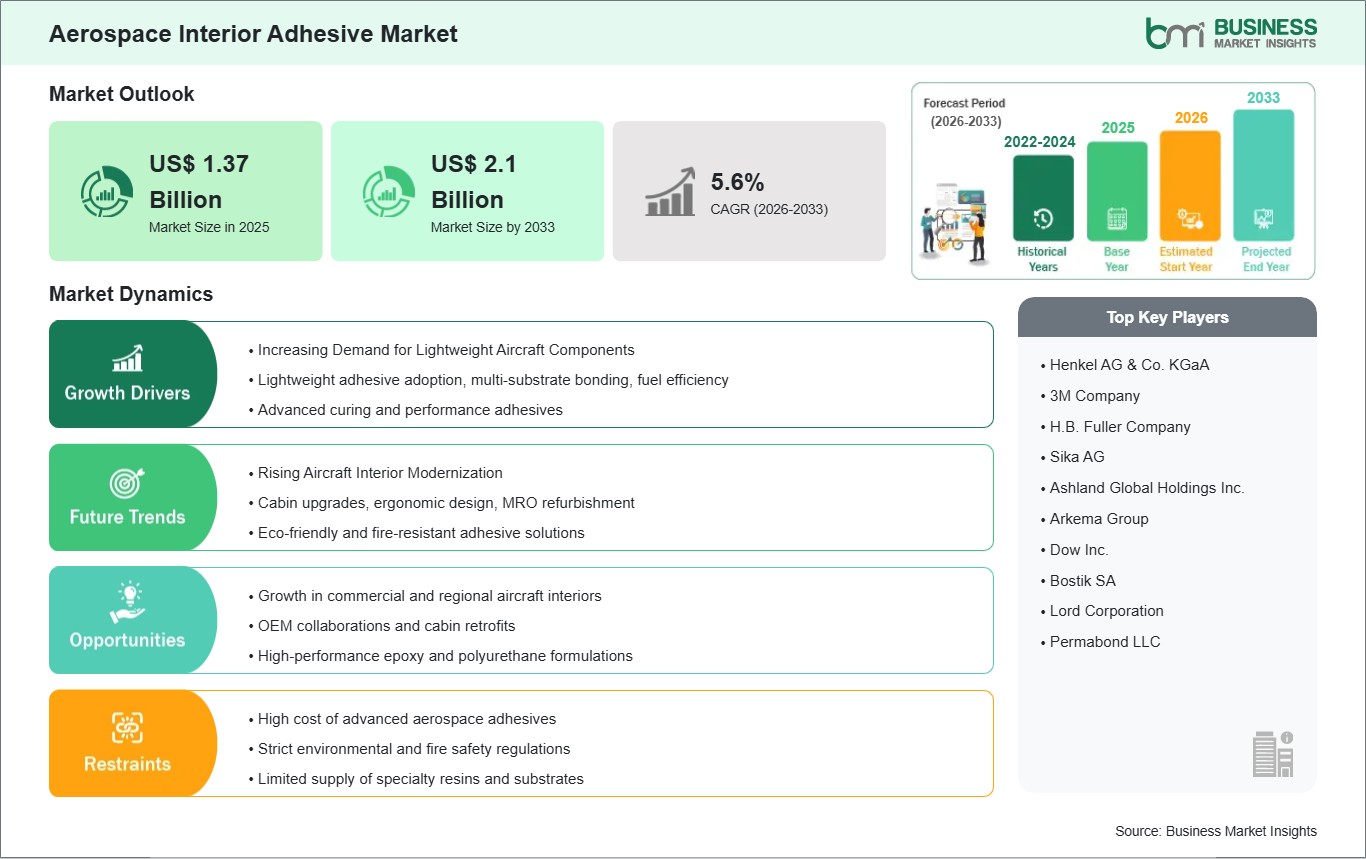
The global aerospace interior adhesive market is defined by the growing need for lightweight bonding solutions, increasing aircraft production, and rising demand for enhanced cabin interiors. Aerospace interior adhesives are widely used to bond components such as seating, panels, lavatories, and stowage bins, replacing traditional mechanical fasteners to reduce weight and improve structural integrity. These adhesives play a critical role in ensuring durability, safety, and compliance with stringent aviation standards.
The market is witnessing a shift toward high-performance adhesives that offer superior bonding strength, fire resistance, and low emissions. Aircraft manufacturers and airlines are prioritizing materials that enhance passenger comfort while meeting strict regulatory requirements for toxicity and flammability. The increasing focus on cabin modernization and customization is also driving demand for advanced adhesive solutions.
Competitive dynamics are centered on innovation in adhesive formulations, with manufacturers focusing on developing eco-friendly and low-VOC products. Technological advancements, including fast-curing and multi-substrate bonding adhesives, are improving manufacturing efficiency and reducing assembly time. Strategic collaborations between adhesive manufacturers and aircraft OEMs are enabling the development of tailored solutions for next-generation aircraft interiors.
Segment Analysis
Aerospace Interior Adhesive Market Segmentation
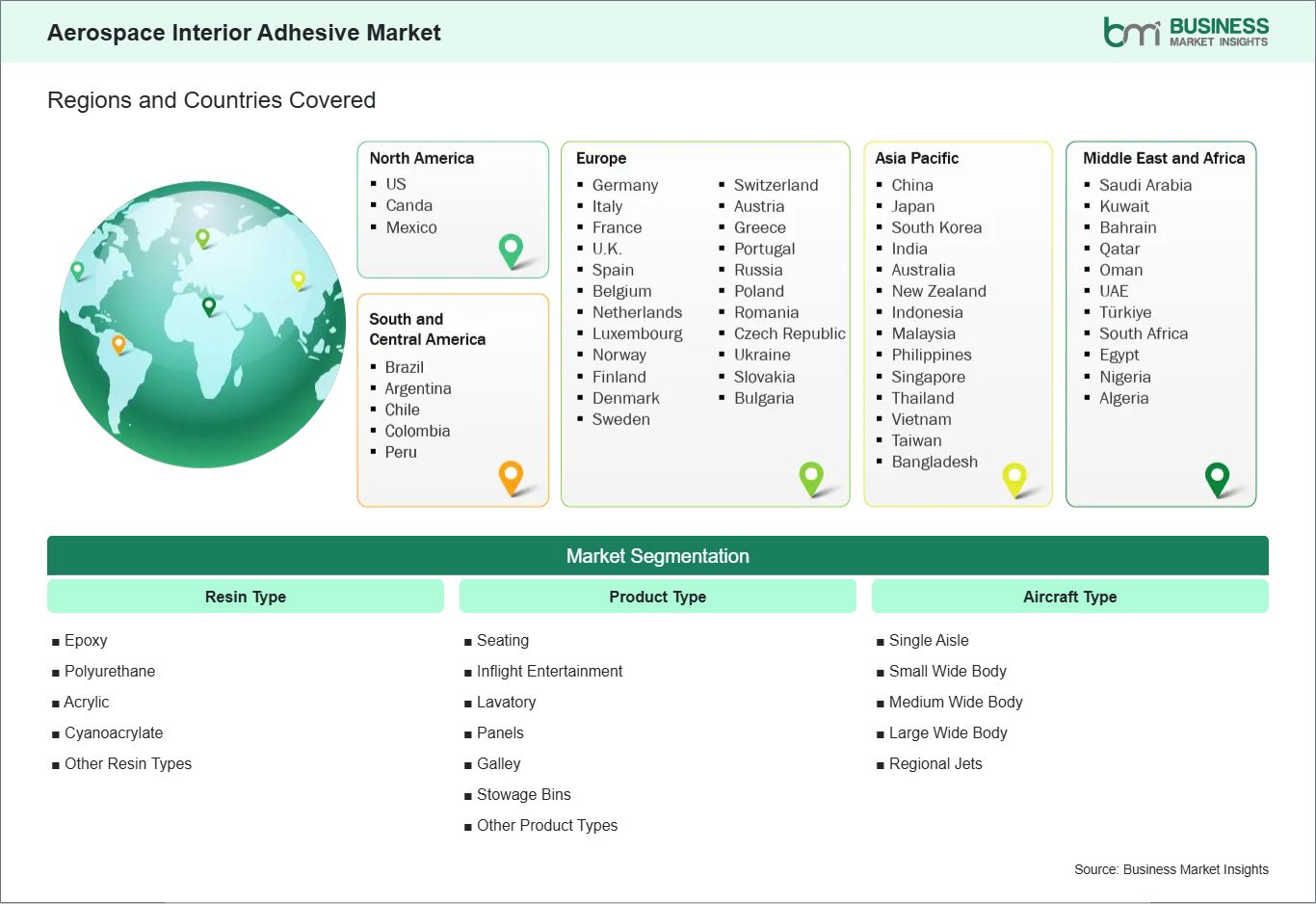
Key segments that contributed to the derivation of the aerospace interior adhesive market analysis are resin type, product type, and aircraft type.
- By resin type, the aerospace interior adhesive market is segmented into epoxy, polyurethane, acrylic, cyanoacrylate, and other resin types. The epoxy segment dominated the market in 2025.
- Based on product type, the aerospace interior adhesive market is segmented into seating, inflight entertainment, lavatory, panels, galley, stowage bins, and other product types. The panels segment dominated the market in 2025.
- In terms of aircraft type, the market is segmented into single aisle, small wide body, medium wide body, large wide body, and regional jets. The single aisle segment dominated the market in 2025.
Market Forces
Aerospace Interior Adhesive Market Drivers and Opportunities
Increasing Demand for Lightweight Aircraft Components
In seeking to improve fuel efficiency and reduce emissions, the aviation industry is increasingly adopting lightweight materials such as aerospace interior adhesives, which provide an alternative to traditional mechanical fasteners and substantially reduce aircraft weight and improve fuel efficiency. As airlines strive to minimize operating costs and meet environmental objectives, the demand for lightweight adhesive solutions continues to grow.
The current generation of aerospace adhesives have been developed to offer superior adhesive properties between multiple substrates (including composite materials, metal, and plastic) while providing improved durability, vibration resistance, and load distribution for use on aircraft interiors. The use of adhesives also enhances the aesthetics of the aircraft interior by eliminating the need for visible fasteners and thereby enhancing the overall design and experience of the cabin.
Advancements in technology related to adhesive formulations have allowed for adhesive products that have faster curing times and enhanced performance under harsh conditions. These advances lead to more efficient manufacturing processes and shorter assembly times, all contributing to market growth. Therefore, the increasing demand for lightweight and high-performance bonding solutions results in growth in demand for aerospace interior adhesives.
Rising Aircraft Interior Modernization
The growing interest in modernizing aircraft interiors is creating a strong demand for aerospace interior adhesives. Airlines are investing heavily in their cabin upgrades to improve passenger comfort, aesthetics, and to stand out in a highly competitive market. This has led to increased demand for newer and better adhesive solutions for seating, panels, in-flight entertainment systems, and all other cabin components.
The purpose of aerospace adhesives is to create the ability to create innovative designs and configurations in the cabin. They allow for flexible bonding of complex geometry and lightweight materials thus enabling the creation of modern, efficient interiors. The desire for better installation of acoustics and vibration reduction are also driving the need for special purpose adhesives.
The airline MRO segment is a big contributor to business growth as the interiors of aircraft require periodic refurbishment and/or maintenance. Adhesives are used extensively when repairing and/or replacing components, thus assuring correct structural integrity and compliance with safety requirements. As airlines continue to place emphasis on improving passenger experience and operating efficiency, the usage of aerospace interior adhesives will grow significantly over time.
Size and Share Analysis
Aerospace Interior Adhesive Market Size and Share Analysis
The Aerospace Interior Adhesive Market demonstrates steady growth, with size and share analysis highlighting evolving trends and competitive dynamics among key players. The report examines subsegments categorized within resin type, product type, and aircraft type, offering insights into their contribution to overall market performance.
By resin type, the epoxy subsegment dominated the market in 2025, driven by its superior bonding strength, chemical resistance, and durability across various interior applications.
Based on product type, the panels subsegment dominated the market in 2025, driven by extensive usage in cabin structures requiring strong and lightweight bonding solutions.
In terms of aircraft type, the single aisle subsegment dominated the market in 2025, driven by high production volumes and increasing demand for narrow-body aircraft in short- and medium-haul routes.
Report Coverage
Aerospace Interior Adhesive Market Report Coverage and Deliverables
The "Aerospace Interior Adhesive Market Size and Forecast (2022 - 2033)" report provides a detailed analysis of the market covering below areas:
- Aerospace Interior Adhesive Market size and forecast at global, regional, and country levels for all the key market segments covered under the scope
- Aerospace Interior Adhesive Market trends, as well as drivers, restraints, and opportunities
- Aerospace Interior Adhesive Market analysis covering key trends, global and regional framework, major players, regulations, and recent developments
- Industry landscape and competition analysis covering market concentration, heat map analysis, prominent players, and recent developments for the Aerospace Interior Adhesive Market
- Detailed company profiles, including SWOT analysis
Geographic Insights
Aerospace Interior Adhesive Market Geographic Insights
The geographical scope of the Aerospace Interior Adhesive Market report is divided into North America, Asia Pacific, Europe, Middle East & Africa, and South & Central America. North America held the largest share in 2025.
The adoption and demand for aerospace interior adhesives vary across regions, influenced by aircraft manufacturing activity, MRO infrastructure, and regulatory standards. North America leads the market due to the strong presence of major aircraft manufacturers and advanced aviation infrastructure. The region also benefits from high defense spending and continuous innovation in aerospace materials.
Europe follows closely, driven by leading aircraft manufacturers and strict environmental regulations. The region emphasizes sustainable and low-emission adhesive solutions, supporting market growth. Collaborative research initiatives and technological advancements further enhance the development of innovative products.
Asia Pacific is experiencing rapid growth due to increasing air travel, expanding airline fleets, and rising investments in aviation infrastructure. Countries such as China and India are emerging as key markets, driven by growing demand for aircraft interiors and modernization programs.
The Middle East & Africa region is witnessing growth due to investments in aviation hubs and fleet expansion by major airlines. Latin America is also showing steady growth, supported by increasing air connectivity and fleet upgrades. Across all regions, regulatory compliance and the need for lightweight, high-performance materials are shaping market trends.
Industry Activity
Recent Developments
The Aerospace Interior Adhesive Market is evaluated by gathering qualitative and quantitative data post primary and secondary research, which includes important corporate publications, association data, and databases. A few of the key developments in the aerospace interior adhesive market are:
- In June 2024, Henkel AG & Co. KGaA emphasized sustainability in its aerospace adhesives portfolio, highlighting low-emission and fire-resistant solutions to meet stricter regulatory standards.
- In October 2024, 3M expanded its aerospace structural adhesives offerings, focusing on improved bonding strength and efficiency across multiple substrates to support next-generation aircraft interiors.
Trust & Transparency
Research Methodology
The market analysis combines proprietary research with secondary data from government agencies, company disclosures, regulatory filings, industry databases and expert interviews. Market estimates are validated through data triangulation, cross-market benchmarking and analyst
review.
View Full Research Methodology
Key Sources Referred:
International Air Transport Association (IATA)Federal Aviation Administration (FAA)European Union Aviation Safety Agency (EASA)Organisation for Economic Cooperation and Development (OECD)World Bank GroupAerospace Industries Association (AIA)