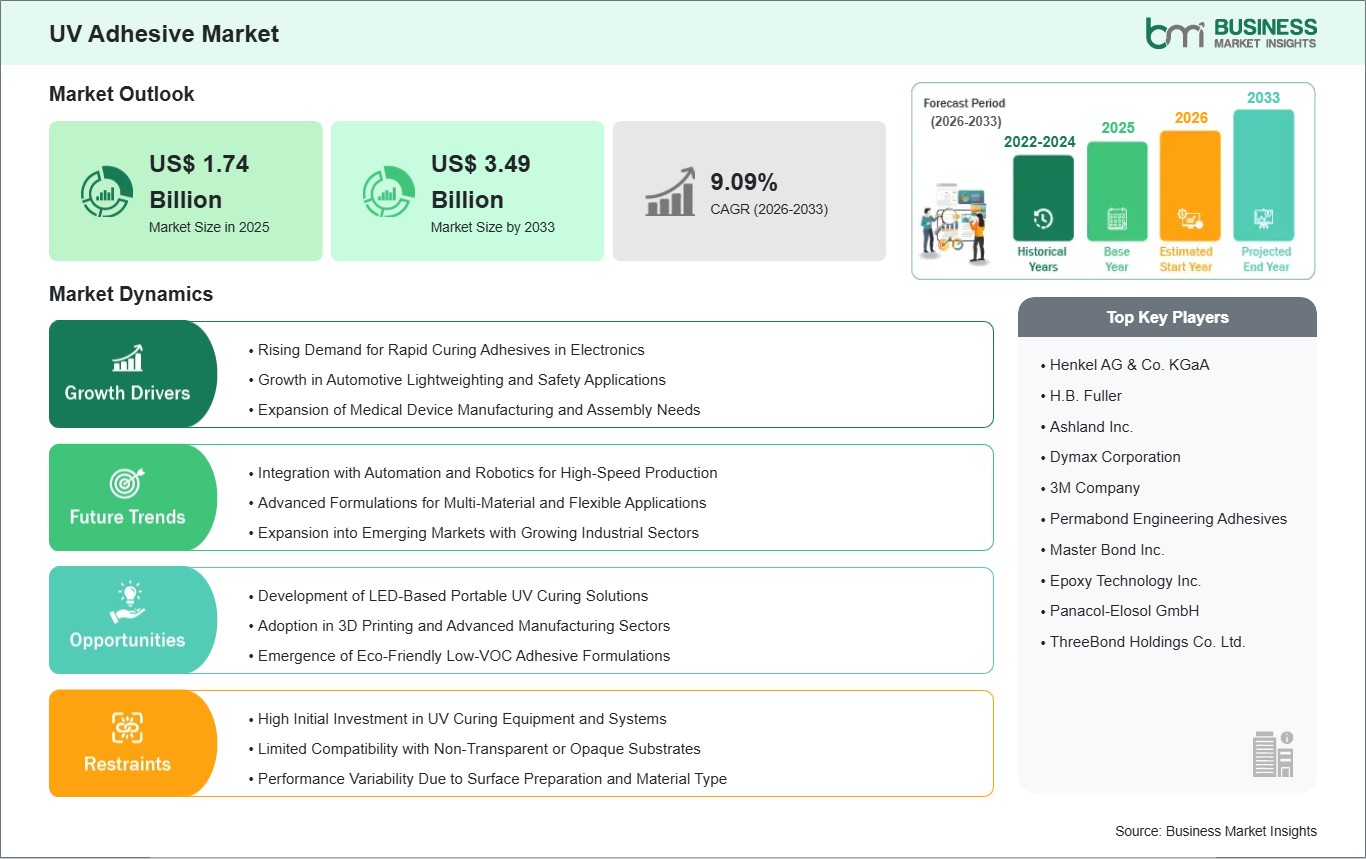
The UV Adhesive Market size is expected to reach US$ 3.49 billion by 2033 from US$ 1.74 billion in 2025. The market is estimated to record a CAGR of 9.09% from 2026 to 2033.
The global UV adhesive market is experiencing growth because industries require bonding solutions that provide fast drying times, strong bonding capabilities, create minimal environmental effects and can bond different types of materials. UV (ultraviolet) adhesives are specialty adhesives that undergo quick curing when exposed to UV light to create permanent bonds that fulfill demanding performance standards used in precise requirements. They are widely used in electronics and medical devices, automotive components, optical assemblies, consumer goods and industrial manufacturing because conventional adhesives cannot match their speed and reliability and powerful bonding strength. The market expands because manufacturers need faster production times, companies adopt automation, customers prefer lightweight materials with advanced performance, and businesses implement eco-friendly practices that produce minimal or zero volatile organic compound (VOC) emissions. UV adhesives support efficient production methods because they provide instant curing, which shortens assembly time and removes the requirement for heating and protracted drying periods, resulting in better efficiency and accuracy for automated assembly processes.
The rapid growth of advanced electronic devices and miniaturized components drives industry expansion, especially in the Asia Pacific and North America, where compact assemblies and high precision are critical. UV adhesives provide secure bonding for sensitive components in flat panel displays, smartphones and medical diagnostic equipment because they enable bonding without damaging heat-sensitive materials. The market does experience limitations, which create challenges for growth. The requirement for specialized UV curing equipment may increase upfront capital costs for manufacturers, particularly small and medium enterprises, and the need for UV‑transparent substrates limits the universality of these adhesives. The performance of bonding operations depends on both the substrate material and the quality of surface preparation, which creates difficulties for specific use cases.
The research barriers that exist currently do not stop scientists from making new developments in polymer chemistry and ultraviolet light curing technologies, which lead to new ways to use them and better performance from adhesive materials. The market now offers new adhesive formulations that provide enhanced flexibility, impact protection and improved bonding power to hard-to-adhere surfaces. The use of portable UV curing systems, which operate with LED technology, has created new possibilities for businesses to apply UV adhesives. The manufacturing sector will depend more on UV adhesives, which provide efficient and eco-friendly bonding methods to create precise industrial products.

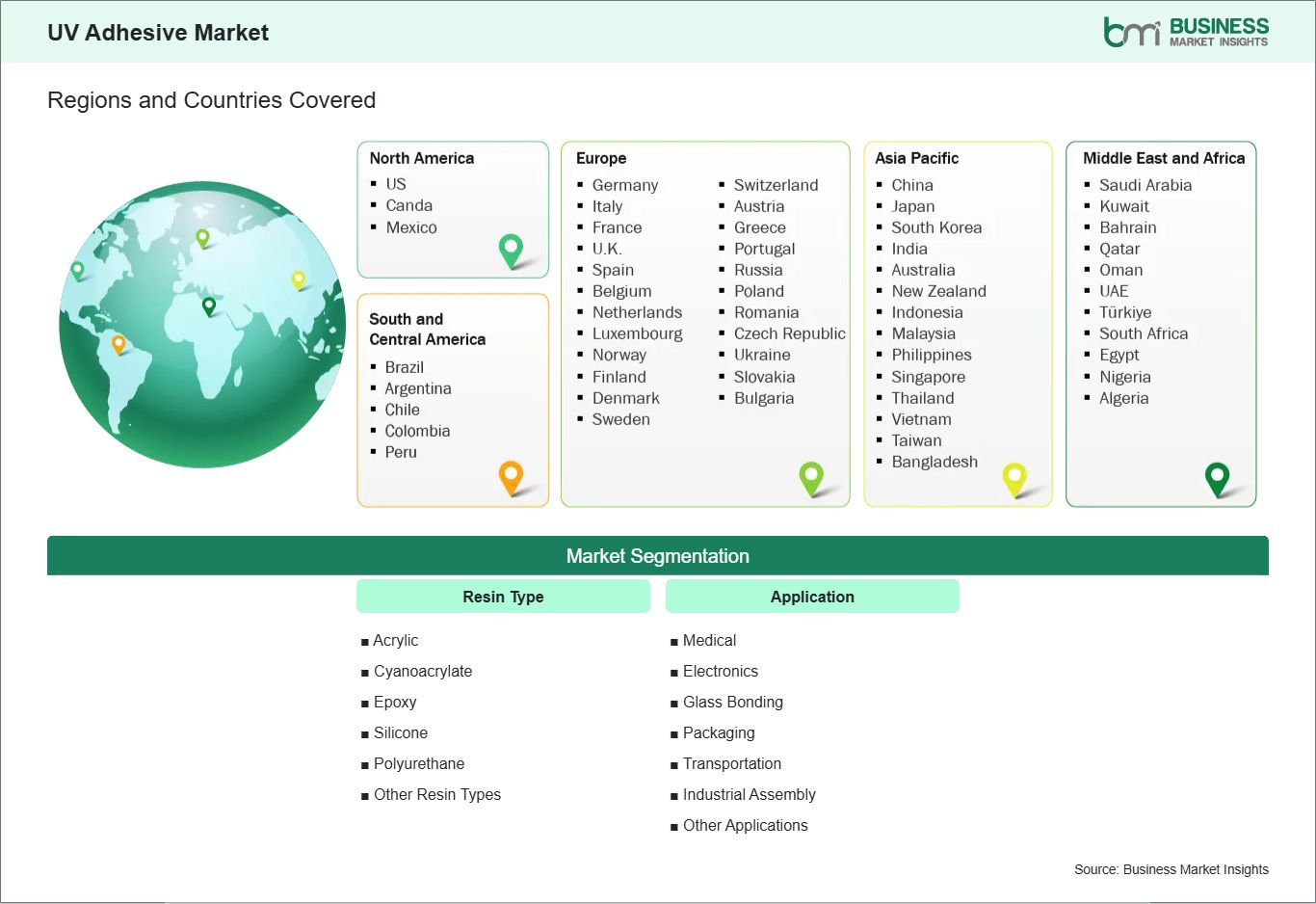
Key segments that contributed to the derivation of the uv adhesive market analysis are resin type and application.
The worldwide electronics sector creates the highest demand for UV adhesives because manufacturers need adhesives that create strong bonds that dry fast to enable their quick production processes. Producers need to assemble smartphones and tablets and wearables and flat panel displays through precise work, which involves putting together touch panels, glass surfaces, sensors and optical lenses. The unique properties of UV adhesives enable them to cure through controlled UV light within their specific conditions, which results in faster production times and increased production output when compared to standard thermal or two-part adhesives. North America and the Asia Pacific serve as primary markets which adopted rapid UV adhesive technology because both regions possess strong electronics manufacturing capabilities, while their manufacturers seek efficient assembly time reduction methods that maintain product quality.
The Asia Pacific region contains China, Japan, South Korea and Taiwan as main centers for electronics and semiconductor manufacturing. The manufacturers at this location need quick-curing solutions to protect their market position while they work to enhance production rates and develop smaller products because standard adhesives create problems during precise application and heat exposure. The current UV adhesives market in Europe supports advanced industrial electronics producers and automotive infotainment system developers through its fast-curing adhesives, which deliver consistent results and minimal outgassing.
The global manufacturing sector experiences a rise in demand because companies increasingly implement smart and automated production systems. UV adhesive systems work seamlessly with robotic dispensing systems and in‑line UV curing stations to enable organizations to implement Industry 4.0 solutions. The adhesives enable curing to take place during assembly, which helps manufacturers to decrease their work-in-progress inventory while achieving better consistency and meeting their strict delivery deadlines. As electronic devices become more intricate and their performance needs grow, UV adhesives provide an effective solution for fast and accurate bonding needs across the world.
The development of LED‑based portable UV curing solutions is transforming the global UV adhesive market by making curing technology more accessible, efficient, and versatile. Traditional mercury‑arc UV lamps are effective but have drawbacks such as high energy consumption, heat generation, and environmental concerns related to ozone production. In contrast, LED UV systems operate at lower power, produce minimal heat, and emit targeted wavelengths that are well‑suited for curing a wide range of UV adhesive chemistries. This has broadened the appeal of UV adhesives beyond traditional industrial settings to field service, repair operations, and flexible manufacturing environments.
In North America, LED‑based UV curing systems are widely adopted in sectors like automotive repair, aerospace maintenance, and electronics refurbishment. Portable handheld LED units enable technicians to cure adhesives in situ, improving productivity and reducing the need for fixed curing stations. Similarly, in Europe, where sustainability and energy efficiency are policy priorities, LED solutions are favored due to their lower carbon footprint and reduced operational costs. These advancements support manufacturers striving to balance performance with environmental responsibility.
Asia Pacific also represents a dynamic market for LED UV developments, particularly in small and medium enterprises (SMEs) that benefit from cost‑effective, compact curing systems. LED technology’s scalability allows firms across China, India, and Southeast Asia to deploy curing solutions tailored to specific applications — from smartphone screen lamination to precision bonding in medical devices. Additionally, emerging technologies such as UV‑LED robotics and conveyor‑integrated curing systems are accelerating adoption in automated assembly lines. As LED UV systems continue to improve in intensity and wavelength accuracy, they are expected to further expand the use cases for UV adhesives globally, enabling high‑speed, energy‑efficient bonding in new industrial domains.

The uv adhesive market demonstrates steady growth, with size and share analysis highlighting evolving trends and competitive dynamics among key players. The report examines subsegments categorized within resin type and application, offering insights into their contribution to overall market performance.
By resin type, the cyanoacrylate subsegment dominated the market in 2025, driven by its fast curing, strong bonding, and wide applicability across multiple industries.
Based on application, the electronics subsegment dominated the market in 2025, driven by the high demand for UV adhesives in electronic components and assemblies.
| Report Attribute | Details |
|---|---|
| Market size in 2025 | US$ 1.74 Billion |
| Market Size by 2033 | US$ 3.49 Billion |
| Global CAGR (2026 - 2033) | 9.09% |
| Historical Data | 2022-2024 |
| Forecast period | 2026-2033 |
| Segments Covered | By Resin Type
|
|
Regions and Countries Covered
| |
| North America | US, Canada, Mexico |
| Europe | Belgium, Austria, Finland, Denmark, Greece, Poland, Romania, Russia, Ukraine, Czech Republic, Slovakia, Bulgaria, Italy, Luxembourg, Germany, Switzerland, France, Netherlands, Norway, Portugal, Spain, Sweden, United Kingdom |
| Asia-Pacific | Australia, China, India, Japan, South Korea, Indonesia, Malaysia, Philippines, Singapore, Thailand, Vietnam, Bangladesh, New Zealand, Taiwan |
| South and Central America | Brazil, Argentina, Peru, Chile, Colombia |
| Middle East and Africa | Bahrain, Kuwait, Oman, Qatar, Saudi Arabia, United Arab Emirates, Turkiye, South Africa, Egypt, Algeria, Nigeria |
| Market leaders and key company profiles |
|
The "UV Adhesive Market Size and Forecast (2022 - 2033)" report provides a detailed analysis of the market covering below areas:
The geographical scope of the UV Adhesive Market report is divided into North America, Asia Pacific, Europe, Middle East & Africa, and South & Central America. North America held the largest share in 2025.
North America holds the largest share of the global UV adhesive market because its advanced manufacturing facilities, together with its high adoption rates in the automotive, electronics, aerospace and medical device industries and its strong research and development capabilities create new adhesive products and UV curing technologies. The United States and Canada lead in demand, as manufacturers increasingly require high-performance bonding solutions for lightweight automotive components, optical assemblies, medical devices, and electronic products. The region uses UV adhesives because stringent quality standards, together with regulatory compliance requirements, make it necessary to use adhesives that bond quickly while releasing minimal volatile organic compounds.
Europe is a mature market that shows widespread usage of UV adhesives in automotive, aerospace, electronics and industrial manufacturing, especially in Germany, France and Italy, which have advanced assembly methods and lightweighting projects that need powerful adhesives.
The Asia Pacific region is experiencing rapid growth with China, Japan, India and South Korea as its main leaders because their increasing production of electronics, automotive assembly and medical device manufacturing is driving up demand for UV adhesives. The region experiences growth because industrial automation increases and manufacturers adopt sustainable energy-efficient production methods.
The Middle East and Africa market develops through its industrial assembly and electronics and medical sectors, which create demand in the UAE, Saudi Arabia and South Africa through their growing infrastructure and new manufacturing projects. The automotive, electronics and industrial sectors in South America and Central America start using UV adhesives, which Brazil and Mexico lead as countries that receive foreign investments and develop their production capabilities through upgraded manufacturing plants and new efficiency initiatives.
The North American region preserves its market leadership through its technological expertise, early UV adhesive adoption and established industrial network, while other areas experience rapid growth because of industrialization and automation and their requirements for accurate, high-quality binding methods.

The UV Adhesive Market is evaluated by gathering qualitative and quantitative data post primary and secondary research, which includes important corporate publications, association data, and databases. A few of the key developments in the uv adhesive market are:
The UV Adhesive Market is valued at US$ 1.74 Billion in 2025, it is projected to reach US$ 3.49 Billion by 2033.
As per our report UV Adhesive Market, the market size is valued at US$ 1.74 Billion in 2025, projecting it to reach US$ 3.49 Billion by 2033. This translates to a CAGR of approximately 9.09% during the forecast period.
The UV Adhesive Market report typically cover these key segments-
The historic period, base year, and forecast period can vary slightly depending on the specific market research report. However, for the UV Adhesive Market report:
The UV Adhesive Market is populated by several key players, each contributing to its growth and innovation. Some of the major players include:
The UV Adhesive Market report is valuable for diverse stakeholders, including:
Essentially, anyone involved in or considering involvement in the UV Adhesive Market value chain can benefit from the information contained in a comprehensive market report.
Please tell us your area of interest
(Market Segments/ Regions and Countries/ Companies)