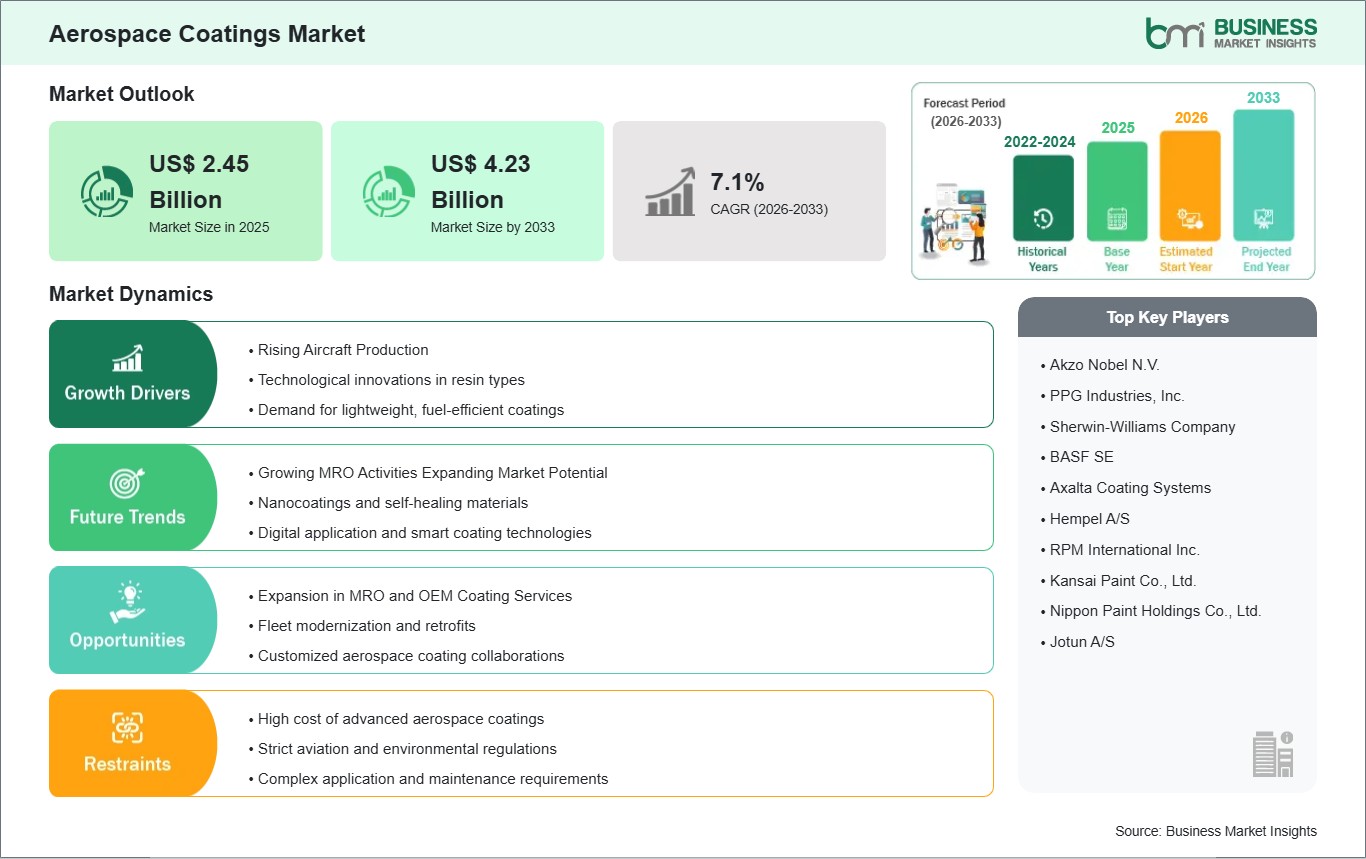
The Aerospace Coatings Market size is expected to reach US$ 4.23 Billion by 2033 from US$ 2.45 Billion in 2025 .The market is estimated to record a CAGR of 7.1% from 2026 to 2033.
The global aerospace coatings market is defined by increasing aircraft production, expanding maintenance cycles, and the growing need for advanced protective solutions that enhance durability and performance. Aerospace coatings—ranging from primers and top-coats to specialty coatings—play a critical role in protecting aircraft surfaces from corrosion, UV radiation, temperature fluctuations, and chemical exposure. These coatings are essential for extending aircraft lifespan, improving fuel efficiency, and maintaining safety standards across commercial and military fleets.
The market is witnessing a shift toward high-performance, lightweight coatings that contribute to operational efficiency. Airlines and defense operators are prioritizing coatings that reduce drag and improve aerodynamics, aligning with broader sustainability and cost-reduction goals.
Competitive dynamics are centered on innovation in coating chemistry, with manufacturers focusing on eco-friendly formulations such as low-VOC and waterborne coatings. Companies are also investing in nanotechnology and smart coatings that offer self-healing and enhanced resistance properties. Regulatory compliance with environmental standards is shaping product development, particularly in North America and Europe. Strategic collaborations between coating manufacturers and aircraft OEMs are becoming more prevalent, enabling customized solutions tailored to specific aircraft requirements.

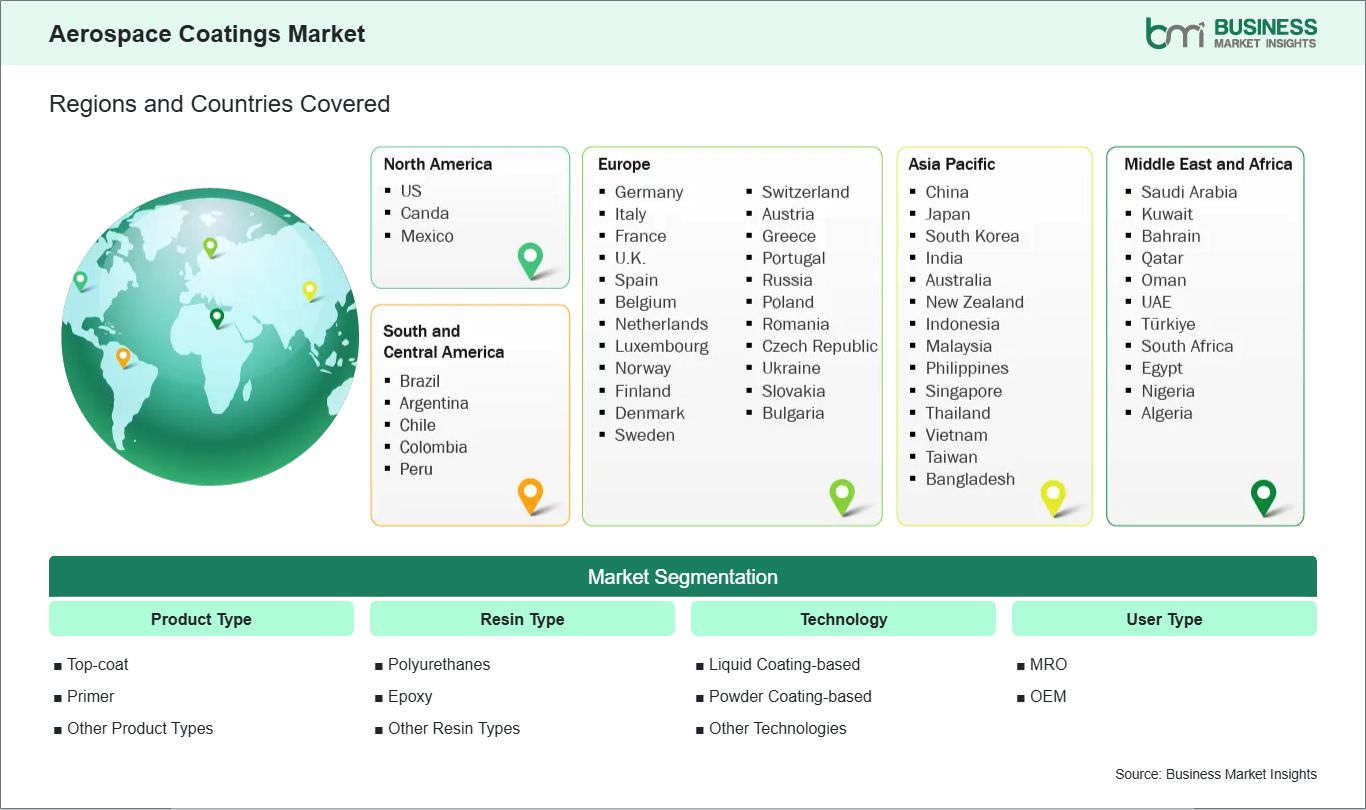
Key segments that contributed to the derivation of the aerospace coatings market analysis are product type, resin type, technology, user type, end user, and application.
The continuous growth in global aircraft production is a major factor fueling the aerospace coatings market. Increasing demand for new commercial aircraft, driven by expanding air travel and fleet modernization programs, has significantly boosted the need for high-performance coatings. Aircraft manufacturers rely on advanced coatings to ensure durability, safety, and compliance with stringent aviation standards.
Modern coatings are engineered to provide superior protection against corrosion, wear, and environmental stress, making them essential for aircraft longevity. The demand for lightweight coatings that contribute to fuel efficiency is also increasing, as airlines seek to reduce operational costs and carbon emissions. These coatings help minimize aircraft weight while maintaining structural integrity and performance.
Technological advancements are further supporting market growth, with innovations such as nanocoatings and self-healing materials enhancing performance characteristics. These developments have made coatings more resilient and efficient, reducing maintenance frequency and lifecycle costs. Thus, the increasing production of aircraft globally and the need for high-performance protective solutions drive the aerospace coatings market.
The expansion of maintenance, repair, and overhaul (MRO) activities is significantly boosting demand for aerospace coatings. As the global aircraft fleet ages, airlines and operators are investing heavily in maintenance to ensure safety, compliance, and operational efficiency. Coatings play a crucial role in MRO processes by protecting aircraft surfaces and restoring their appearance and functionality.
Frequent repainting and surface treatment are necessary to maintain aircraft performance and prevent corrosion, particularly in harsh operating environments. This has led to increased demand for durable and easy-to-apply coatings that reduce downtime during maintenance procedures. MRO service providers are also adopting advanced coating technologies to improve turnaround times and service quality.
The rise of low-cost carriers and increasing air traffic in emerging markets are further driving MRO activities, creating new opportunities for coating manufacturers. Additionally, digital tools and predictive maintenance strategies are enabling more efficient scheduling of coating applications. As the aviation industry continues to expand, the growing importance of MRO operations is expected to accelerate the adoption of aerospace coatings.
The Aerospace Coatings Market demonstrates steady growth, with size and share analysis highlighting evolving trends and competitive dynamics among key players. The report examines subsegments categorized within product type, resin type, technology, user type, end user, and application, offering insights into their contribution to overall market performance.
By product type, the top-coat subsegment dominated the market in 2025, driven by its critical role in providing surface protection, color retention, and aesthetic enhancement for aircraft.
By resin type, the polyurethanes subsegment dominated the market in 2025, driven by their superior durability, flexibility, and resistance to environmental factors such as UV radiation and chemicals.
Based on technology, the liquid coating-based subsegment dominated the market in 2025, driven by its ease of application, strong adhesion properties, and widespread usage across both OEM and MRO operations.
In terms of user type, the MRO subsegment dominated the market in 2025, driven by the increasing frequency of maintenance cycles and repainting requirements for aging aircraft fleets.
By end user, the commercial aviation subsegment dominated the market in 2025, driven by rising global air passenger traffic and continuous fleet expansion by airlines.
In terms of application, the exterior subsegment dominated the market in 2025, driven by the need for protection against harsh environmental conditions such as temperature fluctuations, moisture, and UV exposure.
| Report Attribute | Details |
|---|---|
| Market size in 2025 | US$ 2.45 Billion |
| Market Size by 2033 | US$ 4.23 Billion |
| Global CAGR (2026 - 2033) | 7.1% |
| Historical Data | 2022-2024 |
| Forecast period | 2026-2033 |
| Segments Covered | By Product Type
|
|
Regions and Countries Covered
| |
| North America | US, Canada, Mexico |
| Europe | Belgium, Austria, Finland, Denmark, Greece, Poland, Romania, Russia, Ukraine, Czech Republic, Slovakia, Bulgaria, Italy, Luxembourg, Germany, Switzerland, France, Netherlands, Norway, Portugal, Spain, Sweden, United Kingdom |
| Asia-Pacific | Australia, China, India, Japan, South Korea, Indonesia, Malaysia, Philippines, Singapore, Thailand, Vietnam, Bangladesh, New Zealand, Taiwan |
| South and Central America | Brazil, Argentina, Peru, Chile, Colombia |
| Middle East and Africa | Bahrain, Kuwait, Oman, Qatar, Saudi Arabia, United Arab Emirates, Turkiye, South Africa, Egypt, Algeria, Nigeria |
| Market leaders and key company profiles |
|
The "Aerospace Coatings Market Size and Forecast (2022 - 2033)" report provides a detailed analysis of the market covering below areas:
The geographical scope of the Aerospace Coatings Market report is divided into North America, Asia Pacific, Europe, Middle East & Africa, and South & Central America. North America held the largest share in 2025.
The adoption and maturity of aerospace coatings vary across regions, influenced by aircraft production capacity, regulatory frameworks, and MRO infrastructure. In North America, strong presence of aircraft manufacturers and MRO service providers has established the region as a key market. The US leads in innovation and adoption of advanced coatings, supported by stringent environmental regulations and high defense spending.
In Europe, the market is driven by leading aircraft manufacturers and strict environmental standards promoting eco-friendly coatings. Countries such as Germany, France, and the UK emphasize sustainable aviation practices, encouraging the adoption of low-VOC and waterborne coatings. Collaborative research initiatives further support innovation in coating technologies.
Asia Pacific is witnessing rapid growth due to increasing air travel, expanding airline fleets, and rising investments in aviation infrastructure. Countries such as China and India are emerging as key markets, driven by growing demand for commercial aircraft and expanding MRO capabilities.
The Middle East & Africa region is benefiting from strategic investments in aviation hubs and fleet expansion by major airlines. Latin America is also experiencing steady growth, supported by increasing air connectivity and modernization of aircraft fleets. Across all regions, regulatory compliance and sustainability goals are shaping market strategies and product development.

The Aerospace Coatings Market is evaluated by gathering qualitative and quantitative data post primary and secondary research, which includes important corporate publications, association data, and databases. A few of the key developments in the aerospace coatings market are:
The Aerospace Coatings Market is valued at US$ 2.45 Billion in 2025, it is projected to reach US$ 4.23 Billion by 2033.
As per our report Aerospace Coatings Market, the market size is valued at US$ 2.45 Billion in 2025, projecting it to reach US$ 4.23 Billion by 2033. This translates to a CAGR of approximately 7.1% during the forecast period.
The Aerospace Coatings Market report typically cover these key segments-
The historic period, base year, and forecast period can vary slightly depending on the specific market research report. However, for the Aerospace Coatings Market report:
The Aerospace Coatings Market is populated by several key players, each contributing to its growth and innovation. Some of the major players include:
The Aerospace Coatings Market report is valuable for diverse stakeholders, including:
Essentially, anyone involved in or considering involvement in the Aerospace Coatings Market value chain can benefit from the information contained in a comprehensive market report.
Please tell us your area of interest
(Market Segments/ Regions and Countries/ Companies)