Market Summary
Executive Summary and Global Market Analysis
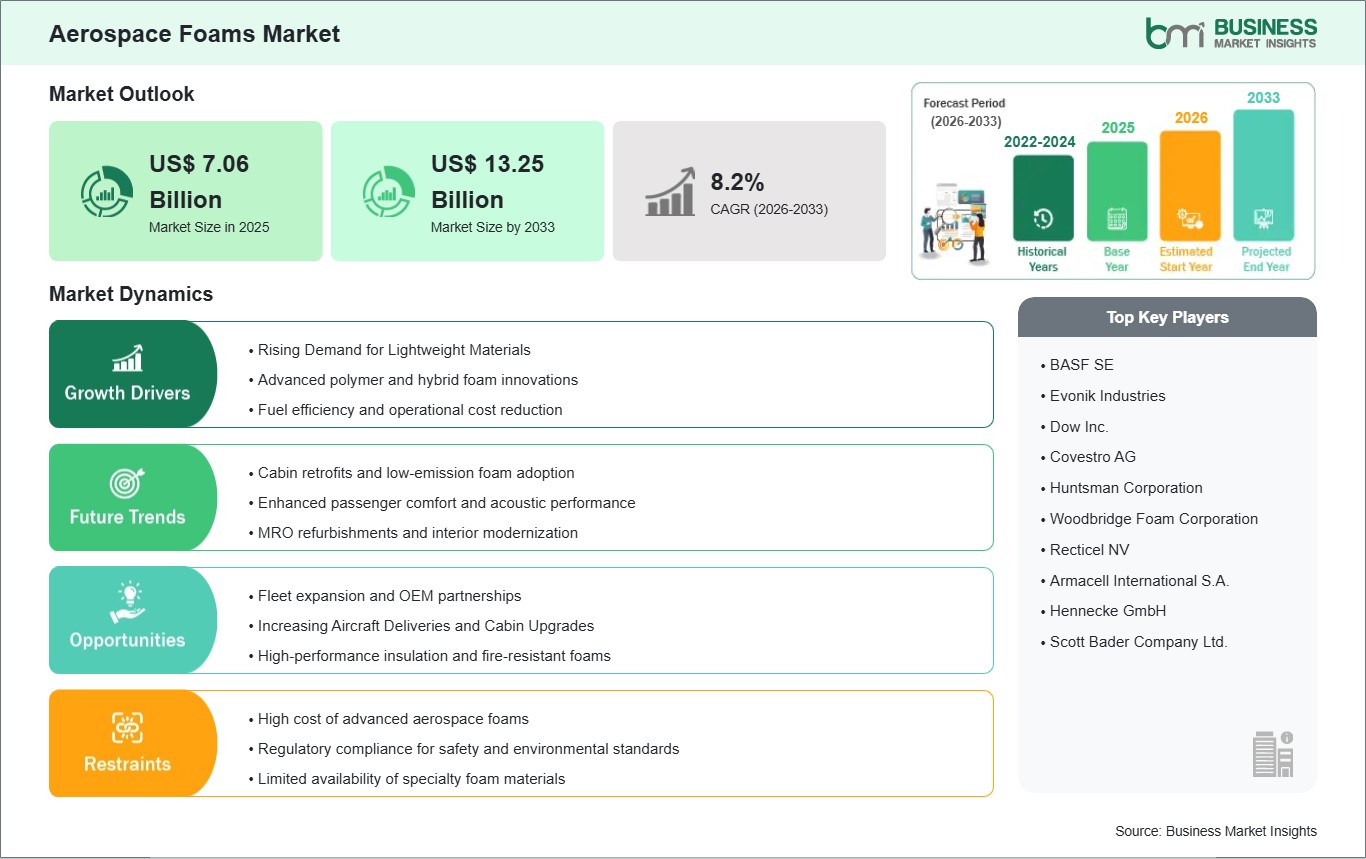
The global aerospace foams market is defined by increasing demand for lightweight materials, rising aircraft production, and growing emphasis on passenger comfort and safety. Aerospace foams—used extensively in seating, insulation, and structural components—play a vital role in reducing aircraft weight while maintaining durability and performance. These materials are critical in enhancing fuel efficiency, lowering emissions, and improving overall aircraft operational efficiency.
The market is experiencing a shift toward high-performance foams with superior thermal insulation, fire resistance, and acoustic properties. Airlines and manufacturers are prioritizing materials that enhance cabin comfort while complying with stringent safety regulations. Additionally, the expansion of global air travel and increasing aircraft deliveries are contributing to higher demand for aerospace foams across both OEM and aftermarket segments.
Competitive dynamics are focused on innovation in foam materials and manufacturing technologies. Companies are investing in advanced polymer formulations and hybrid materials to improve strength-to-weight ratios and performance characteristics. Sustainability is also emerging as a key focus area, with manufacturers developing recyclable and low-emission foam solutions. Strategic collaborations with aircraft manufacturers and interior system suppliers are enabling tailored product offerings, strengthening market positioning in a competitive landscape.
Segment Analysis
Aerospace Foams Market Segmentation
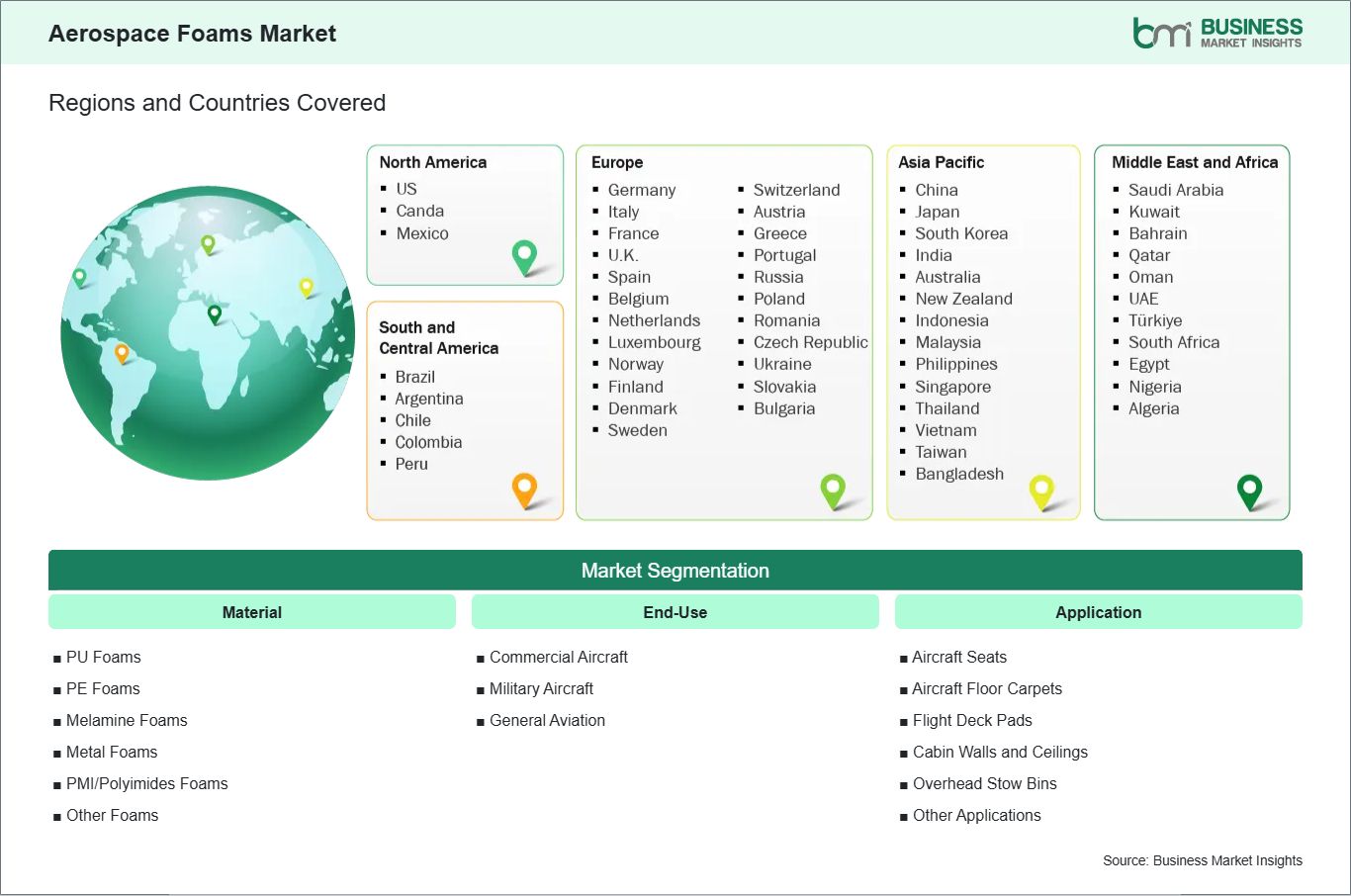
Key segments that contributed to the derivation of the aerospace foams market analysis are material, end-use, and application.
- By material, the aerospace foams market is segmented into PU foams, PE foams, melamine foams, metal foams, PMI/polyimides foams, and other foams. The PU foams segment dominated the market in 2025.
- Based on end-use, the aerospace foams market is segmented into commercial aircraft, military aircraft, and general aviation. The commercial aircraft segment dominated the market in 2025.
- In terms of application, the market is segmented into aircraft seats, aircraft floor carpets, flight deck pads, cabin walls and ceilings, overhead stow bins, and other applications. The aircraft seats segment dominated the market in 2025.
Market Forces
Aerospace Foams Market Drivers and Opportunities
Rising Demand for Lightweight Materials
There is growing demand for lighter airplanes as there is a significant emphasis on reducing the carbon footprint and increasing the fuel efficiency of aviation. The introduction of lightweight materials like aerospace foams has had a profound impact on reducing the overall weight of an airplane and the fuel consumption and operating costs associated with it. Aerospace foams can be found throughout both the interiors and structure of an airplane in order to help achieve overall weight savings; however, these foam products do not detract from performance or safety.
Engineered foam materials today are designed with high strength-to-weight ratios, thermal insulation properties, and great fire resistance. These characteristics make engineered foam products suitable for a large number of applications such as for aircraft seats, insulation, and for use in aircraft structures. Furthermore, the use of advanced engineered foams will assist the aviation industry to meet strict regulations in relation to safety and environmental issues.
Ongoing advancements will help improve engineered foams in the aerospace industry even further. Improvements in polymer chemistry and manufacturing technologies are making engineered foams exhibit greater durability and improve their ability to perform in extreme environmental conditions than ever before. Therefore, the trend towards developing more lightweight, high-performing materials will continue to support the growth of the aerospace foam industry.
Increasing Aircraft Deliveries and Cabin Upgrades
The growth in global aircraft deliveries and the increasing focus on cabin modernization are creating significant opportunities for the aerospace foams market. Airlines are investing in upgrading cabin interiors to enhance passenger comfort and differentiate their services, leading to increased demand for advanced foam materials.
Aerospace foams are extensively used in seating, insulation, and interior panels, where comfort and safety are paramount. The demand for ergonomic seating and improved acoustic insulation is driving the adoption of high-performance foams. Additionally, the expansion of low-cost carriers and long-haul flights is further boosting the need for comfortable and efficient cabin interiors.
The MRO sector also plays a crucial role in market growth, as aircraft interiors require periodic refurbishment and replacement. Foam materials are frequently replaced during maintenance cycles to ensure optimal performance and compliance with safety standards. As airlines continue to prioritize passenger experience and operational efficiency, the demand for aerospace foams is expected to grow steadily.
Size and Share Analysis
Aerospace Foams Market Size and Share Analysis
The Aerospace Foams Market demonstrates steady growth, with size and share analysis highlighting evolving trends and competitive dynamics among key players. The report examines subsegments categorized within material, end-use, and application, offering insights into their contribution to overall market performance.
By material, the PU foams subsegment dominated the market in 2025, driven by their excellent cushioning properties, lightweight nature, and versatility across multiple aerospace applications.
Based on end-use, the commercial aircraft subsegment dominated the market in 2025, driven by increasing aircraft deliveries and rising passenger traffic globally.
In terms of application, the aircraft seats subsegment dominated the market in 2025, driven by the high demand for comfort, durability, and lightweight materials in passenger seating systems.
Report Coverage
Aerospace Foams Market Report Coverage and Deliverables
The "Aerospace Foams Market Size and Forecast (2022 - 2033)" report provides a detailed analysis of the market covering below areas:
- Aerospace Foams Market size and forecast at global, regional, and country levels for all the key market segments covered under the scope
- Aerospace Foams Market trends, as well as drivers, restraints, and opportunities
- Aerospace Foams Market analysis covering key trends, global and regional framework, major players, regulations, and recent developments
- Industry landscape and competition analysis covering market concentration, heat map analysis, prominent players, and recent developments for the Aerospace Foams Market
- Detailed company profiles, including SWOT analysis
Geographic Insights
Aerospace Foams Market Geographic Insights
The geographical scope of the Aerospace Foams Market report is divided into North America, Asia Pacific, Europe, Middle East & Africa, and South & Central America. North America held the largest share in 2025.
The adoption and demand for aerospace foams vary across regions, influenced by aircraft production, MRO infrastructure, and regulatory requirements. North America leads the market due to the strong presence of aircraft manufacturers, advanced aviation infrastructure, and high demand for lightweight materials. The region also benefits from significant defense spending and continuous innovation in aerospace materials. Europe follows closely, driven by leading aircraft manufacturers and a strong focus on sustainability and safety standards. The region emphasizes the development of eco-friendly materials and advanced interior solutions, contributing to market growth.
Asia Pacific is witnessing rapid expansion due to increasing air travel, growing airline fleets, and rising investments in aviation infrastructure. Emerging economies such as China and India are becoming key markets, supported by expanding aviation sectors and increasing demand for aircraft interiors.
The Middle East & Africa region is experiencing growth due to investments in aviation hubs and fleet expansion by major airlines. Latin America is also showing steady growth, driven by increasing connectivity and modernization of aircraft fleets. Across all regions, regulatory compliance and the need for efficient, lightweight materials are shaping market trends.
Industry Activity
Recent Developments
The Aerospace Foams Market is evaluated by gathering qualitative and quantitative data post primary and secondary research, which includes important corporate publications, association data, and databases. A few of the key developments in the aerospace foams market are:
- In May 2024, BASF SE showcased its lightweight foam technologies for aerospace and automotive interiors, emphasizing improved fire resistance and sustainability in line with stricter environmental standards.
- In November 2024, Evonik Industries expanded its ROHACELL PMI foam portfolio for aerospace applications, highlighting enhanced thermal stability and mechanical strength for use in structural components.
Trust & Transparency
Research Methodology
The market analysis combines proprietary research with secondary data from government agencies, company disclosures, regulatory filings, industry databases and expert interviews. Market estimates are validated through data triangulation, cross-market benchmarking and analyst
review.
View Full Research Methodology
Key Sources Referred:
International Air Transport Association (IATA)Federal Aviation Administration (FAA)European Union Aviation Safety Agency (EASA)Organisation for Economic Cooperation and Development (OECD)World Bank GroupAerospace Industries Association (AIA)