Market Summary
Executive Summary and Global Market Analysis
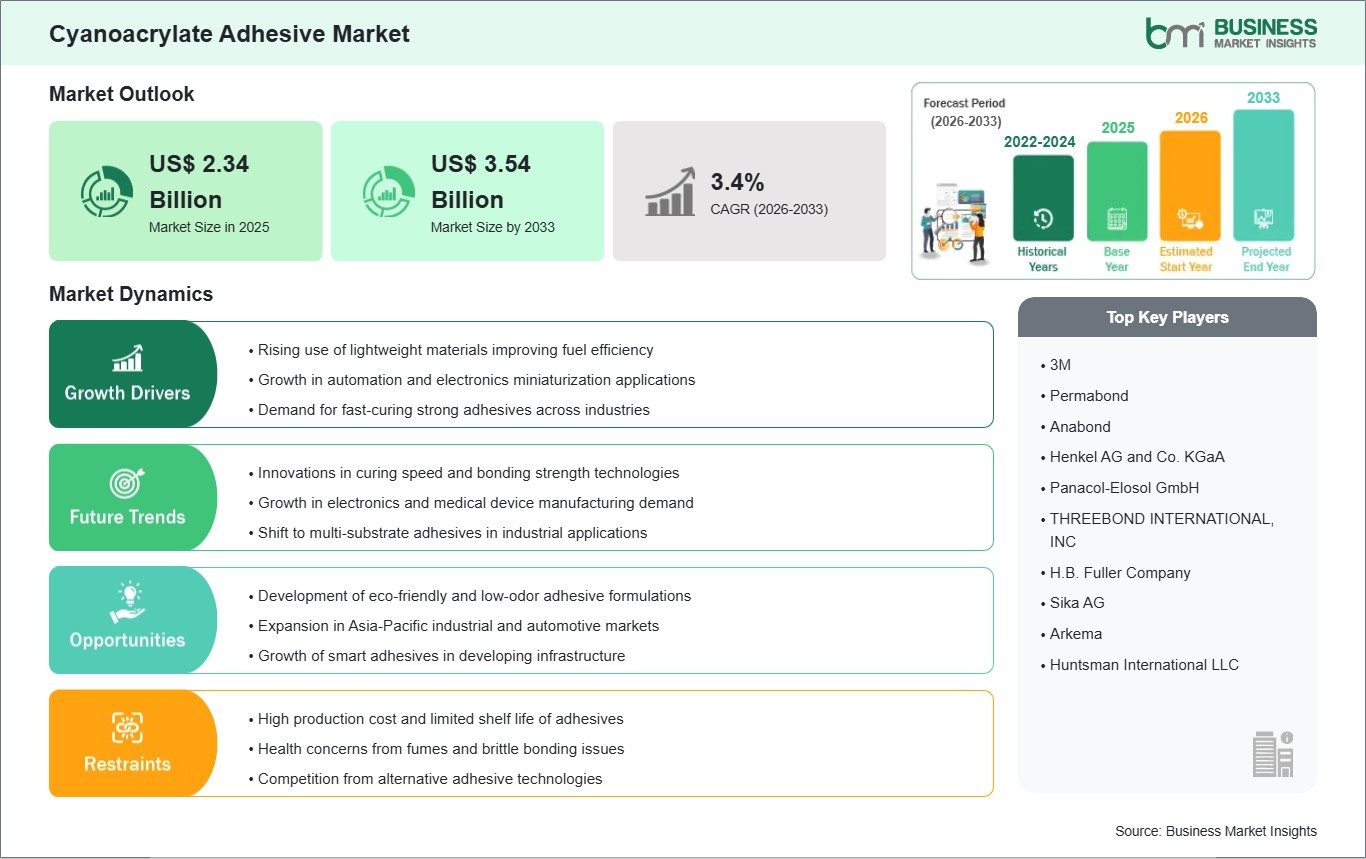
Cyanoacrylate adhesives are vital in today's bonding applications. They provide quick and strong adhesion for a variety of materials with accuracy and efficiency. These adhesives find widespread use in industries like electronics, automotive, medical, and consumer goods manufacturing. They serve as dependable solutions for instant bonding, assembly, and repair tasks. Cyanoacrylate adhesives cure quickly, have high strength, and require minimal application effort. They also help improve productivity and cut down processing time. Their benefits include fast setting times, strong bonding performance, ease of use, and excellent compatibility with different substrates. The market is growing mainly due to the rise in industrial automation, the need for high-performance bonding solutions, and expansion in different sectors. Developments in formulation technologies and specialty-grade adhesives further drive market growth.
However, the cyanoacrylate adhesive market has some challenges, such as sensitivity to moisture and temperature changes, which can affect performance, while limited gap-filling ability may limit some uses. Cost issues and handling precautions could also influence adoption in certain situations. Proper surface preparation and controlled use are essential for achieving the best results. Despite these challenges, the market shows strong growth potential thanks to ongoing innovation, increasing demand for lightweight and durable assemblies, and rising applications in new industries. Future trends will likely focus on creating flexible and impact-resistant formulations, environmentally friendly products, and wider use in advanced manufacturing processes.
Segment Analysis
Cyanoacrylate Adhesive Market Segmentation
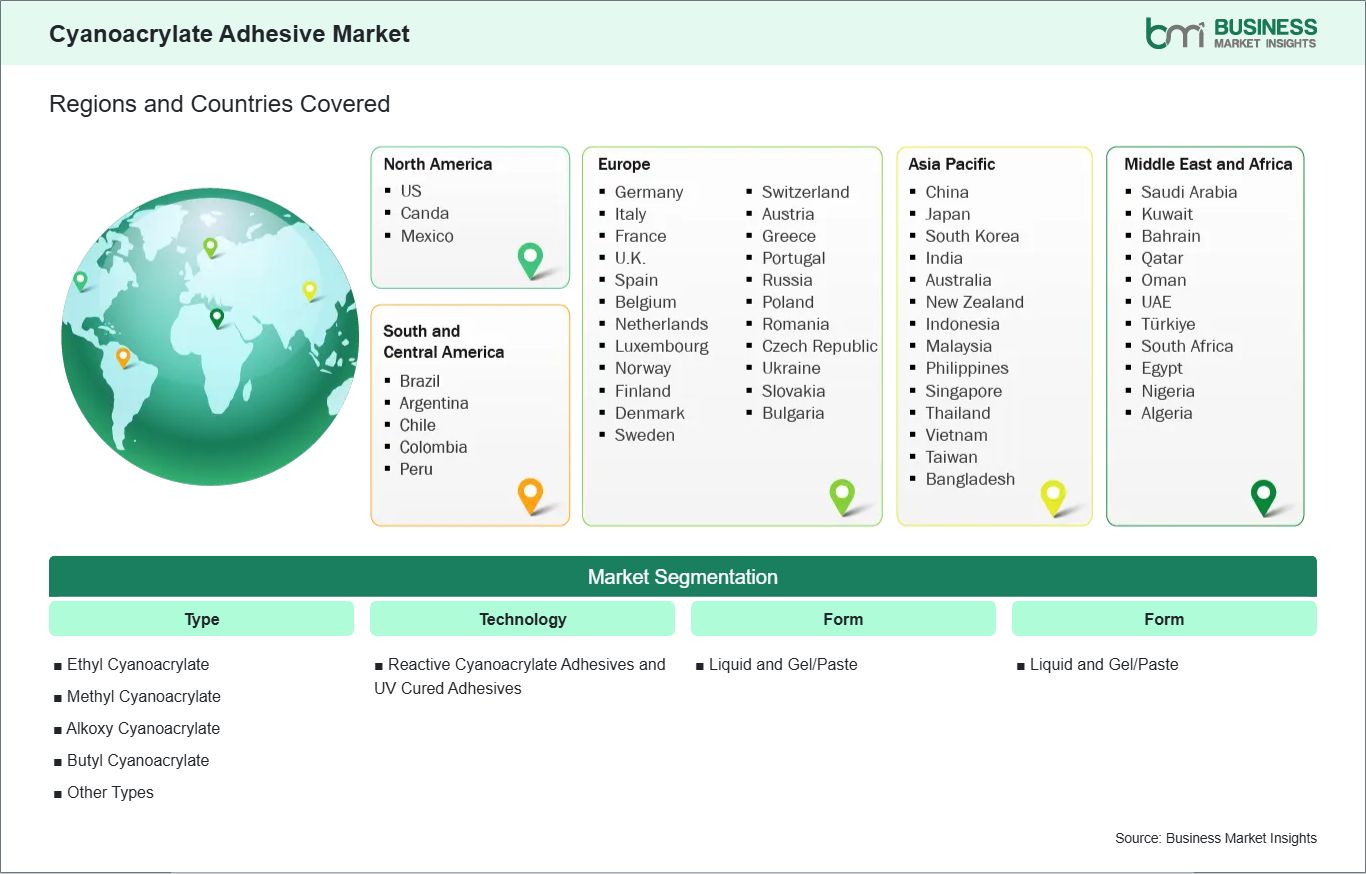
Key segments that contributed to the derivation of the cyanoacrylate adhesive market analysis are type, technology, form, and end-use industry.
- By type, the cyanoacrylate adhesive market is segmented into ethyl cyanoacrylate, methyl cyanoacrylate, alkoxy cyanoacrylate, butyl cyanoacrylate, and other types. The ethyl cyanoacrylate segment dominated the market in 2025.
- By technology, the market is categorized into reactive cyanoacrylate adhesives and UV-cured adhesives. The reactive cyanoacrylate adhesives segment dominated the market in 2025.
- By form, the cyanoacrylate adhesive market is segmented into liquid and gel/paste. The liquid segment dominated the market in 2025.
- By end-use industry, the market is categorized into automotive, electrical and electronics, medical and healthcare, construction and woodworking, consumer goods, aerospace and defense, and other end-use industries. The medical and healthcare segment held the largest share of the market in 2025.
Market Forces
Cyanoacrylate Adhesive Market Drivers and Opportunities
Rising Demand for Fast and Efficient Bonding in Industrial Applications
Industries are increasingly using cyanoacrylate adhesives for quick assembly and strong bonding without complicated steps. These adhesives cure instantly and bond well to different surfaces, making them perfect for fast-paced production settings. Their ability to cut down assembly time and improve efficiency leads to wider use in sectors like electronics, automotive, and consumer goods. As manufacturers focus on lighter components and precise engineering, the demand for dependable bonding solutions rises. Cyanoacrylate adhesives also lower the need for mechanical fasteners, allowing for cleaner designs and less material waste. Ongoing improvements in adhesive performance and compatibility further enhance their importance in today's manufacturing. This increasing focus on productivity, efficiency, and smoother operations is a major driver of market growth.
Expansion of Advanced Medical and Electronics Applications
Emerging uses in medical devices and small electronics offer strong growth opportunities for the cyanoacrylate adhesive market. These adhesives are becoming more popular for wound closure, wearable devices, and delicate electronic components because of their precision and quick-setting features. The move toward less invasive procedures and smaller electronic designs is driving demand for specific adhesive formulations. New developments in biocompatible and low-odor options are creating fresh possibilities in sensitive applications. The growth of wearable technology and smart devices is encouraging the use of adhesives that provide durability and flexibility at small scales. Support from regulations for healthcare solutions and rising investment in electronics manufacturing also add to this opportunity. As industries shift toward high-performance and compact solutions, cyanoacrylate adhesives are set to play an important role in future advancements.
Size and Share Analysis
Cyanoacrylate Adhesive Market Size and Share Analysis
The cyanoacrylate adhesive market demonstrates steady growth, with size and share analysis revealing evolving trends and competitive positioning among key players. The report further examines subsegments categorized within type, technology, form, and end-use industry, offering insights into their contribution to overall market performance.
Based on type, the ethyl cyanoacrylate subsegment dominates the cyanoacrylate adhesive market. Ethyl cyanoacrylate adhesives cure quickly and bond strongly. They work well with many types of materials. These adhesives stick nicely to plastics, metals, and rubber, making them great for various industrial and consumer uses. Common applications include electronics assembly, automotive parts, medical devices, and home repairs. Their reliable performance, simple application, and low cost make them the top choice for manufacturers who need dependable and fast bonding solutions for high-volume and precise tasks.
Report Coverage
Cyanoacrylate Adhesive Market Report Coverage and Deliverables
The " Cyanoacrylate Adhesive Market Size and Forecast (2022 - 2033)" report provides a detailed analysis of the market covering the following areas:
- Cyanoacrylate Adhesive market size and forecast at global, regional, and country levels for all the key market segments covered under the scope
- Cyanoacrylate Adhesive market trends, as well as market dynamics such as drivers, restraints, and key opportunities
- Cyanoacrylate Adhesive market analysis covering key market trends, global and regional framework, major players, regulations, and recent market developments
- Industry landscape and competition analysis covering market concentration, heat map analysis, prominent players, and recent developments for the cyanoacrylate adhesive market
- Detailed company profiles, including SWOT analysis
Geographic Insights
Cyanoacrylate Adhesive Market Geographic Insights
The geographical scope of the cyanoacrylate adhesive market report is divided into five regions: North America, Asia Pacific, Europe, Middle East & Africa, and South & Central America. The Asia Pacific Cyanoacrylate Adhesive Market is segmented into China, Japan, South Korea, India, Australia, New Zealand, Indonesia, Malaysia, the Philippines, Singapore, Thailand, Vietnam, Taiwan, Bangladesh, and the Rest of Asia Pacific. Asia Pacific has a strong industrial base, especially in electronics manufacturing, automotive production, and medical device assembly. This makes it a leading region in the cyanoacrylate adhesive market. Rapid urbanization and growing manufacturing activities in countries like China, India, and Southeast Asian nations support widespread use of these adhesives.
Market growth is fueled by the rising demand for high-performance bonding solutions, cost-effective production methods, and lightweight component assembly. The region also sees more investments in industrial automation, a growing consumer goods sector, and ongoing infrastructure development. Furthermore, the presence of large manufacturing hubs, supportive government policies, and a focus on new materials strengthen the Asia Pacific's position as a key player in the global cyanoacrylate adhesive industry.
Industry Activity
Recent Developments
The cyanoacrylate adhesive market is evaluated by gathering qualitative and quantitative data post-primary and secondary research, which includes important corporate publications, association data, and databases. A few of the key developments in the cyanoacrylate adhesive market are:
- In March 2026, SkinBond, a veterinary skin adhesive designed to aid wound healing and minimize infection, is now available in multi-pack options in the UK. Animus Surgical has introduced SkinBond Multi, which complements the original SkinBond product in a reusable dropper bottle, offering three, five, or ten single-use 0.25ml pipettes. Both products utilize veterinary-grade n-butyl cyanoacrylate, which forms a strong, flexible, and waterproof anti-bacterial seal within seconds. They are suitable for closing minor skin lacerations and surgical incisions across all animal species.
- In December 2024, Bostik launched Super Glue Ultra+, an adhesive made with 60% bio-based materials through a patented synthesis process. This product combines high performance with sustainability, offering exceptional strength and resistance to heat and water for various repair uses. The adhesive is packaged in recycled cardboard blisters, with future packaging in recycled aluminium tubes, reflecting Bostik's commitment to reducing waste and promoting circular economy practices.
Trust & Transparency
Research Methodology
The market analysis combines proprietary research with secondary data from government agencies, company disclosures, regulatory filings, industry databases and expert interviews. Market estimates are validated through data triangulation, cross-market benchmarking and analyst
review.
View Full Research Methodology
Key Sources Referred:
World Bank - Global Trade IndicatorsEuropean Chemicals AgencyInternational Council of Chemical AssociationsInternational Monetary Fund (IMF)World Trade Organization (WTO)International Trade Administration (ITA)Company WebsitesCompany Annual ReportsCompany Investor Presentations