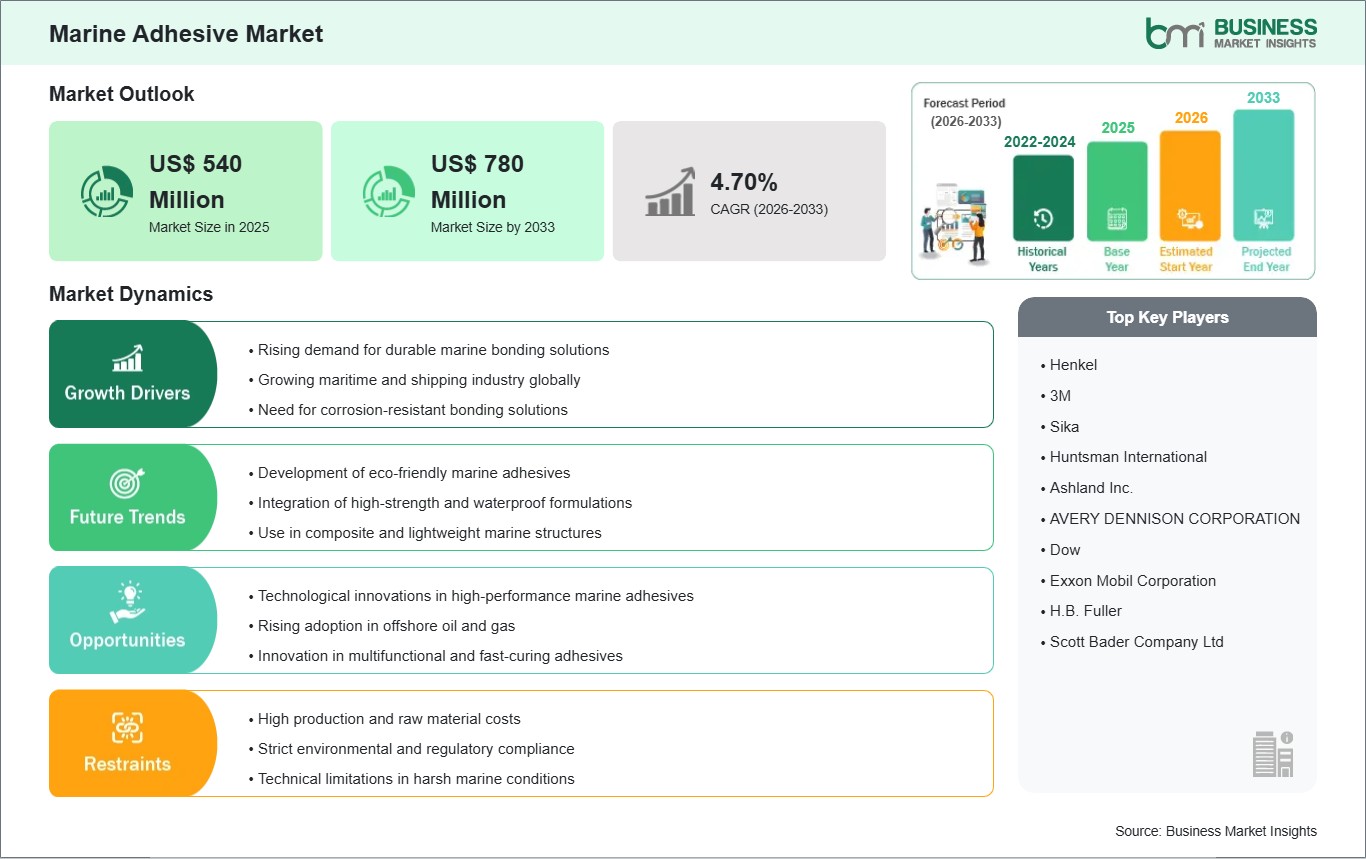
The Marine Adhesive Market size is expected to reach US$ 780 Million by 2033 from US$ 540 Million in 2025. The market is estimated to record a CAGR of 4.70% from 2026 to 2033.
The global market for marine adhesives is steadily increasing, as the marine and shipbuilding industries are continuing to depend on advanced bonding technologies that can provide structural integrity, corrosion protection and durability when subjected to extremely harsh aquatic environments. Marine adhesives have been specifically formulated to provide superior adhesion, flexibility and resistance to water, salt, UV exposure and temperature change and are a requirement for applications associated with ship hulls and decks, interior structures, offshore platforms and the repair of boats. The main types of products include epoxy, polyurethane, silicone and acrylic adhesives, and each type has been designed to accommodate a particular type of bonding requirement: metal-to-metal bonding, metal-to-composite bonding or composite-to-composite bonding.
A number of factors are driving the marine adhesives market, including the continually increasing number of ships being constructed throughout the world, the growth of offshore oil and gas infrastructure and the requirement for lightweight, corrosion-resistant composite materials for use in marine applications. Development of new technologies has fueled the introduction of environmentally compliant, low-VOC, fast-curing adhesives that can be formulated to reduce the amount of labor and maintenance required, while also meeting the necessary environmental and regulatory requirements. A number of companies are placing emphasis on developing custom solutions for high-performance marine applications and collaborating with OEMs and shipyards to enhance application efficiency. As the marine industry transitions toward advanced composites and modular construction techniques, marine adhesives are fast becoming an essential factor in attaining long-term structural performance, reliability and sustainability.

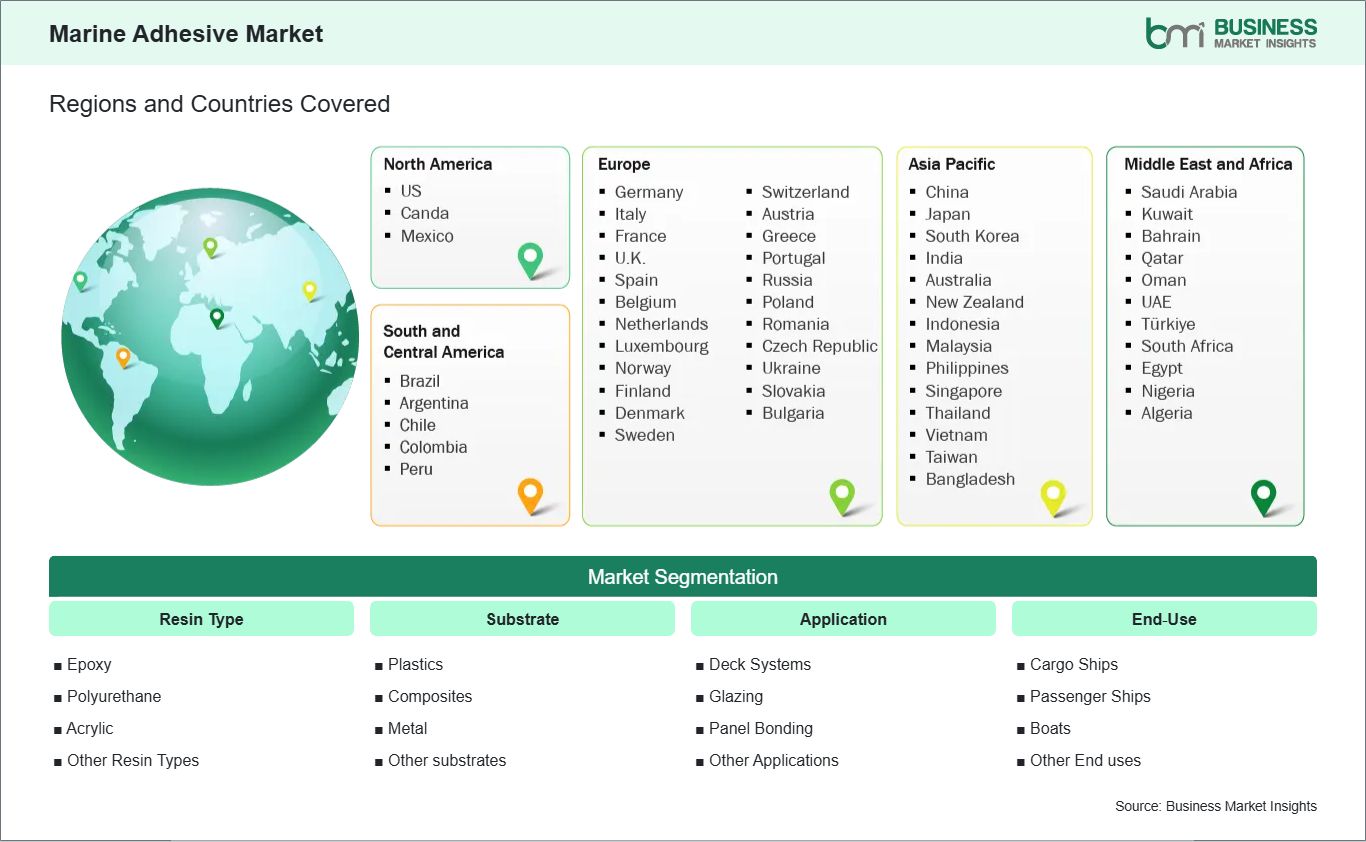
Key segments that contributed to the derivation of the marine adhesive market analysis are resin type, substrate, application, and end‑use.
The marine adhesive market is growing due to the increase in structural integrity required in the marine industry to meet the needs of shipbuilding and boat manufacturing, as well as offshore infrastructure that uses adhesives to endure extreme environmental conditions, including, but not limited to, exposure to water, high humidity, salt and UV rays. Marine adhesives provide structural bonding, sealing, and maintenance, allowing for dependable performance in demanding environments. Adhesives are increasingly used in place of mechanical fasteners or, in some cases, as a supplement to traditional mechanical fasteners in the construction of commercial and recreational vessels to enhance structural integrity, lower weight, and simplify assembly. The use of marine adhesives in hull bonding, deck panels and the interior fixtures of vessels increases the durability of these structures, and helps dramatically reduce the likelihood of leaks and rust. Manufacturers are working towards developing adhesives that will continue to maintain performance properties through high cyclic loading and frequent changes in temperature over extended periods.
Furthermore, repairs and maintenance to vessels and offshore facilities have relied on marine adhesives to minimize both costs and downtime. The increasing focus within the marine industry on durability, safety, and performance is creating consistent demand for specialized adhesive solutions. These trends will continue to position the marine adhesive market for steady growth globally across the commercial, recreational, and industrial marine markets.
Innovation in marine adhesives is creating opportunities for market expansion by improving performance, application versatility, and environmental compliance. Manufacturers are developing high-strength, flexible, and quick-curing formulations that provide excellent adhesion to a wide range of substrates, including metals, composites, and plastics. These advanced adhesives meet the rigorous demands of modern shipbuilding and offshore applications. Research is also focused on environmentally friendly solutions, including low-VOC and solvent-free formulations, to reduce environmental impact and improve worker safety. Innovations in polyurethane, epoxy, and silicone-based adhesives enhance resistance to water, temperature variations, and chemical exposure, extending the service life of bonded components. Collaborations between adhesive producers and marine equipment manufacturers are accelerating the development of customized solutions tailored to specific applications, such as deck installations, hull repairs, and offshore maintenance. By combining high performance, durability, and eco-friendly properties, these technological advancements are driving broader adoption of marine adhesives and positioning the market for sustained global growth.
The marine adhesive market demonstrates steady growth, with size and share analysis highlighting evolving trends and competitive dynamics among key players. The report examines subsegments categorized within resin type, substrate, application, and end‑use, offering insights into their contribution to overall market performance.
By Resin Type, the epoxy subsegment dominated the market in 2025, driven by its high strength, excellent resistance to outdoor weathering, and ability to bond dissimilar materials used in vessels and marine structures.
Based on Substrate, the metal subsegment dominated the market in 2025, supported by extensive use of metal components in ship hulls and structures requiring durable adhesive bonding.
On the basis of Application, the deck systems subsegment dominated the market in 2025, owing to high demand for strong, water‑resistant adhesives that ensure long‑lasting bonding in deck assembly.
On the basis of End‑Use, the cargo ships subsegment dominated the market in 2025, fueled by the growing volume of global cargo transportation and expansion of commercial shipping fleets.
| Report Attribute | Details |
|---|---|
| Market size in 2025 | US$ 540 Million |
| Market Size by 2033 | US$ 780 Million |
| Global CAGR (2026 - 2033) | 4.70% |
| Historical Data | 2022-2024 |
| Forecast period | 2026-2033 |
| Segments Covered | By Resin Type
|
|
Regions and Countries Covered
| |
| North America | US, Canada, Mexico |
| Europe | Belgium, Austria, Finland, Denmark, Greece, Poland, Romania, Russia, Ukraine, Czech Republic, Slovakia, Bulgaria, Italy, Luxembourg, Germany, Switzerland, France, Netherlands, Norway, Portugal, Spain, Sweden, United Kingdom |
| Asia-Pacific | Australia, China, India, Japan, South Korea, Indonesia, Malaysia, Philippines, Singapore, Thailand, Vietnam, Bangladesh, New Zealand, Taiwan |
| South and Central America | Brazil, Argentina, Peru, Chile, Colombia |
| Middle East and Africa | Bahrain, Kuwait, Oman, Qatar, Saudi Arabia, United Arab Emirates, Turkiye, South Africa, Egypt, Algeria, Nigeria |
| Market leaders and key company profiles |
|
The "Marine Adhesive Market Size and Forecast (2022 - 2033)" report provides a detailed analysis of the market covering below areas:
The geographical scope of the Marine Adhesive Market report is divided into North America, Asia Pacific, Europe, Middle East & Africa, and South & Central America. North America held the largest share in 2025.
Regional demand for marine adhesives is closely linked to shipbuilding, offshore activities, and marine infrastructure development. North America dominates, driven by the U.S. and Canada, where naval vessels, commercial ships, and offshore platforms require high-performance adhesives for long-term durability and regulatory compliance. Europe maintains strong adoption in countries such as Germany, Italy, and Norway, fueled by advanced shipyards, luxury yacht manufacturing, and strict environmental regulations that encourage low-VOC, high-performance adhesives.
In the Asia Pacific, rapid industrialization, expansion of commercial and naval shipbuilding, and growing offshore oil and gas operations in China, Japan, South Korea, and India are driving substantial demand for epoxy, polyurethane, and structural adhesives.
Middle East & Africa is emerging, with focus on commercial ships, oil rigs, and port infrastructure projects in Saudi Arabia, UAE, and South Africa, where high-performance bonding solutions improve longevity and reduce maintenance.
South & Central America, particularly Brazil and Mexico, is gradually increasing marine adhesive adoption due to growing commercial shipping, fishing industries, and ship repair activities. Across all regions, product reliability, resistance to harsh environments, and compliance with marine safety standards are critical drivers for growth and competitive positioning in the marine adhesive market.

The Marine Adhesive Market is evaluated by gathering qualitative and quantitative data post primary and secondary research, which includes important corporate publications, association data, and databases. A few of the key developments in the marine adhesive market are:
The Marine Adhesive Market is valued at US$ 540 Million in 2025, it is projected to reach US$ 780 Million by 2033.
As per our report Marine Adhesive Market, the market size is valued at US$ 540 Million in 2025, projecting it to reach US$ 780 Million by 2033. This translates to a CAGR of approximately 4.70% during the forecast period.
The Marine Adhesive Market report typically cover these key segments-
The historic period, base year, and forecast period can vary slightly depending on the specific market research report. However, for the Marine Adhesive Market report:
The Marine Adhesive Market is populated by several key players, each contributing to its growth and innovation. Some of the major players include:
The Marine Adhesive Market report is valuable for diverse stakeholders, including:
Essentially, anyone involved in or considering involvement in the Marine Adhesive Market value chain can benefit from the information contained in a comprehensive market report.
Please tell us your area of interest
(Market Segments/ Regions and Countries/ Companies)