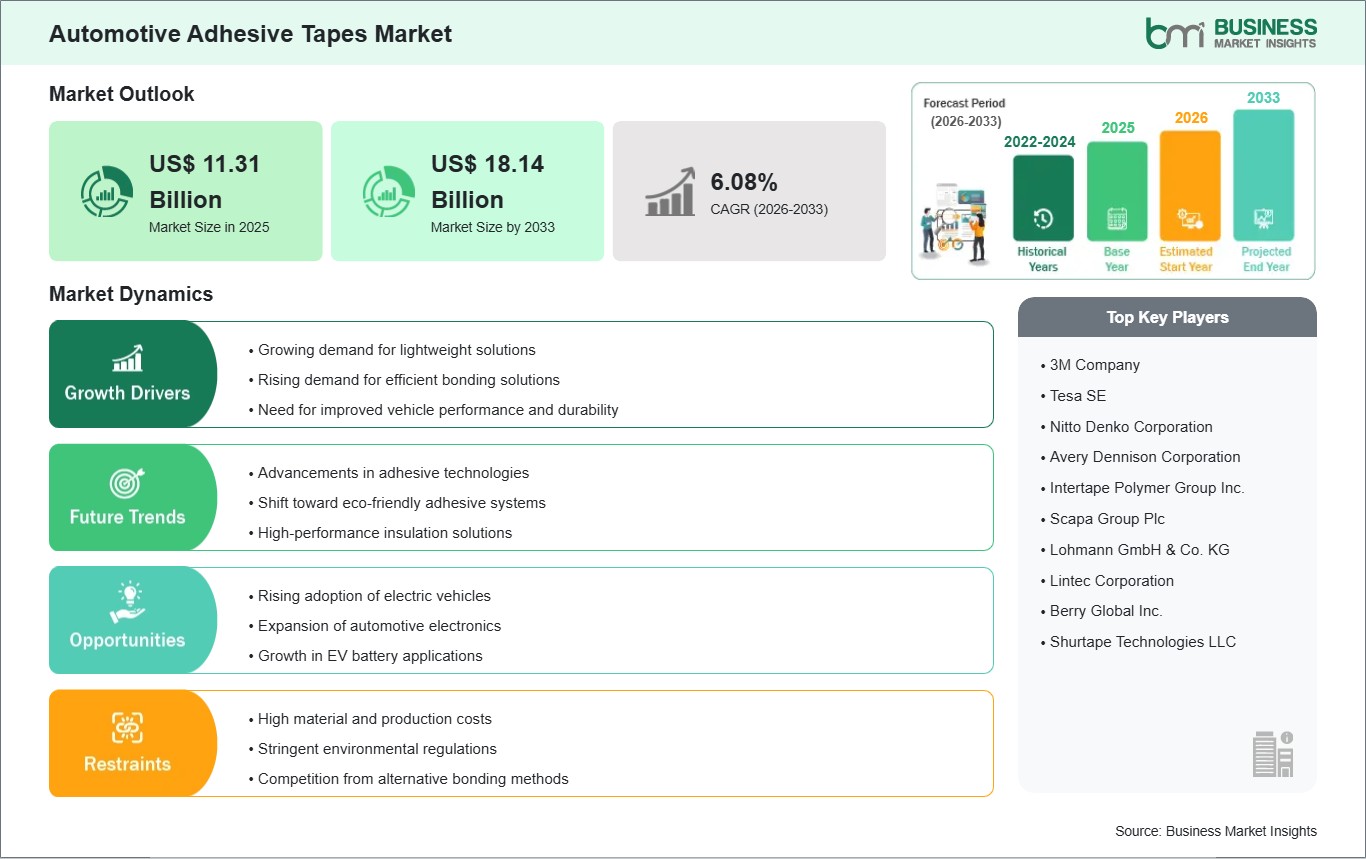
The Automotive Adhesive Tapes Market size is expected to reach US$ 18.14 Billion by 2033 from US$ 11.31 Billion in 2025. The market is estimated to record a CAGR of 6.08% from 2026 to 2033.
The global automotive adhesive tapes market is defined by the increasing adoption of advanced bonding and fastening solutions that enhance vehicle performance, durability, and manufacturing efficiency. Automotive adhesive tapes provide advantages such as uniform stress distribution, corrosion resistance, vibration damping, and improved aesthetic finish, making them a preferred alternative to traditional fastening methods such as screws and rivets.
The market is witnessing steady growth driven by the automotive industry’s focus on lightweight materials and fuel efficiency. Adhesive tapes enable the bonding of dissimilar substrates including plastics, metals, and composites, which are widely used in modern vehicle designs. Additionally, the integration of advanced electronics and the shift toward electric mobility are increasing the demand for high-performance adhesive tapes with superior insulation and thermal management properties.
Competitive dynamics are centered on product innovation, material advancements, and sustainability initiatives. Manufacturers are developing high-performance adhesive tapes with enhanced adhesion strength, temperature resistance, and durability. The growing emphasis on eco-friendly materials and solvent-free adhesive systems is also shaping market strategies. Strategic partnerships with automotive OEMs and component manufacturers are further driving innovation and expanding market reach.

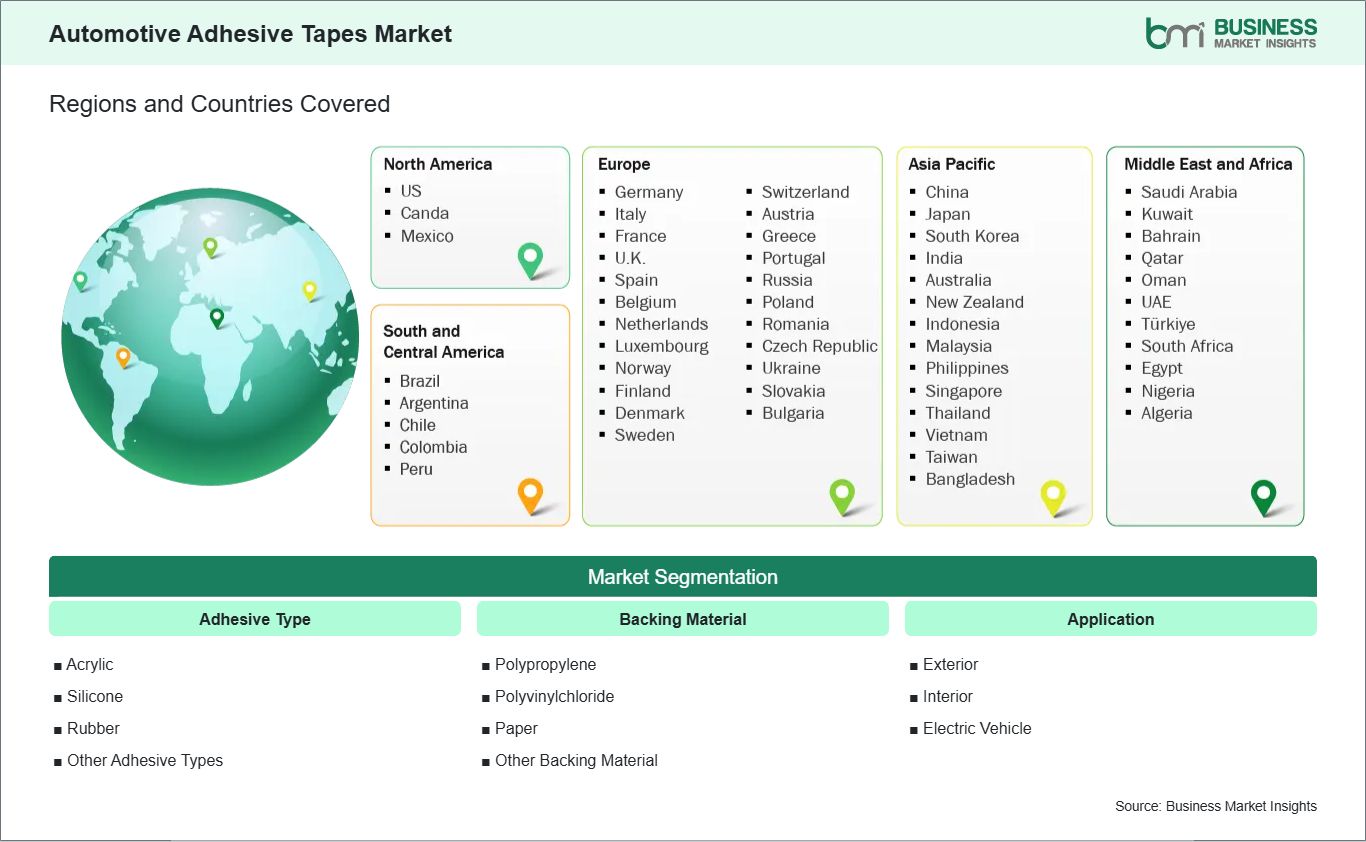
Key segments that contributed to the derivation of the automotive adhesive tapes market analysis are adhesive type, backing material, and application.
Adhesive tapes are increasingly being used in the automotive industry as automobile manufacturers place a greater emphasis on creating lightweight vehicles. Manufacturers have come under increasing pressure to develop heavier weight vehicles that have better fuel economy while having lower emissions. To help meet these increasing pressures for better fuel economy, designers and manufacturers have focused on incorporating more lightweight materials such as plastics, composites, and aluminum into the design of their automobiles. Automotive adhesive tapes help make it easier to bond these types of materials and create a stronger and more structurally sound automobile without adding additional weight to the overall design of the vehicle to improve its fuel economy.
Automotive adhesive tapes provide a variety of benefits as compared to traditional methods of fastening parts together. The adhesive tape creates an even distribution of the loads that are transferred from one bonded surface to another throughout the surface area of the material. The even distribution of loads reduces the chances of material fatigue and failure of the bonded components, and also creates an overall stronger and more structurally sound automotive component. Adhesive tapes have also improved the overall sound and vibration (NVH) characteristics of an automobile, leading to improved comfort for the occupants of the vehicle. The seamless bonding or joining of materials also adds to the overall aesthetic appearance of vehicle interiors as well as exteriors.
In addition to these benefits of performance and aesthetic appeal, advancements in adhesive technology have also allowed for the development of automotive adhesive tapes that have additional and improved characteristics such as high-temperature, UV, and long-term durability. These developments have allowed the use of automotive adhesive tapes for a growing number of applications (automotive components), such as automobile trim, panels, and electronic systems. As the automotive market moves toward the goal of creating more lightweight, more efficient, and higher performance vehicles, the automotive adhesive tape market will continue to grow.
The automotive adhesive tape market is benefitting from the rapidly growing electric vehicle (EV) market, as EVs require specialized materials and bonding solutions to meet unique requirements (thermal management, electrical insulation and lightweight). As a result, adhesive tapes will continue to grow in popularity in applications associated with EVs given their ability to effectively meet these needs.
Adhesive tapes are primarily used in battery systems for cell insulation, module assembly and thermal management to keep batteries operating within the correct temperature range while ensuring both the safety and performance of the battery pack. In addition, adhesive tapes are being used in many other areas of EVs including in electronic components, wire harnesses, and sensors, which are all essential to the overall functioning of EVs.
Additionally, the complexity of vehicle electronics is driving demand for high-performance adhesive tapes that demonstrate good dielectric properties and high resistance to environmental challenges. Finally, the push toward green mobility is leading manufacturers of adhesive tapes to produce environmentally friendly adhesives that comply with applicable environmental regulations.
Investment in electric mobility by both government and automotive OEMs will continue to accelerate the adoption of EVs and, therefore, there will be a dramatic increase in demand for innovative adhesive tape solutions designed specifically for EV applications, providing new opportunities for growth for all market participants.

The Automotive Adhesive Tapes Market demonstrates steady growth, with size and share analysis highlighting evolving trends and competitive dynamics among key players. The report examines subsegments categorized within adhesive type, backing material, and application, offering insights into their contribution to overall market performance.
By adhesive type, the acrylic subsegment dominated the market in 2025, driven by its strong adhesion, durability, and resistance to environmental conditions.
Based on backing material, the polypropylene (PP) subsegment dominated the market in 2025, driven by its lightweight nature and cost-effectiveness.
In terms of application, the interior subsegment dominated the market in 2025, driven by extensive use in trims, panels, and decorative components.
| Report Attribute | Details |
|---|---|
| Market size in 2025 | US$ 11.31 Billion |
| Market Size by 2033 | US$ 18.14 Billion |
| Global CAGR (2026 - 2033) | 6.08% |
| Historical Data | 2022-2024 |
| Forecast period | 2026-2033 |
| Segments Covered | By Adhesive Type
|
|
Regions and Countries Covered
| |
| North America | US, Canada, Mexico |
| Europe | Belgium, Austria, Finland, Denmark, Greece, Poland, Romania, Russia, Ukraine, Czech Republic, Slovakia, Bulgaria, Italy, Luxembourg, Germany, Switzerland, France, Netherlands, Norway, Portugal, Spain, Sweden, United Kingdom |
| Asia-Pacific | Australia, China, India, Japan, South Korea, Indonesia, Malaysia, Philippines, Singapore, Thailand, Vietnam, Bangladesh, New Zealand, Taiwan |
| South and Central America | Brazil, Argentina, Peru, Chile, Colombia |
| Middle East and Africa | Bahrain, Kuwait, Oman, Qatar, Saudi Arabia, United Arab Emirates, Turkiye, South Africa, Egypt, Algeria, Nigeria |
| Market leaders and key company profiles |
|
The "Automotive Adhesive Tapes Market Size and Forecast (2022 - 2033)" report provides a detailed analysis of the market covering below areas:
The geographical scope of the Automotive Adhesive Tapes Market report is divided into North America, Asia Pacific, Europe, Middle East & Africa, and South & Central America. North America held the largest share in 2025.
The adoption and demand for automotive adhesive tapes vary across regions, influenced by automotive production, technological advancements, and regulatory standards. In North America, the market is driven by strong automotive manufacturing capabilities and increasing adoption of advanced bonding solutions.
In Europe, stringent environmental regulations and a strong focus on sustainability are encouraging the use of eco-friendly adhesive tapes. The region is also witnessing significant growth in electric vehicle adoption, further boosting demand for advanced solutions.
Asia Pacific is the fastest-growing region, supported by large-scale automotive production and rising demand for passenger vehicles. Countries such as China, India, and Japan are key contributors to market growth.
The Middle East & Africa and South & Central America are experiencing moderate growth, driven by increasing vehicle demand and industrial development. Across all regions, evolving automotive technologies and regulatory frameworks continue to shape market dynamics.

The Automotive Adhesive Tapes Market is evaluated by gathering qualitative and quantitative data post primary and secondary research, which includes important corporate publications, association data, and databases. A few of the key developments in the automotive adhesive tapes market are:
The Automotive Adhesive Tapes Market is valued at US$ 11.31 Billion in 2025, it is projected to reach US$ 18.14 Billion by 2033.
As per our report Automotive Adhesive Tapes Market, the market size is valued at US$ 11.31 Billion in 2025, projecting it to reach US$ 18.14 Billion by 2033. This translates to a CAGR of approximately 6.08% during the forecast period.
The Automotive Adhesive Tapes Market report typically cover these key segments-
The historic period, base year, and forecast period can vary slightly depending on the specific market research report. However, for the Automotive Adhesive Tapes Market report:
The Automotive Adhesive Tapes Market is populated by several key players, each contributing to its growth and innovation. Some of the major players include:
The Automotive Adhesive Tapes Market report is valuable for diverse stakeholders, including:
Essentially, anyone involved in or considering involvement in the Automotive Adhesive Tapes Market value chain can benefit from the information contained in a comprehensive market report.
Please tell us your area of interest
(Market Segments/ Regions and Countries/ Companies)