Market Summary
Executive Summary and Global Market Analysis
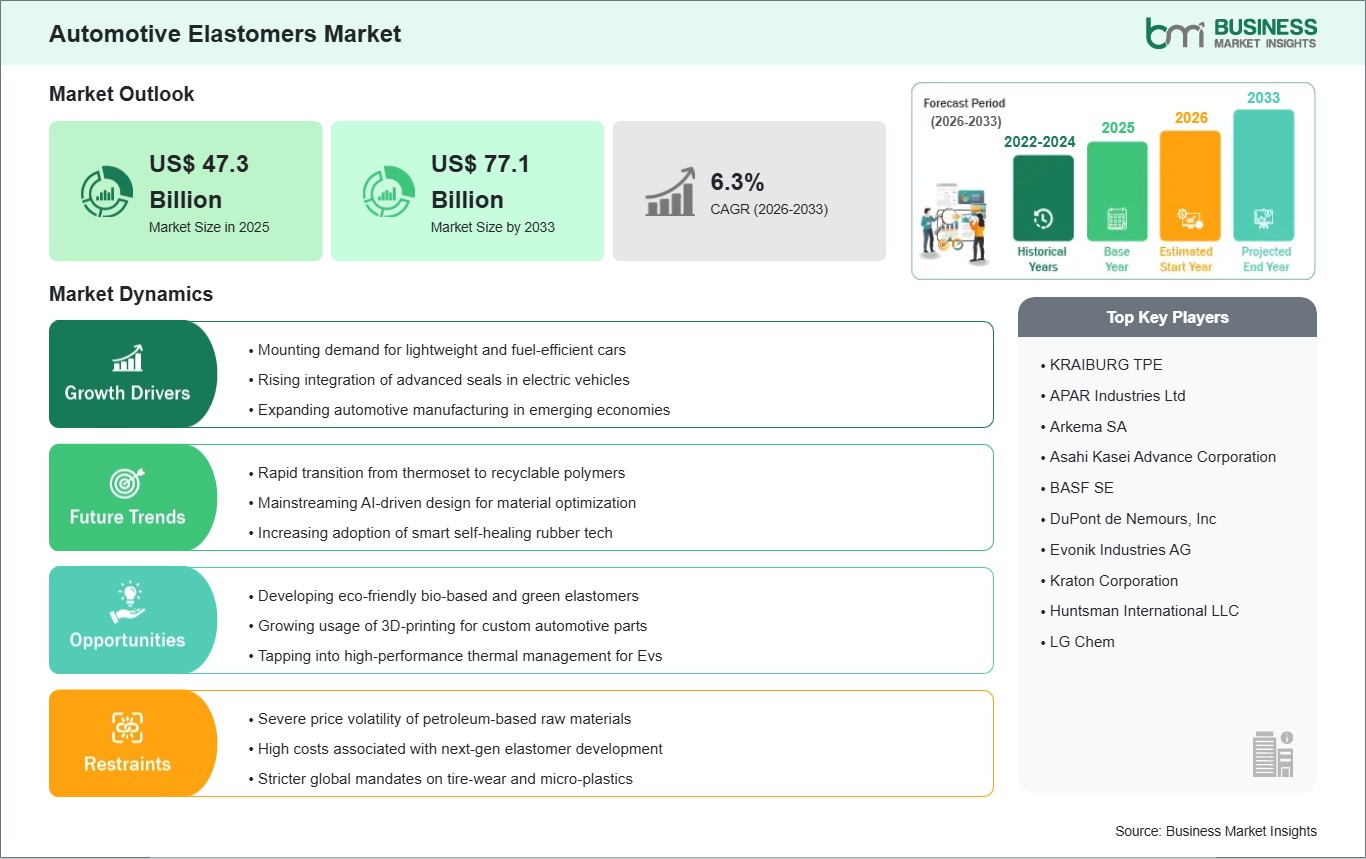
Automotive Elastomers are fundamental to the modern vehicle's architecture, providing the essential flexibility, sealing, and damping required for both safety and comfort. These high-performance polymers are critical for core sectors: Vehicle Assembly (Chassis & Body), Tire Manufacturing, Powertrain Systems, and the rapidly evolving EV Infrastructure. Automotive elastomers offer advantages including superior vibration isolation (NVH reduction), extreme thermal stability, and exceptional resistance to oils and chemicals. The market is fueled by the global transition toward vehicle lightweighting to enhance fuel efficiency, the surge in Electric Vehicle (EV) production, which requires specialized battery seals and thermal management materials, and the increasing consumer demand for refined interior aesthetics and cabin quietness.
However, several challenges restrain market growth: unpredictable price fluctuations of petroleum-derived monomers and natural rubber create significant margin pressures for manufacturers. Heightened environmental scrutiny regarding the end-of-life disposal of thermoset rubbers and strict regulations on volatile organic compound (VOC) emissions from interior components necessitate costly research and development. Furthermore, the industry faces constraints due to the technical difficulty of creating bio-based alternatives that can match the high-temperature performance of traditional synthetic rubbers. Despite these hurdles, opportunities arise driven by the breakthroughs in recyclable Thermoplastic Elastomers (TPEs), the integration of smart elastomers with sensing capabilities for autonomous driving systems, and the booming demand for EMI-shielding gaskets in electronic-heavy vehicle architectures. The shift toward "circular" automotive design is expected to open new avenues for market expansion.
Segment Analysis
Automotive Elastomers Market Segmentation
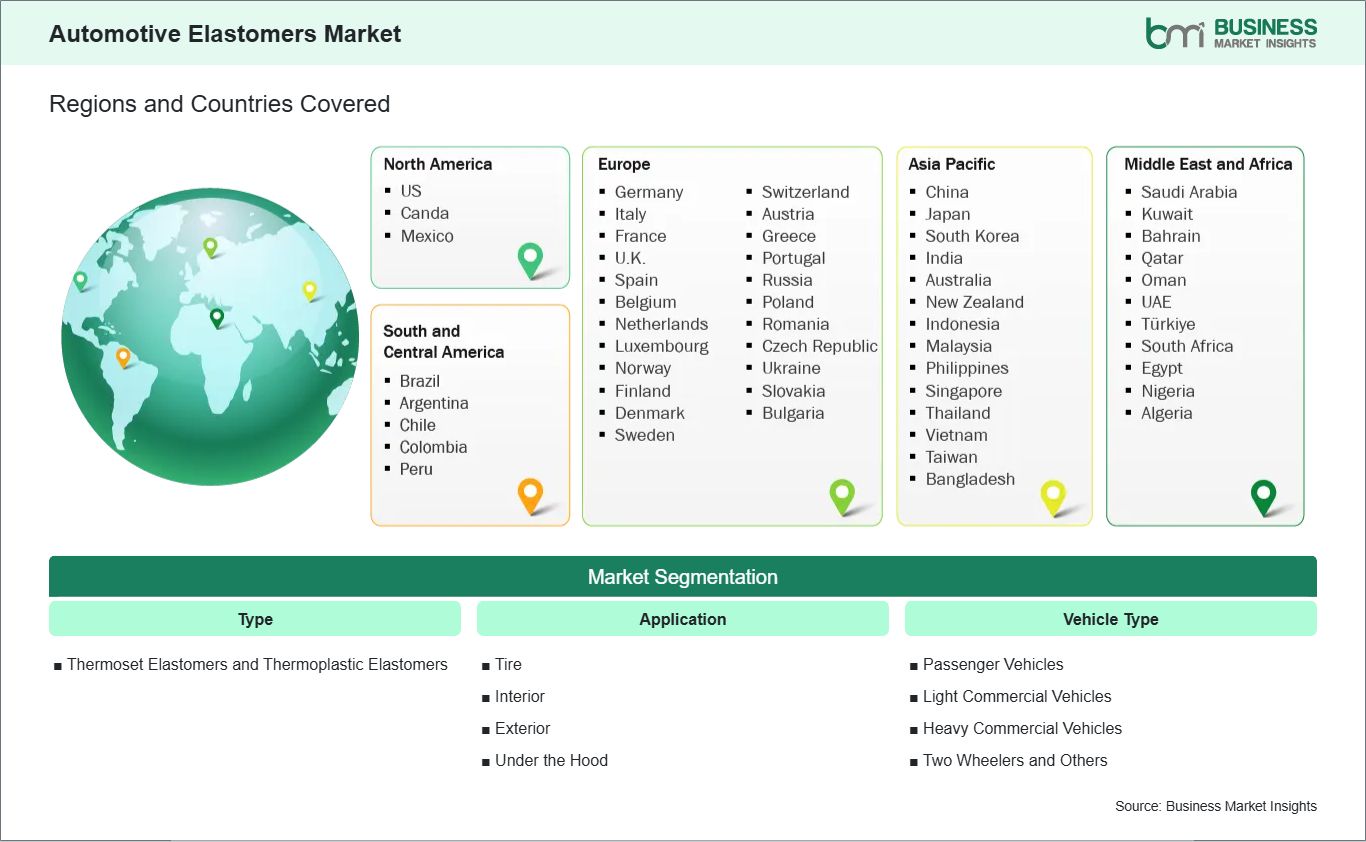
Key segments that contributed to the derivation of the Automotive Elastomers Market analysis are type, application, and vehicle type.
- By Type, the market is bifurcated into Thermoset Elastomers and Thermoplastic Elastomers (TPE). The Thermoset Elastomers segment is further divided into Natural Rubber (NR), Synthetic Rubber (SR), Styrene-Butadiene Rubber (SBR), Butyl Rubber (IIR), Polybutadiene Rubber (BR), Neoprene Rubber / Polychloroprene Rubber (CR), Nitrile Butadiene Rubber (NBR), and Others. The Thermoplastic Elastomers (TPE) segment is further categorized into Styrene Block Copolymer (SBC), Thermoplastic Polyurethane (TPU), Thermoplastic Polyolefins (TPO), Thermoplastic Vulcanizates (TPV), and Others.
- By Application, the market is segmented into Tire, Interior, Exterior, and Under the Hood.
The Interior segment is further divided into Hoses and Seals, Door Panels, Airbags, Conveyors and Transmission Belts, Dashboards, Seating, and Others.
The Exterior segment is further categorized into Front End Body Panel, Brakes and Suspensions, Bumper Fascia, and Others. The Under the Hood segment is further divided into Battery Casing, Hoses and Nozzles, and Others. - By Vehicle Type, the market is segmented into Passenger Vehicles, Light Commercial Vehicles, Heavy Commercial Vehicles, Two Wheelers, and Others.
Market Forces
Automotive Elastomers Market Drivers and Opportunities
Growing Demand for Lightweight Vehicle Components
The primary driver for the Automotive Elastomers Market is the intensive industry-wide shift toward vehicle lightweighting to meet increasingly strict global emission and fuel efficiency regulations. Automotive manufacturers are replacing traditional, heavier metal components with high-performance elastomers in various applications, including under-the-hood hoses, seals, and structural gaskets. These materials offer an exceptional strength-to-weight ratio and superior viscoelasticity, which not only reduces the overall mass of the vehicle but also significantly improves Noise, Vibration, and Harshness (NVH) performance. By enhancing passenger comfort and aiding in the reduction of carbon dioxide emissions, advanced elastomers have become a critical material choice for original equipment manufacturers (OEMs) striving to comply with environmental mandates such as the Corporate Average Fuel Economy (CAFE) standards and various regional carbon-neutral targets.
Emergence of Specialized E-Mobility Solutions
The rapid shift to electric vehicles and the growing need for high-performance, sustainable elastomers are creating major growth opportunities. Electric vehicles bring new engineering challenges, such as advanced thermal management and strong battery seals to prevent overheating. There is an increasing demand for specialized elastomers, such as fluorocarbons and silicone types, which can handle high heat and provide electrical insulation. As car makers focus more on environmental, social, and governance goals, there is also a rising interest in bio-based and recycled elastomers made from renewable sources or reused rubber. Creating materials that fit a circular economy and match the durability of traditional petroleum-based products helps manufacturers reach premium markets and support the move to zero-emission, eco-friendly transportation.
Size and Share Analysis
Automotive Elastomers Market Size and Share Analysis
The Automotive Elastomers Market demonstrates steady growth, with size and share analysis revealing evolving trends and competitive positioning among key players. The report further examines subsegments categorized within type, application, and vehicle type, offering insights into their contribution to overall market performance.
For instance, Styrene-Butadiene Rubber is a type of thermoset elastomer used in passenger vehicle tires. It is largely used due to its excellent abrasion resistance and traction, which are essential for meeting safety and durability standards in high-traffic consumer markets. Therefore, this subsegment is likely to hold a significant share of the overall market during the forecast period.
Report Coverage
Automotive Elastomers Market Report Coverage and Deliverables
The "Automotive Elastomers Market Size and Forecast (2022 - 2033)" report provides a detailed analysis of the market covering below areas:
- Automotive Elastomers Market size and forecast at global, regional, and country levels for all the key market segments covered under the scope
- Automotive Elastomers Market trends, as well as market dynamics such as drivers, restraints, and key opportunities
- Automotive Elastomers Market analysis covering key market trends, global and regional framework, major players, regulations, and recent market developments
- Industry landscape and competition analysis covering market concentration, heat map analysis, prominent players, and recent developments for the Automotive Elastomers Market
- Detailed company profiles, including SWOT analysis
Geographic Insights
Automotive Elastomers Market Geographic Insights
The geographical scope of the Automotive Elastomers Market report is divided into five regions: North America, Asia Pacific, Europe, the Middle East & Africa, and South & Central America.
The Asia-Pacific Automotive Elastomers Market is segmented into China, Japan, South Korea, India, Australia, New Zealand, Indonesia, Malaysia, the Philippines, Singapore, Thailand, Vietnam, Taiwan, Bangladesh, and the Rest of Asia.
The region's status drives the market as a global automotive manufacturing hub and the rapid shift toward Electric Vehicles (EVs). Growth in the region is dominantly fueled by the demand for lightweight materials to enhance fuel efficiency and EV range.
Industry Activity
Recent Developments
The Automotive Elastomers Market is evaluated by gathering qualitative and quantitative data post-primary and secondary research, which includes important corporate publications, association data, and databases. A few of the key developments in the Automotive Elastomers Market are:
- In November 2024, Prism Worldwide, a leader in innovative material solutions that is dedicated to advancing end-of-life tire recycling technology, announced it has raised US$ 40 million in Series A and Series A1 funds. This funding has enabled Prism to reach commercial viability, reflected in its initial sales and sales commitments for its thermoelastic polymers (TPEs). The development of these TPEs represents a breakthrough, marking the first successful creation of a sustainable, high?performance polymer derived from end?of?life tires by any company.
- In March 2024, Dow (NYSE: DOW) formulated a breakthrough option of polyolefin elastomers (POE) based artificial leather—a solution to address the automotive industry’s need to shift towards increasingly animal-free product alternatives to leather. The POE alternative leather option has been commercialized by HIUV Materials Technology, a China-based partner and qualified by an electric car manufacturer in their auto seating application.
Trust & Transparency
Research Methodology
The market analysis combines proprietary research with secondary data from government agencies, company disclosures, regulatory filings, industry databases and expert interviews. Market estimates are validated through data triangulation, cross-market benchmarking and analyst
review.
View Full Research Methodology
Key Sources Referred:
World Bank - Global Trade IndicatorsWorld Trade Organization (WTO)International Monetary Fund (IMF)International Trade Administration (ITA)Company WebsitesCompany Annual ReportsCompany Investor Presentations