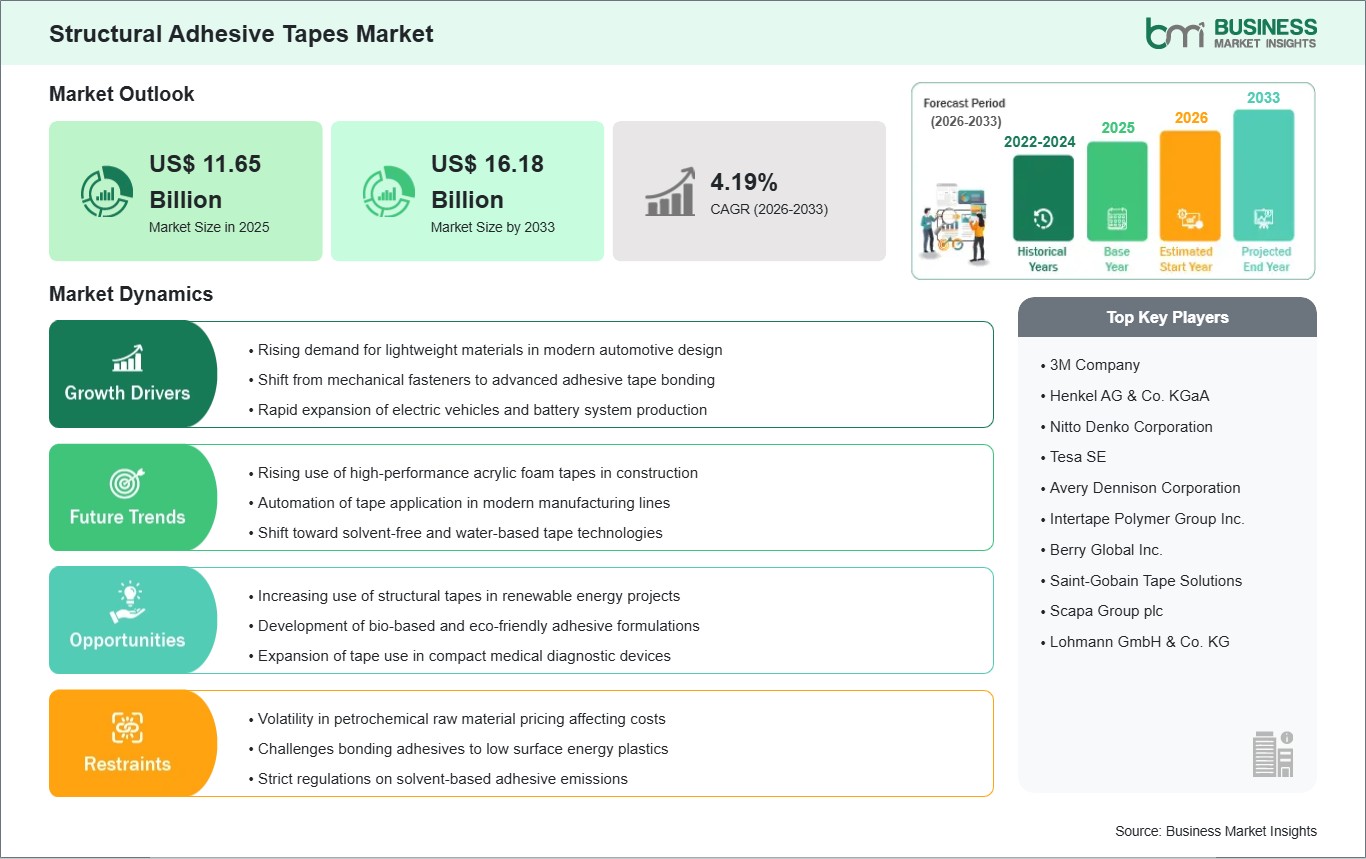
The Structural Adhesive Tapes Market size is expected to reach US$ 16.18 billion by 2033 from US$ 11.65 billion in 2025. The market is estimated to record a CAGR of 4.19% from 2026 to 2033.
The Global Structural Adhesive Tape Market is crucial to today's manufacturing by enabling high-strength and invisible bonds necessary for next generation product designs. As industries shift from traditional heavy-duty mechanical fasteners, structural tapes, especially double-sided acrylic foam types, have emerged as the primary option to join dissimilar materials in high-stress applications. While the expansion of the market is being driven largely by automotive manufacturers seeking to lighten their products, the miniaturization trend in electronics is also contributing to the continued growth of the market.
Besides superior bond strength, these structural tapes possess many other important functions such as dampening vibration, insulating thermal energy, and preventing corrosion, making them extremely flexible within complex and diverse manufacturing processes. An area of strategic innovation ongoing is the development of green adhesive chemistries, and integrating these tapes into automated and high-speed production lines. Due to constantly changing raw material costs, the risk of market disruption remains; however, the long-term cost of reduced time spent assembling components using structural adhesive tape, and creating lighter finished products will continue to drive adoption of this type of adhesive technology.
Currently, North America has the highest value of sales within the structural adhesive tape market largely due to its sophisticated aerospace and medical industries, but the Asia-Pacific region has been showing strong sales growth in volume. As we move forward, the integration of structural tapes into renewable energy infrastructure and the emergence of smart, conductive tapes for 5G applications are expected to be the primary catalysts for continued market evolution.

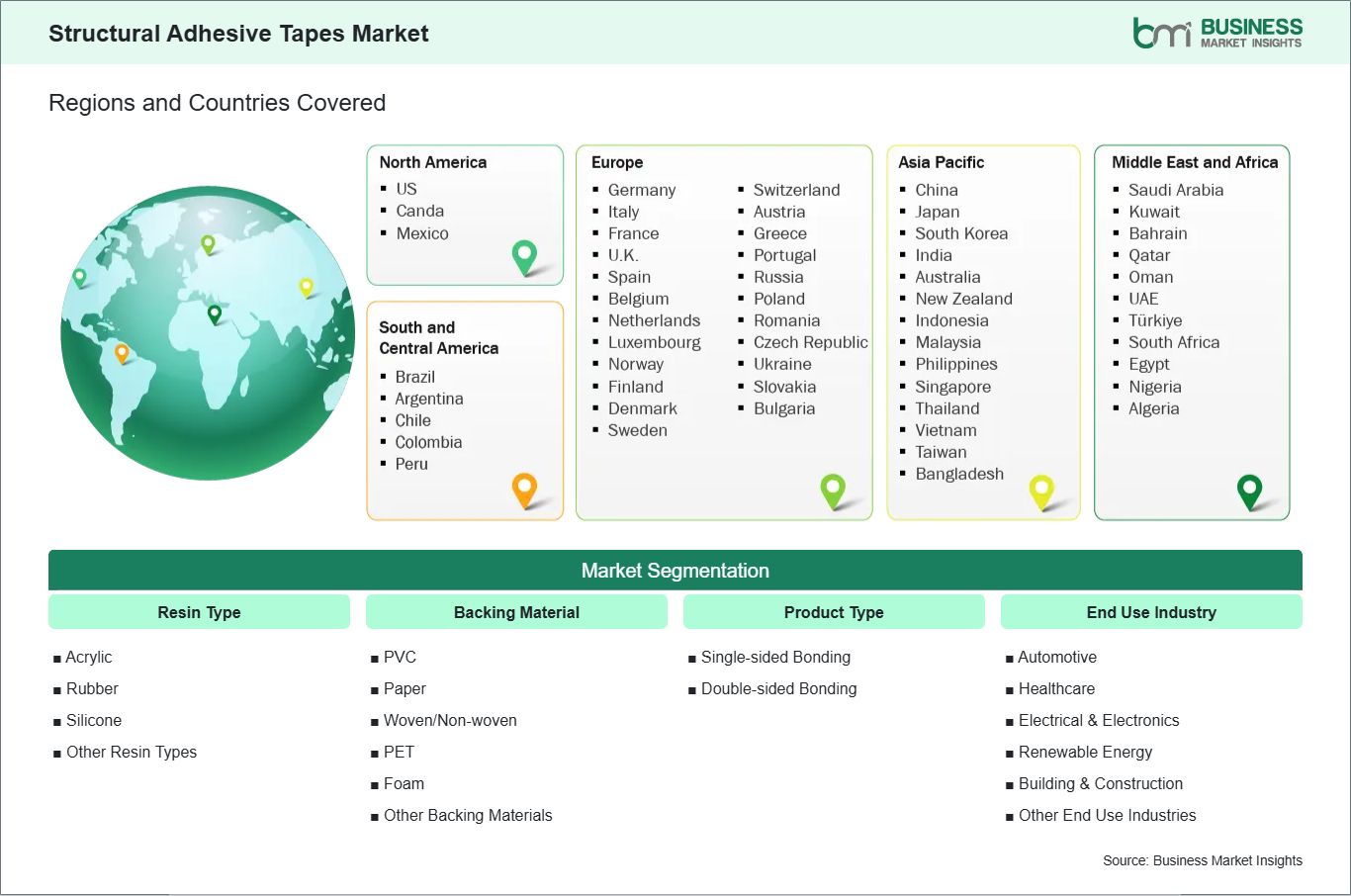
Key segments that contributed to the derivation of the Structural Adhesive Tapes market analysis are resin type, backing material, product type, and end use industry.
The most important driver in the structural adhesive tapes industry is the global trend towards "light weighting," which is particularly prevalent in the transportation industry. As fuel efficiency regulations become increasingly stringent and the move towards electric vehicles (EVs) gathers pace, the importance of reducing the overall weight of the vehicle's body and internal components has become paramount. In this respect, traditional fastening materials like bolts, screws, and rivets are extremely detrimental to the fuel efficiency of vehicles, since they tend to add substantial weight to the overall structure, while the drilling of holes to accommodate these fasteners compromises the integrity of thin-gauge materials. Structural adhesive tapes, on the other hand, offer an extremely sophisticated solution to this problem, since they enable the joining of thin-gauge materials like aluminum, carbon fiber, and high-strength composites.
Unlike traditional fastening materials, which impose point loads on the materials being joined, structural adhesive tapes impose even stress across the entire surface area, thus preventing stress concentrations that often cause cracks and failure in materials like aluminum and carbon fiber. The use of high-strength adhesive tapes enables manufacturers to employ materials with reduced gauges without compromising the integrity or stiffness of the overall structure. This weight reduction is especially critical in EVs, where every gram saved directly contributes to extending the driving range of the vehicle, making adhesive tapes an essential technology for the next generation of mobility.
Furthermore, the move toward light weighting is also driven by the aesthetic and aerodynamic requirements of modern industrial design. Adhesive tapes allow for completely smooth exterior surfaces, which reduces air drag and improves the visual appeal of consumer products and vehicles alike. The ability of these tapes to bond dissimilar materials—such as a plastic trim to a metal door—without the risk of galvanic corrosion or thermal expansion mismatch makes them the preferred choice for engineers. As industries continue to prioritize material efficiency, the role of structural tapes as a primary joining method will only continue to expand.
The transition to a sustainable energy grid presents a massive opportunity for the structural adhesive tapes market, specifically in the wind and solar power sectors. Solar panel manufacturing requires robust bonding solutions that can withstand 25 years of exposure to harsh UV radiation, rain, and extreme temperature cycles. Structural tapes are increasingly used to bond solar cells to their frames and to attach junction boxes, providing a permanent seal that prevents moisture ingress and electrical failure. Compared to traditional liquid adhesives, tapes offer faster processing times and no "cure-time" bottlenecks, significantly increasing factory throughput.
In the wind energy sector, structural tapes are finding critical use in the assembly of massive turbine blades and internal nacelle components. As wind turbines increase in size to capture more power, the mechanical loads on the blade structures become immense. Tapes are used for leading-edge protection and to bond internal stiffeners, where their ability to absorb vibrations and resist fatigue is vital for long-term reliability. The lightweight nature of adhesive tapes also helps in maintaining the balance and efficiency of the blades, which is a key factor in lowering the levelized cost of energy for wind farm operators.
Beyond the energy generation stage, the expansion of green energy infrastructure—including large-scale battery storage systems (BESS)—creates further demand. These storage units require high-strength bonding for thermal management components and structural housing. As government subsidies for renewable energy continue to rise in North America and Europe, the demand for high-performance, weather-resistant structural tapes is poised for substantial growth. Tape manufacturers who can provide specialized products with documented long-term durability in outdoor environments will have a significant competitive advantage in this high-value infrastructure segment.

The global Structural Adhesive Tapes market is experiencing steady growth, with market size and share analysis reflecting evolving treatment preferences and competitive dynamics among key players. The report evaluates important subsegments categorized within resin type, backing material, product type, and end use industry, highlighting their respective contributions to overall market performance.
By resin type, the Acrylic subsegment dominated the market in 2025 because its long-term stability and resistance to UV light and chemicals make it the most reliable choice for structural applications in both indoor and outdoor environments.
By backing material, the Foam subsegment dominated the market in 2025 due to its ability to distribute stress evenly across the bond line, which prevents material fatigue and allows for the secure mounting of heavy components in the automotive and construction sectors.
By product type, the Double-sided Bonding subsegment dominated the market in 2025 because it eliminates the need for drilling holes and using heavy bolts, which reduces overall assembly weight and protects the structural integrity of the bonded substrates.
By end use industry, the Automotive subsegment dominated the market in 2025 driven by the massive production volumes of electric vehicles, which utilize structural tapes extensively for battery pack assembly, interior trim, and the attachment of aerodynamic exterior parts.
| Report Attribute | Details |
|---|---|
| Market size in 2025 | US$ 11.65 Billion |
| Market Size by 2033 | US$ 16.18 Billion |
| Global CAGR (2026 - 2033) | 4.19% |
| Historical Data | 2022-2024 |
| Forecast period | 2026-2033 |
| Segments Covered | By Resin Type
|
|
Regions and Countries Covered
| |
| North America | US, Canada, Mexico |
| Europe | Belgium, Austria, Finland, Denmark, Greece, Poland, Romania, Russia, Ukraine, Czech Republic, Slovakia, Bulgaria, Italy, Luxembourg, Germany, Switzerland, France, Netherlands, Norway, Portugal, Spain, Sweden, United Kingdom |
| Asia-Pacific | Australia, China, India, Japan, South Korea, Indonesia, Malaysia, Philippines, Singapore, Thailand, Vietnam, Bangladesh, New Zealand, Taiwan |
| South and Central America | Brazil, Argentina, Peru, Chile, Colombia |
| Middle East and Africa | Bahrain, Kuwait, Oman, Qatar, Saudi Arabia, United Arab Emirates, Turkiye, South Africa, Egypt, Algeria, Nigeria |
| Market leaders and key company profiles |
|
The "Structural Adhesive Tapes Market Size and Forecast (2022 - 2033)" report provides a detailed analysis of the market covering below areas:
The geographical scope of the Structural Adhesive Tapes market report is divided into: North America, Asia Pacific, Europe, Middle East & Africa, and South & Central America. North America held the largest share in 2025.
North America maintained its position as the leading region in the Structural Adhesive Tapes Market in 2025, a status driven by its advanced manufacturing ecosystem and the high concentration of industry-leading innovators. The United States and Canada are home to many of the world`s most prominent aerospace, defense, and medical device companies, all of which require specialized, high-performance structural tapes that meet rigorous safety and performance certifications. The region`s leadership is further solidified by the rapid reshoring of high-tech manufacturing, particularly in the semiconductor and electric vehicle sectors, which has created a surge in localized demand for high-precision adhesive solutions.
The dominance of the North American market is also a reflection of its mature regulatory environment, which has successfully pushed the industry toward low-VOC and sustainable adhesive formulations. This focus on premium, environmentally compliant products allows North American manufacturers to capture a significant portion of the global market value. While other regions may produce higher volumes of standard industrial tapes, North America excels in the high-margin segment of "engineered" tapes tailored for extreme environments. Furthermore, a robust distribution network and a high number of specialized industrial integrators ensure that North American companies remain at the forefront of adhesive technology adoption and application expertise through the end of the decade.

The Structural Adhesive Tapes market is evaluated by gathering qualitative and quantitative data post primary and secondary research, which includes important corporate publications, association data, and databases. A few of the key developments in the Structural Adhesive Tapes market are:
The Structural Adhesive Tapes Market is valued at US$ 11.65 Billion in 2025, it is projected to reach US$ 16.18 Billion by 2033.
As per our report Structural Adhesive Tapes Market, the market size is valued at US$ 11.65 Billion in 2025, projecting it to reach US$ 16.18 Billion by 2033. This translates to a CAGR of approximately 4.19% during the forecast period.
The Structural Adhesive Tapes Market report typically cover these key segments-
The historic period, base year, and forecast period can vary slightly depending on the specific market research report. However, for the Structural Adhesive Tapes Market report:
The Structural Adhesive Tapes Market is populated by several key players, each contributing to its growth and innovation. Some of the major players include:
The Structural Adhesive Tapes Market report is valuable for diverse stakeholders, including:
Essentially, anyone involved in or considering involvement in the Structural Adhesive Tapes Market value chain can benefit from the information contained in a comprehensive market report.
Please tell us your area of interest
(Market Segments/ Regions and Countries/ Companies)