Market Summary
Executive Summary and Global Market Analysis
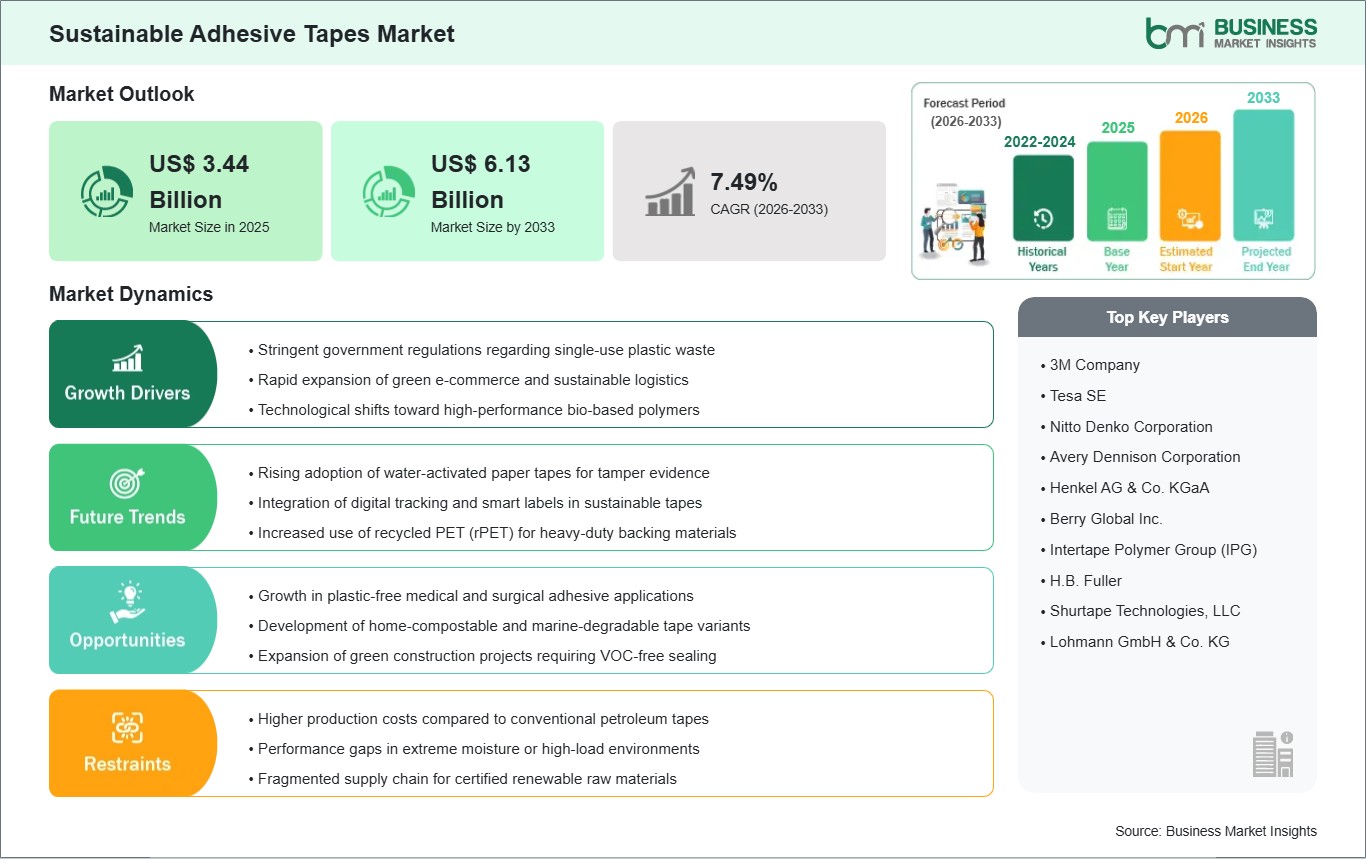
As the worldwide manufacturing industry transitions towards a more circular economy, the market for eco-friendly adhesive tapes is being rapidly transformed. The adhesive tape market forms a vital link for industries seeking to eliminate plastic waste and reduce their carbon footprint: these include sectors such as e-commerce and automotive. Sustainable adhesive tape products have previously been viewed as inferior or significantly more expensive compared with their non-eco-friendly counterparts; however, this view has been changed through technological advances in material science. The current dominant materials in the adhesive tape market are paper-based materials with an environmentally friendly water-based adhesive system that provides both mechanical strength and environmental compatibility needed by today`s high-speed, modern fully automated packaging lines.
The current drive in growth is being spurred by a mix of strong regulatory requirements and a shift in consumer attitude that supports brands with open sustainability policies. Although the largest consumer of the product remains the packaging industry, the development of electronics and healthcare applications has begun to diversify the streams of revenue for the product. In spite of the challenges posed by raw material costs and the technical challenges of providing moisture resistance in biopolymers, the product has seen a record level of investment in R&D. However, the future focus for manufacturers aiming to lead in this exciting space will undoubtedly be the inclusion of recycled content and the development of fully compostable options.
Segment Analysis
Sustainable Adhesive Tapes Market Segmentation
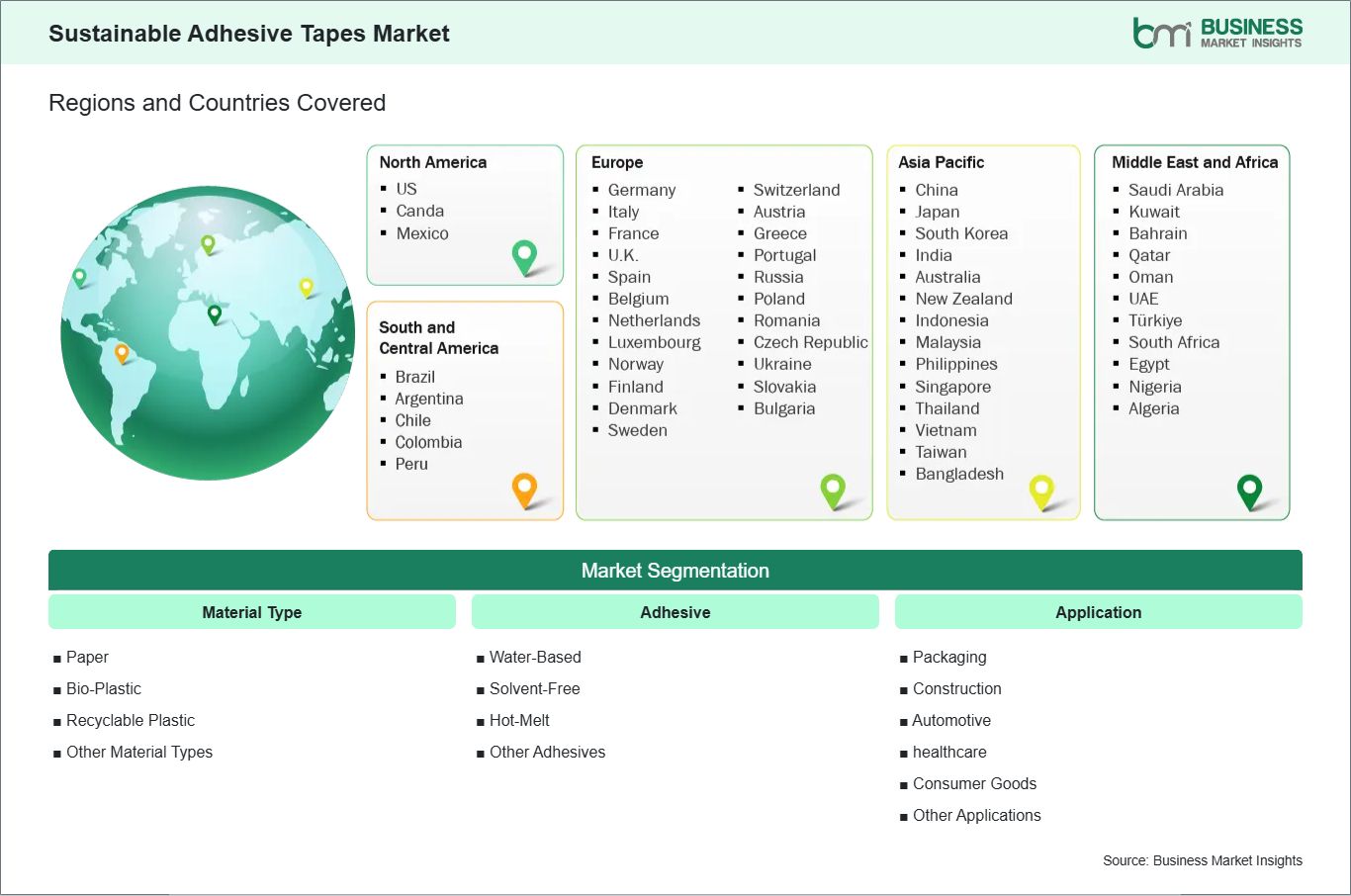
Key segments that contributed to the derivation of the Sustainable Adhesive Tapes market analysis are material type, adhesive, and application.
- By material type, the sustainable adhesive tapes market is segmented into Paper, Bio-Plastic, Recyclable Plastic, and Other Material Types. The Paper segment dominated the market.
- By adhesive, the sustainable adhesive tapes market is segmented into Water-Based, Solvent-Free, Hot-Melt, and Other Adhesives. The Water-Based segment dominated the market.
- By application, the sustainable adhesive tapes market is segmented into Packaging, Construction, Automotive, Healthcare, Consumer Goods, and Other Applications. The Packaging segment dominated the market.
Market Forces
Sustainable Adhesive Tapes Market Drivers and Opportunities
Stringent government regulations regarding single-use plastic waste
One of the most influential drivers for the sustainable adhesive tapes market is the tightening of global environmental legislation aimed at reducing plastic pollution. Regulatory bodies, particularly in Europe and North America, have introduced extended producer responsibility (EPR) schemes that penalize companies for using non-recyclable packaging components. These mandates are forcing manufacturers to reassess every element of their shipping materials, including adhesive tapes. As a result, there is a significant shift away from traditional polypropylene and PVC tapes toward paper-based or bio-plastic alternatives that comply with new circular economy directives. This regulatory push is not only reshaping packaging strategies but also accelerating innovation in sustainable adhesive technologies.
Additionally, many municipalities are implementing bans on specific plastic additives and non-biodegradable adhesives that contaminate recycling streams. Since adhesive tapes often remain attached to cardboard boxes during the pulping process, the demand for wash-off or recycling-compatible adhesives has surged. This regulatory pressure is more than just a compliance hurdle—it is fundamentally transforming the market landscape. Sustainable tapes are moving from a premium niche product to a standard requirement for companies engaged in international trade zones that prioritize environmental stewardship. As governments continue to strengthen waste reduction policies, the adoption of eco-friendly adhesive tapes is expected to grow rapidly, positioning them as a critical component of sustainable packaging solutions worldwide.
Growth in plastic-free medical and surgical adhesive applications
The healthcare sector presents a high-value opportunity for the expansion of sustainable adhesive tapes, specifically through the development of plastic-free and bio-compatible medical tapes. Traditional medical adhesives often rely on synthetic polymers that can cause skin irritation or contribute to hospital plastic waste. There is a growing clinical demand for tapes made from renewable fibers like bamboo or organic cotton, paired with hypoallergenic, bio-based adhesives. These products appeal to a dual need: improving patient comfort through breathability and reducing the environmental footprint of single-use medical consumables.
As hospitals and clinics globally implement Green Hospital initiatives, procurement departments are actively seeking biodegradable alternatives for wound care, surgical drapes, and wearable device fixation. This segment offers higher profit margins compared to high-volume packaging tapes because it requires specialized certifications and clinical validation. Companies that can engineer a sustainable tape that maintains high "initial tack" and "shear strength" in a sterile, moisture-rich medical environment will tap into a lucrative market. This evolution toward bio-medical adhesives is expected to redefine standards for patient-facing products over the coming years.
Size and Share Analysis
Sustainable Adhesive Tapes Market Size and Share Analysis
The global Sustainable Adhesive Tapes market is experiencing steady growth, with market size and share analysis reflecting evolving treatment preferences and competitive dynamics among key players. The report evaluates important subsegments categorized within material type, adhesive, and application, highlighting their respective contributions to overall market performance.
By material type, the Paper subsegment dominated the market because it is naturally biodegradable, easily recyclable within existing paper mill streams, and offers a low-carbon alternative to traditional plastic-backed tapes, making it the primary choice for eco-conscious shipping and retail brands.
By adhesive, the Water-Based subsegment dominated the market due to its low volatile organic compound (VOC) emissions and safer manufacturing profile, providing a sustainable bonding solution that meets strict environmental regulations while maintaining excellent clarity and aging resistance for long-term storage.
By application, the Packaging subsegment dominated the market as the global explosion of e-commerce necessitates massive volumes of carton sealing solutions, where brands are rapidly transitioning to sustainable tapes to meet corporate "zero-waste" goals and satisfy consumer demand for plastic-free deliveries.
Report Coverage
Sustainable Adhesive Tapes Market Report Coverage and Deliverables
The "Sustainable Adhesive Tapes Market Size and Forecast (2022 - 2033)" report provides a detailed analysis of the market covering below areas:
- Sustainable Adhesive Tapes market size and forecast at the regional and country levels for segments covered under the scope
- Sustainable Adhesive Tapes market trends, as well as drivers, restraints, and opportunities
- Sustainable Adhesive Tapes market analysis covering key trends, regional framework, major players, regulations, and recent developments
- Industry landscape and competition analysis covering market concentration, heat map analysis, prominent players, and recent developments for the Sustainable Adhesive Tapes market
- Detailed company profiles, including SWOT analysis
Geographic Insights
Sustainable Adhesive Tapes Market Geographic Insights
The geographical scope of the Sustainable Adhesive Tapes market report is divided into: North America, Asia Pacific, Europe, Middle East & Africa, and South & Central America. North America held the largest share in 2025.
North America maintains a leading position in the sustainable adhesive tapes market, a status anchored by its sophisticated logistics infrastructure and the headquarters of major global e-commerce and retail giants. The region`s dominance is underpinned by a robust domestic manufacturing base that has been quick to adopt Green Chemistry principles. In the United States and Canada, corporate sustainability pledges from Fortune 500 companies have acted as a primary catalyst, creating a massive, pre-existing demand for plastic-free sealing solutions. Additionally, the region's advanced waste management and recycling facilities are increasingly setting standards for tape-to-substrate compatibility, favoring paper-based and recyclable-plastic variants.
The North American market also benefits from a high concentration of material science innovators and chemical manufacturers who are pioneering solvent-free and bio-based adhesive technologies. While Europe leads in certain regulatory aspects, North America`s sheer volume of parcel shipments—driven by a mature online shopping culture—results in higher total consumption of sustainable tapes. Furthermore, the regional automotive and construction sectors are increasingly incorporating sustainable tapes for lightweighting and VOC reduction in building interiors. This cross-industry adoption, supported by significant R&D spending and a consumer base willing to pay a premium for eco-friendly products, ensures that North America remains the central hub for market growth and innovation.
Industry Activity
Recent Developments
The Sustainable Adhesive Tapes market is evaluated by gathering qualitative and quantitative data post primary and secondary research, which includes important corporate publications, association data, and databases. A few of the key developments in the Sustainable Adhesive Tapes market are:
- In March 2026, AJ Adhesives announced that it was reshaping its adhesive tape portfolio by incorporating higher recycled content into substrates and adhesive technologies. The company emphasized that corrugated board, flexible films, and paper labels now integrate sustainable adhesives to meet brand and regulatory demands for eco-friendly packaging.
- In September 2025, 3M Company announced that it had expanded its sustainable adhesive tape offerings by introducing new packaging tapes made with bio-based and recycled materials, targeting e-commerce and logistics industries seeking lower carbon footprint solutions.
- In July 2024, Tesa SE announced that it had launched a new line of ecoLogo adhesive tapes, manufactured with recycled PET backing and solvent-free adhesives, designed for carton sealing and industrial packaging applications.
Trust & Transparency
Research Methodology
The market analysis combines proprietary research with secondary data from government agencies, company disclosures, regulatory filings, industry databases and expert interviews. Market estimates are validated through data triangulation, cross-market benchmarking and analyst
review.
View Full Research Methodology
Key Sources Referred:
Pressure Sensitive Tape Council (PSTC, USA) Adhesive and Sealant Council (ASC, USA) European Adhesive Tape Association (Afera) China Adhesives and Tape Industry Association (CATIA) Japan Adhesive Industry Association (JAIA) Indian Adhesives and Sealants Manufacturers Association (IASMA) Company Websites Company Annual Reports Company Investor Presentations