Market Summary
Executive Summary and Global Market Analysis
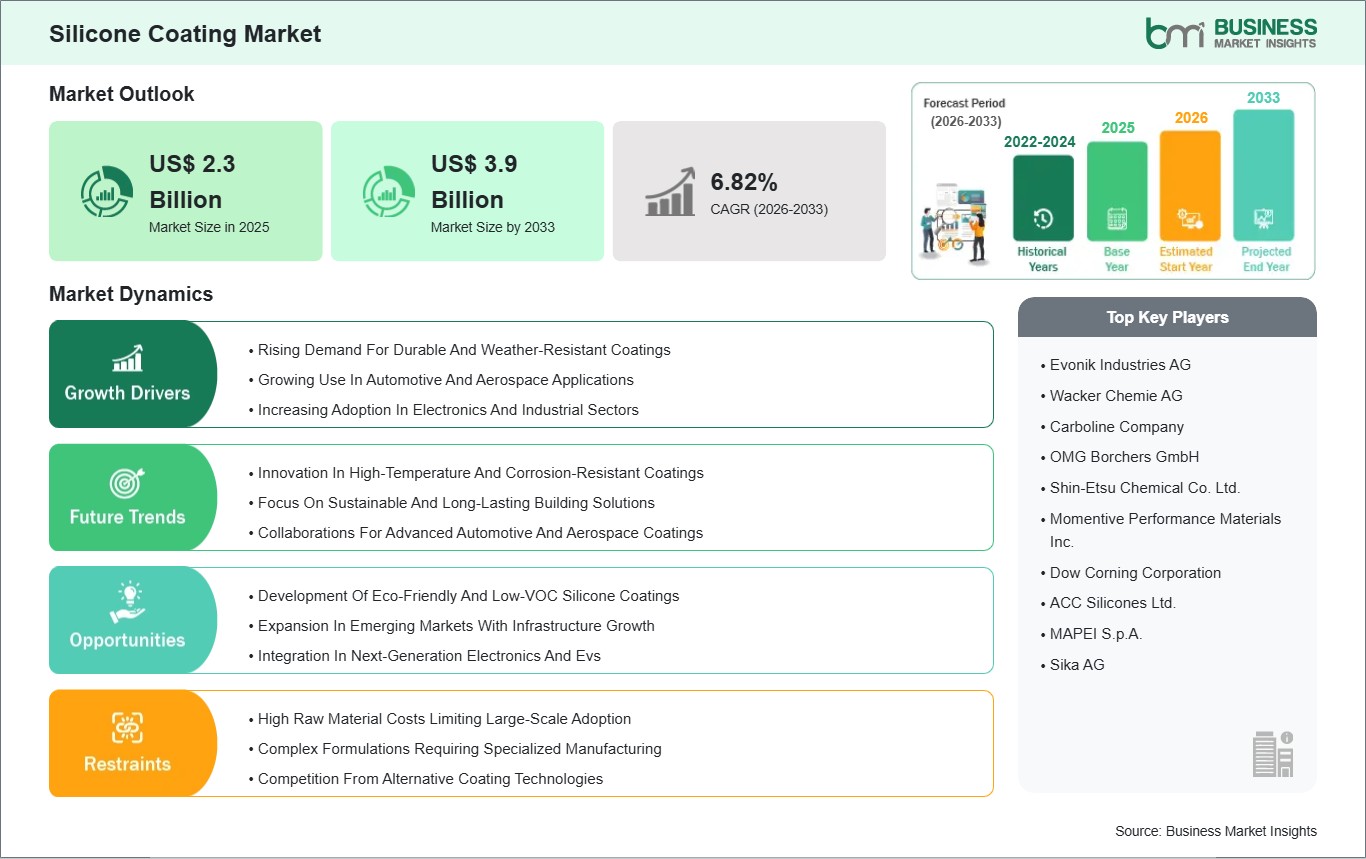
The global silicone coating market is experiencing growth because businesses are starting to use advanced surface protection products that provide long-lasting weatherproofing and outstanding heat and chemical resistance. Silicone coatings show high adaptability and common application in construction and automotive and electronics and aerospace and marine and textiles and industrial equipment industries because they possess heat resistance and flexibility and UV protection and hydrophobicity and extended operational life. The essentiality of silicone coatings as a material exists because they provide broad applications to situations which require optimal surface performance and extended material durability. The construction and infrastructure sector shows strong demand for international markets because its durability requirements and low maintenance costs function as key business goals. The application of silicone coatings takes place on roofs and façades and bridges and concrete structures to improve weather resistance and safeguard against water damage and temperature changes and environmental damage.
The performance of silicone coatings in extreme climate regions with high UV exposure and major temperature changes stays superior to traditional solutions because they keep their ability to stretch and stick for extended time periods. The automotive and aerospace industries drive market expansion through their application of silicone coatings which provide thermal management and corrosion protection and sealing capabilities. In automotive manufacturing, silicone‑based paints and protective layers improve vehicle appearance, protect against road chemicals, and enhance longevity.
In aerospace operations, silicone coatings function as protective elements for airframe and engine and cabin interior applications because their lightweight and heat-resistant attributes enhance both performance and safety. The use of silicone coatings has grown in electronics and electrical equipment applications because these coatings protect against moisture and provide dielectric stability and thermal insulation. The global demand for protective coatings has increased because smart devices and wearable electronics and outdoor sensors have become more common.
The market experiences strong growth drivers but faces two main restraints because raw material costs and formulation complexities hinder market expansion. The production of silicone products requires special precursor materials and processing methods that lead to higher costs than conventional coating systems. The development of adhesion and curing properties across different substrates needs precise formulation skills, which creates difficulties for smaller coating companies.
The global silicone coating market benefits from three trends: the demand for high-performance materials and sustainable products and the need to reduce lifecycle costs. This development makes silicone coatings the most suitable solution for protecting surfaces in challenging industrial applications around the world.
Segment Analysis
Silicone Coating Market Segmentation
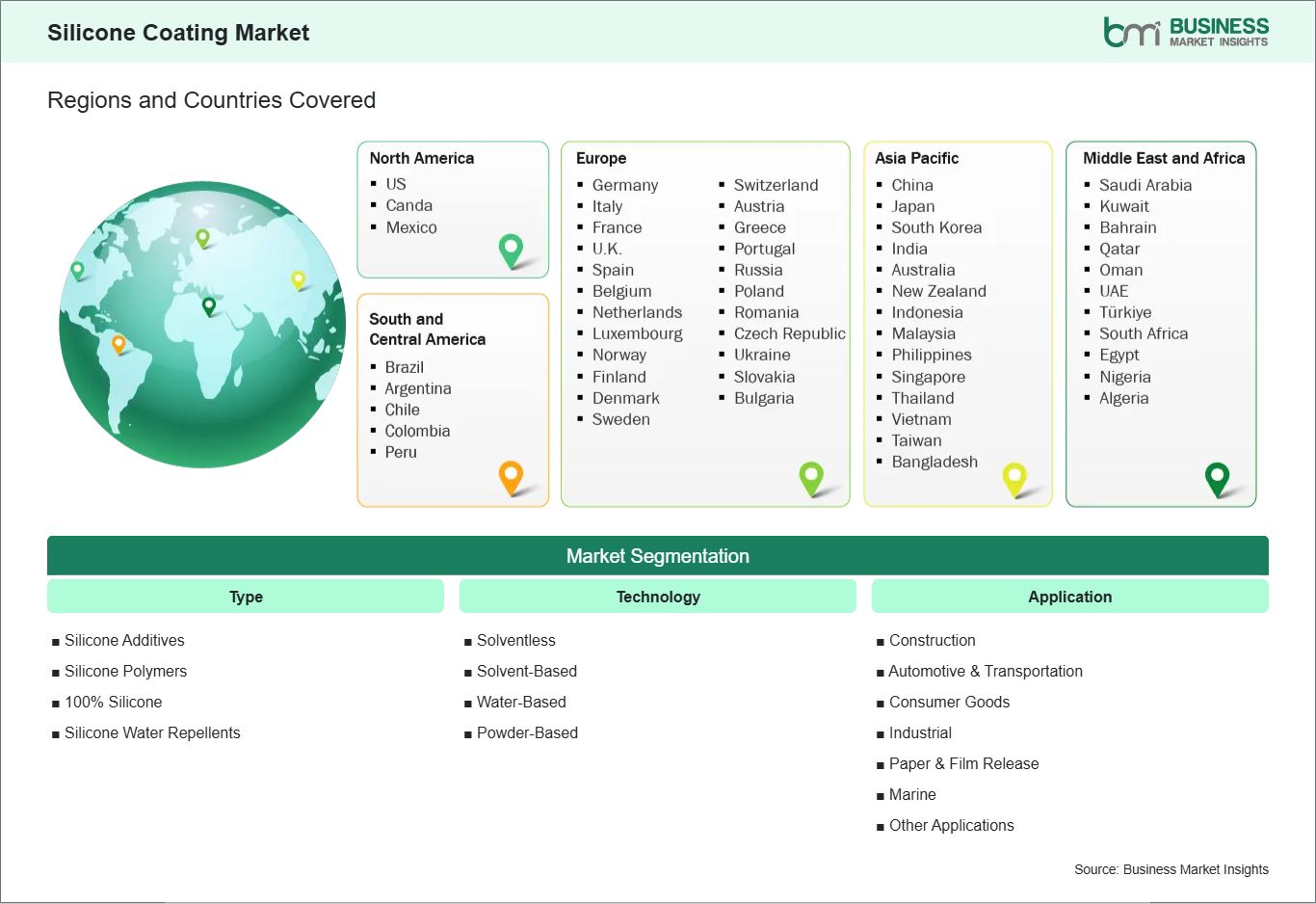
Key segments that contributed to the derivation of the silicone coating market analysis are type, technology and application.
- By type, the silicone coating market is segmented into silicone additives, silicone polymers, 100% silicone, and silicone water repellents. The 100% silicone segment dominated the market in 2025.
- Based on technology, the silicone coating market is categorized into solventless, solvent‑based, water‑based, and powder‑based. The solventless segment dominated the market in 2025.
- In terms of application, the silicone coating market is categorized into construction, automotive & transportation, consumer goods, industrial, paper & film release, marine, and other applications. The construction segment dominated the market in 2025.
Market Forces
Silicone Coating Market Drivers and Opportunities
Rising Demand For Durable And Weather‑Resistant Coatings
The global silicone coating market is strongly driven by the growing requirement for durable and weather‑resistant surface protection across industries exposed to harsh environmental conditions. Construction, infrastructure, and industrial maintenance projects select silicone coatings because these materials provide protection against ultraviolet radiation and temperature fluctuations and water penetration and chemical substances. Architects and facility managers in North America and the Middle East select silicone coatings for roofs and façades and structural elements to improve building durability and lower future maintenance expenses in regions that experience severe weather.
This trend is particularly evident in large commercial and institutional projects where lifecycle cost savings are prioritized over initial material costs. The automotive and aerospace industries require materials which can endure high velocities and temperature variations and exposure to corrosive substances driving the increased use of silicone coatings. European and North American OEMs and tier-1 suppliers use silicone-based protective coatings on engine components and underbody parts and exterior components to extend their operational lifespan. The durable coatings protect against road salts and fuel residues and thermal stress which serve as essential elements for everyday performance and extended distance use. Industrial manufacturers also benefit from the weather‑resistant properties of silicone coatings in equipment subject to outdoor exposure or corrosive service environments, such as marine platforms and power generation facilities.
Development Of Eco‑Friendly And Low‑VOC Silicone Coatings
The silicone coating market experiences heightened demand for environmentally friendly products which contain minimal volatile organic compounds because environmental regulations and sustainability standards become more important worldwide. Manufacturers in North America and Europe now reformulate traditional silicone coatings because stricter building codes and product standards require them to decrease VOC emissions during the product application process and the curing process. The low-VOC alternatives maintain equivalent performance levels which include UV resistance and flexibility and adhesion properties while complying with green building standards and indoor air quality regulations.
Architectural projects require this shift because building occupants need to stay healthy while construction materials must meet environmental regulations. Local chemical formulators dedicate their research resources toward creating silicone coatings which achieve environmental compliance while maintaining product durability to meet new green standard requirements. Silicone coatings now achieve superior weather resistance and product durability because scientists developed new binder technologies and cross-linking systems which enable them to decrease their VOC emissions. The technical advancement enables more companies to implement their solutions across transport systems industrial machinery and construction development projects because these industries need to assess their environmental effects and total operational expenses.
Size and Share Analysis
Silicone Coating Market Size and Share Analysis
The silicone coating market demonstrates steady growth, with size and share analysis highlighting evolving trends and competitive dynamics among key players. The report examines subsegments categorized within type, technology and application, offering insights into their contribution to overall market performance.
By type, the 100% silicone subsegment dominated the market in 2025, driven by its superior durability, weather resistance, and high-performance properties across multiple end-use applications.
Based on technology, the solventless subsegment dominated the market in 2025, driven by increasing demand for environmentally friendly, low-VOC, and high-efficiency coating technologies.
In terms of application, the construction subsegment dominated the market in 2025, driven by growing adoption of silicone coatings for building exteriors, roofing, and protective surfaces.
Report Coverage
Silicone Coating Market Report Coverage and Deliverables
The "Silicone Coating Market Size and Forecast (2022 - 2033)" report provides a detailed analysis of the market covering below areas:
- Silicone Coating Market size and forecast at global, regional, and country levels for all the key market segments covered under the scope
- Silicone Coating Market trends, as well as drivers, restraints, and opportunities
- Silicone Coating Market analysis covering key trends, global and regional framework, major players, regulations, and recent developments
- Industry landscape and competition analysis covering market concentration, heat map analysis, prominent players, and recent developments for the Silicone Coating Market
- Detailed company profiles, including SWOT analysis
Geographic Insights
Silicone Coating Market Geographic Insights
The geographical scope of the Silicone Coating Market report is divided into North America, Asia Pacific, Europe, Middle East & Africa, and South & Central America. North America held the largest share in 2025.
North America leads the global silicone coating market because its industrial facilities meet advanced sector requirements and establish performance benchmarks while using modern materials in essential industrial applications. The construction sector in the United States and Canada drives demand for weatherproof and energy-saving coatings which developers use in their commercial and institutional and infrastructure projects. The automotive and aerospace industries in North America drive silicone coating usage because companies use the coatings to create thermal shields and anti-corrosion protection and exterior surfaces which enhance product efficiency while decreasing upkeep expenses. The electronics and semiconductor industries in the region depend on silicone coatings to provide protective covering and moisture protection for their equipment used in extreme environments.
The Asia Pacific region experiences its fastest market growth because industrial and urban development in China and India and Japan and South Korea raise demand for silicone coatings used in construction and automotive and industrial sectors. The region shows high adoption rates because of its substantial infrastructure upgrades and increased production capacity and growing consumer electronics manufacturing.
Europe experiences continuous market expansion which Germany and France and the UK drive through their increasing use of silicone coatings in environmentally friendly building projects and sustainable industrial coatings and advanced automotive technologies. European environmental and building regulations require products to meet low-VOC standards which directly impact consumer preferences and product development.
The Middle East and Africa market experiences growth because oil and gas industries and marine operations and infrastructure projects create demand for coatings that protect against severe weather conditions and high-temperature environments and corrosive materials.
The South and Central American market develops at a steady pace because Brazil and Mexico lead the market through their increasing construction activities and automotive production and industrial maintenance needs.
The worldwide demand for silicone coatings stems from the requirement for coatings that provide better durability and lower maintenance expenses and comply with environmental regulations while different industrial development levels and regulatory systems determine how companies adopt these technologies and expand their operations.
Industry Activity
Recent Developments
The Silicone Coating Market is evaluated by gathering qualitative and quantitative data post primary and secondary research, which includes important corporate publications, association data, and databases. A few of the key developments in the silicone coating market are:
- In June 2025, Evonik Coating Additives announced that it launched TEGO Foamex 8051, a new highly efficient siloxane defoamer designed for use in waterborne decorative and industrial coatings, offering strong defoaming performance and low VOC/SVOC content to support high‑performance and environmentally compliant formulations.
- In January 2025, Wacker Chemie AG announced that it expanded production capacity for specialty silicone products in Japan and South Korea by starting up new facilities to meet growing demand for silicone‑based materials used in automotive, construction, and electronics sectors, strengthening its global manufacturing footprint.
Trust & Transparency
Research Methodology
The market analysis combines proprietary research with secondary data from government agencies, company disclosures, regulatory filings, industry databases and expert interviews. Market estimates are validated through data triangulation, cross-market benchmarking and analyst
review.
View Full Research Methodology
Key Sources Referred:
World Health Organization (WHO) Organisation for Economic Cooperation and Development (OECD) The World Bank Group Worldometer The Lancet International Bar Association International Trade Administration