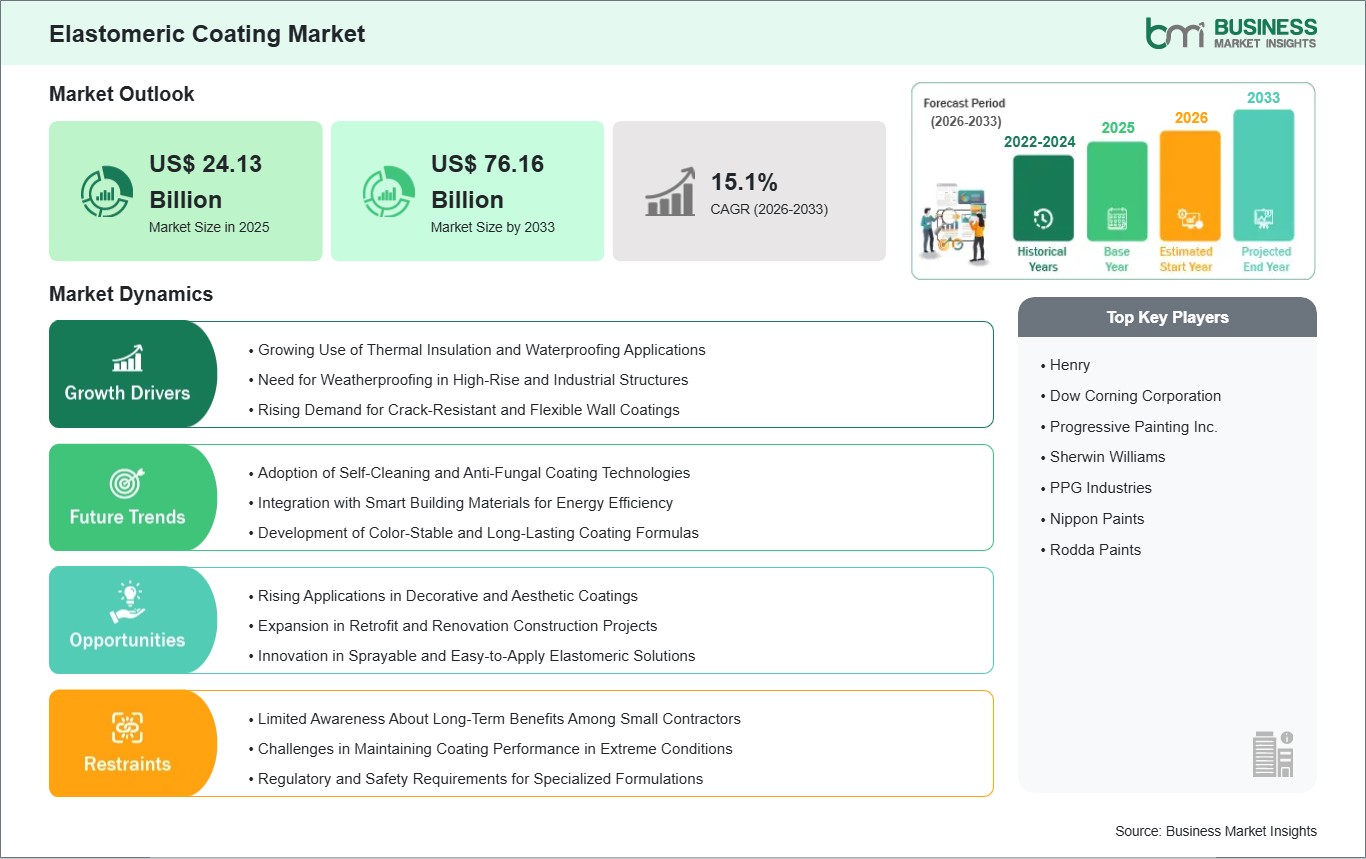
The Elastomeric Coating Market size is expected to reach US$ 76.16 Billion by 2033 from US$ 24.13 Billion in 2025 .The market is estimated to record a CAGR of 15.1% from 2026 to 2033.
The global elastomeric coating market can be said to have evolved as a significant part of the protective coatings industry, owing to its potential to provide flexibility, water resistance, and durability. These coatings have been specifically formulated to extend and contract with the substrate, thus providing protection from crack formation, water infiltration, and exposure to high temperatures. These characteristics make these coatings perfect for roofing, facades, and infrastructure projects, as long-term performance and reduction of maintenance activities are critical. The market is expected to grow owing to the increasing rate of construction activities, along with the focus on energy efficiency and the need to extend the lifespan of structures with minimum repair costs. Besides their durability, elastomeric coatings are increasingly being recognized for their reflective capabilities, which are beneficial for energy conservation. However, the use of elastomeric coatings is limited by certain factors, such as complexity in application, susceptibility to environmental factors during curing, and higher costs of application in comparison to other coatings. In addition, differences in substrate suitability and labor costs for proper application are limiting factors in certain markets. Nevertheless, progress in polymer science, the introduction of eco-friendly products, and increased focus on green building materials are driving the growth of elastomeric coatings in a positive direction.

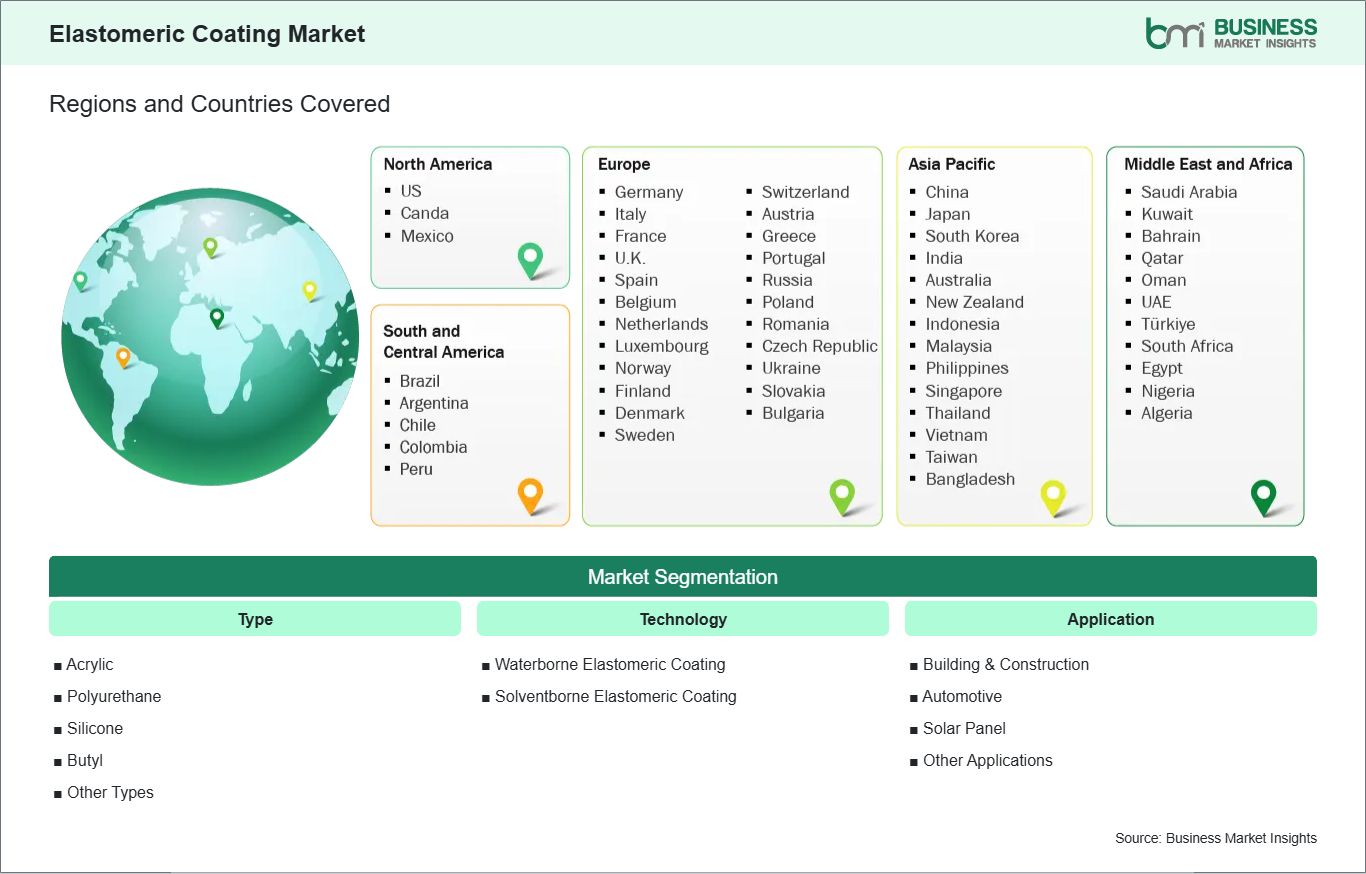
Key segments that contributed to the derivation of the elastomeric coating market analysis are type, technology, and application.
Elastomeric coatings are increasingly being used for thermal insulation and waterproofing due to the fact that they possess the ability to be elastic and weather-resistant. These coatings are different from other coatings such as paints and sealants since they can stretch and return to their original form, thereby filling the cracks and ensuring that water does not pass through them. This has ensured that they are used for various applications, especially on the external envelopes of structures and on roofs.
Energy efficiency is a key factor driving adoption. Elastomeric coatings can reduce heat transfer through walls and roofs, helping buildings maintain stable indoor temperatures without heavy reliance on heating or cooling systems. Facility managers and building owners are recognizing the long-term savings associated with coating surfaces that provide both insulation and waterproofing, creating steady demand for these products.
Additionally, durability and reduction of maintenance are other key factors. Elastomeric coatings provide protection to structural surfaces from moisture, UV damage, and thermal stress. They are effective in extending the lifespan of concrete, metal, or masonry surfaces. Their ability to provide a continuous layer without joints and to bond well to different surfaces is a guarantee for durability, thus promoting their use on a global scale in different sectors.
Beyond performance, elastomeric coatings are gaining attention for their decorative potential. New formulations now allow architects and designers to apply coatings with vibrant colors, custom textures, and patterned finishes, transforming plain surfaces into visually engaging facades. The combination of aesthetic appeal and functional protection opens opportunities in residential, commercial, and public spaces where visual design is as important as performance.
The market is also fueled by the rising demand for low-maintenance finishes. Elastomeric coatings are resistant to fading, chalking, and staining while retaining color intensity. This makes them ideal for applications where beautiful color lasts. Today, designers can offer their clients beautiful finishes that are durable and retain their color intensity for years without the need for constant repainting and retouching.
Eco-friendly and specialty coatings are also another area where innovation in elastomeric coatings could provide new opportunities for growth. Water-based elastomeric coatings, reflective coatings, and textured finishes are ideal for sustainable building applications. Today, buildings are required to meet stringent requirements for both aesthetics and sustainability. Elastomeric coatings are likely to find new opportunities in construction and renovation applications worldwide.

The elastomeric coating market is experiencing steady growth, with market size and share analysis reflecting evolving treatment preferences and competitive dynamics among key players. The report evaluates important subsegments categorized within type, technology, and application, highlighting their respective contributions to overall market performance.
By type, the Acrylic subsegment dominated the Elastomeric Coating market in 2025. Acrylic elastomeric coatings offer excellent flexibility, weather resistance, and durability, making them highly suitable for protective and decorative applications, which drives their widespread adoption.
Based on technology, the Waterborne Elastomeric Coating subsegment dominated the Elastomeric Coating market in 2025. Waterborne coatings provide low VOC emissions, easy application, and environmental compliance, making them ideal for sustainable coating solutions and supporting strong market demand.
In terms of application, the Wall Coatings subsegment dominated the Elastomeric Coating market in 2025. Wall coatings benefit from elastomeric coatings’ superior adhesion, crack-bridging capabilities, and long-term protection, reinforcing the dominance of this segment.
| Report Attribute | Details |
|---|---|
| Market size in 2025 | US$ 24.13 Billion |
| Market Size by 2033 | US$ 76.16 Billion |
| Global CAGR (2026 - 2033) | 15.1% |
| Historical Data | 2022-2024 |
| Forecast period | 2026-2033 |
| Segments Covered | By Type
|
|
Regions and Countries Covered
| |
| North America | US, Canada, Mexico |
| Europe | Belgium, Austria, Finland, Denmark, Greece, Poland, Romania, Russia, Ukraine, Czech Republic, Slovakia, Bulgaria, Italy, Luxembourg, Germany, Switzerland, France, Netherlands, Norway, Portugal, Spain, Sweden, United Kingdom |
| Asia-Pacific | Australia, China, India, Japan, South Korea, Indonesia, Malaysia, Philippines, Singapore, Thailand, Vietnam, Bangladesh, New Zealand, Taiwan |
| South and Central America | Brazil, Argentina, Peru, Chile, Colombia |
| Middle East and Africa | Bahrain, Kuwait, Oman, Qatar, Saudi Arabia, United Arab Emirates, Turkiye, South Africa, Egypt, Algeria, Nigeria |
| Market leaders and key company profiles |
|
The "Elastomeric Coating Market Size and Forecast (2022 - 2033)" report provides a detailed analysis of the market covering below areas:
The geographical scope of the Elastomeric Coating market report is divided into five regions: North America, Asia Pacific, Europe, Middle East & Africa, and South & Central America. The Elastomeric Coating market in North America is expected to grow during the forecast period.
North America has the highest share of the elastomeric coating market, owing to the mature construction industry, high infrastructure investments, and proactive approach towards the adoption of high-performance protective coatings. In the North American region, elastomeric coatings have been used extensively in commercial, residential, and industrial sectors, especially in regions where temperature variations, UV rays, and moisture are potential hazards. Roofing and facades are the prominent sectors of the elastomeric coating market, as the coating provides protection against water, temperature-related damage, and efficiency. One of the defining characteristics of the North American market is the emphasis on innovation in formulation, focusing on the properties of high reflectivity, chemical resistance, and longer lifespan. There is active collaboration between the manufacturers and architects/building contractors in the region to ensure the best possible coating properties in the given environmental and building conditions. Furthermore, the sustainability and certification requirements in the North American market are driving the demand for low-VOC and environmentally friendly elastomeric coatings, thus contributing to the overall market size in the region. The challenges in the North American market are related to the costs and application complexities of the coatings, as they require skilled labor and environmental conditions to achieve uniform coverage and curing properties. However, the focus on durability, energy savings, and regulatory compliance in the North American market cements the position of the elastomeric coatings market in this region as the global benchmark and sets the trends for the rest of the world to follow.

The elastomeric coating market is evaluated by gathering qualitative and quantitative data post primary and secondary research, which includes important corporate publications, association data, and databases. A few of the key developments in the elastomeric coating market are:
The Elastomeric Coating Market is valued at US$ 24.13 Billion in 2025, it is projected to reach US$ 76.16 Billion by 2033.
As per our report Elastomeric Coating Market, the market size is valued at US$ 24.13 Billion in 2025, projecting it to reach US$ 76.16 Billion by 2033. This translates to a CAGR of approximately 15.1% during the forecast period.
The Elastomeric Coating Market report typically cover these key segments-
The historic period, base year, and forecast period can vary slightly depending on the specific market research report. However, for the Elastomeric Coating Market report:
The Elastomeric Coating Market is populated by several key players, each contributing to its growth and innovation. Some of the major players include:
The Elastomeric Coating Market report is valuable for diverse stakeholders, including:
Essentially, anyone involved in or considering involvement in the Elastomeric Coating Market value chain can benefit from the information contained in a comprehensive market report.
Please tell us your area of interest
(Market Segments/ Regions and Countries/ Companies)