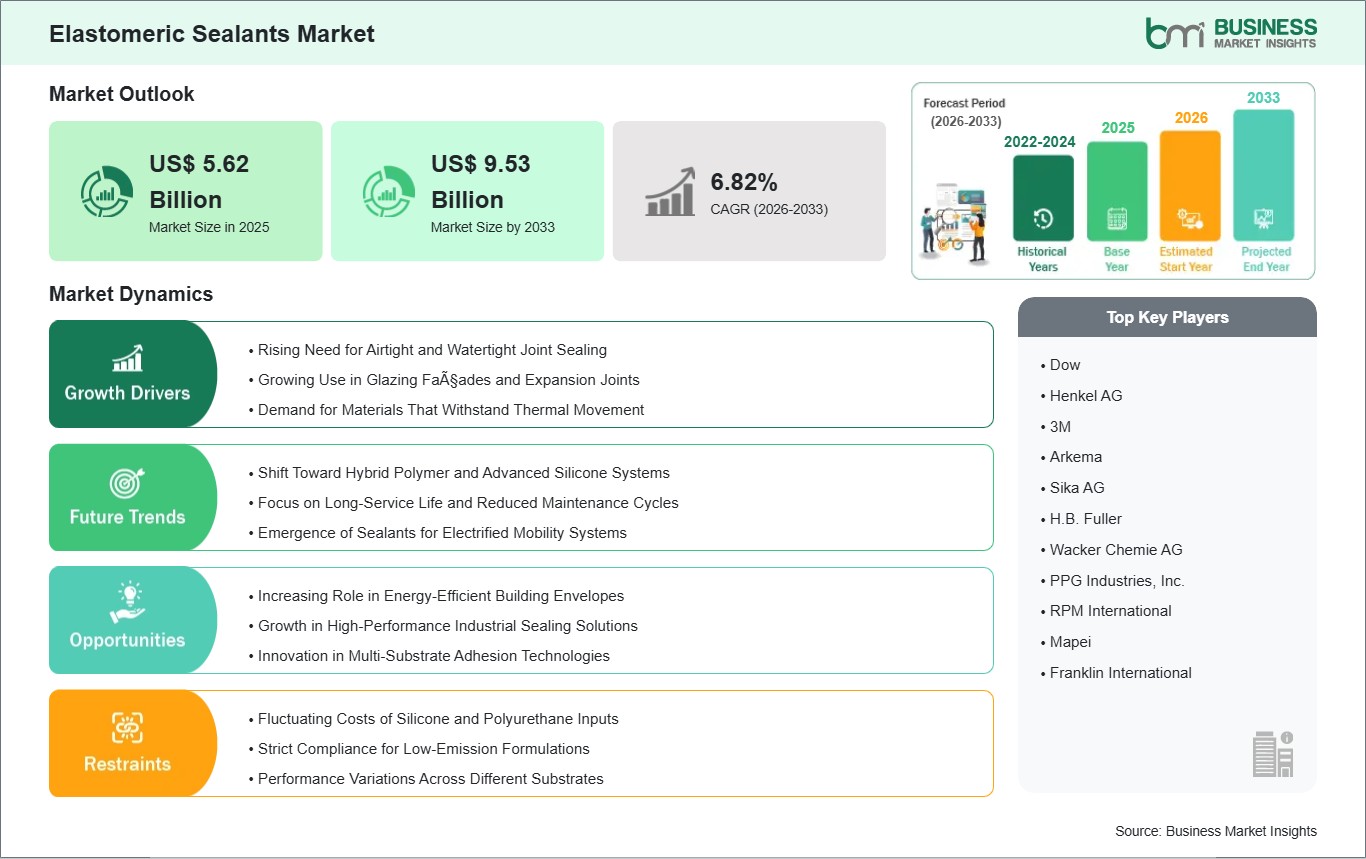
The Elastomeric Sealants Market size is expected to reach US$ 9.53 Billion by 2033 from US$ 5.62 Billion in 2025. The market is estimated to record a CAGR of 6.82% from 2026 to 2033.
The global elastomeric sealants market plays an integral role in contemporary construction and assembly, providing flexible sealing options that are resistant to movement, pressure, and environmental conditions. Elastomeric sealants are used in various applications, including expansion joints, glazing, prefabricated structures, and transportation equipment, where it is critical to maintain airtight and watertight conditions over long periods. One of the driving forces in the elastomeric sealants market is the trend in high-performance building envelopes that require materials to adjust to changes in building structures without cracking or losing bonding properties. This is more common in cities where vertical construction and modular construction are increasingly used. Another unique growth factor is the increase in the use of elastomeric sealants for renovation and retrofitting. This is mainly due to the application of the sealants to upgrade old infrastructure. Another growth factor is the increase in the improvement of hybrid sealant technology, which combines the properties of elasticity and adhesiveness to various substrates. However, the limitations of the product include its sensitivity to poor application and curing processes. The product may also be limited due to the presence of other sealants that compete with it on the basis of cost. However, the versatility of the product and its ability to improve the durability of structures contribute to the increase in the global demand for the product.

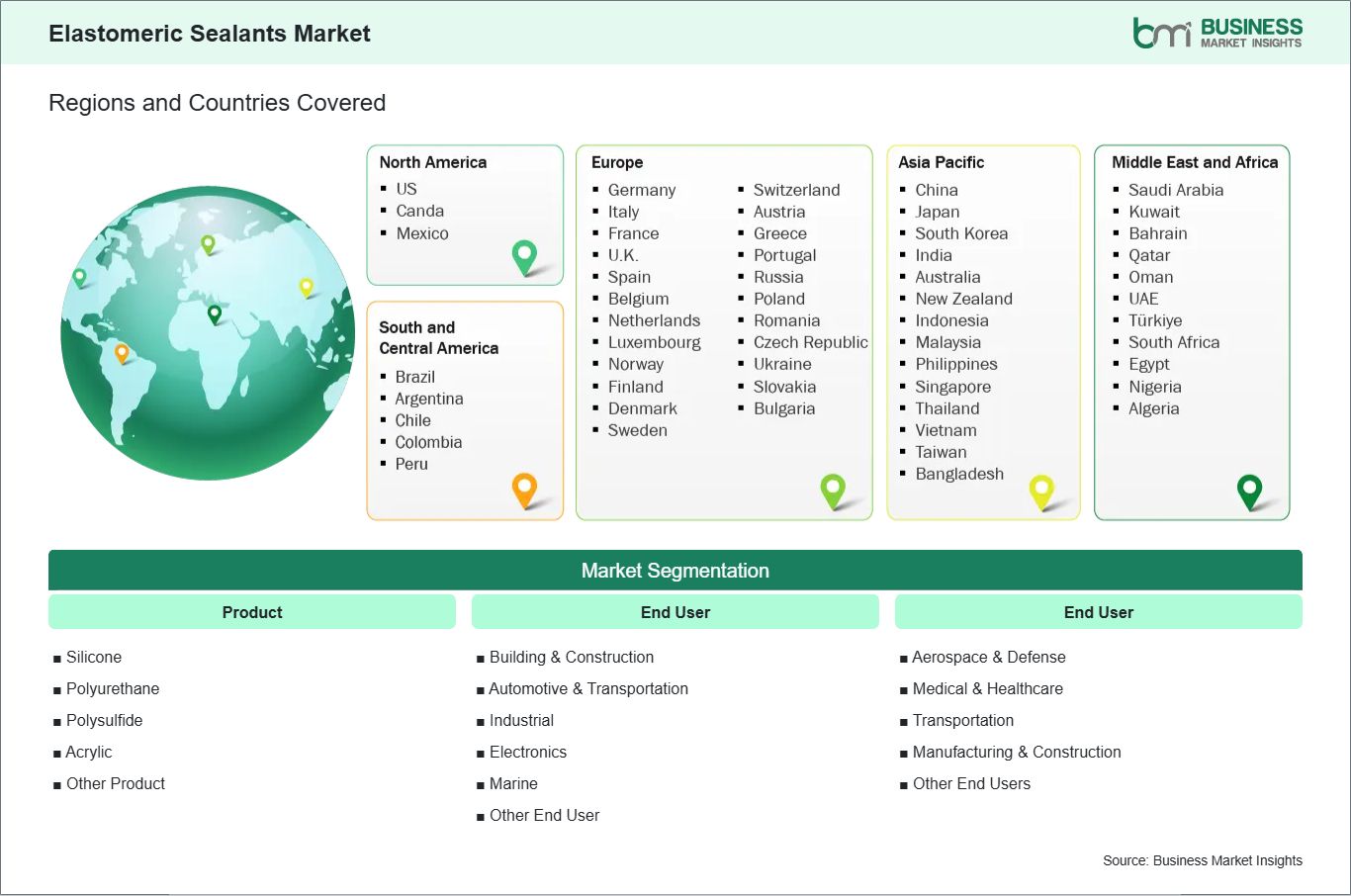
Key segments that contributed to the derivation of the elastomeric sealants market analysis are product and end user.
Elastomeric sealants are increasingly essential in modern construction due to the growing need for airtight and watertight joints. As buildings become more complex, with multiple materials and interfaces, ensuring tight sealing at expansion joints, window perimeters, and façade connections has become critical. Elastomeric sealants offer the flexibility to absorb movement while maintaining a strong seal, preventing air leakage and water intrusion over time.
The push for higher construction quality standards is also accelerating their use. Contractors and developers are paying closer attention to long-term performance, especially in areas exposed to heavy rainfall, wind pressure, or humidity. Sealants that can maintain elasticity without cracking or shrinking are becoming a preferred choice, helping reduce post-construction repair work and improving overall structural reliability.
Another important factor is their role in protecting building interiors and critical components. Poor sealing can lead to moisture penetration, mold growth, and deterioration of insulation materials. Elastomeric sealants act as a first line of defense, preserving indoor environments and extending the lifespan of building elements. This practical benefit continues to drive their widespread adoption across residential, commercial, and industrial projects.
Elastomeric sealants are gaining importance as buildings are designed with a stronger focus on energy efficiency. A well-sealed building envelope is essential for controlling heat transfer and minimizing energy loss, and sealants play a key role in eliminating gaps where air can escape. Their ability to maintain flexibility over time ensures that the building remains sealed even as materials expand and contract with temperature changes.
The growing emphasis on sustainable construction is creating opportunities for advanced sealant formulations. Low-emission, durable, and weather-resistant sealants are being integrated into high-performance building systems to support green building practices. These products help maintain consistent indoor temperatures, reduce reliance on heating and cooling systems, and contribute to overall energy savings.
There is also increasing potential in retrofit and renovation projects, where improving energy efficiency is a major objective. Older buildings often suffer from air leakage and poor insulation, and elastomeric sealants provide a relatively simple yet effective solution. By sealing gaps and reinforcing the building envelope, they enable upgrades without extensive structural changes, positioning them as a key material in the global transition toward more energy-conscious construction.

The elastomeric sealants market is experiencing steady growth, with market size and share analysis reflecting evolving treatment preferences and competitive dynamics among key players. The report evaluates important subsegments categorized within product and end user, highlighting their respective contributions to overall market performance.
By product, the Silicone subsegment dominated the Elastomeric Sealants market in 2025. Silicone sealants offer excellent flexibility, weather resistance, and long-term durability, making them highly suitable for a wide range of sealing applications, which drives their widespread adoption.
In terms of end user, the Building & Construction subsegment dominated the Elastomeric Sealants market in 2025. Building and construction applications benefit from these sealants’ superior adhesion, waterproofing, and resistance to environmental stress, supporting strong market demand.
| Report Attribute | Details |
|---|---|
| Market size in 2025 | US$ 5.62 Billion |
| Market Size by 2033 | US$ 9.53 Billion |
| Global CAGR (2026 - 2033) | 6.82% |
| Historical Data | 2022-2024 |
| Forecast period | 2026-2033 |
| Segments Covered | By Product
|
|
Regions and Countries Covered
| |
| North America | US, Canada, Mexico |
| Europe | Belgium, Austria, Finland, Denmark, Greece, Poland, Romania, Russia, Ukraine, Czech Republic, Slovakia, Bulgaria, Italy, Luxembourg, Germany, Switzerland, France, Netherlands, Norway, Portugal, Spain, Sweden, United Kingdom |
| Asia-Pacific | Australia, China, India, Japan, South Korea, Indonesia, Malaysia, Philippines, Singapore, Thailand, Vietnam, Bangladesh, New Zealand, Taiwan |
| South and Central America | Brazil, Argentina, Peru, Chile, Colombia |
| Middle East and Africa | Bahrain, Kuwait, Oman, Qatar, Saudi Arabia, United Arab Emirates, Turkiye, South Africa, Egypt, Algeria, Nigeria |
| Market leaders and key company profiles |
|
The "Elastomeric Sealants Market Size and Forecast (2022 - 2033)" report provides a detailed analysis of the market covering below areas:
The geographical scope of the Elastomeric Sealants market report is divided into five regions: North America, Asia Pacific, Europe, Middle East & Africa, and South & Central America. The Elastomeric Sealants market in North America is expected to grow during the forecast period.
North America is a dominant force in the elastomeric sealants market due to its focus on building performance and safety, as well as the need for building durability. The use of sealants in this market is not only restricted to the basic function of sealing but is increasingly being used in the application of advanced facade systems, curtain walls, and glazing systems. The demand is particularly strong in the commercial sector and infrastructure, where the need to achieve a tight seal and resist environmental elements is critical. One of the most significant aspects of the North American market is the application of elastomeric sealants in the renovation cycle, particularly in the upgrade of older buildings to achieve the latest standards in energy efficiency and weatherproofing requirements. The need for sealants that have the ability to provide long-term elasticity and be compatible with a wide range of building materials, including glass, aluminum, and engineered materials, is critical in this sector. Furthermore, the need to achieve disaster resistance in terms of wind and temperature is critical in this market and has placed greater emphasis on the importance of sealants. Even the requirement of expertise in the application of the product, as well as the need for strict installation procedures, can be considered as a potential impediment. However, the high standards of construction techniques, as well as the presence of well-established frameworks of product standardization, provide the required guarantee of performance. The sustained investments made in the development of sustainable infrastructure, as well as building refurbishment, guarantee the leadership of the North American region in the elastomeric sealant market.

The elastomeric sealants market is evaluated by gathering qualitative and quantitative data post primary and secondary research, which includes important corporate publications, association data, and databases. A few of the key developments in the elastomeric sealants market are:
The Elastomeric Sealants Market is valued at US$ 5.62 Billion in 2025, it is projected to reach US$ 9.53 Billion by 2033.
As per our report Elastomeric Sealants Market, the market size is valued at US$ 5.62 Billion in 2025, projecting it to reach US$ 9.53 Billion by 2033. This translates to a CAGR of approximately 6.82% during the forecast period.
The Elastomeric Sealants Market report typically cover these key segments-
The historic period, base year, and forecast period can vary slightly depending on the specific market research report. However, for the Elastomeric Sealants Market report:
The Elastomeric Sealants Market is populated by several key players, each contributing to its growth and innovation. Some of the major players include:
The Elastomeric Sealants Market report is valuable for diverse stakeholders, including:
Essentially, anyone involved in or considering involvement in the Elastomeric Sealants Market value chain can benefit from the information contained in a comprehensive market report.
Please tell us your area of interest
(Market Segments/ Regions and Countries/ Companies)