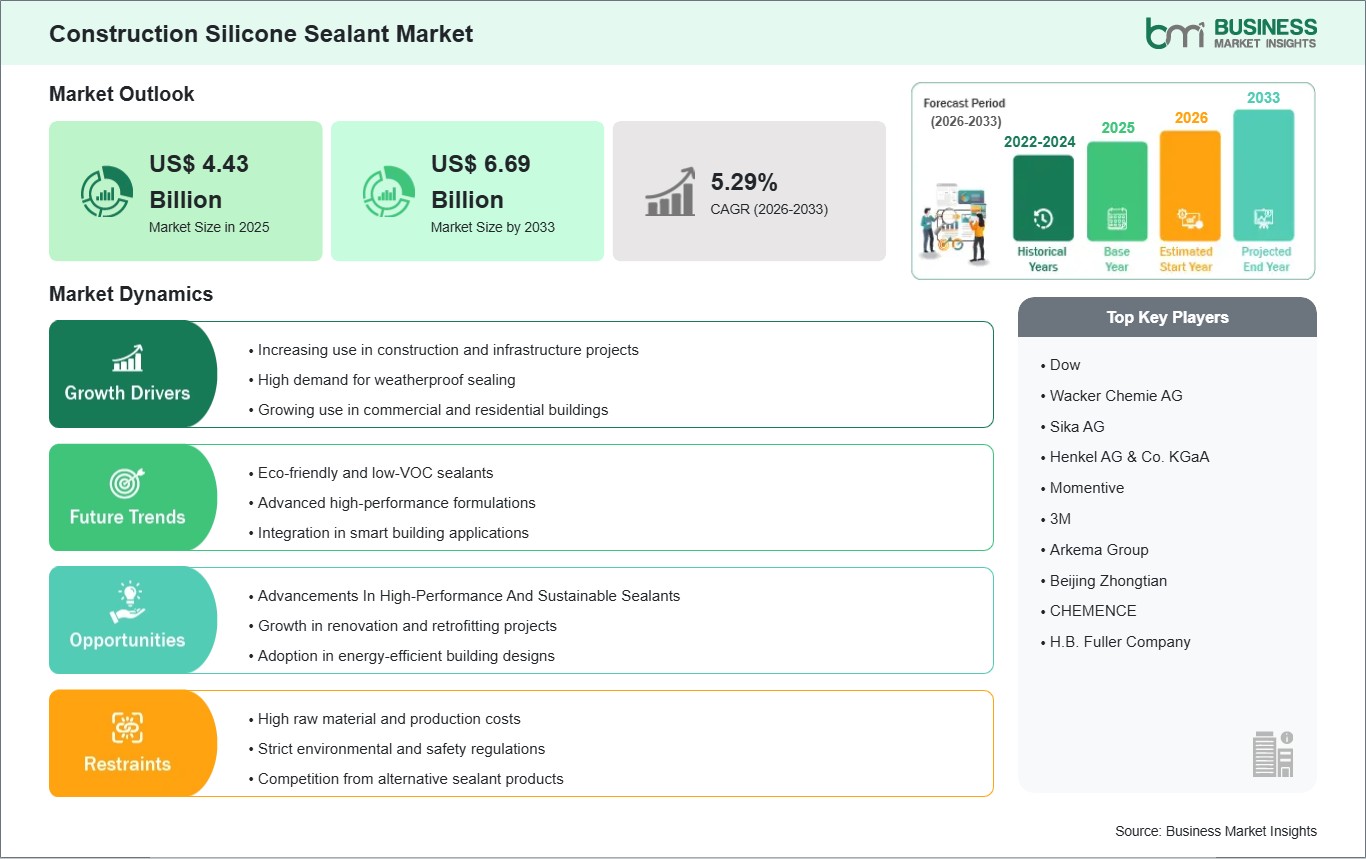
The Construction Silicone Sealant Market size is expected to reach US$ 6.69 Billion by 2033 from US$ 4.43 Billion in 2025. The market is estimated to record a CAGR of 5.29% from 2026 to 2033.
The global construction silicone sealant market is witnessing significant growth, mainly driven by the increasing demand for high-performance building materials that offer greater durability, flexibility, and environmental resistance. Silicone sealants have been widely used in structural glazing, façade construction, expansion joint sealants, and weatherproofing applications due to their high resistance to UV exposure, moisture, temperature changes, and chemical attack. Their ability to retain elasticity during long periods of service life makes them the preferred choice in commercial and residential building projects. The construction silicone sealant market is highly impacted by global urbanization patterns and infrastructure development projects, which have created a greater demand for effective sealing solutions in modern building construction. Furthermore, the increasing trend of using energy-efficient construction techniques is also fueling the demand for silicone sealants in building envelopes to minimize heat loss and energy consumption in buildings. From a competitive point of view, the market is moderately concentrated with multinational companies using their integrated supply chains, high R&D capabilities, and compliance with stringent building standards to retain their market positions. However, regional players compete in cost-sensitive markets, especially in standard interior and residential markets. Technological advancements in neutral cure and low VOCs have impacted product development strategies, with regulatory bodies increasingly focusing on indoor air quality and environmental compliance. Moreover, with the advent of prefabricated construction techniques, there is an opportunity for sealant products in modular construction. Despite the challenges faced by the industry in terms of raw material cost volatility and environmental concerns related to chemical emissions, the market is still strong with innovation in formulation chemistry and diverse construction environments.
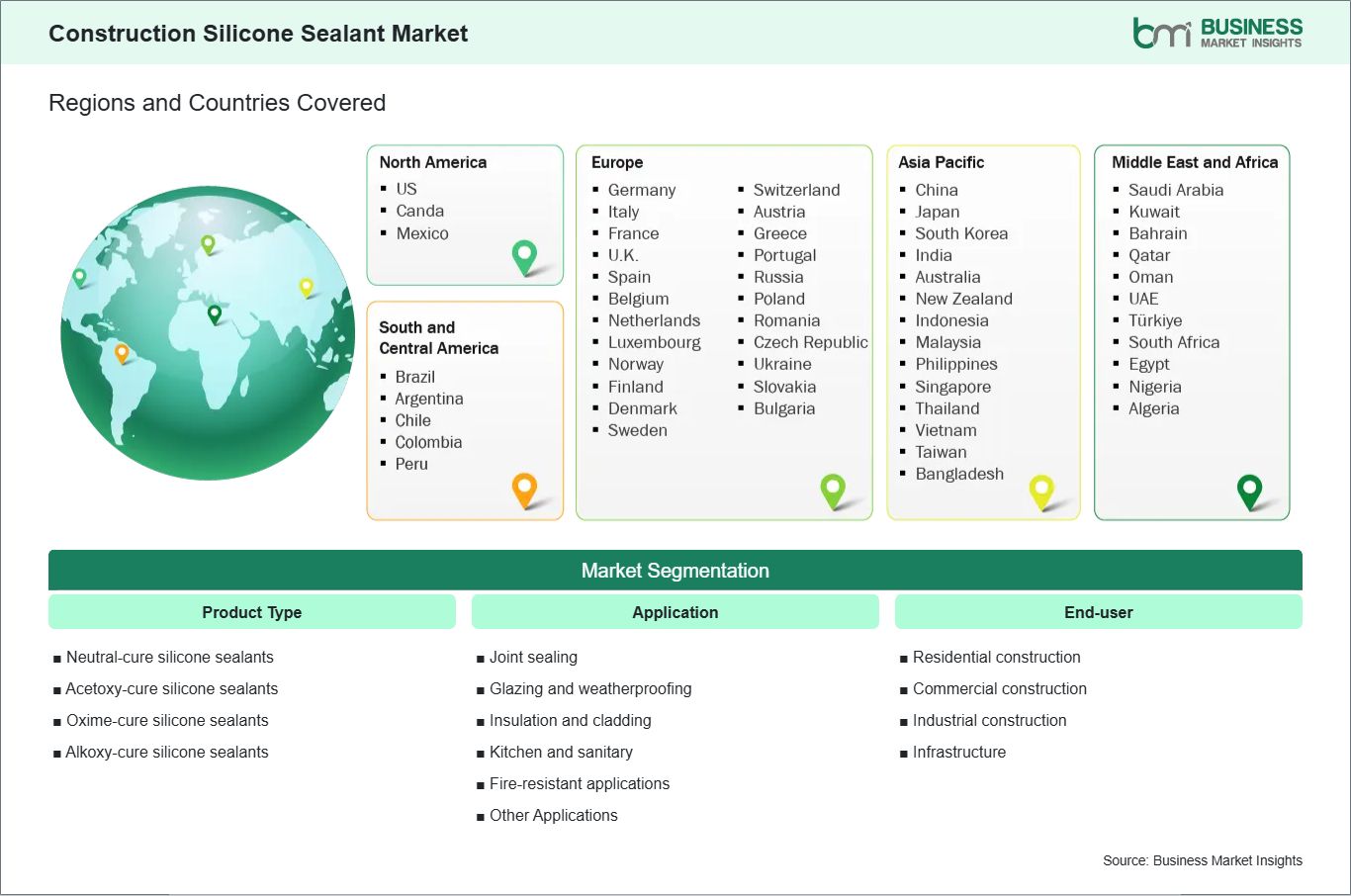
Key segments that contributed to the derivation of the construction silicone sealant market analysis are product type, application, and end-user.
By Product Type, the construction silicone sealant market is segmented into neutral-cure silicone sealants, acetoxy-cure silicone sealants, oxime-cure silicone sealants, and alkoxy-cure silicone sealants. The neutral-cure silicone sealants segment dominated the market in 2025.
Based on Application, the construction silicone sealant market is classified into joint sealing, glazing and weatherproofing, insulation and cladding, kitchen and sanitary, fire-resistant applications, and other applications. The glazing and weatherproofing segment dominated the market in 2025.
On the Basis of End-user, the construction silicone sealant market is segmented into residential construction, commercial construction, industrial construction, and infrastructure. The commercial construction segment dominated the market in 2025.
The global construction silicone sealant market is growing steadily, with increasing importance in modern construction and development. Construction silicone sealants are commonly used in construction for various purposes such as sealing, bonding, and weatherproofing in buildings, including residential, commercial, and industrial structures. Their use in construction is significant due to their ability to offer long-lasting adhesion, flexibility, and resistance to various environmental factors such as water, temperature, and UV rays.
Construction projects use construction silicone sealants in various areas such as windows, doors, facades, joints, and roofs. Their flexibility enables them to withstand structural movement and temperature changes without breaking or losing their adhesiveness. This property of construction silicone sealants is essential in structures such as high-rise buildings, making them significant in architectural designs. Moreover, their resistance to water penetration prevents water from leaking into the structures, thus increasing their lifespan.
The increasing emphasis on energy-efficient buildings and sustainable construction practices is further driving demand. Silicone sealants support insulation and airtightness, improving overall building performance. As construction activities continue to evolve with advanced materials and designs, the need for reliable sealing solutions becomes more important. The combination of durability, adaptability, and performance ensures that silicone sealants remain a key component in construction applications, supporting consistent global demand across infrastructure and building projects.
Technological developments and sustainability factors are influencing the construction silicone sealant market. Manufacturers are shifting their focus to the development of high-performance sealants with better adhesive properties, faster curing times, and improved resistance to extreme environmental conditions. These developments allow the sealants to function well in various construction environments, including areas with high humidity, extreme temperatures, and exposure to chemicals.
Some of the new product developments in the construction silicone sealant market include the development of volatile organic compound-free sealants, which are environmentally friendly and contribute to better indoor air quality. These eco-friendly sealants meet the demands of new construction standards and regulations, which support sustainable construction. Moreover, improvements in formulation technologies allow the sealants to work well with a wide variety of substrates, including glass, metal, concrete, and composite materials.
The industry is also seeing increased demand for specialized sealants designed for specific applications, such as fire-resistant, weatherproof, and structural glazing solutions. These products provide targeted performance benefits, allowing builders and contractors to meet complex design and safety requirements. As construction methods become more advanced and sustainability becomes a priority, innovation in silicone sealants continues to play a crucial role. The focus on performance, environmental responsibility, and application-specific solutions is expected to support long-term adoption across the global construction sector.

The construction silicone sealant market demonstrates steady growth, with size and share analysis highlighting evolving trends and competitive dynamics among key players. The report examines subsegments categorized within product type, application, and end‑user, offering insights into their contribution to overall market performance.
By Product Type, the neutral‑cure silicone sealants subsegment dominated the market in 2025, driven by its corrosion‑free curing and broad substrate compatibility.
Based on Application, the glazing and weatherproofing subsegment dominated the market in 2025, supported by extensive adoption of silicone sealants in curtain‑wall and façade systems.
On the basis of End‑User, the commercial construction subsegment dominated the market in 2025, owing to rising investments in commercial buildings and office complexes requiring durable joint solutions.
| Report Attribute | Details |
|---|---|
| Market size in 2025 | US$ 4.43 Billion |
| Market Size by 2033 | US$ 6.69 Billion |
| Global CAGR (2026 - 2033) | 5.29% |
| Historical Data | 2022-2024 |
| Forecast period | 2026-2033 |
| Segments Covered | By Product Type
|
|
Regions and Countries Covered
| |
| North America | US, Canada, Mexico |
| Europe | Belgium, Austria, Finland, Denmark, Greece, Poland, Romania, Russia, Ukraine, Czech Republic, Slovakia, Bulgaria, Italy, Luxembourg, Germany, Switzerland, France, Netherlands, Norway, Portugal, Spain, Sweden, United Kingdom |
| Asia-Pacific | Australia, China, India, Japan, South Korea, Indonesia, Malaysia, Philippines, Singapore, Thailand, Vietnam, Bangladesh, New Zealand, Taiwan |
| South and Central America | Brazil, Argentina, Peru, Chile, Colombia |
| Middle East and Africa | Bahrain, Kuwait, Oman, Qatar, Saudi Arabia, United Arab Emirates, Turkiye, South Africa, Egypt, Algeria, Nigeria |
| Market leaders and key company profiles |
|
The "Construction Silicone Sealant Market Size and Forecast (2022 - 2033)" report provides a detailed analysis of the market covering below areas:
The geographical scope of the Construction Silicone Sealant Market report is divided into North America, Asia Pacific, Europe, Middle East & Africa, and South & Central America. North America held the largest share in 2025.
Regional-level dynamics in the construction silicone sealant market reflect variations in construction activity, regulatory frameworks, and infrastructure investment across key geographies. North America holds a strong position, supported by advanced construction practices, strict building codes, and high adoption of performance-driven materials in commercial and infrastructure projects. The region’s focus on energy efficiency, green buildings, and renovation activities sustains demand for high-quality silicone sealants in both exterior and interior applications. Europe represents a mature market, led by countries such as Germany, France, and the UK, where stringent environmental regulations and sustainability initiatives drive the adoption of low-VOC and eco-friendly sealant formulations. Compliance with green building certifications further encourages the use of advanced silicone technologies in construction. The Asia Pacific region dominates global consumption, accounting for a significant share due to rapid urbanization, population growth, and extensive infrastructure development in countries such as China and India. Large-scale residential and commercial construction projects, coupled with increasing adoption of modern building materials, continue to drive regional demand. In the Middle East & Africa, demand is driven by large infrastructure projects, commercial real estate expansion, and extreme climatic conditions that require durable and weather-resistant sealants. Countries such as the UAE and Saudi Arabia are key contributors, particularly in high-rise and mega-project construction. South & Central America, led by Brazil and Mexico, exhibits moderate growth supported by urban development and infrastructure upgrades, although economic fluctuations and regulatory variability influence market expansion. Collectively, these regional dynamics highlight a balance between mature markets emphasizing sustainability and emerging regions driving volume growth through infrastructure development.
The Construction Silicone Sealant Market is evaluated by gathering qualitative and quantitative data post primary and secondary research, which includes important corporate publications, association data, and databases. A few of the key developments in the construction silicone sealant market are:
The Construction Silicone Sealant Market is valued at US$ 4.43 Billion in 2025, it is projected to reach US$ 6.69 Billion by 2033.
As per our report Construction Silicone Sealant Market, the market size is valued at US$ 4.43 Billion in 2025, projecting it to reach US$ 6.69 Billion by 2033. This translates to a CAGR of approximately 5.29% during the forecast period.
The Construction Silicone Sealant Market report typically cover these key segments-
The historic period, base year, and forecast period can vary slightly depending on the specific market research report. However, for the Construction Silicone Sealant Market report:
The Construction Silicone Sealant Market is populated by several key players, each contributing to its growth and innovation. Some of the major players include:
The Construction Silicone Sealant Market report is valuable for diverse stakeholders, including:
Essentially, anyone involved in or considering involvement in the Construction Silicone Sealant Market value chain can benefit from the information contained in a comprehensive market report.
Please tell us your area of interest
(Market Segments/ Regions and Countries/ Companies)