Market Summary
Executive Summary and Global Market Analysis
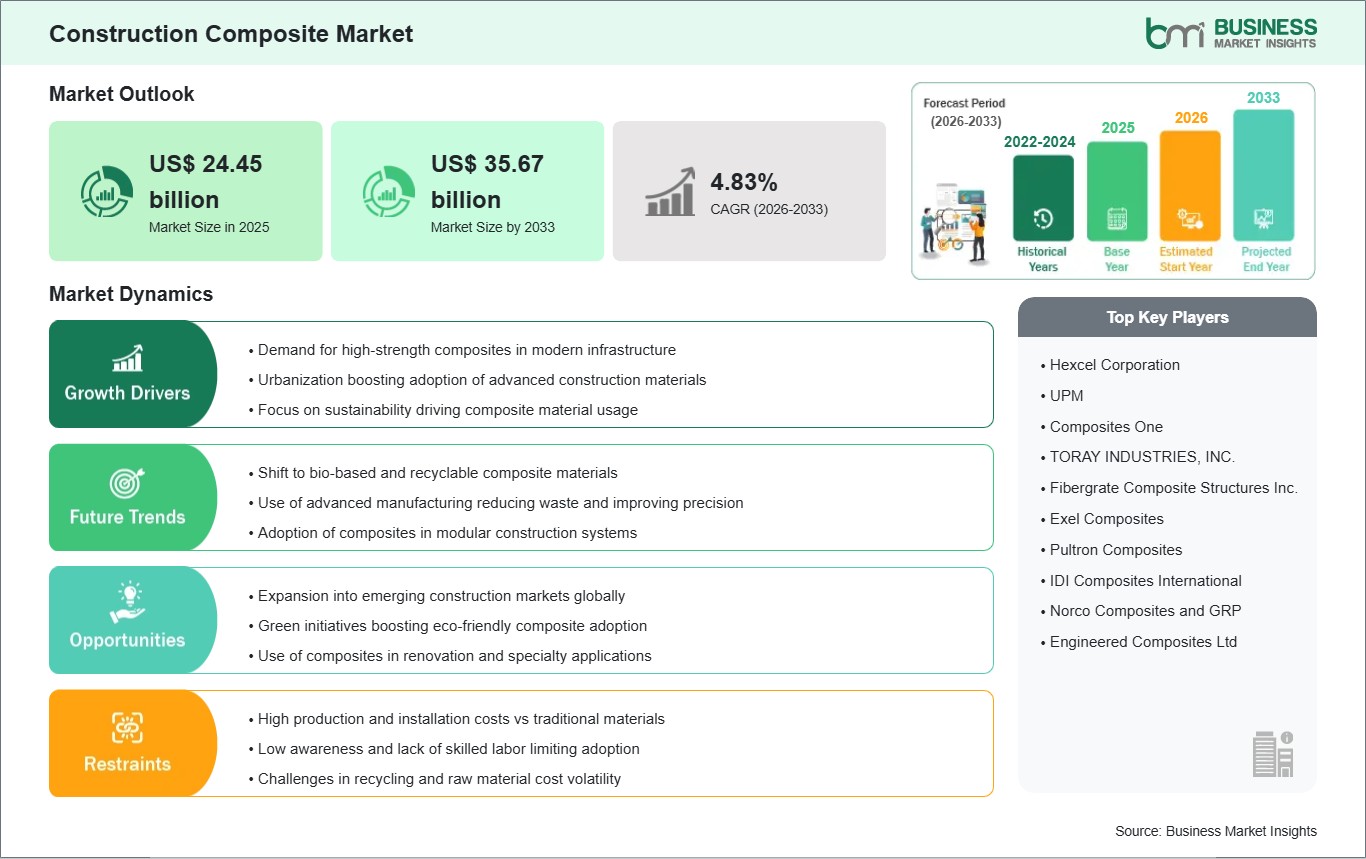
Construction composites are materials made by mixing two or more components, usually fibers like glass, carbon, or natural fibers embedded in a polymer, resin, or cement matrix. These materials are designed to provide better strength, durability, resistance to corrosion, and lightweight features compared to traditional construction materials. Construction composites are commonly used for structural reinforcement, bridge parts, roofing, cladding, pipes, insulation, and prefabricated building elements. They come in different forms, including fiber-reinforced polymers (FRP), wood-plastic composites, and engineered cement composites, each tailored to meet specific performance needs in construction settings.
The market is growing steadily due to the rising demand for strong and lightweight construction materials. Rapid urban growth, updates to infrastructure, and the need for long-lasting buildings are important factors driving market growth. Additionally, the increasing focus on sustainability and energy efficiency is promoting the use of composites because they require less maintenance and have longer lifespans. Advances in material engineering are enhancing performance and cost-effectiveness. Moreover, increased investment in infrastructure development and renovation projects is boosting the global growth of the construction composites market.
.
Segment Analysis
Construction Composite Market Segmentation
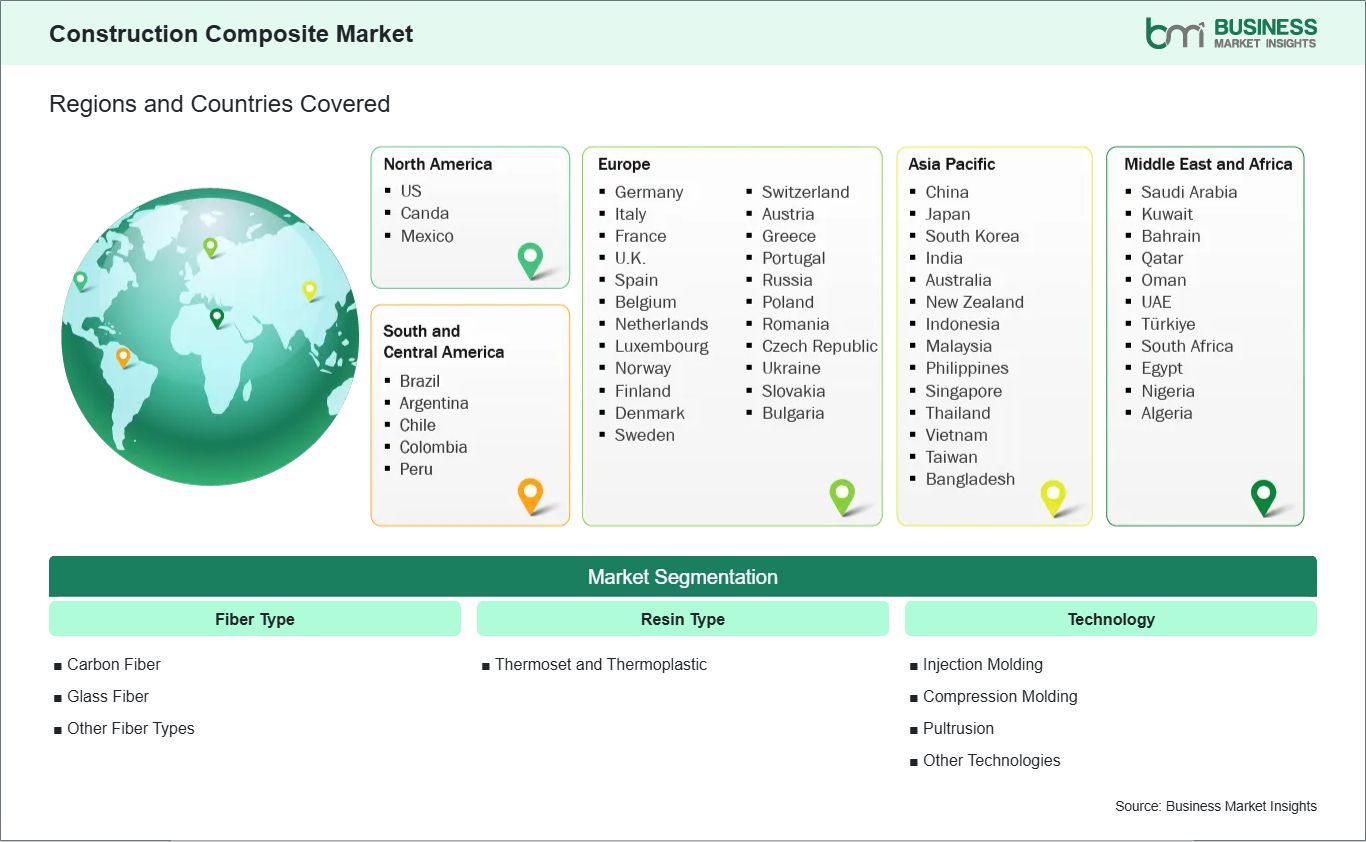
Key segments that contributed to the derivation of the construction composite market analysis are fiber type, resin type, technology, and application.
- By fiber type, the construction composites market is segmented into carbon fiber, glass fiber, and others. The glass fiber segment held the largest market share in 2025.
- By resin type, the construction composites market is segmented into thermoset and thermoplastic. The thermoset segment held the largest market share in 2025.
- By technology, the construction composites market is segmented into injection molding, compression molding, pultrusion, and others. The pultrusion segment held the largest market share in 2025.
- By application, the construction composites market is segmented into residential, commercial, industrial, infrastructural, and institutional. The infrastructural segment held the largest market share in 2025.
Market Forces
Construction Composite Market Drivers and Opportunities
Increasing Demand for Durable and Lightweight Materials
The rising demand for durable and lightweight materials in construction is a key factor in the growth of the construction composites market. Traditional materials like steel, wood, and concrete face issues such as corrosion, heavy weight, and high maintenance needs. In contrast, construction composites provide better strength-to-weight ratios, corrosion resistance, and longer service life, making them ideal for modern construction. These features are especially important for infrastructure projects like bridges, highways, and coastal structures, where durability and low maintenance are essential.
Lightweight composites also make transportation and installation easier, which cuts down on labor costs and construction time. This efficiency is particularly useful in large and complex projects where optimizing operations is important. The ability to mold composites into different shapes and sizes further broadens their applications. As construction increasingly focuses on performance, longevity, and cost efficiency, the use of composite materials continues to grow, boosting demand across global construction sectors.
Expansion of Sustainable and Green Building Practices
The rising focus on sustainable construction and eco-friendly building methods presents a significant growth opportunity for the construction composites market. As governments and industry members aim to cut carbon emissions and improve resource efficiency, the demand for materials that help achieve these goals is growing. Construction composites offer several environmental benefits, such as less material waste, longer lifespans, and lower maintenance needs, which enhance overall sustainability.
Several composites also provide better thermal insulation, improving energy efficiency in buildings and lowering operational energy use. In addition, ongoing research and development are leading to new bio-based and recyclable composite materials, which fit with global sustainability goals and green certification standards. The increasing use of prefabrication and modular construction techniques further supports the use of composites because of their flexibility and ease of integration. Moreover, the rising trend of retrofitting existing infrastructure to meet modern environmental standards is creating new opportunities for composite applications, expanding market possibilities worldwide.
Size and Share Analysis
Construction Composite Market Size and Share Analysis
The construction composite market demonstrates steady growth, with size and share analysis revealing evolving trends and competitive positioning among key players. The report examines subsegments categorized within fiber type, resin type, technology, and application, offering insights into their contribution to overall market performance. By application, the infrastructural segment holds the largest market share. Construction composites are commonly used in infrastructure projects like bridges, highways, tunnels, and public utilities for structural reinforcement, corrosion resistance, and long-lasting durability. Governments and contractors choose construction composites because of their high strength-to-weight ratio, resistance to tough environmental conditions, and low maintenance needs. These materials last longer and reduce the need for frequent repairs when compared to traditional materials like steel and concrete. The industry prefers construction composites because they improve structural performance, allow for quicker installation, and support eco-friendly construction practices. Growth in this segment comes from increased investments in infrastructure development, a rising need for durable and corrosion-resistant materials, fast urbanization, and government efforts aimed at modernizing public infrastructure globally.
Report Coverage
Construction Composite Market Report Coverage and Deliverables
The " Construction Composite Market Size and Forecast (2022 - 2033)" report provides a detailed analysis of the market covering below areas:
- Construction composite market size and forecast at global, regional, and country levels for all the key market segments covered under the scope
- Construction composite market trends, as well as market dynamics such as drivers, restraints, and key opportunities
- Construction composite market analysis covering key market trends, global and regional framework, major players, regulations, and recent market developments
- Industry landscape and competition analysis covering market concentration, heat map analysis, prominent players, and recent developments for the construction composite market
- Detailed company profiles, including SWOT analysis
Geographic Insights
Construction Composite Market Geographic Insights
The geographical scope of the construction composite market report is divided into five regions: North America, Asia Pacific, Europe, the Middle East & Africa, and South & Central America. Asia Pacific holds a significant share of the construction composite market. The market growth is due to rapid urbanization, growing infrastructure development, and strong activity in both residential and commercial construction. Countries like China, India, Japan, and those in Southeast Asia are seeing major investments in transportation infrastructure, smart cities, industrial areas, and housing projects. This trend is driving the demand for high-performance construction materials. The region's large population and rising income levels are boosting construction activities, leading to ongoing demand for composite materials.
Moreover, having a well-established manufacturing base, access to raw materials, and affordable labor helps produce and use construction composites widely. Government efforts aimed at modernizing infrastructure, building disaster-resistant structures, and promoting sustainable development are also fueling market growth. Additionally, greater awareness of the advantages of lightweight, durable, and corrosion-resistant materials is promoting the use of composites in various applications. This reinforces the Asia-Pacific's top position in the global construction composites market.
Industry Activity
Recent Developments
The construction composite market is evaluated by gathering qualitative and quantitative data post-primary and secondary research, which includes important corporate publications, association data, and databases. A few of the key developments in the construction composite market are:
- In February 2026, Avient introduced the first thermoplastic composite panels with built-in flame retardance at the NAHB International Builders' Show. This innovation simplifies construction by removing the need for additional fireproof layers, while also improving durability and performance.
- In October 2025, 3A Composites increased the availability of its ALUCORE composite panels in India. These panels come in honeycomb and corrugated core options for high-performance, sustainable architectural and infrastructure uses.
Trust & Transparency
Research Methodology
The market analysis combines proprietary research with secondary data from government agencies, company disclosures, regulatory filings, industry databases and expert interviews. Market estimates are validated through data triangulation, cross-market benchmarking and analyst
review.
View Full Research Methodology
Key Sources Referred:
World Bank - Global Trade IndicatorsWorld Trade Organization (WTO)International Monetary Fund (IMF)International Trade Administration (ITA)Company WebsitesCompany Annual ReportsCompany Investor PresentationsAmerican Composites Manufacturers AssociationEuropean Composites Industry AssociationJapan Carbon Fiber Manufacturers AssociationChina Composites Industry Association