Market Summary
Executive Summary and Global Market Analysis
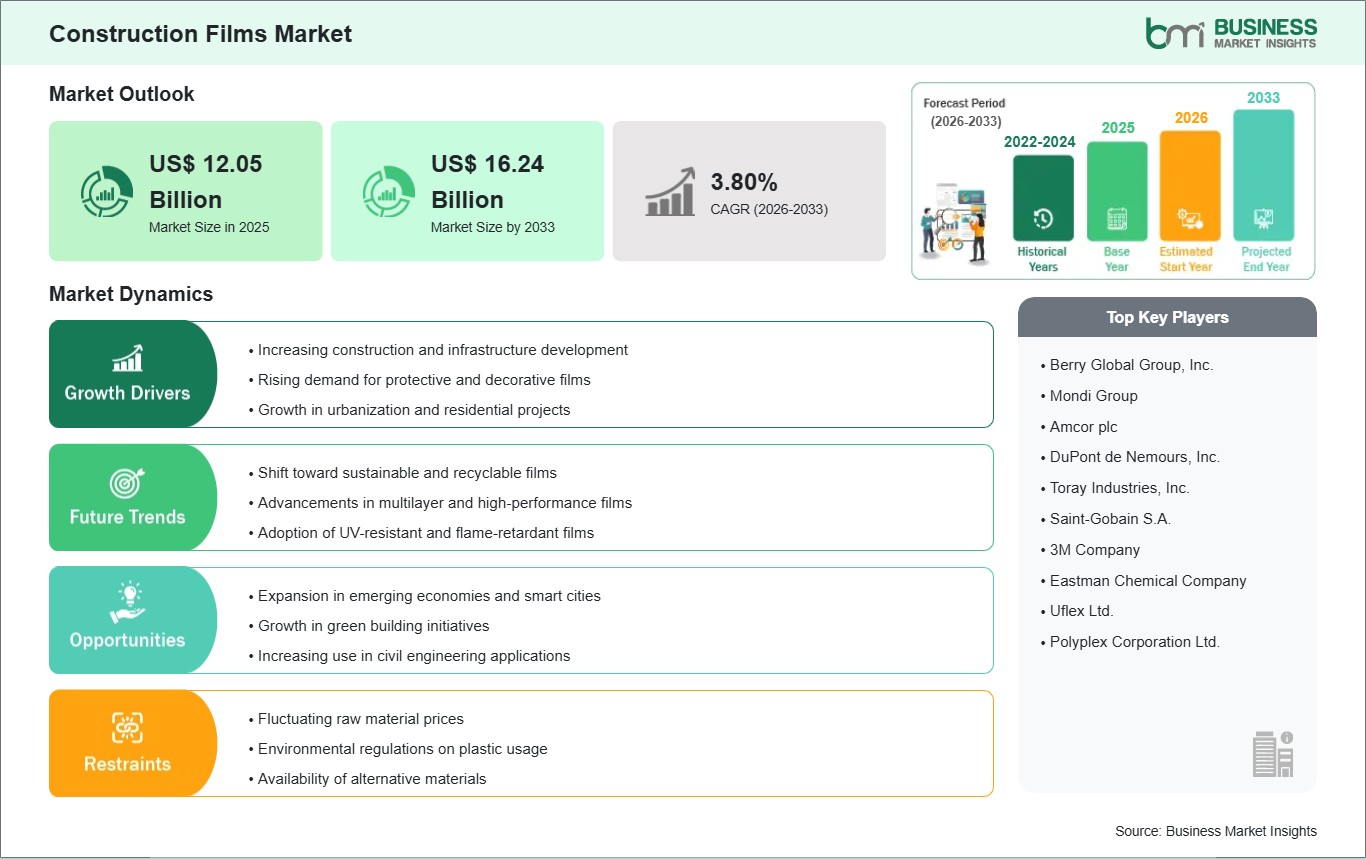
The global construction films market is witnessing steady growth, driven by increasing construction activities, infrastructure projects, and the need for durable, protective, and decorative solutions in modern buildings. Construction films, made from polymers such as LDPE, HDPE, BOPP, and PET, serve as barriers against moisture, dust, UV exposure, and mechanical damage, while also providing decorative finishes for walls, windows, and façades.
Rising urbanization, industrialization, and residential and commercial development projects are creating significant demand for construction films globally. Protective films are extensively used in civil engineering, roofing, flooring, and glazing applications, while decorative films enhance the aesthetic appeal of interior and exterior surfaces.
Technological advancements in polymer films are expanding their performance characteristics, including UV resistance, tensile strength, flame retardancy, and chemical resistance. Manufacturers are increasingly developing multilayer and co-extruded films that offer superior barrier properties and longevity, addressing both performance and regulatory requirements.
Sustainability is becoming a key focus in the construction films market. Eco-friendly films with recyclable or biodegradable properties are gaining traction, especially in North America and Europe, driven by stringent environmental regulations and green building initiatives. The adoption of energy-efficient and green construction practices is fostering demand for innovative film solutions that reduce waste, enhance insulation, and improve building longevity.
Overall, the construction films market is expected to continue growing steadily, supported by infrastructure development, urban expansion, technological innovations, and the increasing demand for sustainable and functional building materials.
Segment Analysis
Construction Films Market Segmentation
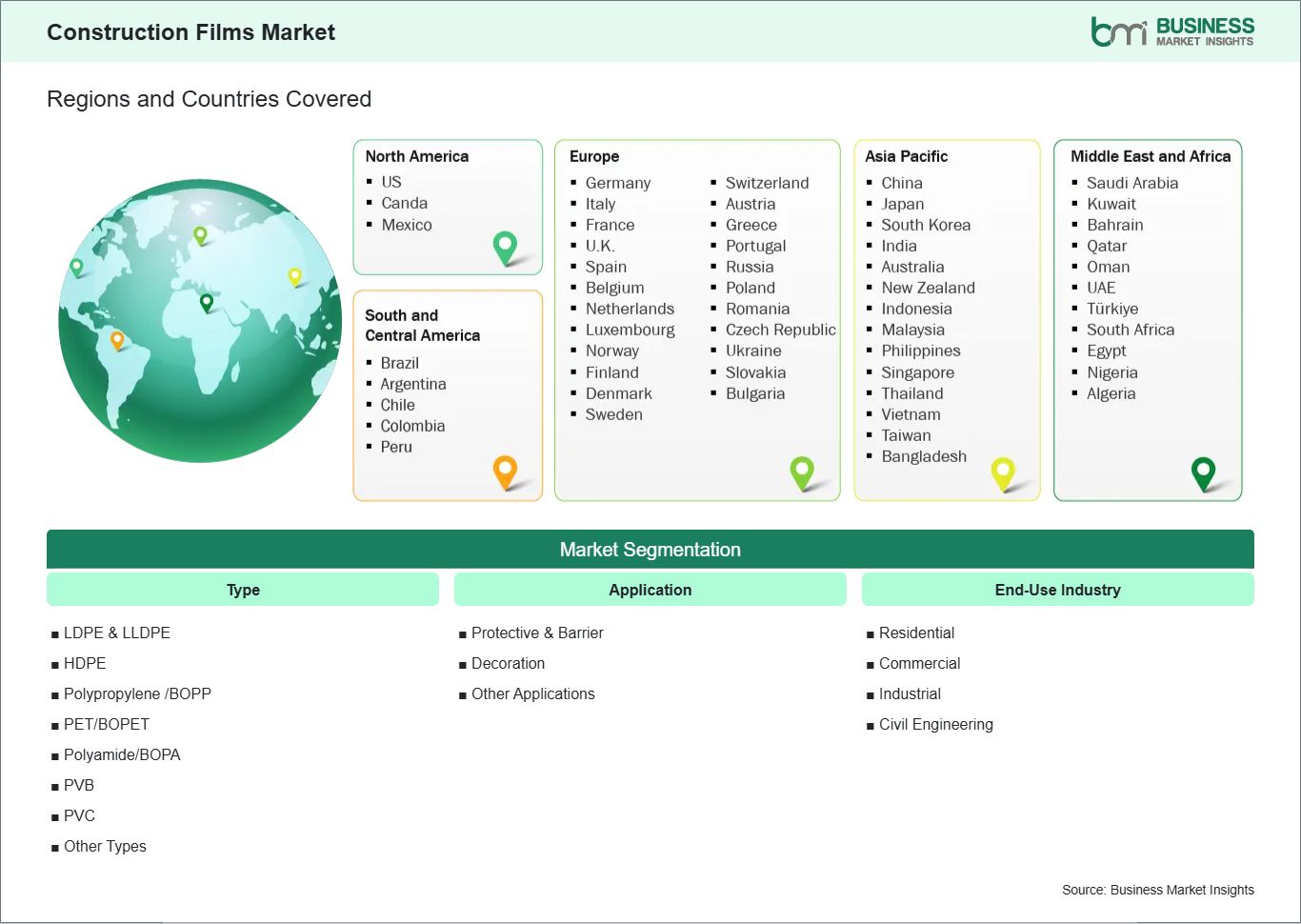
Key segments that contributed to the derivation of the construction films market analysis are type, application, and end-use industry.
- By type, the construction films market is segmented into LDPE & LLDPE, HDPE, Polypropylene (PP)/BOPP, PET/BOPET, Polyamide/BOPA, PVB, PVC, and other types. The LDPE & LLDPE segment dominated the market in 2025.
- In terms of application, the construction films market is segmented into protective & barrier, decoration, and other applications. The protective & barrier segment dominated the market in 2025.
- By end-use industry, the construction films market is segmented into residential, commercial, industrial, and civil engineering. The residential segment dominated the market in 2025.
Market Forces
Construction Films Market Drivers and Opportunities
Increasing Construction Activities and Urban Development
The construction films industry is rapidly expanding as a result of fast-paced urbanization, industrialization, and the growth of worldwide populations. As cities continue to grow and new infrastructure development projects arise, protective films are becoming more important than ever to protect the surfaces of buildings and construction sites. By preventing dust accumulation, moisture, scratches, and harmful UV light, protection films help maintain the durability of building materials while lowering maintenance costs. Protective films are used extensively in residential and commercial projects, where they protect floors, windows, and other decorative surfaces. In the case of civil engineering projects (e.g., bridges, tunnels, and roads), protective films act as a protective layer for construction and help to enhance the safety and extend the life of the materials. The increase in housing and infrastructure development in emerging economies, especially those in Asia-Pacific, will create a high demand for flexible and durable polymer films that can be used to protect building surfaces.
In addition, decorative films continue to be increasingly popular with consumers who want to create aesthetically pleasing finishes for their homes (inside and out). For commercial and industrial buildings, decorative films are often used to improve façade design, enhance glazing and branding elements, and provide a functional solution to multiple design issues. As a result, the combination of increased infrastructure investment, increased housing demand, and the need for protective and decorative solutions means that construction films are becoming increasingly relevant materials used in the development of modern urban centers. This broad applicability of construction films means that they continue to be an essential component in the exploration of a wide variety of functional and aesthetic design components related to construction.
Technological Innovation and Sustainable Films
There is rapid evolution occurring in the construction film market due to advancing technologies and sustainability initiatives. Manufacturers are developing new performance levels with high performance, multi-layered, co-extruded film products producing substantial improvements through film barrier properties, UV resistance and tensile strength. Flame-retardant films and anti-static films are being introduced to meet regulations and standards for safety in both industrial and commercial construction applications. Sustainability is also a significant driver in market growth, as there has been an increasing demand for recyclable, biodegradables, and low-VOC film products all over the world as governments and industry organizations push for more eco-friendly ways to build projects.
North America and Europe are currently leading the way in terms of adoption rates of sustainable films due to stringent environmental regulations; however, the Asia-Pacific market demonstrates considerable growth opportunities based on rapid urbanization and industrialization. The integration of emerging technologies that create advanced functionalities and sustainability is changing the face of the construction film market and provides manufacturers with a variety of options for differentiation through innovative products. Manufacturers who invest in environmentally friendly technologies while also providing the highest-quality products will capture the greatest percentage of the construction film market. Ultimately, the construction film industry will continue to develop in terms of durability, safety, and environmental responsibility, while continuing to play an important role within modern construction processes worldwide.
Size and Share Analysis
Construction Films Market Size and Share Analysis
The Construction Films Market demonstrates steady growth, with size and share analysis highlighting evolving trends and competitive dynamics among key players. The report examines subsegments categorized within type, application, and end-use industry, offering insights into their contribution to overall market performance.
By product, the LDPE & LLDPE subsegment dominated the market in 2025, driven by its versatility, cost-effectiveness, and strong protective capabilities.
In terms of application, the protective & barrier subsegment dominated the market in 2025, driven by its essential role in safeguarding surfaces during construction, renovation, and transportation.
By end-use industry, the residential subsegment dominated the market in 2025, supported by rising housing projects, urbanization, and demand for protective and decorative films in domestic applications.
Report Coverage
Construction Films Market Report Coverage and Deliverables
The "Construction Films Market Size and Forecast (2022 - 2033)" report provides a detailed analysis of the market covering below areas:
- Construction Films Market size and forecast at global, regional, and country levels for all the key market segments covered under the scope
- Construction Films Market trends, as well as drivers, restraints, and opportunities
- Construction Films Market analysis covering key trends, global and regional framework, major players, regulations, and recent developments
- Industry landscape and competition analysis covering market concentration, heat map analysis, prominent players, and recent developments for the Construction Films Market
- Detailed company profiles, including SWOT analysis
Geographic Insights
Construction Films Market Geographic Insights
The geographical scope of the Construction Films Market report is divided into North America, Asia Pacific, Europe, Middle East & Africa, and South & Central America. North America held the largest share in 2025.
North America leads the market due to a mature construction industry, strong adoption of advanced materials, and high demand for protective and decorative films in residential, commercial, and civil engineering projects. The United States and Canada are driving growth with large-scale housing, infrastructure, and commercial development projects. Environmental regulations and green construction initiatives are further accelerating adoption of sustainable films.
Europe is a mature market driven by strong regulatory frameworks, energy-efficient construction standards, and demand for aesthetically appealing building materials in Germany, France, and the UK.
Asia Pacific is the fastest-growing region, driven by rapid urbanization, industrialization, and government investments in infrastructure and residential projects in countries like China, India, and Southeast Asia.
Latin America and the Middle East & Africa are emerging markets, benefiting from growing residential and commercial construction activities. Market growth is influenced by local construction spending, regulatory frameworks, and material affordability.
Industry Activity
Recent Developments
The Construction Films Market is evaluated by gathering qualitative and quantitative data post primary and secondary research, which includes important corporate publications, association data, and databases. A few of the key developments in the construction films market are:
- In March 2025, Berry Global Group, Inc. launched a new range of sustainable construction films made from recycled LDPE for protective and barrier applications.
- In October 2024, Mondi Group introduced high-performance BOPET films for decorative and protective applications in construction, enhancing UV resistance and durability.
Trust & Transparency
Research Methodology
The market analysis combines proprietary research with secondary data from government agencies, company disclosures, regulatory filings, industry databases and expert interviews. Market estimates are validated through data triangulation, cross-market benchmarking and analyst
review.
View Full Research Methodology
Key Sources Referred:
European Plastics Converters (EuPC)Plastics Industry Association (PLASTICS)American Coatings Association (ACA)U.S. Census BureauInternational Trade Administration