Market Summary
Executive Summary and Global Market Analysis
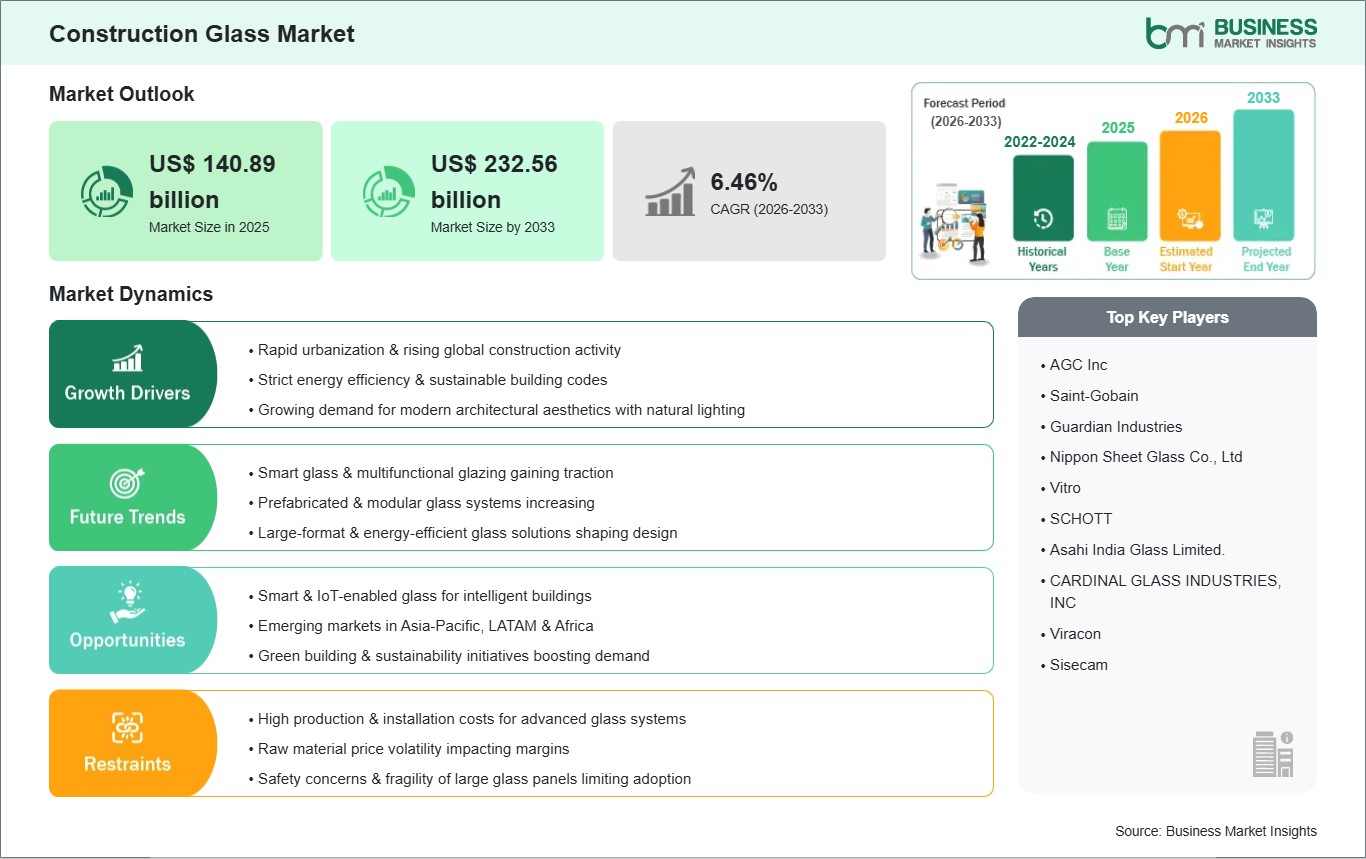
Construction glass refers to specially designed glass products used in building and infrastructure projects. These products improve appearance, safety, energy efficiency, and structural performance. They include tempered glass, laminated glass, insulated glass units, and coated glass, each made to meet specific needs. Construction glass is commonly used in windows, facades, skylights, doors, partitions, and curtain walls. It provides benefits like thermal insulation, sound reduction, UV protection, and better security. Special types, such as low-emissivity (Low-E) and smart glass, help save energy and increase comfort in modern buildings.
The market is growing steadily due to rising urbanization and a greater demand for energy-efficient building materials. Infrastructure development, especially in emerging economies, plays a crucial role in this growth. Increased awareness of green building practices and stricter energy regulations are pushing the use of high-performance glass solutions. Improvements in technology are enhancing product durability, functionality, and cost efficiency. Additionally, the rise in commercial construction and renovation projects is contributing to the global growth of the construction glass market.
.
Segment Analysis
Construction Glass Market Segmentation
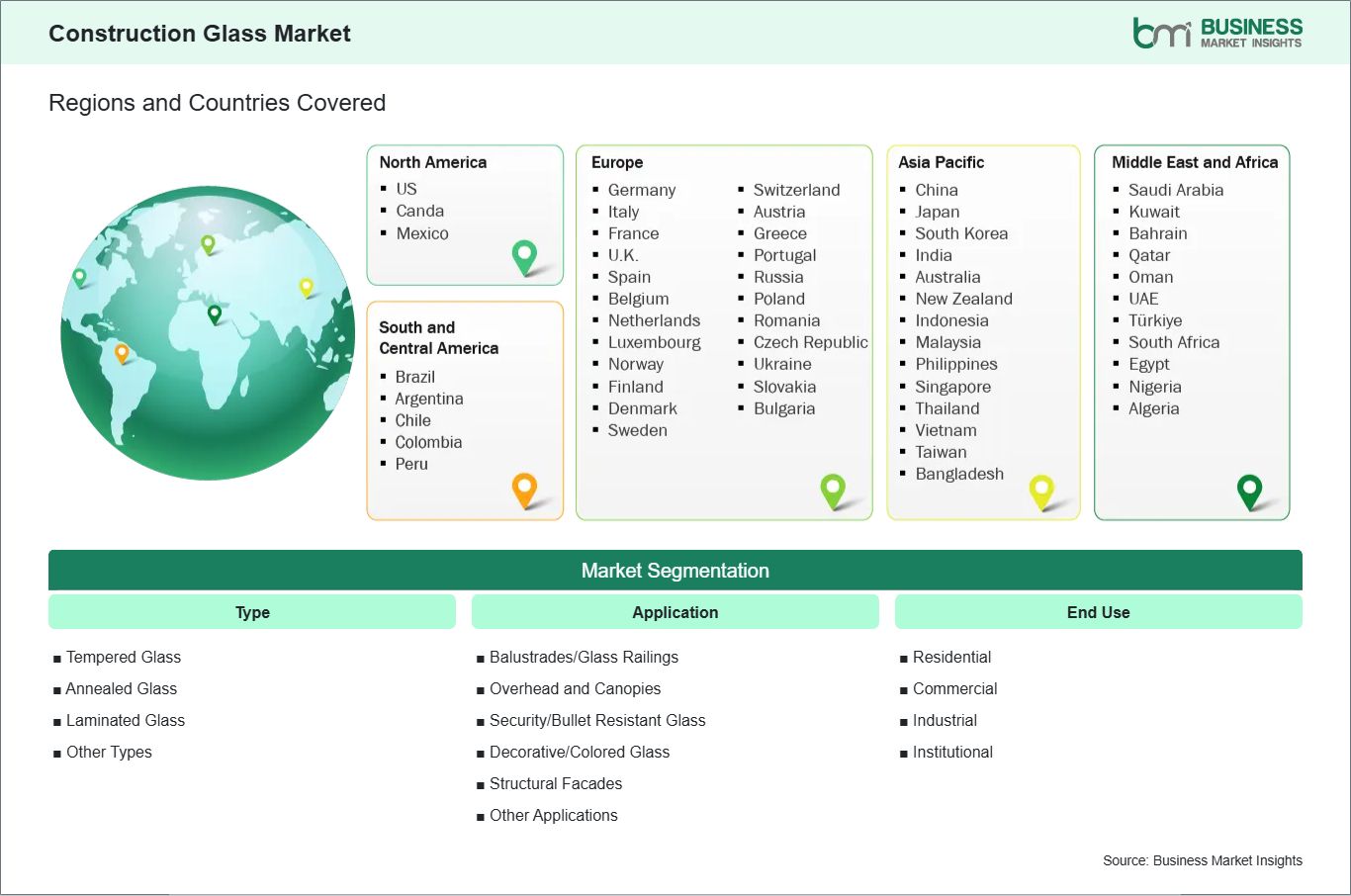
Key segments that contributed to the derivation of the construction composite market analysis are type, application, and end use.
- By type, the construction glass market is segmented into tempered glass, annealed glass, laminated glass, and others. The tempered glass segment held the largest market share in 2025.
- By application, the construction glass market is segmented into balustrades/glass railings, overhead and canopies, security/bullet-resistant glass, decorative/colored glass, structural facades, and others. The structural facades segment held the largest market share in 2025.
- By end use, the construction glass market is segmented into residential, commercial, industrial, and institutional. The commercial segment held the largest market share in 2025.
Market Forces
Construction Glass Market Drivers and Opportunities
Rising Demand for Energy-Efficient Buildings
One of the main reasons for growth in the construction glass market is the rising need for energy-efficient buildings in residential and commercial areas. Energy use in buildings makes up a large portion of global consumption. Thus, there is a strong focus on reducing heat loss and improving insulation. Construction glass, especially types like low-emissivity (Low-E) and insulated glass units, is vital for better thermal performance. It minimizes heat transfer and still allows natural light in. Governments and regulatory bodies around the world are putting stricter building codes and energy efficiency standards in place.
This encourages the use of high-performance glazing solutions. Moreover, growing awareness among consumers and developers about long-term savings from lower energy consumption is speeding up product use. Including construction glass in green building designs meets sustainability goals and helps gain certifications for energy-efficient buildings. This mix of regulatory push, environmental awareness, and economic advantages keeps demand for construction glass strong globally.
Expansion of Smart and Sustainable Glass Technologies
A significant growth opportunity in the construction glass market lies in the development and adoption of smart and sustainable glass technologies. Innovations like electrochromic glass, photochromic glass, and solar control glazing are changing how buildings handle light and heat. These solutions allow for dynamic adjustments to transparency and heat gain, improving occupant comfort while cutting down on artificial lighting and air conditioning use. As smart buildings and sustainable infrastructure become more popular, the demand for intelligent glass solutions is expected to increase significantly.
Ongoing research and development efforts are also improving product affordability and scalability, making these technologies easier to access for large-scale construction projects. The integration of renewable energy features, such as photovoltaic glass, opens new opportunities for market growth by letting buildings generate electricity. Growing investments in green infrastructure and the rising adoption of smart city initiatives will likely create favorable conditions for the widespread use of innovative construction glass solutions in the coming years.
Size and Share Analysis
Construction Glass Market Size and Share Analysis
The construction composite market demonstrates steady growth, with size and share analysis revealing evolving trends and competitive positioning among key players. The report examines subsegments categorized within type, application, and end use, offering insights into their contribution to overall market performance. By application, the structural facades segment holds the largest market share. Construction glass is commonly used in residential, commercial, and infrastructure projects for facades, partitions, windows, skylights, and exterior building envelopes. Builders and developers choose construction glass because of its strength, thermal insulation, energy efficiency, and ability to improve natural lighting in buildings. The industry appreciates construction glass for its durability, weather resistance, sound insulation, and support for modern architectural designs that are visually appealing. Additionally, it offers design flexibility, comes in various coatings and finishes, requires little maintenance, and meets changing safety and environmental standards. Growth in this segment is fueled by rapid urbanization, increasing high-rise construction, the rising demand for green buildings, and growing investments in modern infrastructure and energy-efficient construction solutions worldwide.
Report Coverage
Construction Glass Market Report Coverage and Deliverables
The " Construction Glass Market Size and Forecast (2022 - 2033)" report provides a detailed analysis of the market covering below areas:
- Construction composite market size and forecast at global, regional, and country levels for all the key market segments covered under the scope
- Construction composite market trends, as well as market dynamics such as drivers, restraints, and key opportunities
- Construction composite market analysis covering key market trends, global and regional framework, major players, regulations, and recent market developments
- Industry landscape and competition analysis covering market concentration, heat map analysis, prominent players, and recent developments for the construction composite market
- Detailed company profiles, including SWOT analysis
Geographic Insights
Construction Glass Market Geographic Insights
The geographical scope of the construction composite market report is divided into five regions: North America, Asia Pacific, Europe, the Middle East & Africa, and South & Central America. Asia Pacific holds a significant share of the construction composite market. The market growth is due to rapid urban growth, large infrastructure projects, and a booming construction sector. Countries like China, India, and those in Southeast Asia are seeing significant investments in housing, commercial buildings, and industrial developments. This creates a strong demand for construction glass products. The growth of urban populations and rising middle-class incomes is increasing the need for modern homes and high-rise buildings, where glass is commonly used for facades, windows, and interior features.
Moreover, government programs focused on smart cities and sustainable infrastructure are speeding up the use of energy-efficient glass solutions in the region. The presence of major glass manufacturers, along with affordable raw materials and labor, also supports the market's strength. Additionally, greater awareness of green building practices and new energy efficiency rules are promoting the use of modern glass technologies. This all reinforces the Asia-Pacific's top position in the global construction glass market.
Industry Activity
Recent Developments
The construction composite market is evaluated by gathering qualitative and quantitative data post-primary and secondary research, which includes important corporate publications, association data, and databases. A few of the key developments in the construction composite market are:
- In June 2023, Saint-Gobain Glass started producing India's first low-carbon glass. This reduces carbon emissions by about 40% while keeping the same performance. It supports sustainable construction and strengthens the company's commitment to net-zero and energy-efficient building solutions.
- In September 2025, Saint-Gobain Glass teamed up with LuxWall to introduce INSIO vacuum glazing in Europe. This innovation uses transparent insulation technology to greatly cut down on building energy loss, improve efficiency, and aid in decarbonizing modern building envelopes.
Trust & Transparency
Research Methodology
The market analysis combines proprietary research with secondary data from government agencies, company disclosures, regulatory filings, industry databases and expert interviews. Market estimates are validated through data triangulation, cross-market benchmarking and analyst
review.
View Full Research Methodology
Key Sources Referred:
World Bank - Global Trade IndicatorsWorld Trade Organization (WTO)International Monetary Fund (IMF)International Trade Administration (ITA)Company WebsitesCompany Annual ReportsCompany Investor PresentationsNational Glass AssociationInternational Commission on GlassGlass Association of North AmericaFlat Glass Manufacturers Association