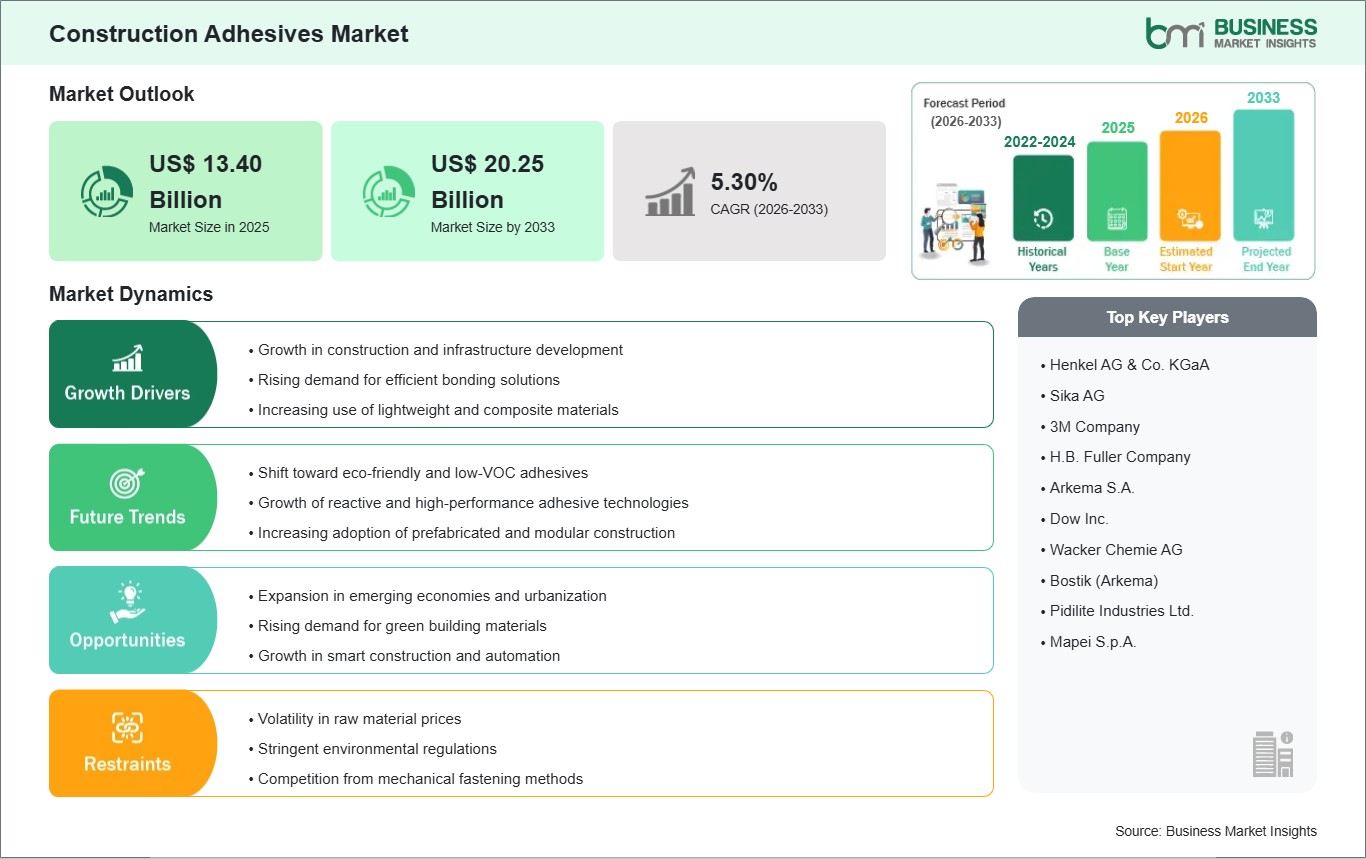
The Construction Adhesives Market size is expected to reach US$ 20.25 Billion by 2033 from US$ 13.40 Billion in 2025. The market is estimated to record a CAGR of 5.30% from 2026 to 2033.
The global construction adhesives market is experiencing steady growth, driven by increasing construction activities, urbanization, and the rising demand for high-performance bonding solutions in modern infrastructure. Construction adhesives are widely used to bond various materials such as wood, concrete, metal, ceramics, and plastics, offering advantages such as enhanced durability, flexibility, and reduced installation time compared to traditional mechanical fastening methods.
The rapid expansion of residential and commercial construction projects is a major factor contributing to market growth. Increasing population, urban migration, and rising disposable incomes are fueling demand for housing and infrastructure development, particularly in emerging economies. Construction adhesives are extensively used in flooring, roofing, panel installation, and drywall lamination, making them an integral part of modern construction practices.
Technological advancements in adhesive formulations are also playing a crucial role in market expansion. Manufacturers are developing advanced adhesives with improved bonding strength, faster curing times, and enhanced resistance to environmental factors such as moisture, temperature fluctuations, and chemicals. These innovations are enabling the use of adhesives in more demanding applications, including structural bonding and prefabricated construction systems.
Additionally, the growing trend toward sustainable and green construction is influencing the market. Low-VOC and eco-friendly adhesives are gaining popularity due to increasing environmental regulations and consumer awareness. Water-borne adhesives, in particular, are witnessing strong demand as they offer reduced emissions and improved safety during application.
Overall, the construction adhesives market is expected to grow steadily, supported by increasing construction activities, technological advancements, and the shift toward sustainable building practices.

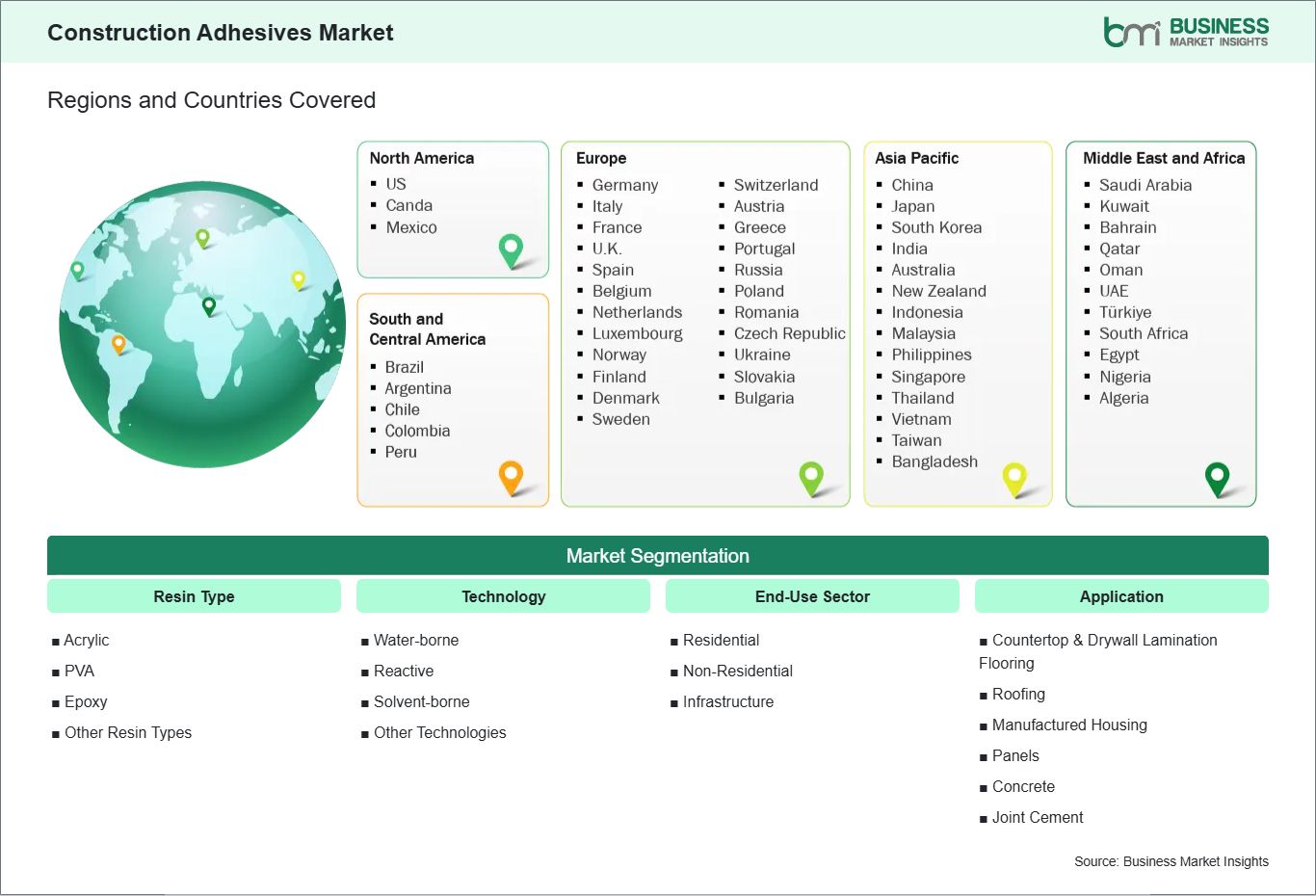
Key segments that contributed to the derivation of the construction adhesives market analysis are resin type, technology, end-use sector, and application.
The global construction industry's rapid expansion is driving demand for construction adhesives. Due to population growth and an increase in urbanization, demand for residential, commercial, and infrastructure projects (e.g., roads, bridges, and public utilities) is increasing. Because construction adhesives provide lasting, dependable bonds between a multitude of different materials used in construction (e.g., plastering, steel, wood, concrete, etc.), they are essential to the completion of construction projects.
Construction adhesives are extensively used in residential construction by allowing for quicker, easier flooring, tiling, and panel installation while reducing labor costs. Furthermore, the increase in the use of prefabricated and modular construction is contributing to demand for construction adhesives since they depend on innovative bonding technologies. Additionally, significant demand for high-performance adhesives that withstand extreme weather conditions is being generated by the infrastructure construction industry, specifically in the areas of energy and transportation.
The growing focus on enhancing construction efficiency and shortening project completion times has also contributed to the expansion of the construction adhesives industry. Compared to other types of fastening systems, adhesives install more quickly, helping contractors finish their projects faster. Additionally, the increase in the use of lightweight and composite materials in construction has also increased the demand for construction adhesives to provide strong bonds without sacrificing the structural integrity of the materials being bonded together.
Growing concern for our planet as well as governmental regulations concerning sustainability affects the construction adhesives industry. Manufacturers are developing green and sustainable adhesives which have low levels of volatile organic compounds (VOCs) so they can meet strict government rules and reduce their impact on the planet's environment. Waterborne adhesives are becoming more favoured because of their reduced emissions and better safety records; hence they are the most commonly used adhesives fo green building projects at this time.
Emerging technologies in the adhesives industry also represent opportunities for new market growth. Adhesives with reactive capabilities allow for much stronger bonds than traditional adhesives; therefore, they are well suited for heavy-duty and structural bonding. As more of these types of adhesives become available, we will see greater usage in industrial and large-scale infrastructure projects.
The quickest growing opportunity for adhesive manufacturers is with the rapidly growing economies in Asia Pacific (APAC), Latin America (LATAM) and Middle East and Africa (MEA). Urbanisation is happening at a rapid pace in these three regions; additionally, they are making large investments in public infrastructure and increasing numbers of construction projects are occurring there. Additionally, the increasing use of smart technologies in construction as well as automation (robotic processes) should add significantly to the growth of the construction adhesives market as a result of improved efficiency and waste reduction.

The Construction Adhesives Market demonstrates steady growth, with size and share analysis highlighting evolving trends and competitive dynamics among key players. The report examines subsegments categorized within resin type, technology, end-use sector, and application, offering insights into their contribution to overall market performance.
By product, the acrylic subsegment dominated the market in 2025, driven by its strong bonding properties, versatility, and wide applicability across construction projects.
By technology, the water-borne subsegment dominated the market in 2025, driven by its eco-friendly characteristics, low VOC emissions, and compliance with environmental regulations.
By end-use sector, the residential subsegment dominated the market in 2025, driven by increasing housing demand and rising construction activities globally.
In terms of application, the countertop & drywall lamination flooring subsegment dominated the market in 2025, driven by extensive use of adhesives in tile installation, laminates, and wood flooring systems.
| Report Attribute | Details |
|---|---|
| Market size in 2025 | US$ 13.40 Billion |
| Market Size by 2033 | US$ 20.25 Billion |
| Global CAGR (2026 - 2033) | 5.30% |
| Historical Data | 2022-2024 |
| Forecast period | 2026-2033 |
| Segments Covered | By Resin Type
|
|
Regions and Countries Covered
| |
| North America | US, Canada, Mexico |
| Europe | Belgium, Austria, Finland, Denmark, Greece, Poland, Romania, Russia, Ukraine, Czech Republic, Slovakia, Bulgaria, Italy, Luxembourg, Germany, Switzerland, France, Netherlands, Norway, Portugal, Spain, Sweden, United Kingdom |
| Asia-Pacific | Australia, China, India, Japan, South Korea, Indonesia, Malaysia, Philippines, Singapore, Thailand, Vietnam, Bangladesh, New Zealand, Taiwan |
| South and Central America | Brazil, Argentina, Peru, Chile, Colombia |
| Middle East and Africa | Bahrain, Kuwait, Oman, Qatar, Saudi Arabia, United Arab Emirates, Turkiye, South Africa, Egypt, Algeria, Nigeria |
| Market leaders and key company profiles |
|
The "Construction Adhesives Market Size and Forecast (2022 - 2033)" report provides a detailed analysis of the market covering below areas:
The geographical scope of the Construction Adhesives Market report is divided into North America, Asia Pacific, Europe, Middle East & Africa, and South & Central America. North America held the largest share in 2025.
North America dominates the global construction adhesives market, supported by a well-established construction industry, advanced infrastructure, and strong adoption of innovative building materials. The United States and Canada are major contributors, with significant investments in residential, commercial, and infrastructure development projects. The region’s focus on improving construction efficiency and sustainability is driving the adoption of advanced adhesive technologies.
The increasing demand for renovation and remodeling activities in North America is also contributing to market growth. Aging infrastructure and buildings require maintenance and upgrades, creating strong demand for construction adhesives used in repair and refurbishment projects. Additionally, stringent environmental regulations are encouraging the use of eco-friendly adhesives, particularly water-borne formulations with low VOC emissions.
The European region is an advanced business sector with key rules and regulations in place to ensure construction methods that help with viability long term (sustainability). The European countries of Germany, France and the UK provide funding to build highly energy-efficient buildings and develop projects to create more innovative types of glue products.
The Asia Pacific consists of some of the fastest growing economies in the world, largely due to the increasing urban development, significant population growth, and increased spending on construction infrastructure. Major economies contributing to the demand for residential and commercial construction are China, India, and other Southeast Asian countries.
EMEA and the Americas are emerging construction markets that are growing rapidly due largely to increased construction activity. However, both regions will experience different growth rates because of the costs associated with each region, as well as governing bodies developing rules that create barriers for the use of adhesives. Overall, all emerging and existing markets throughout the globe will experience growth both from the amount of construction taking place, and from advancements in technology.

The Construction Adhesives Market is evaluated by gathering qualitative and quantitative data post primary and secondary research, which includes important corporate publications, association data, and databases. A few of the key developments in the construction adhesives market are:
The Construction Adhesives Market is valued at US$ 13.40 Billion in 2025, it is projected to reach US$ 20.25 Billion by 2033.
As per our report Construction Adhesives Market, the market size is valued at US$ 13.40 Billion in 2025, projecting it to reach US$ 20.25 Billion by 2033. This translates to a CAGR of approximately 5.30% during the forecast period.
The Construction Adhesives Market report typically cover these key segments-
The historic period, base year, and forecast period can vary slightly depending on the specific market research report. However, for the Construction Adhesives Market report:
The Construction Adhesives Market is populated by several key players, each contributing to its growth and innovation. Some of the major players include:
The Construction Adhesives Market report is valuable for diverse stakeholders, including:
Essentially, anyone involved in or considering involvement in the Construction Adhesives Market value chain can benefit from the information contained in a comprehensive market report.
Please tell us your area of interest
(Market Segments/ Regions and Countries/ Companies)