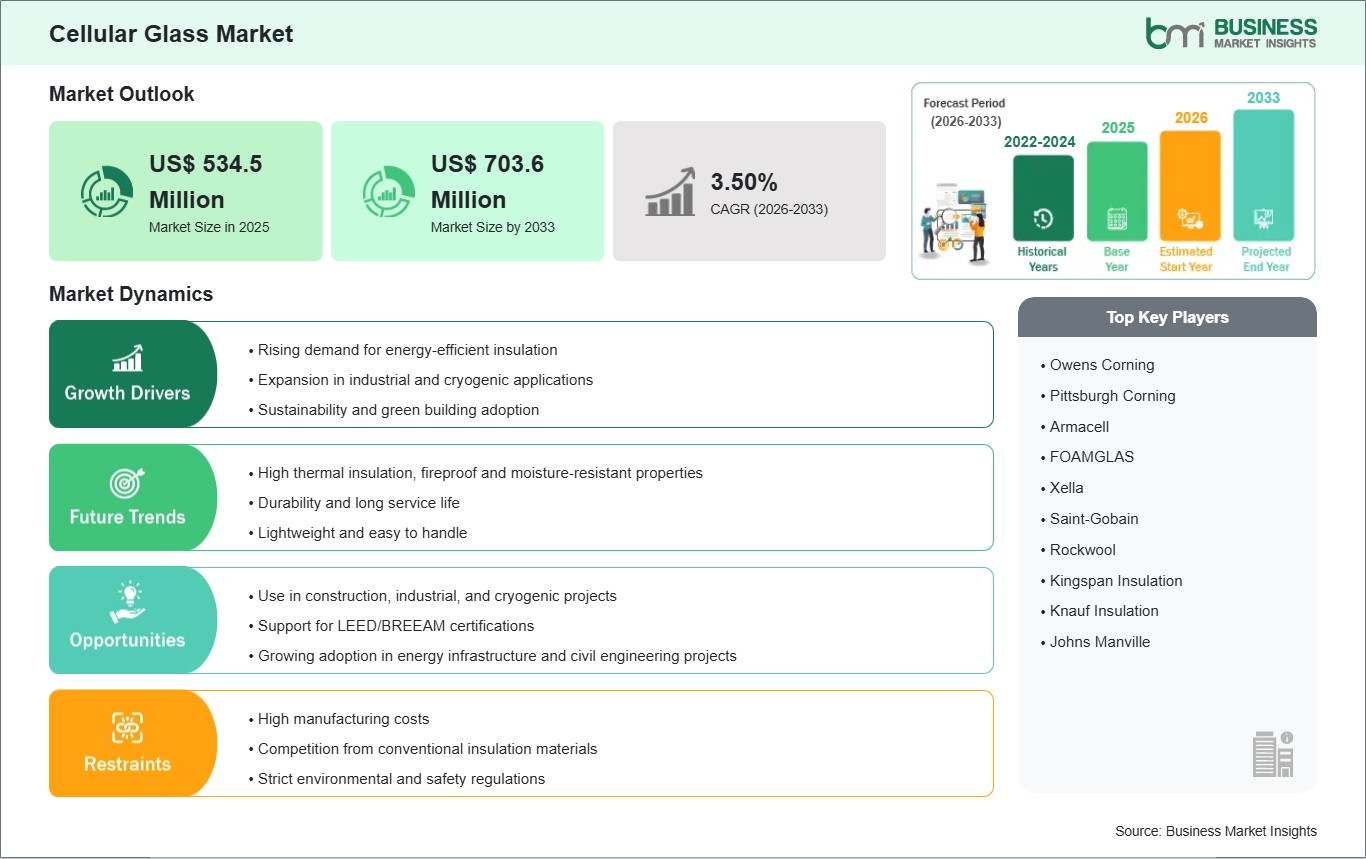
The Cellular Glass Market size is expected to reach US$ 703.6 Million by 2033 from US$ 534.5 Million in 2025. The market is estimated to record a CAGR of 3.50% from 2026 to 2033.
The global cellular glass market is experiencing steady growth driven by increasing demand for high-performance insulation materials across construction and industrial sectors. Cellular glass, also known as foam glass, is a lightweight, rigid material made from recycled glass with a closed-cell structure, offering superior thermal insulation, moisture resistance, and fireproof properties.
The growing emphasis on energy efficiency and sustainable construction practices is significantly contributing to the adoption of cellular glass. Its non-combustible nature, long service life, and resistance to water and vapor penetration make it highly suitable for applications in buildings, cryogenic systems, and industrial insulation.
Additionally, stringent environmental regulations and increasing awareness regarding green building standards are encouraging the use of eco-friendly insulation materials such as cellular glass. Technological advancements in manufacturing processes are further enhancing product performance and expanding application areas.

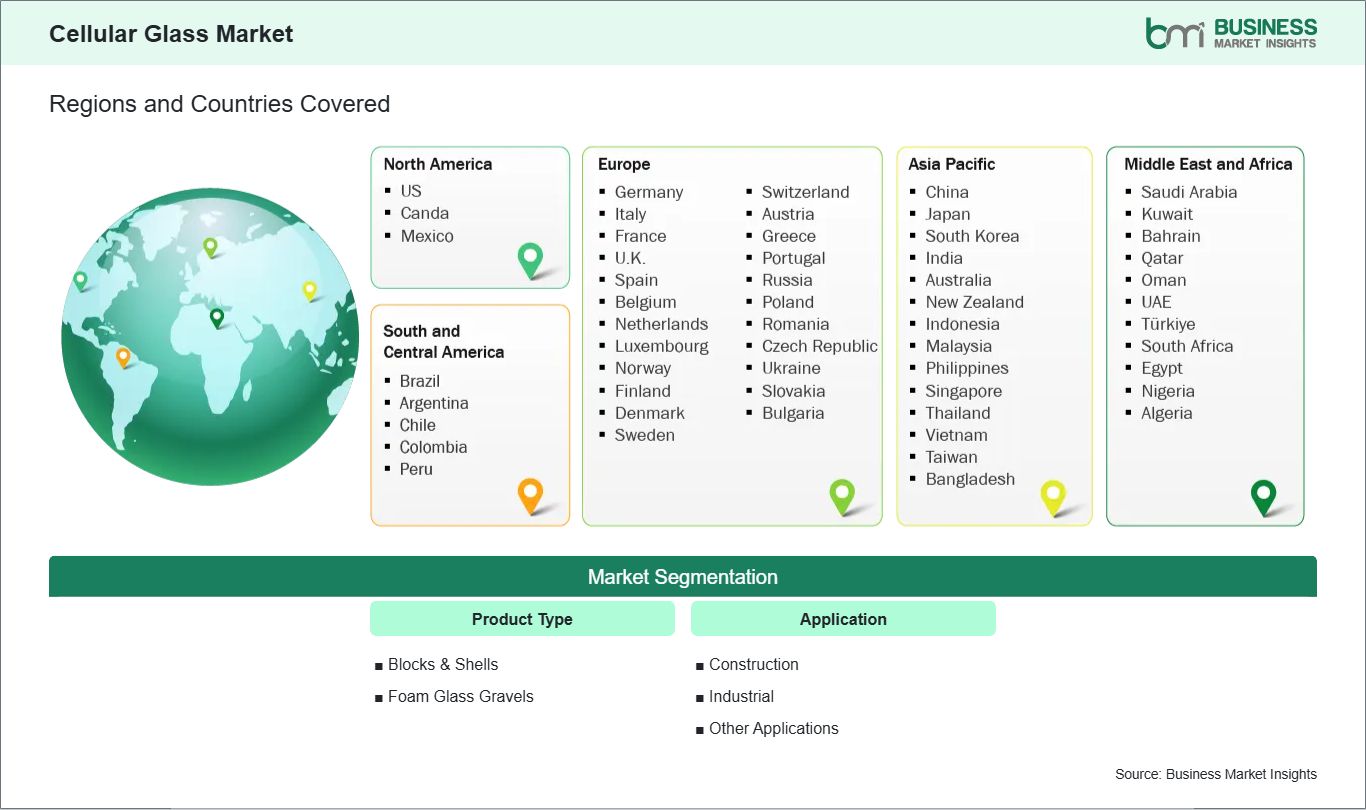
Key segments that contributed to the derivation of the cellular glass market analysis are product type and application.
Cellular glass represents one of the fastest growing areas for manufacturers of insulation composites because of the increased importance placed on conserving energy and thermal efficiency in today's construction practices. As energy prices continue to rise around the world, and local, state and federal governments continue to impose stricter regulations on energy use, builders and developers are seeking increasingly sophisticated forms of insulation that will provide long-term value for years to come. Cellular glass provides a significant advantage over other insulation materials because of the extremely low thermal conductivity of cellular glass. Cellular glass will provide the best combination of insulation to walls, roofs, and floors than any of the insulation materials currently available in the marketplace today. Cellular glass does not deteriorate or degrade over time, which means that it provides the same quality of insulation over the life of a building, unlike most other conventional insulation materials. This long-term level of performance makes cellular glass an attractive choice for construction companies engaged in sustainable construction projects where performance and longevity are critical.
Many governments and regulatory agencies throughout the world are now implementing energy efficiency requirements through regulatory standards such as those set forth by the LEED and BREEAM program requirements, which provide guidelines for the selection of high-performance insulation materials. As a result, cellular glass will contribute significantly to improving the thermal performance of heating and cooling systems, thereby helping to decrease the number of greenhouse gas emissions produced globally.
The closed-cell structure of cellular glass makes it resistant to moisture, fire, and pests, which adds to its growing popularity as an insulation material for many residential, commercial, and industrial projects.
As urban centers continue to expand and the demand for sustainable and environmentally friendly housing projects increases, cellular glass is rapidly becoming a choice for incorporation into green building projects because of its ability to provide excellent thermal efficiency and durability.
Beyond construction, the industrial sector represents a major growth avenue for the cellular glass market. Its unique properties—resistance to extreme temperatures, corrosion, and moisture—make it indispensable in industries such as oil and gas, chemical processing, and power generation. One of the most critical applications lies in cryogenic insulation, particularly for liquefied natural gas (LNG) storage and transport systems. Cellular glass provides reliable thermal performance under extremely low temperatures, ensuring safety and efficiency in handling LNG, which is vital for the global energy supply chain.
The increasing demand for LNG, driven by the transition to cleaner energy sources, is fueling investments in energy infrastructure worldwide. As new LNG terminals, pipelines, and storage facilities are developed, the need for durable and safe insulation materials is rising sharply. Cellular glass offers clear advantages over conventional insulation, including non-combustibility, dimensional stability, and resistance to chemical exposure, making it a preferred choice in critical industrial environments.
In addition to cryogenic applications, cellular glass is gaining traction in civil engineering projects. Foam glass gravel, a derivative product, is being used for lightweight fill applications, drainage systems, and ground stabilization. Its ability to provide structural support while reducing load makes it valuable in infrastructure projects such as roads, railways, and foundations.
With industries prioritizing safety, efficiency, and sustainability, cellular glass is positioned as a versatile solution that meets diverse requirements. Its expanding role in both energy infrastructure and civil engineering underscores its importance as a material that bridges construction and industrial applications, ensuring steady market growth.

The Cellular Glass Market demonstrates steady growth, with size and share analysis highlighting evolving trends and competitive dynamics among key players. The report examines subsegments categorized within product type and application, offering insights into their contribution to overall market performance.
Based on product type, the blocks & shells subsegment dominated the market in 2025, driven by their extensive use in industrial insulation and building applications.
In terms of application, the construction subsegment dominated the market in 2025, driven by increasing demand for high-performance insulation materials in residential and commercial buildings.
| Report Attribute | Details |
|---|---|
| Market size in 2025 | US$ 534.5 Million |
| Market Size by 2033 | US$ 703.6 Million |
| Global CAGR (2026 - 2033) | 3.50% |
| Historical Data | 2022-2024 |
| Forecast period | 2026-2033 |
| Segments Covered | By Product Type
|
|
Regions and Countries Covered
| |
| North America | US, Canada, Mexico |
| Europe | Belgium, Austria, Finland, Denmark, Greece, Poland, Romania, Russia, Ukraine, Czech Republic, Slovakia, Bulgaria, Italy, Luxembourg, Germany, Switzerland, France, Netherlands, Norway, Portugal, Spain, Sweden, United Kingdom |
| Asia-Pacific | Australia, China, India, Japan, South Korea, Indonesia, Malaysia, Philippines, Singapore, Thailand, Vietnam, Bangladesh, New Zealand, Taiwan |
| South and Central America | Brazil, Argentina, Peru, Chile, Colombia |
| Middle East and Africa | Bahrain, Kuwait, Oman, Qatar, Saudi Arabia, United Arab Emirates, Turkiye, South Africa, Egypt, Algeria, Nigeria |
| Market leaders and key company profiles |
|
The "Cellular Glass Market Size and Forecast (2022 - 2033)" report provides a detailed analysis of the market covering below areas:
The geographical scope of the Cellular Glass Market report is divided into North America, Asia Pacific, Europe, Middle East & Africa, and South & Central America. North America held the largest share in 2025.
North America is witnessing steady growth, supported by increasing adoption of high-performance insulation in industrial and commercial sectors. The presence of well-established infrastructure and regulatory frameworks is encouraging market expansion.
Europe market is growing due to strong emphasis on energy-efficient buildings and stringent environmental regulations. Countries such as Germany, France, and the UK are adopting advanced insulation materials to meet sustainability targets, driving demand for cellular glass.
Asia Pacific is expected to register significant growth due to rapid urbanization, industrialization, and infrastructure development. Countries such as China, India, and Japan are investing heavily in construction and energy projects, boosting demand for cellular glass products.
In the Middle East & Africa, the market is expanding due to increasing investments in oil & gas and infrastructure projects. Meanwhile, South & Central America is experiencing moderate growth, supported by rising construction activities and industrial development.
Across all regions, sustainability initiatives, energy efficiency regulations, and industrial expansion are shaping market dynamics.

The Cellular Glass Market is evaluated by gathering qualitative and quantitative data post primary and secondary research, which includes important corporate publications, association data, and databases. A few of the key developments in the cellular glass market are:
The Cellular Glass Market is valued at US$ 534.5 Million in 2025, it is projected to reach US$ 703.6 Million by 2033.
As per our report Cellular Glass Market, the market size is valued at US$ 534.5 Million in 2025, projecting it to reach US$ 703.6 Million by 2033. This translates to a CAGR of approximately 3.50% during the forecast period.
The Cellular Glass Market report typically cover these key segments-
The historic period, base year, and forecast period can vary slightly depending on the specific market research report. However, for the Cellular Glass Market report:
The Cellular Glass Market is populated by several key players, each contributing to its growth and innovation. Some of the major players include:
The Cellular Glass Market report is valuable for diverse stakeholders, including:
Essentially, anyone involved in or considering involvement in the Cellular Glass Market value chain can benefit from the information contained in a comprehensive market report.
Please tell us your area of interest
(Market Segments/ Regions and Countries/ Companies)