Foam Glass Market Outlook (2022-2033)

Historic Data: 2022-2024   |   Base Year: 2025   |   Forecast Period: 2026-2033
Report Content: Market Scope, Market Segmentation, Market Dynamics, and Competitive Analysis

Report Coverage:
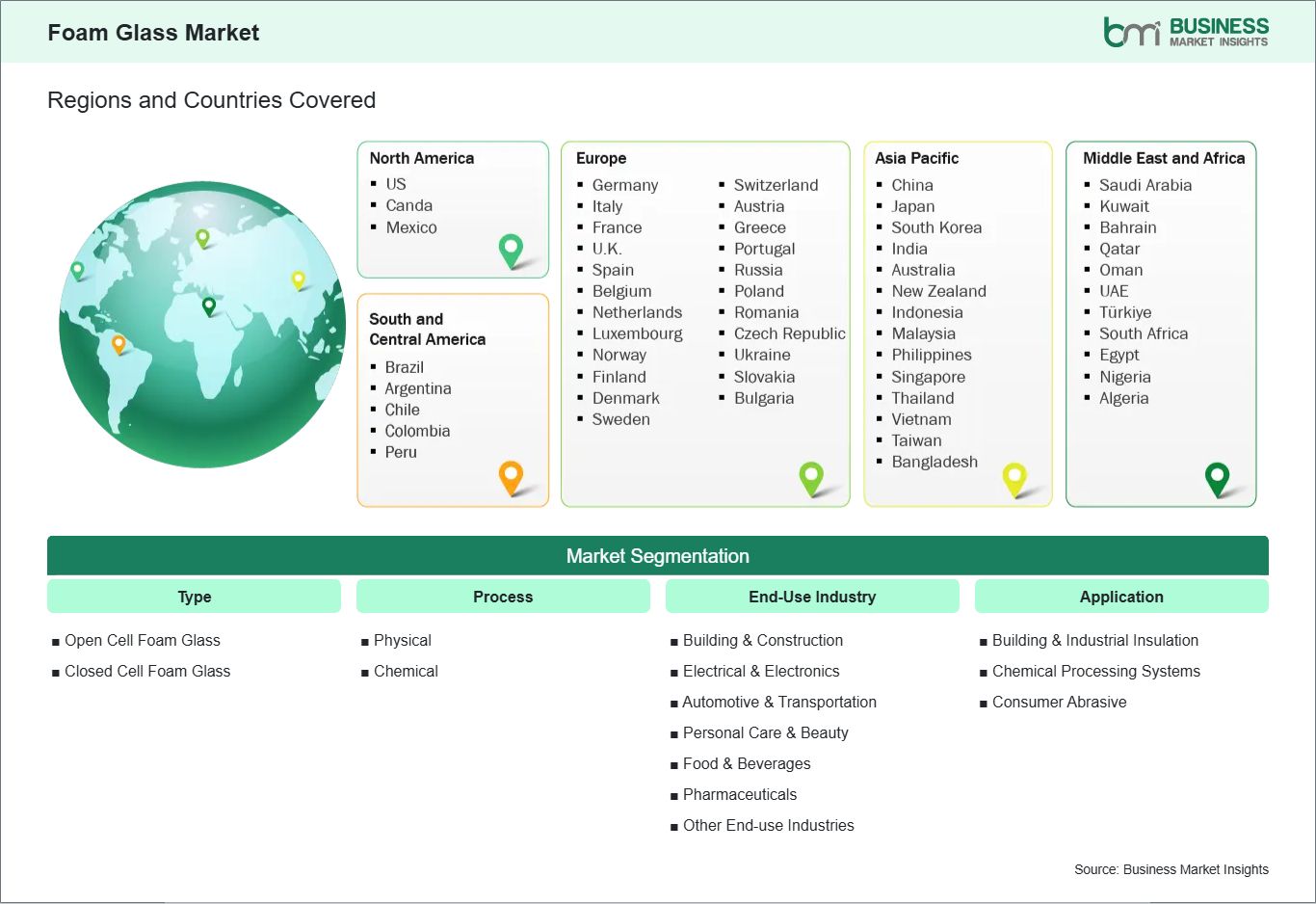
  • Type (Open Cell Foam Glass, Closed Cell Foam Glass)
  • Process (Physical, Chemical)
  • End-Use Industry (Building & Construction, Electrical & Electronics, Automotive & Transportation, Personal Care & Beauty, Food & Beverages, Pharmaceuticals, Other End-use Industries)
  • Application (Building & Industrial Insulation, Chemical Processing Systems, Consumer Abrasive)

No. of Pages: 406
Report Code: BMIPUB00033946
Category: Chemicals and Materials
Foam Glass Market

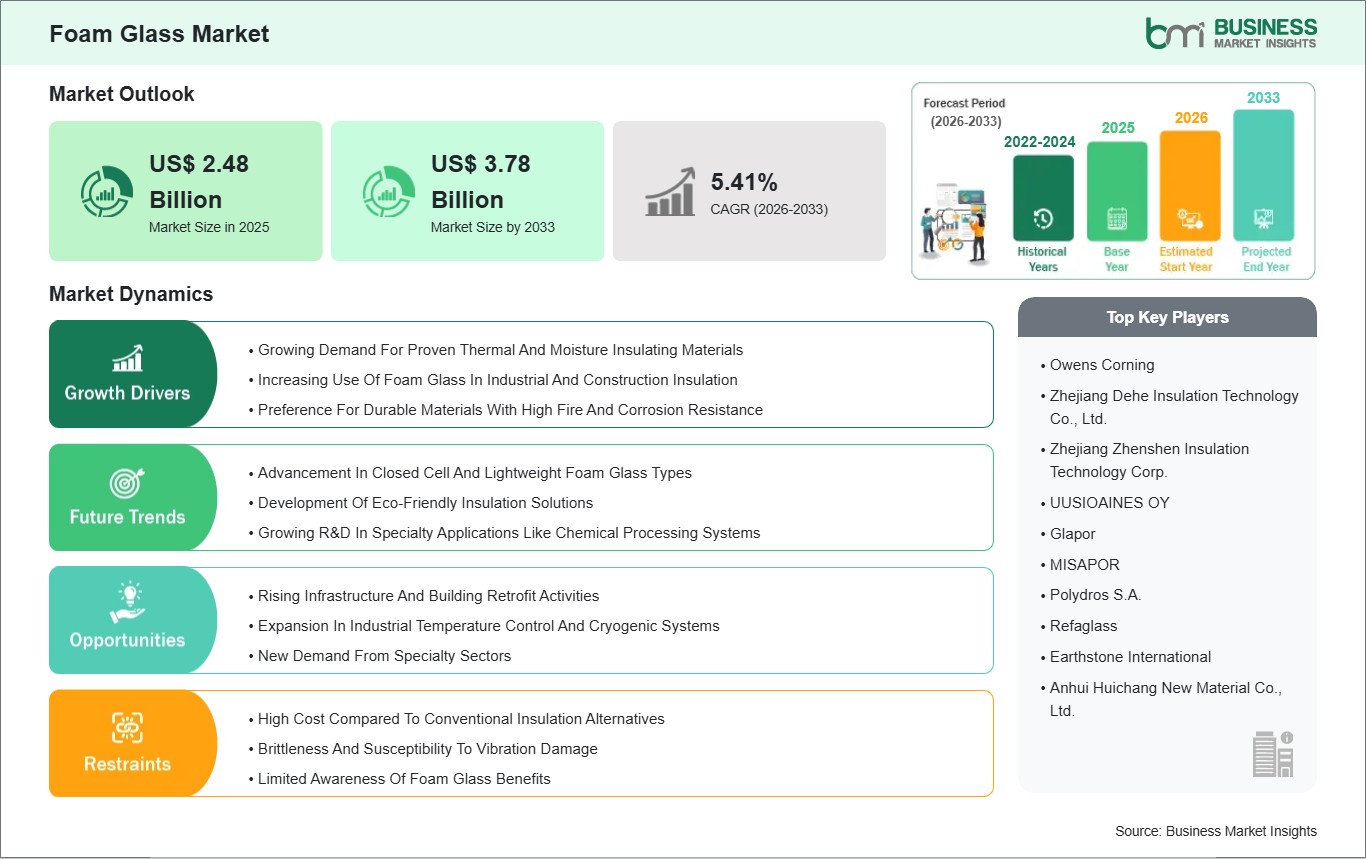
The Foam Glass Market size is expected to reach US$ 3.78 Billion by 2033 from US$ 2.48 Billion in 2025. The market is estimated to record a CAGR of 5.41% from 2026 to 2033.

Executive Summary and Global Market Analysis:

The global foam glass market refers to the lightweight cellular glass materials that are commonly used in building, insulation, industrial, and infrastructure projects. Foam glass, known for its thermal insulation, resistance to fire, chemicals, and moisture, offers a green solution to insulation materials. The foam glass market has witnessed significant growth due to the increasing demand for energy-efficient buildings, industrial insulation of pipelines and storage tanks, and green building practices. Moreover, urbanization, green building projects, and the increasing focus on saving energy have also contributed to the demand for foam glass.

In addition, the product's versatility in different forms, including blocks, granules, and panels, has made it possible to incorporate foam glass in numerous applications, including roof insulation, floor coverings, and industrial applications in cryogenic and high-temperature processes. The production of foam glass is an energy-consuming process, and hence, the cost may be higher when compared to other insulation materials. Lack of awareness regarding the usage of foam glass in various developing countries may hinder the market growth. Additionally, the need for special handling and installation may influence the adoption rate of foam glass.

However, the increasing trend towards sustainable and long-lasting building materials, along with the rise in infrastructure and the need for environmental regulations to promote energy-efficient insulation, provides a positive outlook for the foam glass market. Innovation in product and increased availability of customized foam glass products are expected to boost the market presence.

Foam Glass Market - Strategic Insights:

global-market-strategic-framework
Get more information on this report

Foam Glass Market Segmentation Analysis:

Key segments that contributed to the derivation of the foam glass market analysis are type, process, end‑use industry, and application.

  • By type, the foam glass market is segmented into open cell foam glass and closed cell foam glass. The closed cell foam glass subsegment dominated the market in 2025.
  • Based on process, the foam glass market is classified into physical and chemical. The chemical process subsegment dominated the market in 2025.
  • In terms of end‑use industry, the foam glass market is divided into building & construction, industrial, and other end‑use industries. The building & construction subsegment dominated the market in 2025.
  • On the basis of application, the foam glass market is grouped into building & industrial insulation, chemical processing systems, and consumer abrasive. The building & industrial insulation subsegment dominated the market in 2025.

Foam Glass Market Drivers and Opportunities:

Growing Demand For Proven Thermal And Moisture Insulating Materials

The global foam glass market is being driven by its exceptional combination of lightweight durability and chemical stability, making it suitable for challenging and high-performance applications. Unlike conventional insulation materials, foam glass offers long-lasting protection against mechanical stress, water infiltration, and corrosive substances, which is critical in environments such as chemical plants, underground utility networks, and coastal or marine infrastructure. Its rigid, closed-cell structure enables it to serve simultaneously as a structural reinforcement and a protective barrier, supporting mechanical loads while preventing damage from environmental exposure. This dual functionality allows engineers to design systems that are both resilient and compact, reducing the need for additional support structures.

The adoption of foam glass in various regions is subject to the industrial and construction needs of the region. For regions with significant industrial activity, foam glass is employed to shield pipelines, storage tanks, and floors under heavy load from chemical corrosion and water damage. For regions with significant urbanization, foam glass is increasingly being employed in modular building structures, tunnel linings, and roof insulation panels, where its lightweight and non-combustible nature makes installation easier and more efficient. Its flexibility to work well with irregular surfaces and its mechanical strength make it highly suitable for both conventional and unconventional engineering projects.

Sustainability and safety considerations further strengthen demand. Foam glass is produced primarily from recycled glass, offering a more eco-friendly alternative to synthetic insulation materials, while its fire-resistant properties make it suitable for industrial, commercial, and high-risk environments. Its inert nature ensures no harmful leaching, maintaining environmental and operational safety. As global regulatory frameworks increasingly emphasize structural resilience, chemical resistance, and environmental compliance, foam glass emerges as a versatile material that addresses industrial, construction, and safety demands simultaneously, positioning it as a critical solution for modern high-performance insulation applications worldwide.

Rising Infrastructure And Building Retrofit Activities

Infrastructure expansion and building modernization are driving the global foam glass market, as construction and industrial projects seek durable, lightweight, and chemically stable materials. Foam glass panels, blocks, and pipe jackets are increasingly specified for tunnels, industrial complexes, transportation corridors, and cold storage facilities, where their structural rigidity and moisture resistance ensure long-term performance under demanding conditions. In retrofit projects, foam glass reinforces aging underground pipelines, roof systems, and walls, providing mechanical support and preventing material degradation in cases where conventional insulation materials fail to maintain integrity over time.

Regional variations also demonstrate the adaptability of foam glass to fulfill different construction demands. In established urban centers, it is used to renovate older industrial and commercial buildings, enhancing foundations, utility corridors, and high-rise constructions. In rapidly developing regions, foam glass is used for new constructions like ports, warehouses, and modular construction sites, where lightness of installation, resistance to fire, and long lifespan are significant factors. Its capacity to adjust to irregular surfaces and integrate with other systems also makes it highly flexible for intricate and large-scale constructions.

Safety, durability, and operational efficiency continue to be key drivers for foam glass adoption. Its closed-cell structure prevents water penetration and microbial growth, ensuring the longevity of insulation and structural components. Additionally, its non-combustible and chemically inert properties make it suitable for high-risk industrial and transportation facilities. As urban infrastructure expands and aging buildings undergo modernization globally, foam glass provides a low-maintenance, resilient, and environmentally responsible solution, reinforcing its position as a critical material in construction, industrial retrofitting, and specialized engineering applications.

Foam Glass Market Size and Share Analysis:

The foam glass market is experiencing steady growth, with market size and share analysis reflecting evolving treatment preferences and competitive dynamics among key players. The report evaluates important subsegments categorized within type, process, end‑use industry, application, highlighting their respective contributions to overall market performance.

By type, the Closed Cell Foam Glass subsegment dominated the Foam Glass market in 2025. Closed cell foam glass offers superior thermal insulation, moisture resistance, and structural strength, making it highly suitable for a wide range of applications, which drives its widespread adoption.

Based on process, the Chemical Process subsegment dominated the Foam Glass market in 2025. Chemical process foam glass provides consistent quality and enhanced properties through controlled reactions, making it highly suitable for industrial and construction applications, which drives its widespread adoption.

Based on end‑use industry, the Building & Construction subsegment dominated the Foam Glass market in 2025. Building and construction applications demand durable, energy-efficient, and insulating materials, making this segment highly suitable for structural and insulation needs, which drives its widespread adoption.

Based on application, the Building & Industrial Insulation subsegment dominated the Foam Glass market in 2025. Building and industrial insulation applications require effective thermal and acoustic insulation, making this segment highly suitable for energy-saving and protective solutions, which drives its widespread adoption.

Foam Glass Market Report Highlights:

Report Attribute Details
Market size in 2025 US$ 2.48 Billion
Market Size by 2033 US$ 3.78 Billion
Global CAGR (2026 - 2033)5.41%
Historical Data 2022-2024
Forecast period 2026-2033
Segments Covered By Type
  • Open Cell Foam Glass
  • Closed Cell Foam Glass
By Process
  • Physical
  • Chemical
By End-Use Industry
  • Building & Construction
  • Electrical & Electronics
  • Automotive & Transportation
  • Personal Care & Beauty
  • Food & Beverages
  • Pharmaceuticals
  • Other End-use Industries
By Application
  • Building & Industrial Insulation
  • Chemical Processing Systems
  • Consumer Abrasive
Regions and Countries Covered
North America US, Canada, Mexico
Europe Belgium, Austria, Finland, Denmark, Greece, Poland, Romania, Russia, Ukraine, Czech Republic, Slovakia, Bulgaria, Italy, Luxembourg, Germany, Switzerland, France, Netherlands, Norway, Portugal, Spain, Sweden, United Kingdom
Asia-Pacific Australia, China, India, Japan, South Korea, Indonesia, Malaysia, Philippines, Singapore, Thailand, Vietnam, Bangladesh, New Zealand, Taiwan
South and Central America Brazil, Argentina, Peru, Chile, Colombia
Middle East and Africa Bahrain, Kuwait, Oman, Qatar, Saudi Arabia, United Arab Emirates, Turkiye, South Africa, Egypt, Algeria, Nigeria
Market leaders and key company profiles
  • Owens Corning
  • Zhejiang Dehe Insulation Technology Co., Ltd.
  • Zhejiang Zhenshen Insulation Technology Corp.
  • UUSIOAINES OY
  • Glapor
  • MISAPOR
  • Polydros S.A.
  • Refaglass
  • Earthstone International
  • Anhui Huichang New Material Co., Ltd.
Get more information on this report

Foam Glass Market Report Coverage and Deliverables:

The "Foam Glass Market Size and Forecast (2022 - 2033)" report provides a detailed analysis of the market covering below areas:

  • Foam Glass market size and forecast at global, regional, and country levels for all the key market segments covered under the scope
  • Foam Glass market trends, as well as drivers, restraints, and opportunities
  • Foam Glass market analysis covering key trends, regional framework, major players, regulations, and recent developments
  • Industry landscape and competition analysis covering market concentration, heat map analysis, prominent players, and recent developments for the Foam Glass market
  • Detailed company profiles, including SWOT analysis

Foam Glass Market Geographic Insights:

The geographical scope of the Foam Glass market report is divided into five regions: North America, Asia Pacific, Europe, Middle East & Africa, and South & Central America. The Foam Glass market in North America is expected to grow during the forecast period.

North America is the dominant region in the global foam glass market due to its extensive oil and gas industry infrastructure, advanced drilling technology, and a high focus on operational efficiency. The region`s mature exploration and production sector, including both onshore shale and offshore deepwater operations, drives continuous demand for advanced fluid loss control solutions. Operators in North America prioritize additives that enhance drilling efficiency, reduce formation damage, and improve wellbore stability under diverse geological and environmental conditions. Technological advancements in North America have helped manufacturers create highly specialized foam glass products designed for extreme pressure, high-temperature, and complex formation applications.

Environmental factors are also important in the industry, with many organizations focusing on creating environmentally friendly and biodegradable products to meet regulatory requirements. Collaborations between chemical industry players and drilling organizations have also helped create customized products to improve efficiency and reduce non-productive time.

Although the cost of these chemicals and the expertise required are important factors, North America`s established industry, focus on innovation, and regulatory compliance make it an important contributor to the global market for foam glass. The region`s continued emphasis on sustainability and efficiency ensures that it remains at the forefront in this critical aspect of the industry.

global-market-geography
Get more information on this report

Foam Glass Market Research Report Guidance:

  • The report includes qualitative and quantitative data in the Foam Glass market across type, process, end‑use industry, application, and geography.
  • The report starts with the key takeaways (chapter 2), highlighting the key trends and outlook of the Foam Glass market.
  • Chapter 3 focuses on the research methodology of the study.
  • Chapter 4 includes ecosystem analysis.
  • Chapter 5 highlights the major industry dynamics in the Foam Glass market, including factors that are driving the market, prevailing deterrents, potential opportunities, as well as future trends. Impact analysis of these drivers and restraints is also covered in this section.
  • Chapter 6 discusses the Foam Glass market scenario, in terms of historical market revenues, and forecast till the year 2033.
  • Chapters 7 to 11 cover the Foam Glass market segments by type, process, end‑use industry, application, and geography across North America, Europe, Asia Pacific, Middle East and Africa, and South and Central America. They cover the market volume, revenue forecast, and factors driving the market.
  • Chapter 12 describes the competitive analysis with the heat map analysis for the key players operating in the market.
  • Chapter 13 describes the industry landscape analysis. It provides detailed descriptions of business activities such as market initiatives, new developments, mergers, and joint ventures globally, along with a competitive landscape.
  • Chapter 14 provides detailed profiles of the major companies operating in the Foam Glass market. Companies have been profiled on the basis of their key facts, business descriptions, products, financial overview, SWOT analysis, and key developments.
  • Chapter 15, i.e., the appendix, is inclusive of a brief overview of the company, list of abbreviations, and disclaimer.

Foam Glass Market News and Key Development:

The foam glass market is evaluated by gathering qualitative and quantitative data post primary and secondary research, which includes important corporate publications, association data, and databases. A few of the key developments in the foam glass market are:

  • In June 2025, Owens Corning announced that it approved a major strategic investment to expand its FOAMGLAS cellular glass insulation plant in Klasterec, Czech Republic, increasing production capacity by approximately 50 % to better meet growing demand in Europe and enhance sustainability by lowering the carbon intensity of its operations reinforcing its position in the global foam glass insulation segment.
  • In March 2024, Foamit Group Oy announced that it decided on an investment programme of around US$ ~10.7 million to double foam glass manufacturing capacity at its Onsoy plant in Norway, including installation of new electric production lines and conversion of existing lines to reduce emissions, with full expanded capacity expected to be operational by 2026.

Key Sources Referred:

  • International Organization for Standardization (ISO)
  • American Society for Testing and Materials (ASTM International)
  • Bureau of Indian Standards (BIS)
  • Environmental Protection Agency (EPA), USA
  • European Chemicals Agency (ECHA)
  • Central Pollution Control Board (CPCB), India
  • Ministry of Chemicals and Fertilizers, India
  • American Chemistry Council (ACC)
  • Indian Chemical Council (ICC)
  • European Chemical Industry Council (Cefic)
  • Specialty Chemical Association of India (SCAI)
  • Company Websites
  • Company Annual Reports
  • Company Investor Presentations
The List of Companies - Foam Glass Market
  • Owens Corning
  • Zhejiang Dehe Insulation Technology Co., Ltd.
  • Zhejiang Zhenshen Insulation Technology Corp.
  • UUSIOAINES OY
  • Glapor
  • MISAPOR
  • Polydros S.A.
  • Refaglass
  • Earthstone International
  • Anhui Huichang New Material Co., Ltd.
Frequently Asked Questions
How big is the Foam Glass Market?

The Foam Glass Market is valued at US$ 2.48 Billion in 2025, it is projected to reach US$ 3.78 Billion by 2033.

What is the CAGR for Foam Glass Market by (2026 - 2033)?

As per our report Foam Glass Market, the market size is valued at US$ 2.48 Billion in 2025, projecting it to reach US$ 3.78 Billion by 2033. This translates to a CAGR of approximately 5.41% during the forecast period.

What segments are covered in this report?

The Foam Glass Market report typically cover these key segments-

  • Type (Open Cell Foam Glass, Closed Cell Foam Glass)
  • Process (Physical, Chemical)
  • End-Use Industry (Building & Construction, Electrical & Electronics, Automotive & Transportation, Personal Care & Beauty, Food & Beverages, Pharmaceuticals, Other End-use Industries)
  • Application (Building & Industrial Insulation, Chemical Processing Systems, Consumer Abrasive)

What is the historic period, base year, and forecast period taken for Foam Glass Market?

The historic period, base year, and forecast period can vary slightly depending on the specific market research report. However, for the Foam Glass Market report:

  • Historic Period : 2022-2024
  • Base Year : 2025
  • Forecast Period : 2026-2033
  • Who are the major players in Foam Glass Market?

    The Foam Glass Market is populated by several key players, each contributing to its growth and innovation. Some of the major players include:

  • Owens Corning
  • Zhejiang Dehe Insulation Technology Co., Ltd.
  • Zhejiang Zhenshen Insulation Technology Corp.
  • UUSIOAINES OY
  • Glapor
  • MISAPOR
  • Polydros S.A.
  • Refaglass
  • Earthstone International
  • Anhui Huichang New Material Co., Ltd.
  • Who should buy this report?

    The Foam Glass Market report is valuable for diverse stakeholders, including:

    • Investors: Provides insights for investment decisions pertaining to market growth, companies, or industry insights. Helps assess market attractiveness and potential returns.
    • Industry Players: Offers competitive intelligence, market sizing, and trend analysis to inform strategic planning, product development, and sales strategies.
    • Suppliers and Manufacturers: Helps understand market demand for components, materials, and services related to concerned industry.
    • Researchers and Consultants: Provides data and analysis for academic research, consulting projects, and market studies.
    • Financial Institutions: Helps assess risks and opportunities associated with financing or investing in the concerned market.

    Essentially, anyone involved in or considering involvement in the Foam Glass Market value chain can benefit from the information contained in a comprehensive market report.

    Available Report Formats

    pdf-format excel-format pptx-format
    Buy Now
    Sales Assistance
    +1 646 791 7070 (US & UK)
    Customization Form

    Please tell us your area of interest
    (Market Segments/ Regions and Countries/ Companies)