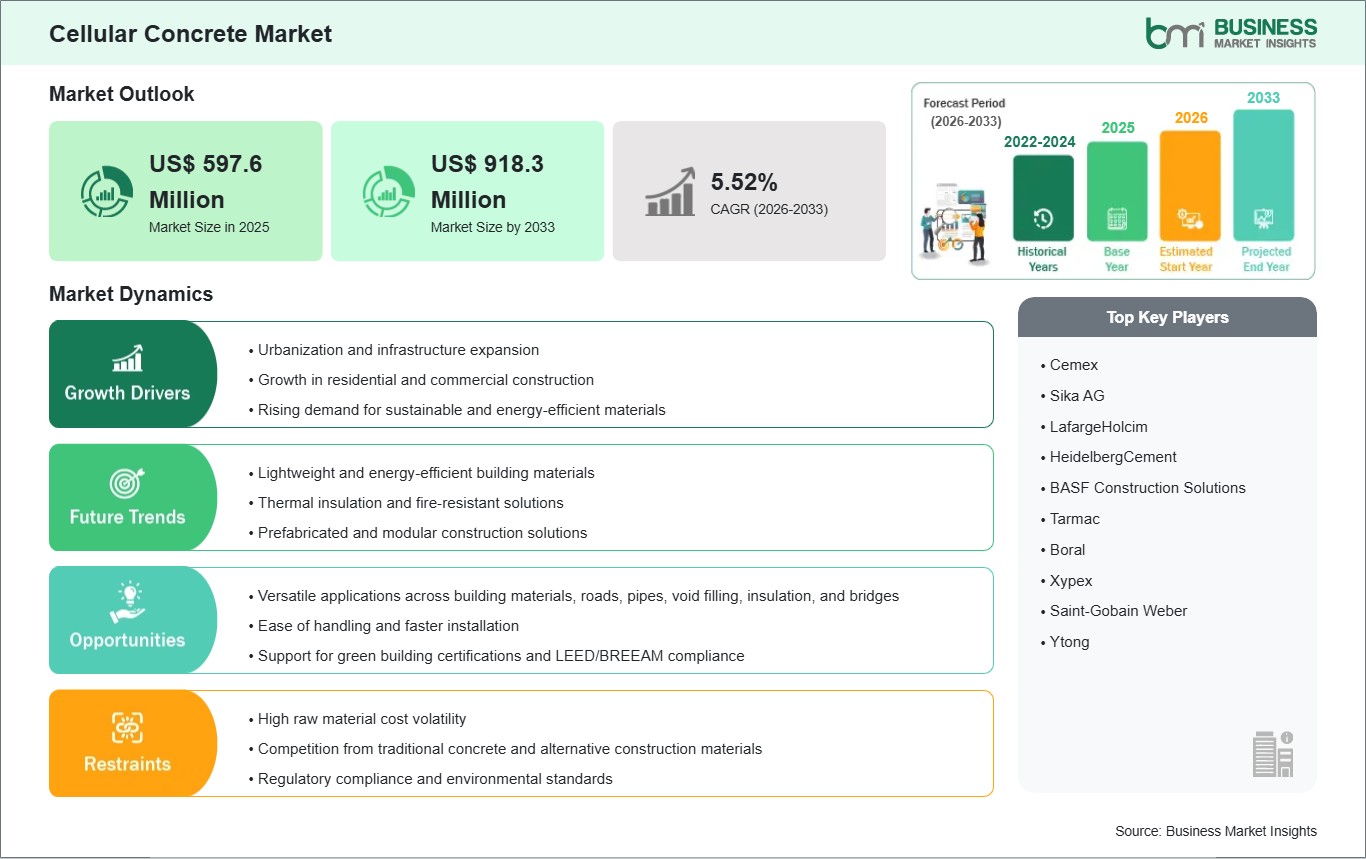
The Cellular Concrete Market size is expected to reach US$ 918.3 Million by 2033 from US$ 597.6 Million in 2025. The market is estimated to record a CAGR of 5.52% from 2026 to 2033.
The global cellular concrete market is witnessing steady growth driven by increasing demand for lightweight, energy-efficient, and cost-effective construction materials. Cellular concrete, including aerated and foam concrete, is widely used in construction due to its low density, excellent thermal insulation, and ease of application. These properties make it highly suitable for modern infrastructure and building projects where reducing structural load and improving energy efficiency are key priorities.
Rapid urbanization and rising investments in infrastructure development are significantly contributing to market expansion. Governments and private sector players are increasingly focusing on sustainable construction practices, which is accelerating the adoption of cellular concrete. Its ability to incorporate recycled materials and reduce carbon footprint further enhances its appeal in environmentally conscious construction projects.
Technological advancements in production processes and material formulation are improving the performance characteristics of cellular concrete, including strength, durability, and consistency. Additionally, the growing trend toward prefabricated and modular construction is further supporting market growth, as cellular concrete offers ease of handling and faster installation.

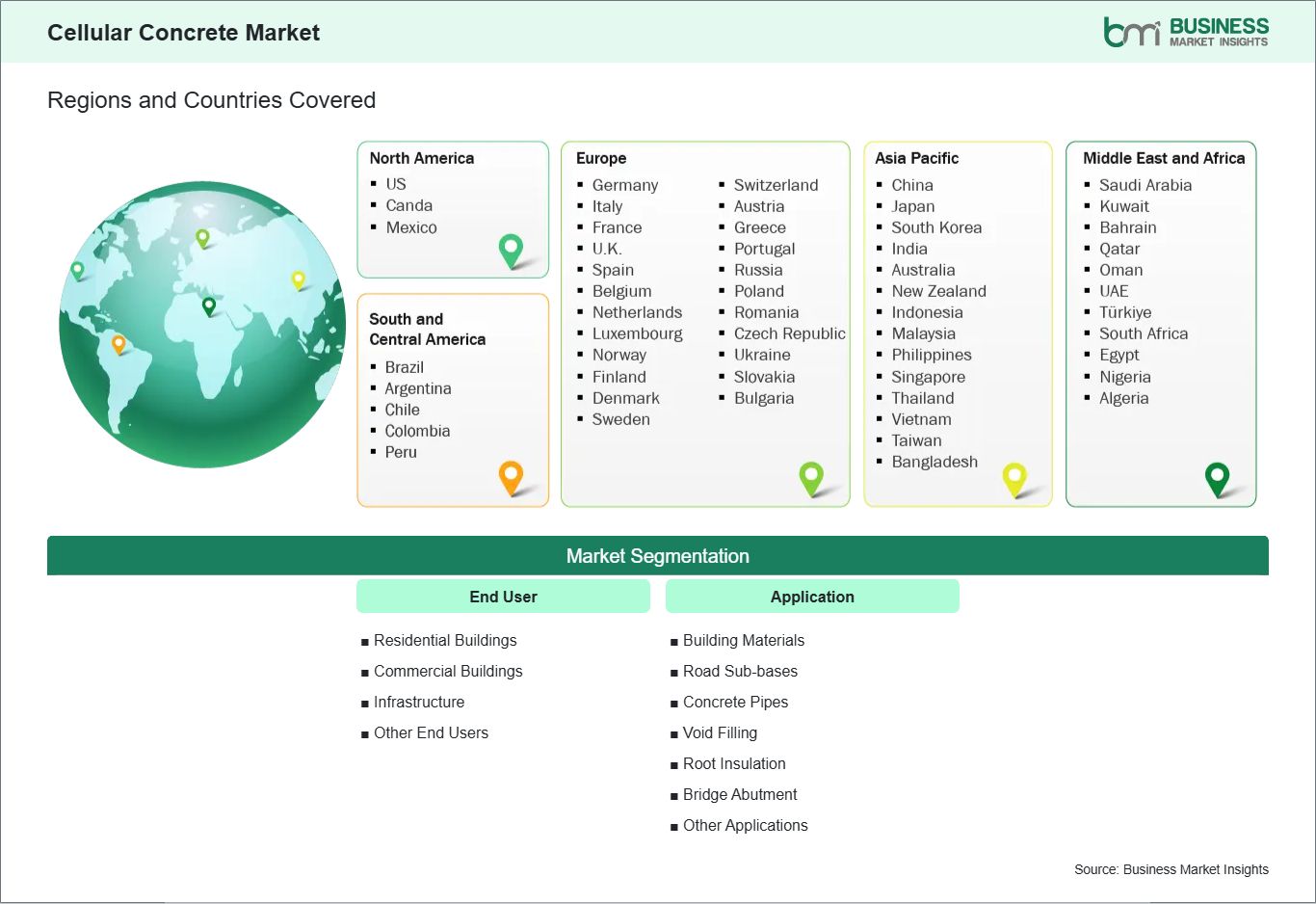
Key segments that contributed to the derivation of the cellular concrete market analysis are end user and application.
The global market for cellular concrete is driven by two main forces, the growth of infrastructure and rapid urbanization. To address increasing populations and modern economies' demands, governments are actively investing in roads, bridges, tunnels and public housing projects worldwide. All of these large-scale projects require durable yet lightweight materials, which is where cellular concrete meets both of these criteria perfectly. By reducing the structural loads while providing stability, cellular concrete is beneficial for applications such as road sub-bases, bridge abutments, and void fill/infill. Additionally, by reducing the total weight of the structure, cellular concrete can help prolong the life of the structure and reduce maintenance costs.
Another benefit of cellular concrete is its flowability and ease of placement, which allows for use in complicated construction environments where more traditional materials may prove difficult to install. This often results in a decrease in both labor needed to install the material and time taken to complete a project. As cities continue expanding, the demand for efficient and flexible materials such as cellular concrete will continue to increase significantly.
The versatility of cellular concrete also allows for it to be utilized for both residential and commercial construction, which enhances the growing need for contemporary housing and smart infrastructure. As the rate of urbanization increases in Asia Pacific, Africa and Latin America, cellular concrete will continue to expand.
Sustainability has become a defining trend in the construction industry, and cellular concrete is gaining traction as a material that aligns with these priorities. One of its most significant advantages is its excellent thermal insulation, which contributes to energy efficiency in both residential and commercial buildings. By reducing heating and cooling demands, cellular concrete helps lower energy consumption and supports the development of environmentally responsible structures.
The production of cellular concrete often incorporates industrial by-products such as fly ash, which reduces waste and supports circular economy initiatives. This not only minimizes environmental impact but also lowers production costs, making it an attractive option for developers seeking sustainable solutions. As global awareness of climate change and resource conservation grows, the demand for eco-friendly building materials is expected to increase substantially.
In addition to sustainability, cellular concrete offers enhanced fire resistance, sound insulation, and durability. These properties make it suitable for a wide range of applications, from residential housing to commercial complexes and public infrastructure. Its ability to meet multiple performance criteria—safety, comfort, and efficiency—positions it as a versatile material for modern construction.
Green building certifications such as LEED and BREEAM are further encouraging the adoption of materials like cellular concrete. Developers and architects are increasingly integrating it into projects to meet regulatory standards and consumer expectations for sustainable living spaces. With its combination of environmental benefits and functional performance, cellular concrete is emerging as a cornerstone material in the push toward energy-efficient and sustainable construction worldwide.

The Cellular Concrete Market demonstrates steady growth, with size and share analysis highlighting evolving trends and competitive dynamics among key players. The report examines subsegments categorized within end user and application, offering insights into their contribution to overall market performance.
Based on end user, the residential buildings subsegment dominated the market in 2025, driven by rising demand for energy-efficient housing and rapid urban population growth.
In terms of application, the building materials subsegment dominated the market in 2025, driven by extensive use in walls, blocks, and insulation systems in both residential and commercial construction.
| Report Attribute | Details |
|---|---|
| Market size in 2025 | US$ 597.6 Million |
| Market Size by 2033 | US$ 918.3 Million |
| Global CAGR (2026 - 2033) | 5.52% |
| Historical Data | 2022-2024 |
| Forecast period | 2026-2033 |
| Segments Covered | By End User
|
|
Regions and Countries Covered
| |
| North America | US, Canada, Mexico |
| Europe | Belgium, Austria, Finland, Denmark, Greece, Poland, Romania, Russia, Ukraine, Czech Republic, Slovakia, Bulgaria, Italy, Luxembourg, Germany, Switzerland, France, Netherlands, Norway, Portugal, Spain, Sweden, United Kingdom |
| Asia-Pacific | Australia, China, India, Japan, South Korea, Indonesia, Malaysia, Philippines, Singapore, Thailand, Vietnam, Bangladesh, New Zealand, Taiwan |
| South and Central America | Brazil, Argentina, Peru, Chile, Colombia |
| Middle East and Africa | Bahrain, Kuwait, Oman, Qatar, Saudi Arabia, United Arab Emirates, Turkiye, South Africa, Egypt, Algeria, Nigeria |
| Market leaders and key company profiles |
|
The "Cellular Concrete Market Size and Forecast (2022 - 2033)" report provides a detailed analysis of the market covering below areas:
The geographical scope of the Cellular Concrete Market report is divided into North America, Asia Pacific, Europe, Middle East & Africa, and South & Central America. North America held the largest share in 2025.
North America is witnessing steady growth due to increasing focus on energy-efficient buildings and sustainable construction practices. The presence of advanced construction technologies and strict environmental regulations is encouraging the adoption of cellular concrete.
Europe is also experiencing significant growth, supported by stringent environmental regulations and the adoption of green building standards. Countries such as Germany, France, and the UK are emphasizing energy-efficient construction materials, driving demand for cellular concrete.
Asia Pacific is a key market driven by rapid urbanization, population growth, and large-scale infrastructure projects in countries such as China, India, and Southeast Asia. The region’s strong construction industry and increasing adoption of sustainable materials are major factors supporting market growth.
In the Middle East & Africa, the market is expanding due to infrastructure development and urbanization. Meanwhile, South & Central America is experiencing moderate growth, supported by rising construction activities and infrastructure investments.
Across all regions, increasing focus on sustainability, technological advancements, and infrastructure development are shaping market dynamics.

The Cellular Concrete Market is evaluated by gathering qualitative and quantitative data post primary and secondary research, which includes important corporate publications, association data, and databases. A few of the key developments in the cellular concrete market are:
The Cellular Concrete Market is valued at US$ 597.6 Million in 2025, it is projected to reach US$ 918.3 Million by 2033.
As per our report Cellular Concrete Market, the market size is valued at US$ 597.6 Million in 2025, projecting it to reach US$ 918.3 Million by 2033. This translates to a CAGR of approximately 5.52% during the forecast period.
The Cellular Concrete Market report typically cover these key segments-
The historic period, base year, and forecast period can vary slightly depending on the specific market research report. However, for the Cellular Concrete Market report:
The Cellular Concrete Market is populated by several key players, each contributing to its growth and innovation. Some of the major players include:
The Cellular Concrete Market report is valuable for diverse stakeholders, including:
Essentially, anyone involved in or considering involvement in the Cellular Concrete Market value chain can benefit from the information contained in a comprehensive market report.
Please tell us your area of interest
(Market Segments/ Regions and Countries/ Companies)