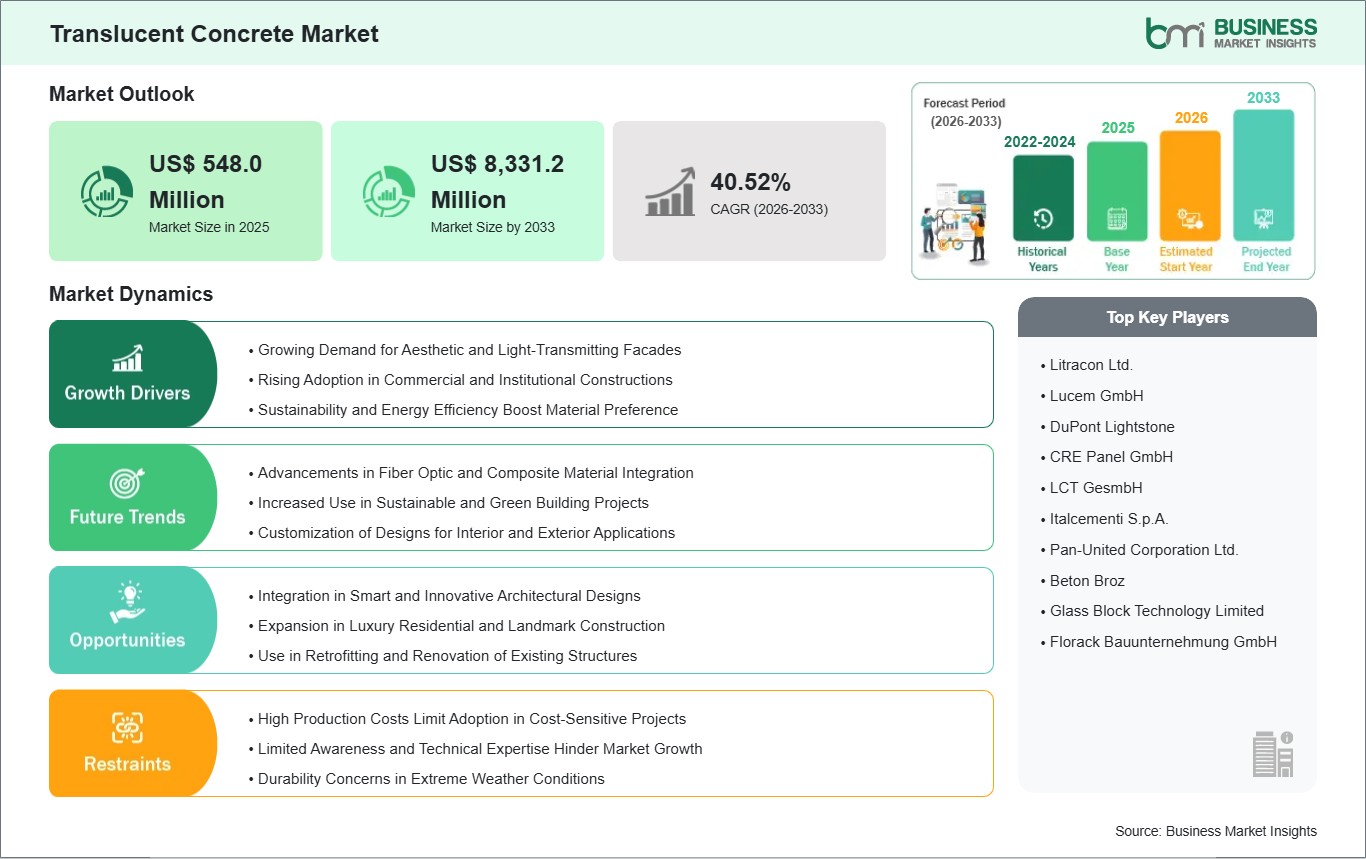
The Translucent Concrete Market size is expected to reach US$ 8,331.2 million by 2033 from US$ 548. million in 2025. The market is estimated to record a CAGR of 40.52% from 2026 to 2033.
The Translucent Concrete Market in North America leads architectural and infrastructural development because of rising needs for contemporary building materials that provide both structural durability and light transmission. Translucent concrete combines cement-based materials with embedded optical fibers or resin components to create a building material that permits daylight entry while supporting structural weight. This unique attribute makes it increasingly attractive for high-end commercial spaces, cultural landmarks, interior design applications, and exterior facade systems where design elements meet functional performance.
In North America, demand originates from a growing preference among architects and designers for materials that enhance interior ambiance, which reduces artificial lighting needs while supporting sustainable design principles. The region’s construction industry, particularly in urban centers, is embracing materials that support daylighting strategies and experiential environments. The growing investments in cultural institutions, hotels, corporate headquarters and landmark public infrastructure projects create opportunities for specialized architectural solutions which include translucent concrete. The manufacturing cost and higher initial investment costs of conventional concrete remain significant barriers for the product, yet its value proposition provides design differentiation and extended lighting benefits, together with improved spatial experience. The use of translucent concrete in mixed-use developments, art installations and retrofit projects demonstrates its ability to function in different types of applications.
North America maintains its position as the leading region for civil engineers and building planners because they increasingly understand how aesthetic innovation can be combined with functional performance through new construction materials. The market outlook is further strengthened by collaborations between material manufacturers and architectural firms, expanding awareness of translucent concrete's potential applications. North America maintains its leadership position in the global translucent concrete market because of its ability to adopt and demonstrate creative applications that support rising sustainability demands, complex design requirements and urban development needs.

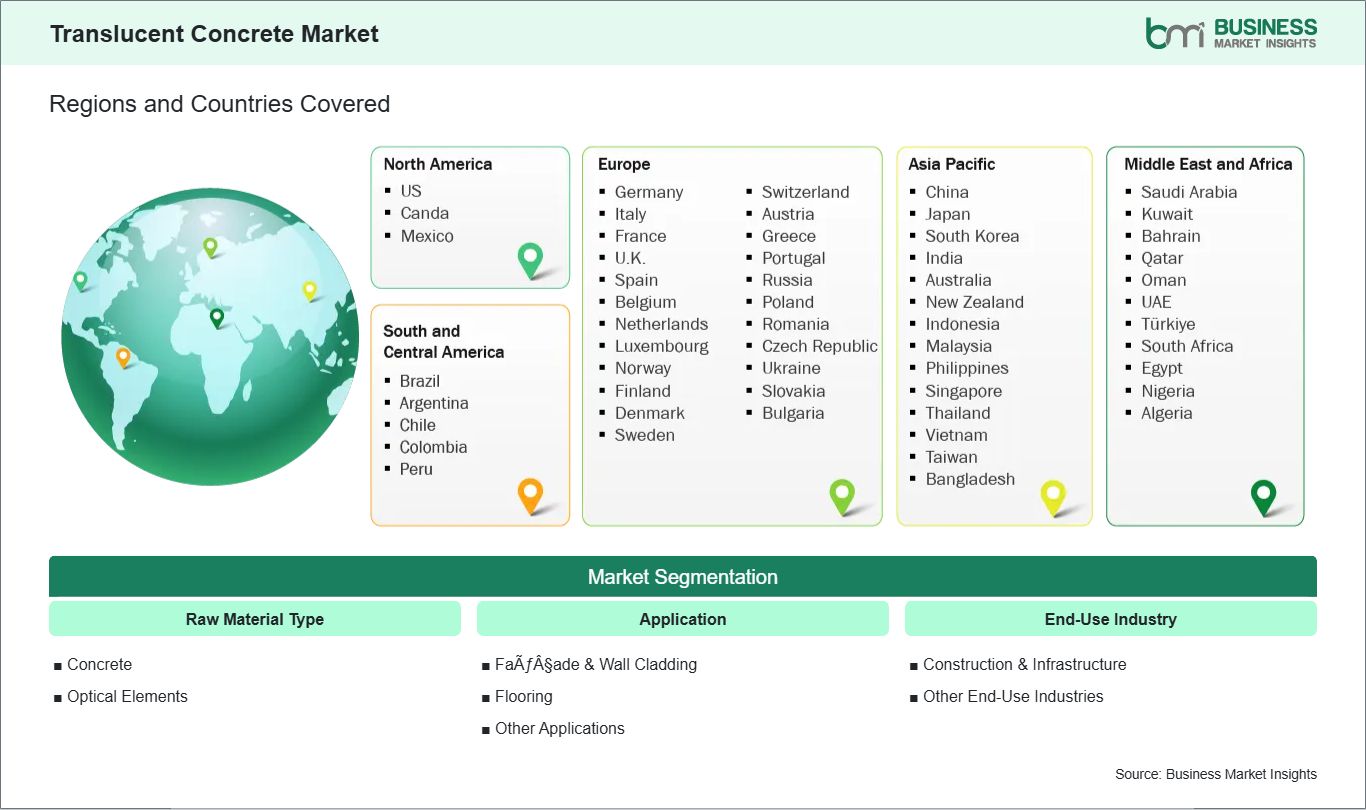
Key segments that contributed to the derivation of the translucent concrete market analysis are raw material type, application, and end‑use industry.
The rising demand for aesthetic and light‑transmitting facades is one of the foremost drivers shaping the global translucent concrete market. Across North America, architects are increasingly specifying materials that enhance building exteriors with both visual impact and functional daylight penetration. Translucent concrete allows natural light to filter through structural surfaces, creating dynamic facades that transform interior spaces while maintaining load‑bearing performance. This trend is particularly visible in contemporary commercial complexes, museums, and cultural institutions where design narratives emphasize visual transparency and spatial experience.
In Europe, aesthetic appeal is closely tied to historic preservation and modern retrofit projects. Designers are using translucent concrete alongside traditional materials to create striking contrasts between old and new, especially in urban renewal districts where lighting and material quality contribute to community identity. Asian markets also reflect aesthetic priorities, especially in Japan and China, where commercial skyscrapers and public buildings increasingly feature illuminated façades to enhance night‑time visibility and brand presence.
Additionally, the material’s ability to balance form and function resonates in luxury residential developments globally, where affluent buyers seek distinctive architectural features. Developers in the Middle East and South America are integrating light‑transmitting facades into upscale condominiums and landmark projects, leveraging the material’s aesthetic benefits to differentiate properties in competitive real estate markets. As design sensibilities evolve worldwide, aesthetic and light‑transmitting facades will remain central to market expansion, reinforcing the value of translucent concrete within modern architecture.
The integration of translucent concrete through smart and innovative architectural designs establishes its growing importance for worldwide construction. Designers are now researching methods to connect building materials with environmental control systems because intelligent building systems are becoming more common. The smart lighting systems of translucent concrete enable users to control artificial light based on their actual daylight needs. The solution improves energy performance while decreasing operational expenses and delivering customizable comfort to building users which architects consider their main goal at commercial and institutional sites throughout Silicon Valley and Singapore.
Europe demonstrates its commitment to innovation through digitally produced façade components which operate within parametric design systems. Architects use computational design methods to create translucent concrete panels which contain different optical fiber densities in order to achieve specific light transmission requirements. The custom-building solutions enable seamless connection with building management systems which create spaces that automatically adapt to changes in sunlight and building occupancy throughout the day. Australian designers are implementing these methods in educational and healthcare settings because they find that controlled daylighting improves the health of building occupants.
Designers use smart design methods to create lighting systems which analyze daylighting requirements. The organization uses translucent concrete throughout its facilities which combine embedded sensors with advanced building analytics systems to track both structural integrity and environmental measurements. The emerging technologies are being adopted by smart city projects in both North America and the Middle East because these regions consider future-ready systems as essential urban development goals.
The translucent concrete market demonstrates steady growth, with size and share analysis highlighting evolving trends and competitive dynamics among key players. The report examines subsegments categorized within raw material type, application, and end‑use industry, offering insights into their contribution to overall market performance.
By raw material type, the concrete subsegment dominated the market in 2025, driven by its high strength and essential role in forming durable translucent concrete products.
Based on application, the façade & wall cladding subsegment dominated the market in 2025, driven by its natural light transmission, aesthetic appeal, and energy-saving benefits.
In terms of end‑use industry, the construction & infrastructure subsegment dominated the market in 2025, driven by the growing urbanization and increased adoption of translucent concrete in buildings and infrastructure projects.
| Report Attribute | Details |
|---|---|
| Market size in 2025 | US$ 548.0 Million |
| Market Size by 2033 | US$ 8,331.2 Million |
| Global CAGR (2026 - 2033) | 40.52% |
| Historical Data | 2022-2024 |
| Forecast period | 2026-2033 |
| Segments Covered | By Raw Material Type
|
|
Regions and Countries Covered
| |
| North America | US, Canada, Mexico |
| Europe | Belgium, Austria, Finland, Denmark, Greece, Poland, Romania, Russia, Ukraine, Czech Republic, Slovakia, Bulgaria, Italy, Luxembourg, Germany, Switzerland, France, Netherlands, Norway, Portugal, Spain, Sweden, United Kingdom |
| Asia-Pacific | Australia, China, India, Japan, South Korea, Indonesia, Malaysia, Philippines, Singapore, Thailand, Vietnam, Bangladesh, New Zealand, Taiwan |
| South and Central America | Brazil, Argentina, Peru, Chile, Colombia |
| Middle East and Africa | Bahrain, Kuwait, Oman, Qatar, Saudi Arabia, United Arab Emirates, Turkiye, South Africa, Egypt, Algeria, Nigeria |
| Market leaders and key company profiles |
|
The "Translucent Concrete Market Size and Forecast (2022 - 2033)" report provides a detailed analysis of the market covering below areas:
The geographical scope of the Translucent Concrete Market report is divided into North America, Asia Pacific, Europe, Middle East & Africa, and South & Central America. North America held the largest share in 2025.
The primary market for translucent concrete exists in North America because its construction industry has reached full development, while architectural designers follow design principles and builders implement environmentally friendly construction methods. The United States and Canada lead in commercial, institutional, and high‑end residential projects, leveraging translucent concrete for feature walls, facades, interior partitions, and art installations. The local manufacturing process uses optical fibers and polymer composites to enable architects and contractors to produce adaptable designs that maintain exceptional light transmission and structural strength. Sustainability initiatives and energy efficiency goals create additional demand for translucent concrete because it decreases artificial lighting needs while improving indoor comfort. The European market exists as a major market in which environmental regulations, green certification requirements, and modern architectural design principles are created.
The countries of Germany, the United Kingdom and Nordic nations use translucent concrete for public buildings, cultural centers and commercial projects while they combine it with daylighting techniques and sustainable material practices. The Asia Pacific region experiences growth because urban areas expand, infrastructure investments increase, and modern design styles become more common in China, Japan and Australia. The private sector and government initiatives have created a rising trend of translucent concrete usage in high-end commercial buildings, hotels and cultural heritage sites.
The Middle East and Africa region exhibits consistent progress toward technological implementation, which occurs mainly through its high-end commercial and hospitality projects in the United Arab Emirates, Saudi Arabia and South Africa that require both aesthetic beauty and architectural excellence and lasting durability. South and Central America function as an emerging market because Brazil, Mexico, and Chile are investigating translucent concrete materials for their upscale commercial buildings and cultural institutions, although these countries face challenges with cost and public understanding of the product.
The North American market maintains its leading position because of its regulatory framework, advanced infrastructure, and commitment to sustainable practices, while each international market segment develops its distinct market characteristics through processes such as urban development, luxury building activities and architectural research.

The Translucent Concrete Market is evaluated by gathering qualitative and quantitative data post primary and secondary research, which includes important corporate publications, association data, and databases. A few of the key developments in the translucent concrete market are:
The Translucent Concrete Market is valued at US$ 548.0 Million in 2025, it is projected to reach US$ 8,331.2 Million by 2033.
As per our report Translucent Concrete Market, the market size is valued at US$ 548.0 Million in 2025, projecting it to reach US$ 8,331.2 Million by 2033. This translates to a CAGR of approximately 40.52% during the forecast period.
The Translucent Concrete Market report typically cover these key segments-
The historic period, base year, and forecast period can vary slightly depending on the specific market research report. However, for the Translucent Concrete Market report:
The Translucent Concrete Market is populated by several key players, each contributing to its growth and innovation. Some of the major players include:
The Translucent Concrete Market report is valuable for diverse stakeholders, including:
Essentially, anyone involved in or considering involvement in the Translucent Concrete Market value chain can benefit from the information contained in a comprehensive market report.
Please tell us your area of interest
(Market Segments/ Regions and Countries/ Companies)