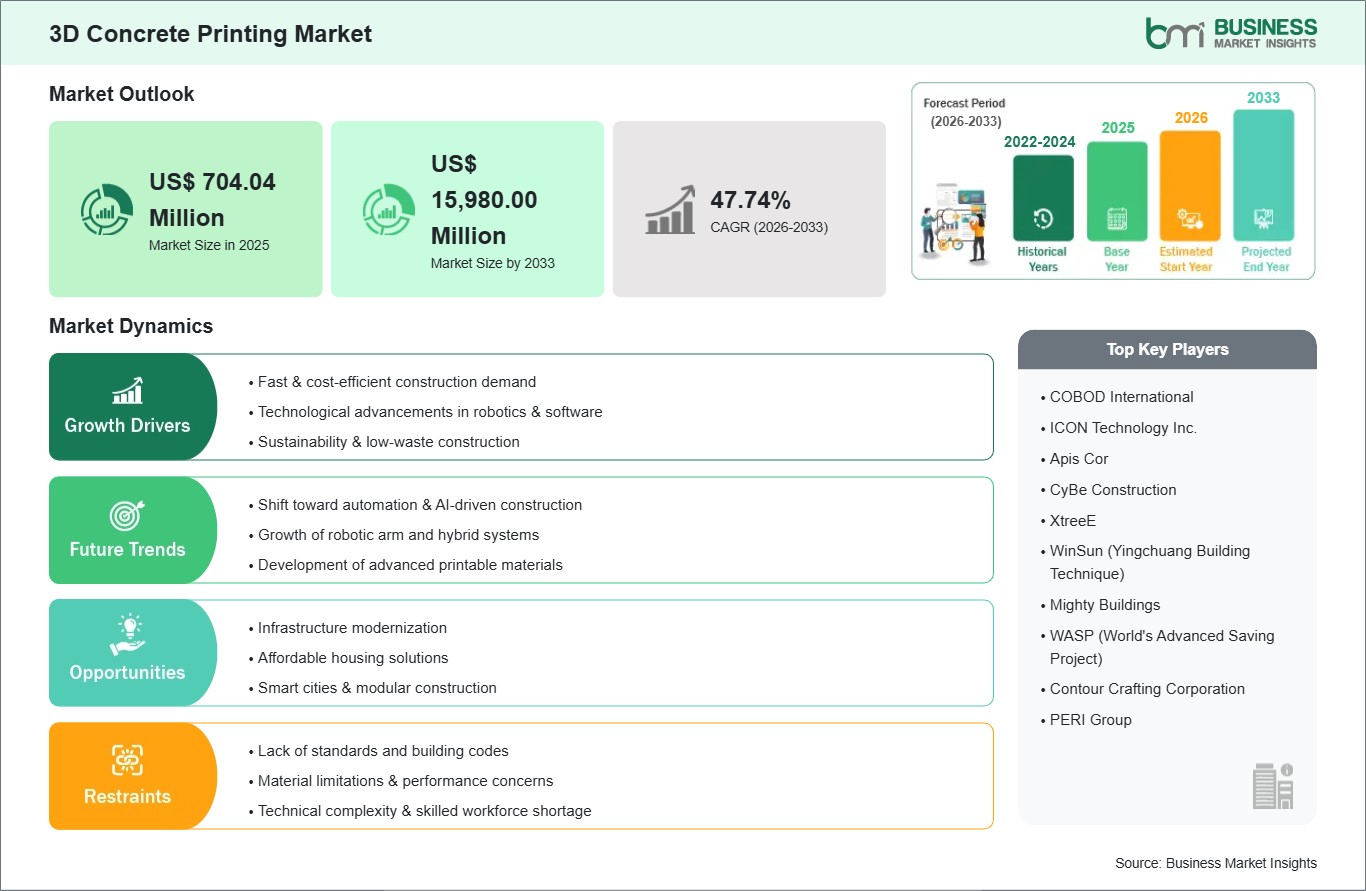
The 3D Concrete Printing Market size is expected to reach US$ 15,980.00 Million by 2033 from US$ 704.04 Million in 2025. The market is estimated to record a CAGR of 47.74% from 2026 to 2033.
The global 3D concrete printing market represents another emerging segment of the advanced construction technology industry, driven by the increasing need for rapid, cost-effective, and flexible construction techniques. The 3D concrete printing technology allows for the automated construction of structural components by printing the cement-based materials layer by layer, eliminating the need for traditional formwork and manual labour. The technology has started to find significant traction in residential, commercial, and infrastructure construction, particularly in projects where the execution rate, architectural requirements, and material efficiency are critical success factors. The increasing urbanization rate and the need to address the shortage of residential units are also driving the adoption of the technology, as it has the potential to deliver rapid construction of residential units and structures. One major growth enhancer for the global 3D printing market is the increased focus on automation and digitalization in the construction industry, where robotics and smart construction are being implemented on a large scale. Sustainability is another major growth enhancer for the global 3D printing market, where the technology is reducing material wastage during the printing process and also creating structures with optimized shapes that require less cement for construction.

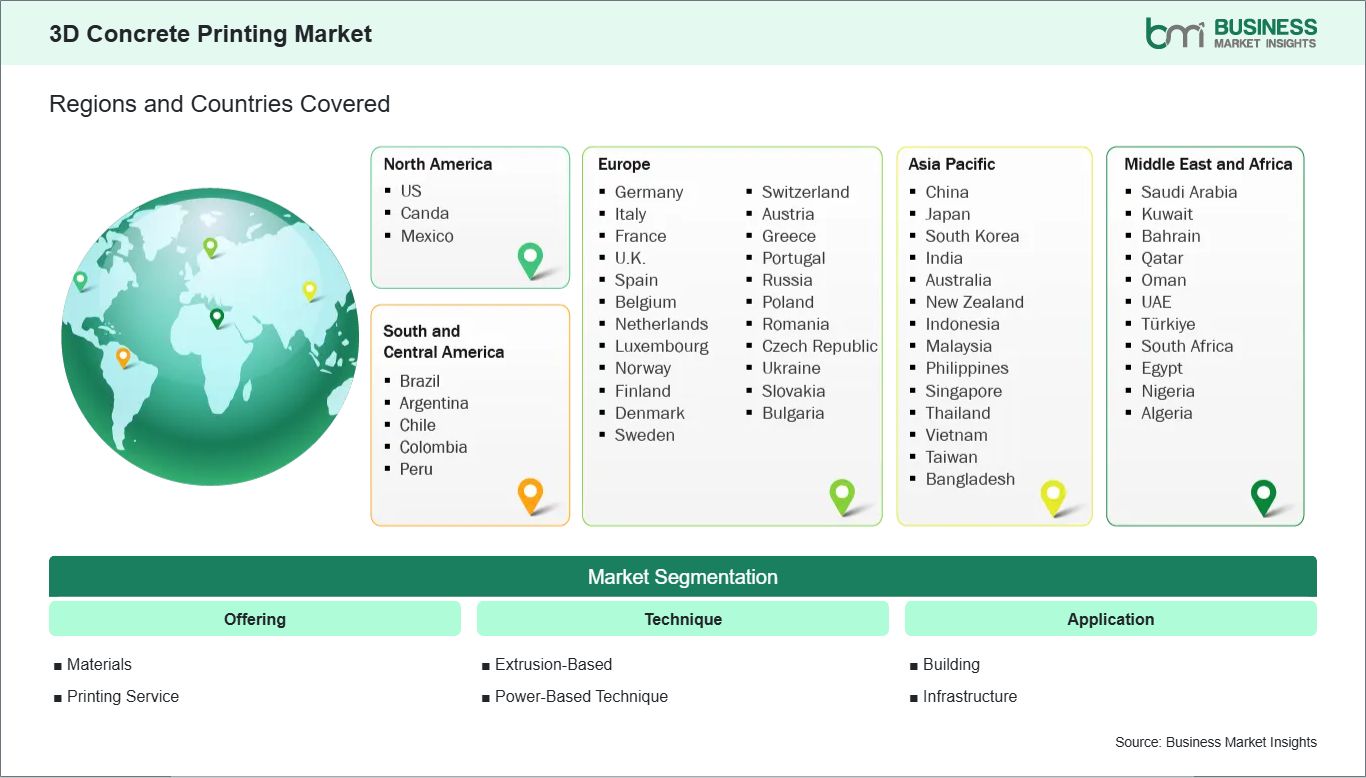
Key segments that contributed to the derivation of the 3D Concrete Printing market analysis are offering, technique, and application
Construction in Western Europe is now characterised by speed, modularisation, and lifecycle cost control, and this is having a major influence on demand for 2K protective coatings. In countries like the UK and Netherlands, fast-track urban housing schemes and commercial regeneration areas like London`s Docklands and Amsterdam`s Zuidas are putting pressure on contractors to use fast-cure epoxy and polyurethane coatings, which enable project completion in shorter times and minimise downtime between different stages of the project.
Cost efficiency is now a major factor in purchase decisions, driven by increasing labour and compliance costs in countries like Germany, France, and Scandinavia. This is causing developers to look for coatings that can reduce maintenance frequency, even if it means paying more for the product. This is evident in logistics schemes like those near Frankfurt and Paris, where steelwork and flooring systems are using 2K coatings to prevent damage from corrosion, abrasion, and chemicals, all while keeping maintenance downtime to a minimum.
Meanwhile, prefabricated and off-site construction techniques are growing in Western Europe, particularly in Sweden and the UK, where housing needs are being filled through modular steel-based construction. This construction method relies heavily on the use of 2K coatings for durability and consistency in a factory environment before being shipped to the construction site for installation, further fueling the demand for high-efficiency coatings.
In Western Europe, infrastructure renewal is an ongoing process, and significant investments are being made in transportation corridors, energy infrastructure, and public utilities, particularly in aging infrastructure constructed decades ago. In Germany's Rhine-Ruhr region and France's Île-de-France rail system, extensive rehabilitation of bridges, tunnels, and metro systems is generating significant demand for durable 2K epoxy-based coatings for maximum service life under heavy loads and environmental stresses.
Another significant factor for modernization is climate adaptation, particularly for regions exposed to flooding, such as Belgium's North Sea coastline and northern Italy's river basins. These regions are increasingly using modern protective coatings for flood barriers, water treatment plants, and reinforced concrete structures exposed to saltwater and humidity, for which maximum durability is critical for climate resilience. Moreover, contributing to the increased demand for these upgrades is the ongoing improvement in energy infrastructure, particularly in Western Europe, which is shifting towards electrification and renewable energy integration. High-voltage transmission towers in Germany, substations in Spain, and grid expansion projects in France are using 2K coating systems for the protection of steel assets from corrosion, UV damage, and industrial pollutants, thereby ensuring longer asset lifetimes with minimum maintenance shutdowns.

The global 3D concrete printing market is experiencing steady growth, with market size and share analysis reflecting evolving treatment preferences and competitive dynamics among key players. The report evaluates important subsegments categorized within offering, technique, and application highlighting their respective contributions to overall market performance.
By offering, the material subsegment dominated the market in 2025 because they represent the core consumable input required for every printing project. Unlike printing systems or services, construction-grade printable concrete, binders, and additives are continuously consumed in large volumes for each structure, making them a recurring and scalable revenue driver.
By technique, the extrusion-based subsegment dominated the market in 2025 due to it being the most practical, cost-effective, and widely adopted method for construction-scale 3D printing. It is compatible with conventional cementitious materials and allows continuous layer-by-layer deposition, making it suitable for large structures such as walls, buildings, and infrastructure components.
By application, the infrastructure subsegment dominated the market in 2025 due to strong global investment in public construction projects such as bridges, roads, tunnels, and smart city development. Governments and private players are increasingly adopting 3D printing to reduce construction time, labor costs, and material waste while improving efficiency.
| Report Attribute | Details |
|---|---|
| Market size in 2025 | US$ 704.04 Million |
| Market Size by 2033 | US$ 15,980.00 Million |
| Global CAGR (2026 - 2033) | 47.74% |
| Historical Data | 2022-2024 |
| Forecast period | 2026-2033 |
| Segments Covered | By Offering
|
|
Regions and Countries Covered
| |
| North America | US, Canada, Mexico |
| Europe | Belgium, Austria, Finland, Denmark, Greece, Poland, Romania, Russia, Ukraine, Czech Republic, Slovakia, Bulgaria, Italy, Luxembourg, Germany, Switzerland, France, Netherlands, Norway, Portugal, Spain, Sweden, United Kingdom |
| Asia-Pacific | Australia, China, India, Japan, South Korea, Indonesia, Malaysia, Philippines, Singapore, Thailand, Vietnam, Bangladesh, New Zealand, Taiwan |
| South and Central America | Brazil, Argentina, Peru, Chile, Colombia |
| Middle East and Africa | Bahrain, Kuwait, Oman, Qatar, Saudi Arabia, United Arab Emirates, Turkiye, South Africa, Egypt, Algeria, Nigeria |
| Market leaders and key company profiles |
|
The "3D Concrete Printing market Size and Forecast (2022 - 2033)" report provides a detailed analysis of the market covering below areas:
The geographical scope of the 3D concrete printing market report is divided into: North America, Asia Pacific, Europe, Middle East & Africa, and South & Central America. North America held the largest share in 2025.
North America has managed to attain the top spot in the world market for 3D concrete printing, given the high rate of technological adoption, the quality of construction infrastructure, and the investments in the development of construction automation technologies. The North American region has been at the forefront of integrating additive technologies into the construction sector, with the support of partnerships between construction companies, robotics firms, and research bodies. The key driver of the success of the North American region in the world market for 3D concrete printing has been the presence of innovative construction practices, where companies are actively looking to explore alternative construction technologies to overcome the problem of labor shortages and increasing construction costs. The United States has witnessed the increasing adoption of 3D concrete printing technology in residential buildings, defense-related infrastructure, and rapid deployment structures. The North American region has also been at the forefront of developing disaster-resistant residential buildings, which has helped to increase the adoption of printed concrete technologies. The sustainability requirements have also helped to increase the adoption of sustainable construction materials, which are efficient in terms of reduced waste and environmental impact. The next important factor is the presence of a well-developed regulatory system that, although very stringent, allows for a controlled testing and certification process of new construction technologies via pilot programs and code development. This helps to gradually assimilate 3D printing into mainstream construction activities. Thus, North America, with its high degree of technological advancements and innovation and adoption culture, is seen to be leading in the global 3D concrete printing market.

The 3D concrete printing market is evaluated by gathering qualitative and quantitative data post primary and secondary research, which includes important corporate publications, association data, and databases. A few of the key developments in the 3D Concrete Printing market are:
The 3D Concrete Printing Market is valued at US$ 704.04 Million in 2025, it is projected to reach US$ 15,980.00 Million by 2033.
As per our report 3D Concrete Printing Market, the market size is valued at US$ 704.04 Million in 2025, projecting it to reach US$ 15,980.00 Million by 2033. This translates to a CAGR of approximately 47.74% during the forecast period.
The 3D Concrete Printing Market report typically cover these key segments-
The historic period, base year, and forecast period can vary slightly depending on the specific market research report. However, for the 3D Concrete Printing Market report:
The 3D Concrete Printing Market is populated by several key players, each contributing to its growth and innovation. Some of the major players include:
The 3D Concrete Printing Market report is valuable for diverse stakeholders, including:
Essentially, anyone involved in or considering involvement in the 3D Concrete Printing Market value chain can benefit from the information contained in a comprehensive market report.
Please tell us your area of interest
(Market Segments/ Regions and Countries/ Companies)