3D Printing Ceramic Market Outlook (2022 - 2033)

Historic Data: 2022-2024   |   Base Year: 2025   |   Forecast Period: 2026-2033
Report Content: Market Scope, Market Segmentation, Market Dynamics, and Competitive Analysis

Report Coverage:
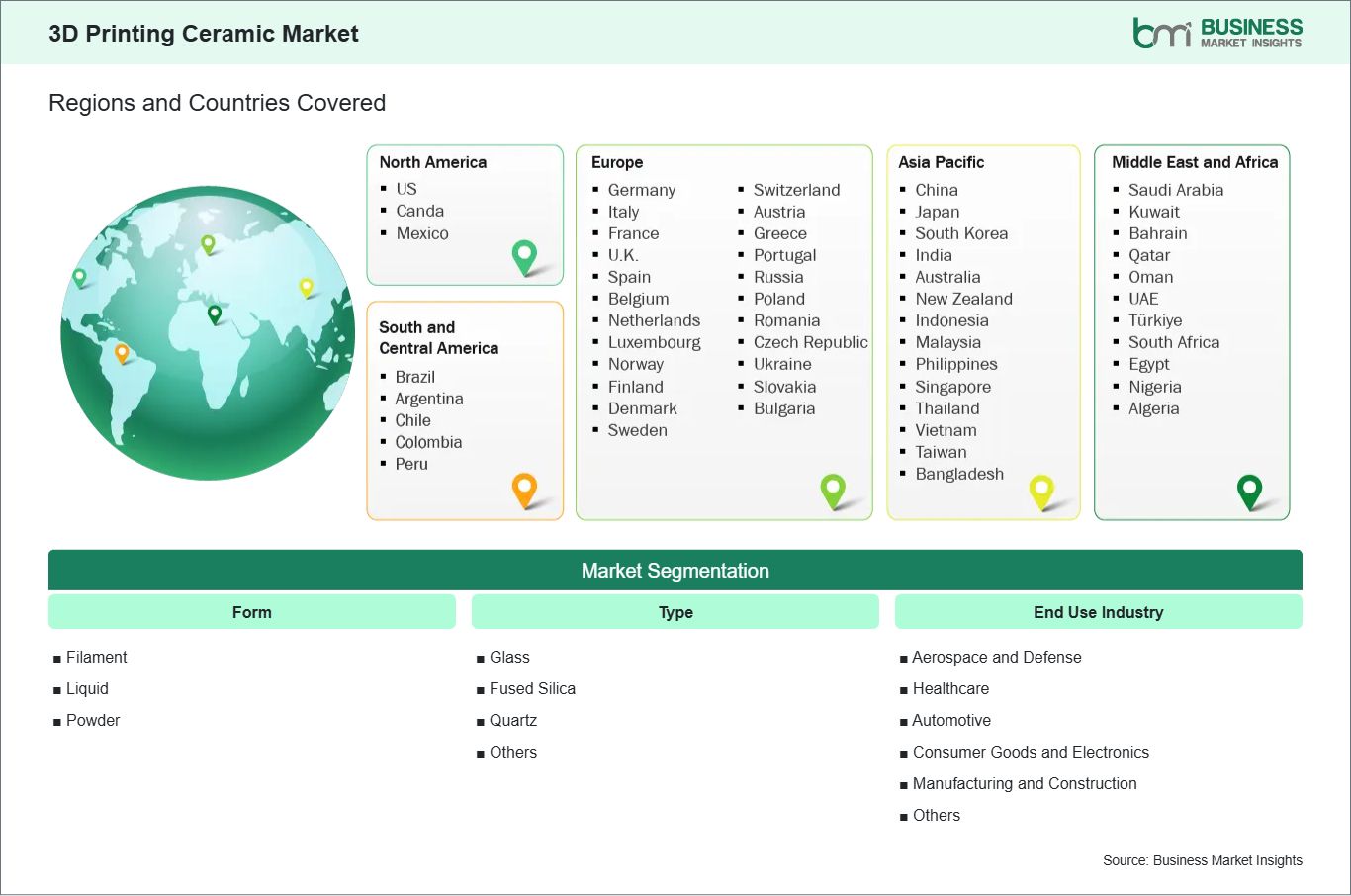
  • Form (Filament, Liquid, and Powder)
  • Type (Glass, Fused Silica, Quartz, and Others)
  • End Use Industry (Aerospace and Defense, Healthcare, Automotive, Consumer Goods and Electronics, Manufacturing and Construction, and Others)

No. of Pages: 400
Report Code: BMIPUB00033223
Category: Chemicals and Materials
3D Printing Ceramic Market

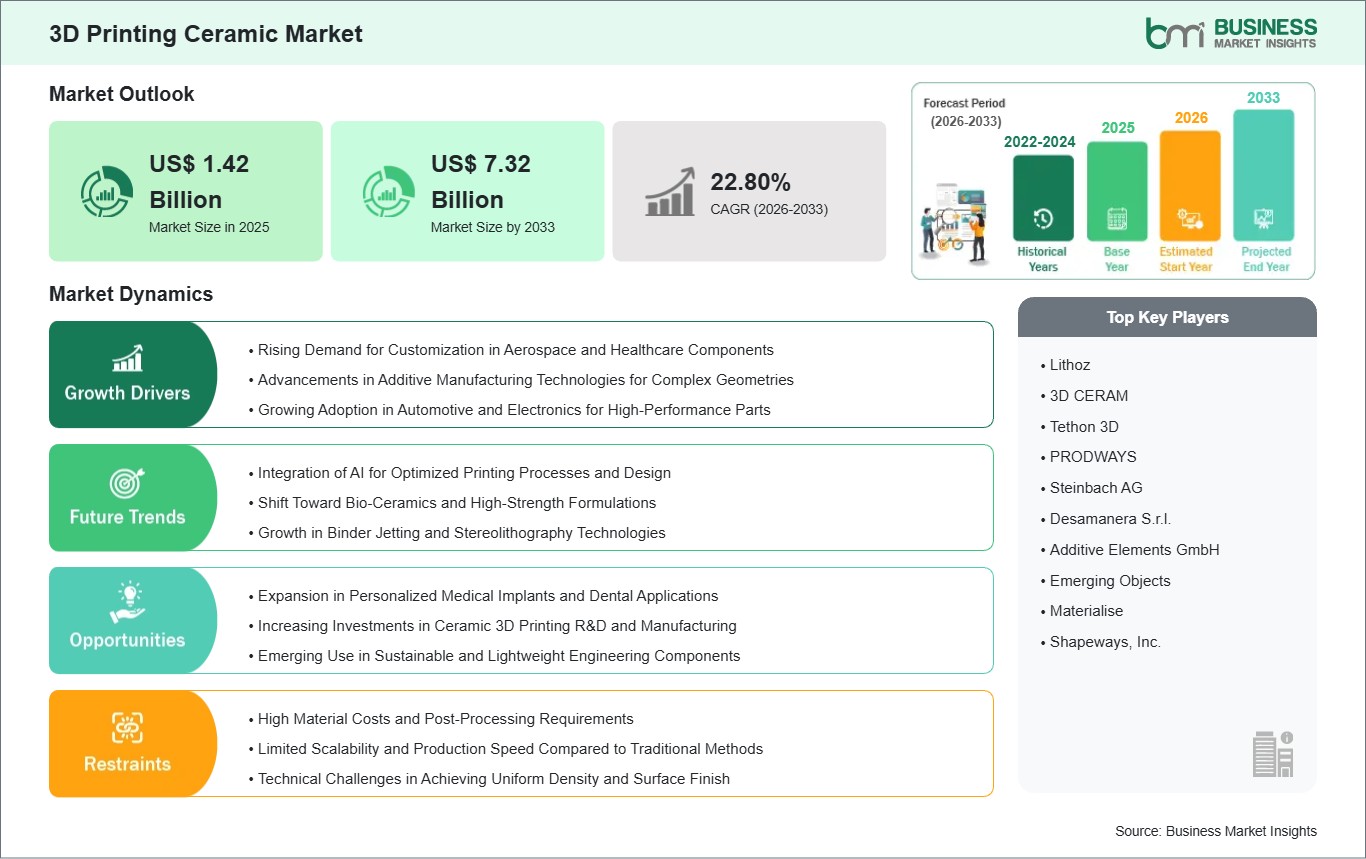
The 3D Printing Ceramic market size is expected to reach US$ 7.32 billion by 2033 from US$ 1.42 billion in 2025. The market is estimated to record a CAGR of 22.8% from 2026 to 2033.

Executive Summary and Global Market Analysis:

The 3D printing of ceramics plays a vital role in advanced manufacturing and industrial processes as it improves the strength, accuracy, stability, and functionality of the components that are being printed. The materials play a major role in enhancing the performance of complex ceramic components in the aerospace, automotive, medical, electronics, and energy applications, guaranteeing reliability and efficiency in the final products. 3D printing ceramics finds application in the medical field as prosthetics and implants, electronics as insulators and sensors, aerospace as lightweight parts, and automobile as high-performance engine parts. The benefits of 3D printing ceramics include good thermal and chemical resistance, high mechanical strength, and compatibility with a variety of printing technologies and complex shapes. The market is growing with the use of additive manufacturing, the increased need for custom and high-performance components, and the increased industrial automation. Besides, the development of printable ceramic formulations, transition to sustainable, recyclable materials, and growing use of 3D printing in manufacturing processes are contributing to the further growth of the market.

Market growth is limited due to expensive production, technicalities in producing ceramics, and limitations in the manufacture of large volumes. Another issue associated with the industry is the problem of post-processing, ensuring the quality of materials is the same, and meeting high industrial standards. However, such issues do not impede the demand, which is due to technological improvement and the increased need for lightweight and durable components, as well as industrial digitalization. The ongoing research and development, the governmental supportive efforts, and the innovations in the materials and production of eco-friendly and high-performance ceramics are likely to emerge as key future trends for the market.

3D Printing Ceramic Market - Strategic Insights:

global-market-strategic-framework
Get more information on this report

3D Printing Ceramic Market Segmentation Analysis:

Key segments that contributed to the derivation of the 3D Printing Ceramic market analysis are product and end use.

  • By form, the 3D printing ceramic market is segmented into filament, liquid, and powder. The powder segment dominated the market in 2025.
  • By type, the market is segmented into glass, fused silica, quartz, and others. The glass segment dominated the market in 2025.
  • By end use industry, the market is categorized into aerospace and defense, healthcare, automotive, consumer goods and electronics, manufacturing and construction, and others. The healthcare segment held the largest share of the market in 2025.

3D Printing Ceramic Market Drivers and Opportunities:

Rising Demand for Advanced Manufacturing and High-Performance Components

The global industries are gradually moving toward the use of 3D printing of ceramics to create resilient, accurate, and intricate parts in sectors such as aerospace, automobile, electronics, and medical products. The demand for 3D printing ceramics is surging due to the rapid automation of industry, the requirements of lightweight and highly-strength materials, and the requirements of customized manufacturing solutions, which affect the quality and reliability of final products. They are utilized in additive production in creating complex components, medical implants, engine components, and electronic substrates, which result in more fine-tuning of outputs, reduced wastage in production, and economic production.

Ceramic components are being used in medical equipment, aerospace parts, and in smart manufacturing. Entrepreneurs are rapidly industrializing and modernizing manufacturing in regions such as North America, Europe, and the Asia Pacific. The changing requirements of quality, performance, and the sustainability of the components are driving manufacturers to develop sophisticated ceramic formulations, which feed into the long-term demand in the market.

Soaring Adoption of Sustainable and High-Performance Ceramic Materials

The production industry is shifting to a more sustainable, energy-saving, and resource-saving production system, pushing the need to have more sophisticated 3D printable ceramics. The materials allow environmentally friendly manufacturing through less consumption of materials, increased efficiency in the use of resources, as well as the long life of parts. Low-energy sintering ceramics, recyclable powders, and high-performance functional ceramics are becoming critical in contemporary industrial use, as well as 3D printing ceramics contribute to the reduction of carbon emissions due to reduced use of raw materials and enhancing manufacturing efficiency.

The increased drive toward sustainable production and the governmental support of green production technologies are stimulating manufacturers to create environmentally friendly ceramic materials. The manufacturing industry has been compelled to use materials that will sustain performance without negatively impacting sustainability through industry standards and certification programs. High-strength, thermal stability, and environmentally compliant printable ceramics, long-term cost-saving, and improved component performance are among the key factors behind the rising trend in the use of sustainable 3D printing ceramics in the global markets.

3D Printing Ceramic Market Size and Share Analysis:

Based on type, the glass segment had the largest share of the 3D printing ceramic market. The glass segment dominated the market in 2025. Glass ceramics are popular in 3D printing since they are thermally and chemically stable, as well as optically, and are suitable for electronics, healthcare, and high-performance parts. They allow high accuracy, robust, low mass components with low defects, and their dependability and low cost-efficacy result in widespread use in high-technology manufacturing industries around the globe.

3D Printing Ceramic Market Report Highlights:

Report Attribute Details
Market size in 2025 US$ 1.42 Billion
Market Size by 2033 US$ 7.32 Billion
Global CAGR (2026 - 2033)22.80%
Historical Data 2022-2024
Forecast period 2026-2033
Segments Covered By Form
  • Filament
  • Liquid
  • Powder
By Type
  • Glass
  • Fused Silica
  • Quartz
  • Others
By End Use Industry
  • Aerospace and Defense
  • Healthcare
  • Automotive
  • Consumer Goods and Electronics
  • Manufacturing and Construction
  • Others
Regions and Countries Covered
North America US, Canada, Mexico
Europe Belgium, Austria, Finland, Denmark, Greece, Poland, Romania, Russia, Ukraine, Czech Republic, Slovakia, Bulgaria, Italy, Luxembourg, Germany, Switzerland, France, Netherlands, Norway, Portugal, Spain, Sweden, United Kingdom
Asia-Pacific Australia, China, India, Japan, South Korea, Indonesia, Malaysia, Philippines, Singapore, Thailand, Vietnam, Bangladesh, New Zealand, Taiwan
South and Central America Brazil, Argentina, Peru, Chile, Colombia
Middle East and Africa Bahrain, Kuwait, Oman, Qatar, Saudi Arabia, United Arab Emirates, Turkiye, South Africa, Egypt, Algeria, Nigeria
Market leaders and key company profiles
  • Lithoz
  • 3D CERAM
  • Tethon 3D
  • PRODWAYS
  • Steinbach AG
  • Desamanera S.r.l.
  • Additive Elements GmbH
  • Emerging Objects
  • Materialise
  • Shapeways, Inc.
Get more information on this report

3D Printing Ceramic Market Report Coverage and Deliverables:

The " 3D Printing Ceramic Market Size and Forecast (2022–2033)" report provides a detailed analysis of the market covering below areas:

  • 3D Printing Ceramic market size and forecast at global, regional, and country levels for all the key segments covered under the scope
  • 3D Printing Ceramic market trends, as well as market dynamics such as drivers, restraints, and key opportunities
  • 3D Printing Ceramic market analysis covering key market trends, global and regional framework, major players, regulations, and recent market developments
  • Industry landscape and competition analysis covering market concentration, heat map analysis, prominent players, and recent developments for the 3D printing ceramic market
  • Detailed company profiles, including SWOT analysis

3D Printing Ceramic Market Geographic Insights:

The geographical scope of the 3D Printing Ceramic market report is divided into five regions: North America, Asia Pacific, Europe, Middle East & Africa, and South & Central America. The 3D Printing Ceramic market in the Asia Pacific is expected to grow significantly during the forecast period.

The Asia Pacific 3D Printing Ceramic market is segmented into China, Japan, South Korea, India, Australia, New Zealand, Indonesia, Malaysia, the Philippines, Singapore, Thailand, Vietnam, Taiwan, Bangladesh, and the Rest of Asia. Asia Pacific is among the most vibrant markets for 3D printing ceramics, as additive manufacturing is increasingly used in the industrial, healthcare, and electronics industries. The key markets are China, India, and Japan, with the key economic strength being due to the rapid industrialization, growth of advanced manufacturing, and the rising demand for highly-performing, personalized components. The ceramic production industry of 3D printing is well-established in the area with access to a talented workforce, good manufacturing ecosystems, and powerful supply chains. Governments of APAC are favoring industrial innovation by offering pro-manufacturing, research, and encouragement to local 3D printing material manufacturers.

Additive manufacturing and high-tech production with a focus on quality, precision, and sustainable materials have been introduced by the Indian government in terms of programs. The Government of Japan has put in place measures that promote the use of superior ceramic materials that are environmentally friendly and efficient. The emergence of high-quality and compliant 3D printable ceramics in the area is rising faster with the augmenting automation in industries, amplifying the expectations of performance and safety of products, and policy-driven measures to encourage long-term innovation and sustainable manufacturing.

global-market-geography
Get more information on this report

3D Printing Ceramic Market Research Report Guidance:

  • The report includes qualitative and quantitative data in the 3D Printing Ceramic market across form, type, end use industry, and geography.
  • The report starts with the key takeaways (chapter 2), highlighting the key trends and outlook of the 3D Printing Ceramic market.
  • Chapter 3 includes the research methodology of the study.
  • Chapter 4 further includes ecosystem analysis.
  • Chapter 5 highlights the major industry dynamics in the 3D Printing Ceramic market, including factors that are driving the market, prevailing deterrents, potential opportunities, as well as future trends. Impact analysis of these drivers and restraints is also covered in this section.
  • Chapter 6 discusses the 3D Printing Ceramic market scenario, in terms of historical market revenues, and forecast till the year 2033.
  • Chapters 7 to 10 cover the 3D Printing Ceramic market segments by form, type, end use industry, and geography across North America, Europe, Asia Pacific, Middle East and Africa, and South and Central America. They cover the market revenue, forecast, and factors driving the market.
  • Chapter 11 describes the competitive analysis along with the heat map analysis for the key players operating in the market.
  • Chapter 12 describes the industry landscape analysis. It provides detailed descriptions of business activities such as market initiatives, new developments, mergers, and joint ventures globally, along with a competitive landscape.
  • Chapter 13 provides detailed profiles of the major companies operating in the 3D Printing Ceramic market. Companies have been profiled on the basis of their key facts, business descriptions, products and services, financial overview, SWOT analysis, and key developments.
  • Chapter 14, i.e., the appendix, is inclusive of a brief overview of the company, a list of abbreviations, and a disclaimer.

3D Printing Ceramic Market News and Key Development:

The 3D Printing Ceramic market is evaluated by gathering qualitative and quantitative data post-primary and secondary research, which includes important corporate publications, association data, and databases. A few of the key developments in the 3D printing ceramic market are:

  • In December 2025, IREC launched a pioneering pilot plant in Catalonia that utilizes 3D printing to manufacture advanced ceramic devices for renewable hydrogen systems. This facility, the first of its kind globally, focuses on producing solid oxide cells (SOC) and aims to transform the manufacturing process of clean hydrogen technology by 3D printing core ceramic components essential for hydrogen machinery.
  • In November 2025, XJet launched the Carmel Pro, a compact and cost-effective platform for its NanoParticle Jetting (NPJ) technology, aimed at increasing access to metal and ceramic 3D printing. This new system is designed for small-to-medium enterprises, research institutions, and jewelry manufacturers who require industrial-level precision without the need for large-scale systems.

Key Sources Referred:

  • World Bank – Global Trade Indicators
  • European Chemicals Agency
  • International Council of Chemical Associations
  • International Monetary Fund (IMF)
  • World Trade Organization (WTO)
  • International Trade Administration (ITA)
  • Company Websites
  • Company Annual Reports
  • Company Investor Presentations
The List of Companies - 3D Printing Ceramic Market
  • Lithoz
  • 3D CERAM
  • Tethon 3D
  • PRODWAYS
  • Steinbach AG
  • Desamanera S.r.l.
  • Additive Elements GmbH
  • Emerging Objects
  • Materialise
  • Shapeways, Inc.
Frequently Asked Questions
How big is the 3D Printing Ceramic Market?

The 3D Printing Ceramic Market is valued at US$ 1.42 Billion in 2025, it is projected to reach US$ 7.32 Billion by 2033.

What is the CAGR for 3D Printing Ceramic Market by (2026 - 2033)?

As per our report 3D Printing Ceramic Market, the market size is valued at US$ 1.42 Billion in 2025, projecting it to reach US$ 7.32 Billion by 2033. This translates to a CAGR of approximately 22.80% during the forecast period.

What segments are covered in this report?

The 3D Printing Ceramic Market report typically cover these key segments-

  • Form (Filament, Liquid, and Powder)
  • Type (Glass, Fused Silica, Quartz, and Others)
  • End Use Industry (Aerospace and Defense, Healthcare, Automotive, Consumer Goods and Electronics, Manufacturing and Construction, and Others)

What is the historic period, base year, and forecast period taken for 3D Printing Ceramic Market?

The historic period, base year, and forecast period can vary slightly depending on the specific market research report. However, for the 3D Printing Ceramic Market report:

  • Historic Period : 2022-2024
  • Base Year : 2025
  • Forecast Period : 2026-2033
  • Who are the major players in 3D Printing Ceramic Market?

    The 3D Printing Ceramic Market is populated by several key players, each contributing to its growth and innovation. Some of the major players include:

  • Lithoz
  • 3D CERAM
  • Tethon 3D
  • PRODWAYS
  • Steinbach AG
  • Desamanera S.r.l.
  • Additive Elements GmbH
  • Emerging Objects
  • Materialise
  • Shapeways, Inc.
  • Who should buy this report?

    The 3D Printing Ceramic Market report is valuable for diverse stakeholders, including:

    • Investors: Provides insights for investment decisions pertaining to market growth, companies, or industry insights. Helps assess market attractiveness and potential returns.
    • Industry Players: Offers competitive intelligence, market sizing, and trend analysis to inform strategic planning, product development, and sales strategies.
    • Suppliers and Manufacturers: Helps understand market demand for components, materials, and services related to concerned industry.
    • Researchers and Consultants: Provides data and analysis for academic research, consulting projects, and market studies.
    • Financial Institutions: Helps assess risks and opportunities associated with financing or investing in the concerned market.

    Essentially, anyone involved in or considering involvement in the 3D Printing Ceramic Market value chain can benefit from the information contained in a comprehensive market report.

    Available Report Formats

    pdf-format excel-format pptx-format
    Buy Now
    Sales Assistance
    +1 646 791 7070 (US & UK)
    Customization Form

    Please tell us your area of interest
    (Market Segments/ Regions and Countries/ Companies)