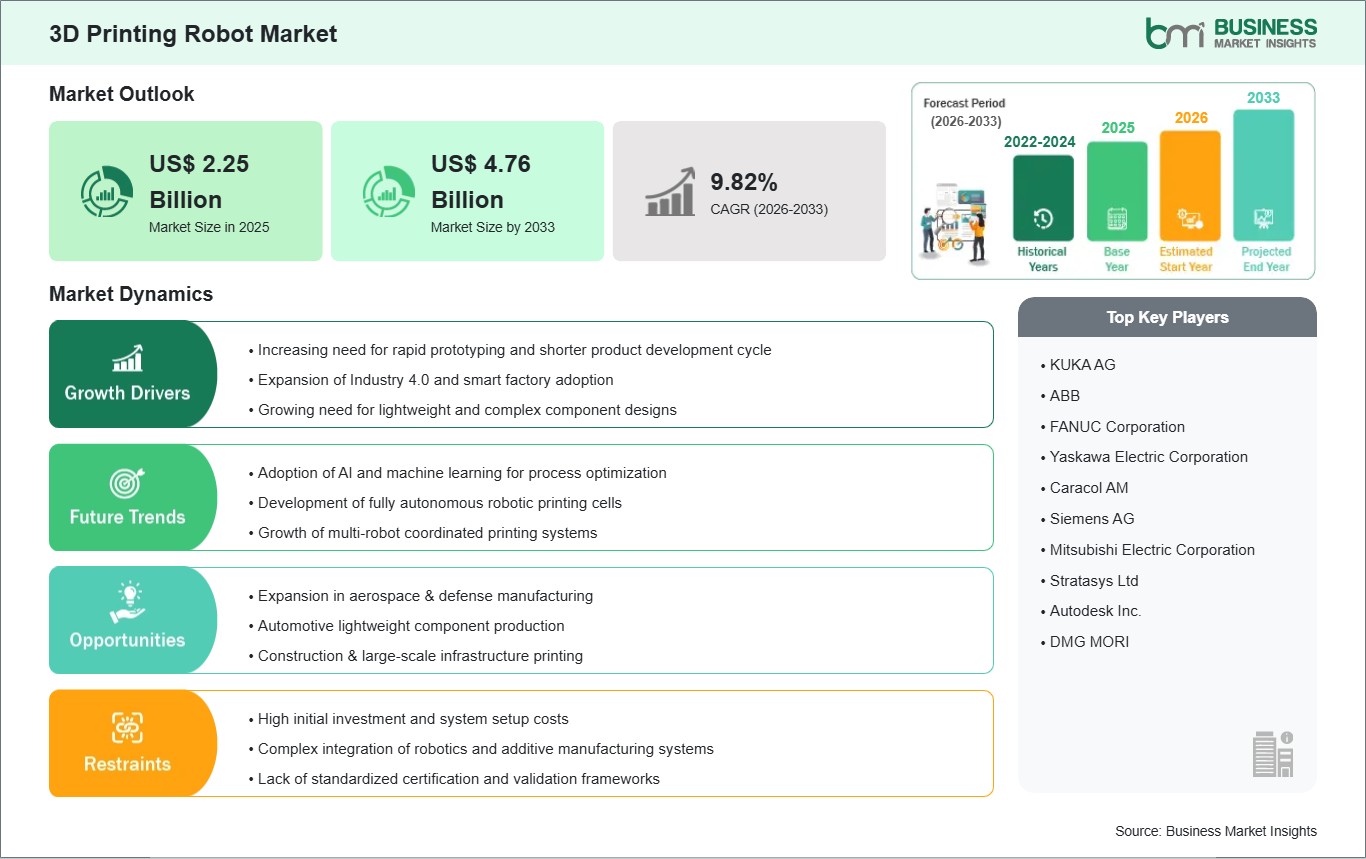
The 3D Printing Robot Market size is expected to reach US$ 4.76 Billion by 2033 from US$ 2.25 Billion in 2025. The market is estimated to record a CAGR of 9.82% from 2026 to 2033.
The global market for 3D printing robots refers to the combined market for industrial robots and 3D printing technologies, in which robots are employed for carrying out large-scale, precise, and complex operations in 3D printing. The market for robots in 3D printing is moving from conventional desktop or fixed frame-based 3D printing systems to flexible and programmable robots with arms for printing complex and diverse parts and hybrid structures. The major sectors in which these robots are being employed are aerospace, automotive, construction, healthcare, and energy. The major factor contributing to the growth of the global market for robots in 3D printing is the increasing need for flexibility in manufacturing and mass customization, which enables organizations to reduce their dependence on tools and speed up their product development process. The employment of robots also provides the benefits of scalability for large-format additive manufacturing. Moreover, the continuous development in printing materials, such as composites and high-performance polymers, is also increasing the functional potential of these parts. In addition, the technical challenges involved in integrating the robotic system with slicing software and extrusion equipment have also posed challenges in the operation of the machines.

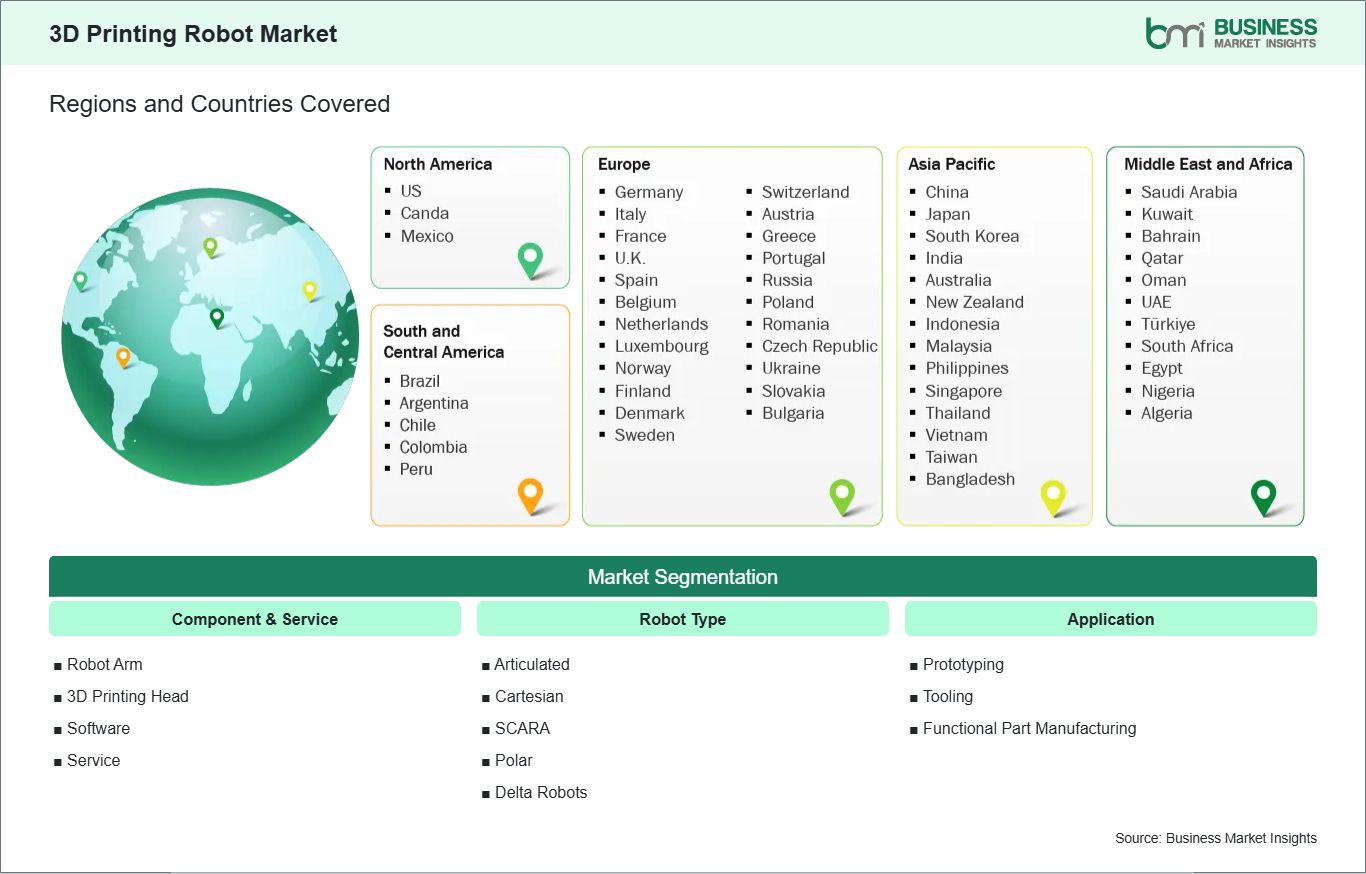
Key segments that contributed to the derivation of the 3D printing robot market analysis are component & service, robot type, and application
The rising need to speed up prototyping and reduce product development time is one of the most prominent factors affecting the global 3D printing robot market. Industries today are in a constant state of flux, where companies are required to innovate and speed up their production processes to keep up with the changing market and customer demands. Conventional manufacturing processes, where various stages of production are required, often hinder the speed of production and make it difficult to keep up with changing market demands. This is where 3D printing robot technology comes in, where a design can be directly converted into a physical model, speeding up the production process and enabling companies to test their products in a much shorter time.
This is especially crucial in industries such as automotive, aerospace, and consumer goods, where various design stages are required to be tested and perfected before a design is finalized. Robotic 3D printing technology helps companies to test their products in a much shorter time, eliminating the need to go through various stages of production, such as retooling, to test their products.
Furthermore, there is also the advantage of scalability when it comes to prototyping bigger and more complicated structures, which may not be efficiently achieved using conventional 3D printing technology. As such, there is no doubt that robotic systems are going to be highly effective when it comes to creating industrial-grade prototypes and functional testing models. The fact that there is the possibility of moving from concept to product in the shortest time not only makes things more efficient but also reduces the risk involved in product development. As such, there is no doubt that there is going to be a major shift when it comes to product development strategies across the globe.
The increasing adoption of robots in the healthcare sector for customized medical devices and implants through 3D printing is creating a new market growth opportunity in the industry. The healthcare sector is increasingly adopting patient-specific treatment, where standard and mass-produced medical devices are not providing the best results. Robotic 3D printing provides highly precise and accurate implants, prosthetics, and medical devices, which are customized according to individual patient requirements. Such customization provides the best results in terms of comfort, functionality, and compatibility with human tissue structures.
One of the major advantages of robotic AM in the healthcare sector is the production of precise and accurate medical devices and implants, including irregular structures such as cranial plates, orthopedic implants, and dental restoratives. Robotic AM provides the best results in terms of the integration of advanced biomaterials, including bio-compatible polymers and metals, which are highly required for implantable medical devices and are essential for patient safety, especially in reconstructive surgery.
Furthermore, the application of robotic 3D printing technology also saves a considerable amount of time in the designing and manufacturing of medical devices. Hospitals and medical research centers are increasingly looking for in-house medical device manufacturing units to reduce dependence on external vendors for medical devices. As the regulatory environment becomes more favorable and the validation of materials progresses, the application of robotic 3D printing technology in the medical field is expected to increase and change the face of personalized medicine and medical manufacturing.

The global 3D printing robot market is experiencing steady growth, with market size and share analysis reflecting evolving treatment preferences and competitive dynamics among key players. The report evaluates important subsegments categorized within component & service, robot type, and application highlighting their respective contributions to overall market performance.
By component & service, the articulated subsegment dominated the market in 2025 due to its continued reliance of manufacturing-intensive industries on rapid design validation and iterative product development.
By robot type, the articulated segment subsegment dominated the market in 2025 due to is primarily attributed to their high degree of freedom, flexibility, and ability to replicate complex tool paths required for large-format and non-planar additive manufacturing.
By application, the prototyping subsegment dominated the market in 2025 because of rapid growth in strong global demand for both residential and commercial furnishings. Wood coatings are extensively used in furniture manufacturing to enhance visual appeal, improve surface smoothness, and provide protection against scratches, stains, and environmental damage.
| Report Attribute | Details |
|---|---|
| Market size in 2025 | US$ 2.25 Billion |
| Market Size by 2033 | US$ 4.76 Billion |
| Global CAGR (2026 - 2033) | 9.82% |
| Historical Data | 2022-2024 |
| Forecast period | 2026-2033 |
| Segments Covered | By Component & Service
|
|
Regions and Countries Covered
| |
| North America | US, Canada, Mexico |
| Europe | Belgium, Austria, Finland, Denmark, Greece, Poland, Romania, Russia, Ukraine, Czech Republic, Slovakia, Bulgaria, Italy, Luxembourg, Germany, Switzerland, France, Netherlands, Norway, Portugal, Spain, Sweden, United Kingdom |
| Asia-Pacific | Australia, China, India, Japan, South Korea, Indonesia, Malaysia, Philippines, Singapore, Thailand, Vietnam, Bangladesh, New Zealand, Taiwan |
| South and Central America | Brazil, Argentina, Peru, Chile, Colombia |
| Middle East and Africa | Bahrain, Kuwait, Oman, Qatar, Saudi Arabia, United Arab Emirates, Turkiye, South Africa, Egypt, Algeria, Nigeria |
| Market leaders and key company profiles |
|
The "3D printing robot market Size and Forecast (2022 - 2033)" report provides a detailed analysis of the market covering below areas:
The geographical scope of the 3D printing robot market report is divided into: North America, Asia Pacific, Europe, Middle East & Africa, and South & Central America. North America held the largest share in 2025.
North America has the leading position in the global market for 3D printing robots due to the presence of a well-developed manufacturing environment and the early adoption of robotics and 3D printing technologies. The North American market benefits from the presence of a well-developed industrial environment in the aerospace and defense, automotive, and healthcare sectors, which invest heavily in precision manufacturing technologies. These sectors increasingly adopt robotic 3D printing systems for the production of complex components and parts that involve the creation of light structures and rapid prototyping technologies that traditional manufacturing systems cannot provide. One of the strengths of the North American market for 3D printing robots is the presence of a well-developed environment for robotics and 3D printing technologies. The constant interactions between private businesses and innovation centers help accelerate the development of hybrid manufacturing systems that integrate robotics and printing technologies with the help of sophisticated printing heads and software systems. Moreover, the emphasis on reshoring within the region`s manufacturing industry is contributing to increased demand for flexible, automated manufacturing technologies. There are more instances of companies adopting robotic 3D printing technologies to minimize dependence on global supply chains. Even though costs associated with implementation are a major issue, large corporations within the region are more likely to afford such costs, thus ensuring North America`s dominance in terms of adoption within a global context.

The 3D printing robot market is evaluated by gathering qualitative and quantitative data post primary and secondary research, which includes important corporate publications, association data, and databases. A few of the key developments in the 3D printing robot market are:
The 3D Printing Robot Market is valued at US$ 2.25 Billion in 2025, it is projected to reach US$ 4.76 Billion by 2033.
As per our report 3D Printing Robot Market, the market size is valued at US$ 2.25 Billion in 2025, projecting it to reach US$ 4.76 Billion by 2033. This translates to a CAGR of approximately 9.82% during the forecast period.
The 3D Printing Robot Market report typically cover these key segments-
The historic period, base year, and forecast period can vary slightly depending on the specific market research report. However, for the 3D Printing Robot Market report:
The 3D Printing Robot Market is populated by several key players, each contributing to its growth and innovation. Some of the major players include:
The 3D Printing Robot Market report is valuable for diverse stakeholders, including:
Essentially, anyone involved in or considering involvement in the 3D Printing Robot Market value chain can benefit from the information contained in a comprehensive market report.
Please tell us your area of interest
(Market Segments/ Regions and Countries/ Companies)