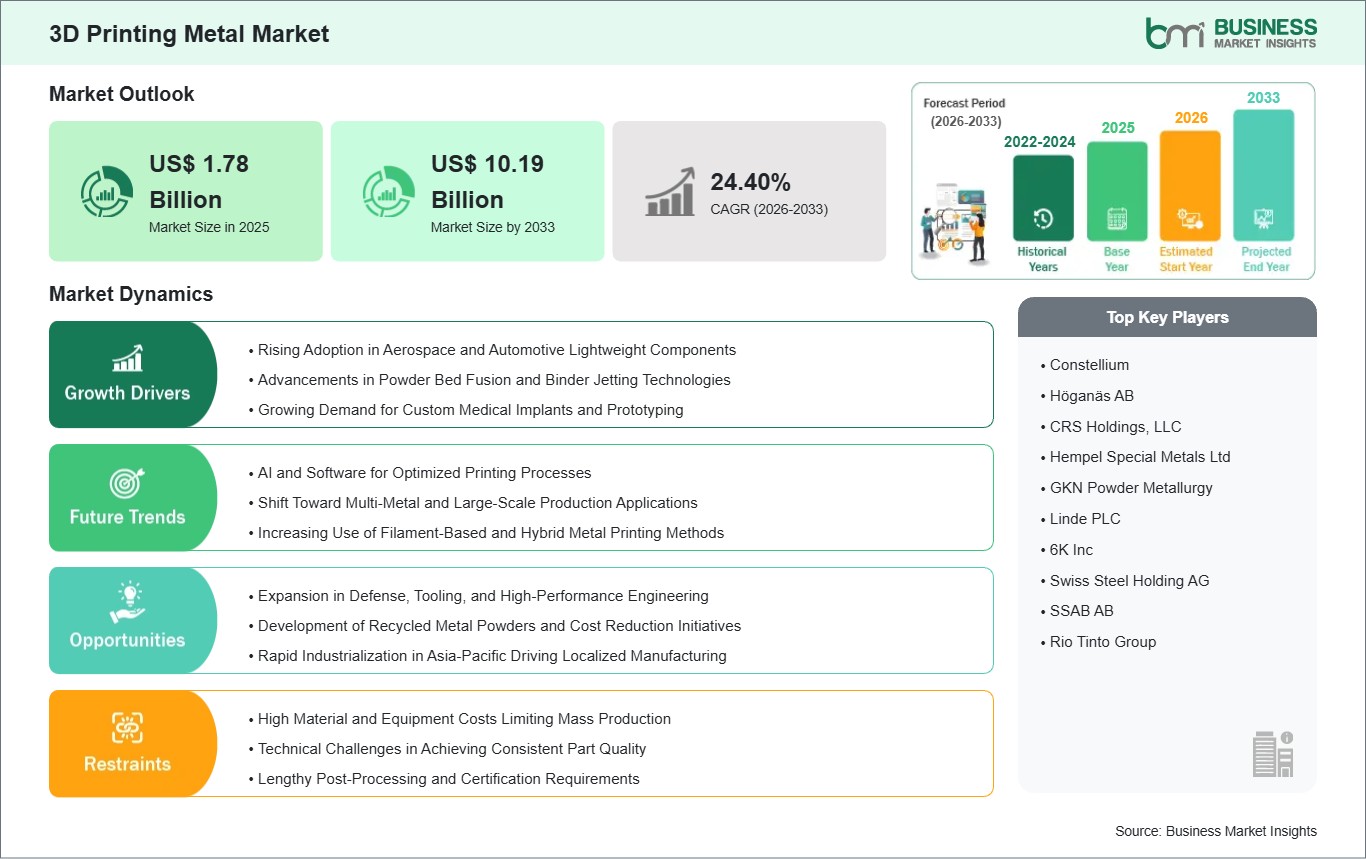
The 3D Printing Metal market size is expected to reach US$ 10.19 billion by 2033 from US$ 1.78 billion in 2025. The market is estimated to record a CAGR of 24.4% from 2026 to 2033.
3D printing of metals is a critical aspect of advanced processing and manufacturing as it improves the strength, accuracy, life cycle, as well as performance of the products being fabricated. Metal alloys also contribute significantly to enhancing the functionality of complicated components deployed in the aerospace, automotive, medical, defense, electronics, and energy product manufacturing; thus, exhibiting high reliability and efficiency in finished products. Specifically, medical implants and surgical equipment, lightweight structural components in the aerospace sector, customized and performance parts in the automotive industry, tooling and spare parts in industrial manufacturing are widely produced using 3D printing of metals. The benefits of 3D printing metals are high mechanical strength, high thermal conductivity, flexibility of design, and the ability to use more advanced additive manufacturing technology that can produce complex geometries. The market is growing because of the increasing use of additive manufacturing, the higher demand for customized and lightweight components, and the increased use of automation in industries. Furthermore, the progress in metal powders, the creation of sustainable and recyclable alloys, and the increased adoption of 3D printing in the production processes continue to propel the market growth.
However, the market growth can be hindered by the high cost of equipment and materials, technical difficulties of the metal printing processes, and constraints concerning mass production. Other issues as post-processing needs, the consistency of material quality, and the strict regulatory and industrial requirements, are other issues. Nevertheless, the market exhibits great potential for growth due to the ever-growing technological developments, increased demand for high-strength and lightweight products, and constant digital transformation of industries. Further research and development, government initiatives, and new developments in new and environmentally friendly metal materials are predicted to continue being a major contributor with regard to the development of the 3D printing metal industry across the world.

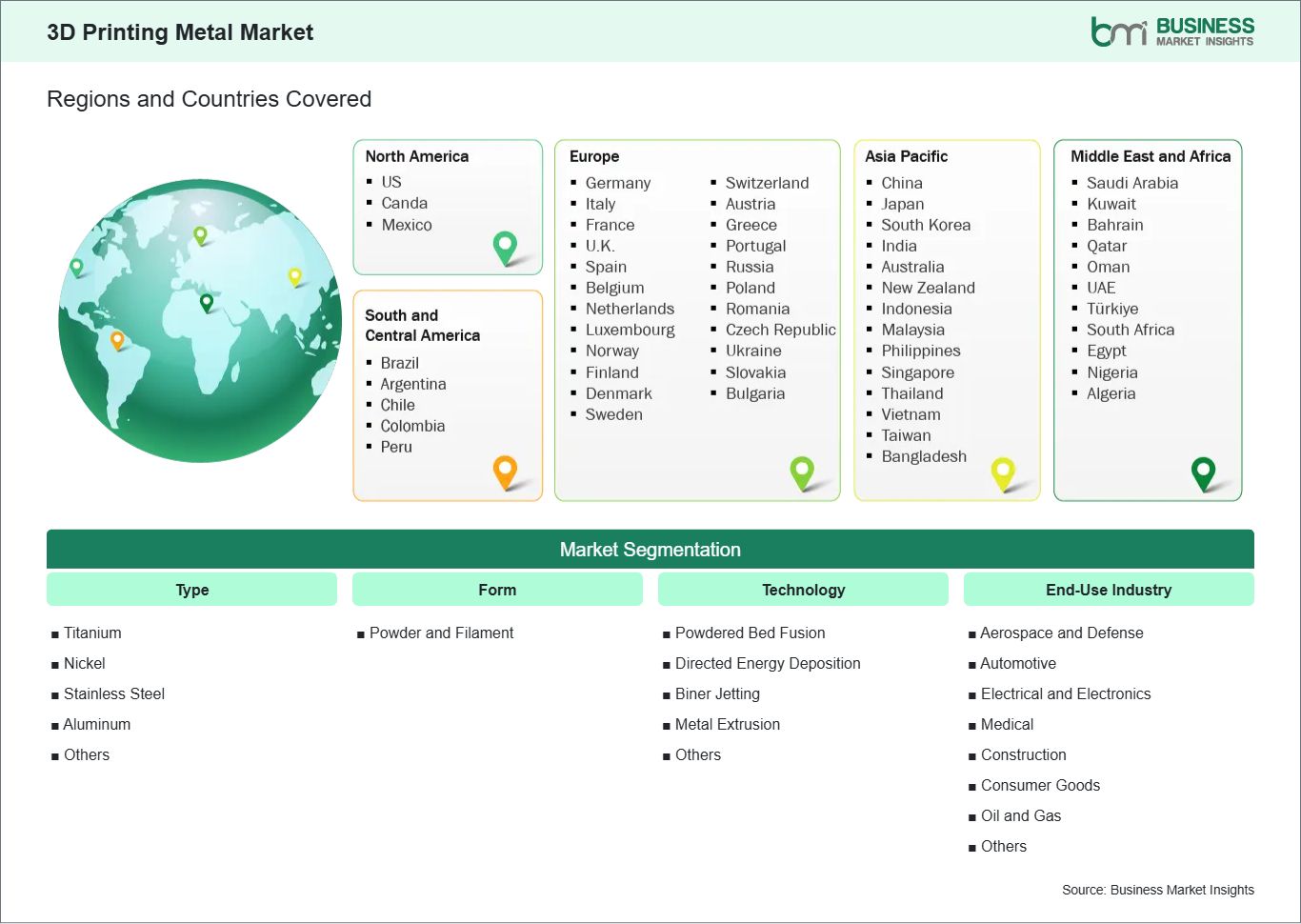
Key segments that contributed to the derivation of the 3D Printing Metal market analysis are type, form, technology, and end-use industry.
The use of 3D printing in metals is gaining popularity in global industries to create highly durable, precise, and intricate components for industries in the aerospace, automotive, defense, medical, industry, and manufacturing sectors. The 3D printing of metal has been increasingly demanded over the past few years because of the accelerated automation of industries, the necessity of lightweight, but high-strength metal parts, and the increasing demand for customized manufacturing solutions, which directly affect the performance and reliability of end-products. Metal additive manufacturing is a popular way of manufacturing multi-layered structural components, medical devices, engine components, tooling, and heat exchangers that allow better optimization of designs, less material wastage, shortened production cycles, and economical production.
One of the primary drivers of the 3D printing metals market is the rapid growth of the additive manufacturing technologies and high-performance metal alloys. The aerospace structures, medical devices, and smart manufacturing systems are progressively incorporating metal components, and industries are investing heavily in them. The intensive industrialization and modernization in areas like North America, Europe, and Asia Pacific are also contributing to the growth of the market. Besides this, increasing demands concerning component strength, longevity, and efficiency are prompting manufacturers to create superior metal powders and alloys, and this supports long-term demand for metal 3D printing in world markets.
The manufacturing industry is actively entering the shift to sustainable, energy-saving, and resource-efficient production processes, which shapes the interest in the development of high-level 3D printable metal materials. Metal additive manufacturing is also eco-friendly as it reduces waste of materials, enhances resource efficiency, and increases component life. Recyclable metal powders, lightweight alloys, as well as high-performance metals, which include titanium, aluminum, and nickel-based alloys, are gaining significance in contemporary industrial settings. Furthermore, metal 3D printing helps to decrease carbon emissions through reducing the use of excess materials, producing locally, and improving the efficiency of the manufacturing process.
The increased attention to sustainable manufacturing processes and favorable government regulations favoring the use of green industrial technologies are giving manufacturers an opportunity to become innovative and make metal materials eco-friendly. The industry regulations, quality certifications, and sustainability are also encouraging the implementation of the latest metal alloys that integrate high strength, resistance to corrosion, and environmental compliance. The main drivers of the growing adoption of sustainable and high-performance 3D printing metals in international industries are improved performance, long-term cost-effective, and reduced environmental impact.

The Additive Masterbatch market demonstrates steady growth, with size and share analysis revealing evolving trends and competitive positioning among key players. The report further examines subsegments categorized within type, form, technology, and end-use industry, offering insights into their contribution to overall market performance.
Based on form, the powder segment had the largest share of the 3D printing metal market. Metal 3D printing requires metal powders because they are highly precise, consistent, and contain strong mechanical properties, which leads to durable and corrosion-resistant components that have less wastage of materials in a variety of industries.
| Report Attribute | Details |
|---|---|
| Market size in 2025 | US$ 1.78 Billion |
| Market Size by 2033 | US$ 10.19 Billion |
| Global CAGR (2026 - 2033) | 24.40% |
| Historical Data | 2022-2024 |
| Forecast period | 2026-2033 |
| Segments Covered | By Type
|
|
Regions and Countries Covered
| |
| North America | US, Canada, Mexico |
| Europe | Belgium, Austria, Finland, Denmark, Greece, Poland, Romania, Russia, Ukraine, Czech Republic, Slovakia, Bulgaria, Italy, Luxembourg, Germany, Switzerland, France, Netherlands, Norway, Portugal, Spain, Sweden, United Kingdom |
| Asia-Pacific | Australia, China, India, Japan, South Korea, Indonesia, Malaysia, Philippines, Singapore, Thailand, Vietnam, Bangladesh, New Zealand, Taiwan |
| South and Central America | Brazil, Argentina, Peru, Chile, Colombia |
| Middle East and Africa | Bahrain, Kuwait, Oman, Qatar, Saudi Arabia, United Arab Emirates, Turkiye, South Africa, Egypt, Algeria, Nigeria |
| Market leaders and key company profiles |
|
The " 3D Printing Metal Market Size and Forecast (2022–2033)" report provides a detailed analysis of the market covering below areas:
The geographical scope of the 3D Printing Metal market report is divided into five regions: North America, Asia Pacific, Europe, the Middle East & Africa, and South & Central America. The 3D Printing Metal market in the Asia Pacific is expected to grow significantly during the forecast period.
The Asia-Pacific 3D Printing Metal market is segmented into China, Japan, South Korea, India, Australia, New Zealand, Indonesia, Malaysia, the Philippines, Singapore, Thailand, Vietnam, Taiwan, Bangladesh, and the Rest of Asia. Asia Pacific has been one of the fastest-developing markets in 3D printing metals. With the growing adoption of additive manufacturing in industrial, healthcare, automotive, and aerospace markets, the industry is going to keep growing. China, India, and Japan are some of the key markets, and robust growth is attainable due to the rapid industrialization, development of high-level manufacturing facilities, and the increased demand for high-performance and custom metal components. The 3D printing metal industry in the area is highly established with an effective workforce, manufacturing base, and streamlined supply chains. A number of governments in the Asia Pacific are actively encouraging industrial innovation using favorable manufacturing policies, research, and incentives to the local metal powder and additive manufacturing technology vendors.
The Indian programs of additive manufacturing in producing high-quality metals focus on advanced manufacturing, automation, and high quality through initiatives led by the government. Likewise, the Japanese government encourages the use of efficient, advanced, and environmentally compliant metal materials to enhance competitiveness in industries. The growing automation of industries further fuels the proliferation of metal 3D printing in the area, the increased demands for performance and safety, and administrative policies that attempt to promote long-term innovation and sustainable manufacturing.

The 3D Printing Metal market is evaluated by gathering qualitative and quantitative data post-primary and secondary research, which includes important corporate publications, association data, and databases. A few of the key developments in the 3D printing metal market are:
The 3D Printing Metal Market is valued at US$ 1.78 Billion in 2025, it is projected to reach US$ 10.19 Billion by 2033.
As per our report 3D Printing Metal Market, the market size is valued at US$ 1.78 Billion in 2025, projecting it to reach US$ 10.19 Billion by 2033. This translates to a CAGR of approximately 24.40% during the forecast period.
The 3D Printing Metal Market report typically cover these key segments-
The historic period, base year, and forecast period can vary slightly depending on the specific market research report. However, for the 3D Printing Metal Market report:
The 3D Printing Metal Market is populated by several key players, each contributing to its growth and innovation. Some of the major players include:
The 3D Printing Metal Market report is valuable for diverse stakeholders, including:
Essentially, anyone involved in or considering involvement in the 3D Printing Metal Market value chain can benefit from the information contained in a comprehensive market report.
Please tell us your area of interest
(Market Segments/ Regions and Countries/ Companies)