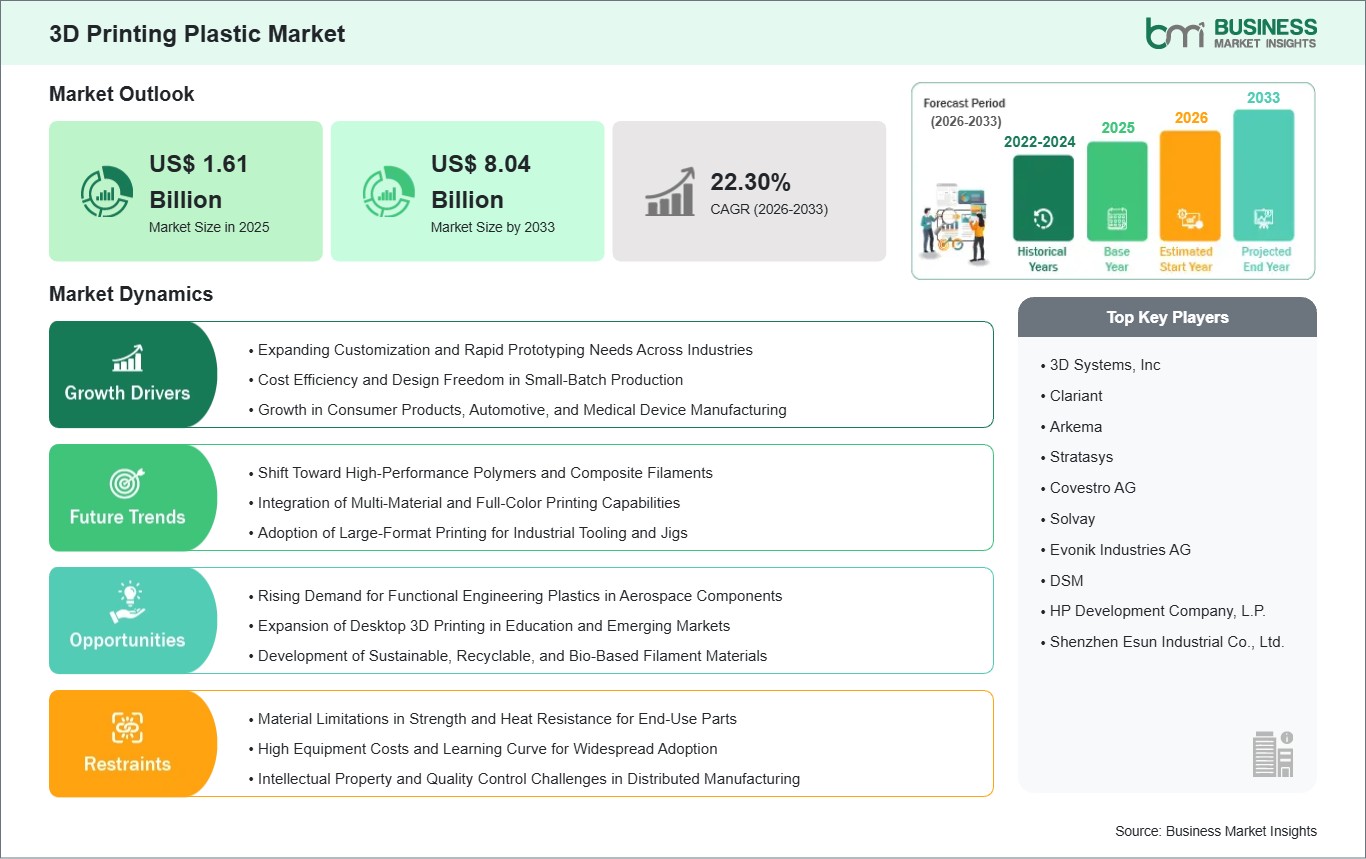
The 3D Printing Plastic market size is expected to reach US$ 8.04 billion by 2033 from US$ 1.61 billion in 2025. The market is estimated to record a CAGR of 22.3% from 2026 to 2033.
Plastic 3D printing is an important factor in contemporary manufacturing and prototyping because it increases the flexibility of designs, shortens the time of production, lowers costs, and enhances the performance and the lifespan of the manufactured products. Plastic polymers are also important for improving the performance of multifunctional elements employed in the aerospace, automobile, medical, consumer electronics, and industrial equipment manufacturing sectors to guarantee high reliability of products and efficiency. In particular, medical tools and prosthetics, light-weight materials in aerospace designs, custom-designed and functional components in the automotive industry, tooling, jigs, and spares in industrial manufacturing are highly manufactured by 3D printing of plastics. The benefits of using 3D printing plastics are low cost of materials, high design flexibility, chemical resistance, and the option to make complex geometries with sophisticated additive manufacturing technologies. Market expansion is being driven by the rising adoption of additive manufacturing, growing demand for lightweight and customized products, and the rapid integration of automation across industrial operations. Furthermore, the market is expanding due to innovations in polymer formulations and the creation of sustainable and recyclable plastics, as well as the increased acceptance of 3D printing in the production process.
Nonetheless, the fast growth of the market can be limited due to the low mechanical and thermal characteristics of certain plastics, the exorbitant price of the high-quality polymer materials, and technical issues concerning accuracy and surface finish. The other problems are the post-processing requirements, material quality variability, and adherence to industry standards and regulations. However, the market portrays a lot of growth opportunities owing to the current technological change, rising demand for light and durable goods, and the constant digitalization of manufacturing sectors. Ongoing research and development, strengthened government support, and advancements in eco‑friendly, high‑performance polymer materials are expected to remain key drivers in advancing the global 3D printing plastics industry.

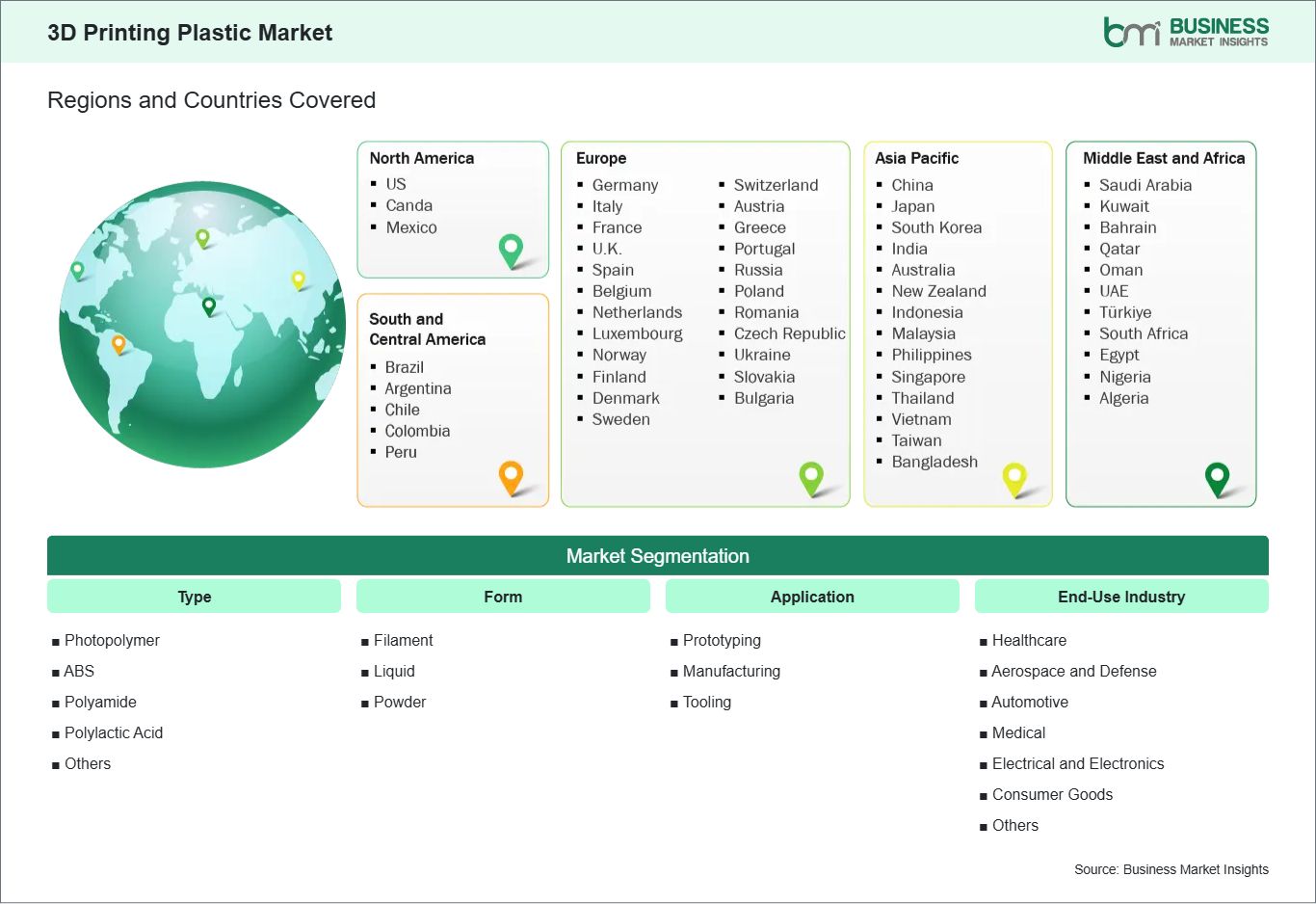
Key segments that contributed to the derivation of the 3D Printing Plastic market analysis are type, form, application, and end-use industry.
3D printing in plastics is gaining immense popularity in creating lightweight, high-precision, and complex parts of the aerospace, automotive, medical, consumer electronics, and industrial manufacturing industries. The use of plastic 3D printing has been rising over the past few years because of increasing automation of production, the necessity of cost-effective but durable components, and the hike in demand for highly customized components, which directly contribute to enhancing the functionality and efficiency of end products. Plastic additive manufacturing finds extensive application in prototyping, tooling, medical devices, structures, and housings, which can be more flexibly designed, generate less waste of materials, take less time to manufacture, and incur lower production costs.
High‑performance plastics are seeing rising adoption across aerospace assemblies, medical devices, and consumer electronics, supported by substantial industry investment. Market growth is further propelled by increasing industrialization and modernization in North America, Europe, and the Asia Pacific. In addition, the demand for lightweight, durable, and customizable components is driving manufacturers to develop advanced polymer compounds, strengthening long‑term expansion prospects for the global 3D‑printed plastics market.
The manufacturing industry is also moving toward sustainable, energy-efficient, and resource-conscious manufacturing, which is making high-performance 3D printable plastics very interesting. Plastic manufacturing additive is environmentally friendly as it lessens material waste, increases the use of resources, and elevates the usefulness of components. Recyclable plastics, bio-based plastics, and highly engineered plastics such as PEEK, ABS, and nylon are becoming dominant in modern industrial uses. In addition, 3D printing of plastics will also reduce carbon footprints by conserving material usage, localizing production, and simplifying manufacturing procedures.
The growing attention toward sustainable production and favorable governmental policies that encourage green technologies allows manufacturers to innovate and create environmentally friendly plastics. Sustainability needs, industry standards, and certification are driving the adoption of superior mechanical strength, heat resistance, and durability of polymers. The major factors that have contributed to increasing use of sustainable and high-performance 3D printing plastics across industries are improved product performance, long-term cost savings as well and minimization of environmental impact.

The 3D printing plastic market demonstrates steady growth, with size and share analysis revealing evolving trends and competitive positioning among key players. The report further examines subsegments categorized within type, form, application, and end-use industry, offering insights into their contribution to overall market performance. By type, the photopolymer segment dominated the market in 2025. Photopolymers are also applicable to 3D printing because of their high precision, good surface finish, rapid curing, and complex and detailed parts, making them an ideal future application in healthcare, dental, jewelry, consumer products, and industrial prototyping.
In terms of form, the filament segment led the market in 2025 due to its strong adoption in 3D printing. Filaments are widely preferred for their versatility, ease of use, cost‑effectiveness, and broad compatibility with desktop and industrial 3D printers, making them ideal for producing functional prototypes, automotive components, consumer products, educational models, and industrial parts.
| Report Attribute | Details |
|---|---|
| Market size in 2025 | US$ 1.61 Billion |
| Market Size by 2033 | US$ 8.04 Billion |
| Global CAGR (2026 - 2033) | 22.30% |
| Historical Data | 2022-2024 |
| Forecast period | 2026-2033 |
| Segments Covered | By Type
|
|
Regions and Countries Covered
| |
| North America | US, Canada, Mexico |
| Europe | Belgium, Austria, Finland, Denmark, Greece, Poland, Romania, Russia, Ukraine, Czech Republic, Slovakia, Bulgaria, Italy, Luxembourg, Germany, Switzerland, France, Netherlands, Norway, Portugal, Spain, Sweden, United Kingdom |
| Asia-Pacific | Australia, China, India, Japan, South Korea, Indonesia, Malaysia, Philippines, Singapore, Thailand, Vietnam, Bangladesh, New Zealand, Taiwan |
| South and Central America | Brazil, Argentina, Peru, Chile, Colombia |
| Middle East and Africa | Bahrain, Kuwait, Oman, Qatar, Saudi Arabia, United Arab Emirates, Turkiye, South Africa, Egypt, Algeria, Nigeria |
| Market leaders and key company profiles |
|
The " 3D Printing Plastic Market Size and Forecast (2022–2033)" report provides a detailed analysis of the market covering below areas:
The geographical scope of the 3D Printing Plastic market report is divided into five regions: North America, Asia Pacific, Europe, the Middle East & Africa, and South & Central America. The 3D Printing Plastic market in the Asia Pacific is expected to grow significantly during the forecast period.
The Asia-Pacific 3D Printing Plastic market is segmented into China, Japan, South Korea, India, Australia, New Zealand, Indonesia, Malaysia, the Philippines, Singapore, Thailand, Vietnam, Taiwan, Bangladesh, and the Rest of Asia. Asia Pacific is one of the most rapidly growing markets in 3D printing plastics. As more industries, especially in healthcare, automotive, and consumer goods, are adopting additive manufacturing, the industry is projected to keep growing. The major markets are China, India, and Japan, and the growth can be achieved strongly because of the high rate of industrialization, the construction of modern manufacturing plants, and the rise in demand for high-performance and custom-made plastic parts. The plastics sector of 3D printing in the region has a well-established market that has a skilled site of workforce, manufacturing strength, and efficient supply chain. Some governments across Asia Pacific are currently encouraging industrial innovation by providing favorable manufacturing policies, research and development efforts, and subsidies to local polymer and additive manufacturing technology providers.
The Indian programs that aid additive manufacturing in plastics are aimed at the higher production methods, automation, and quality production using government-initiated programs. In the same manner, the Japanese government promotes the use of efficient, high-performance, and environmental friendly plastic materials to increase the competitiveness in industry. The trend of automation of industries also encourages the development of plastic 3D printing in the area, as well as more demands in the fields of precision, durability, and design flexibility, and administrative policies to facilitate long-term innovation and sustainable manufacturing.

The 3D Printing Plastic market is evaluated by gathering qualitative and quantitative data post-primary and secondary research, which includes important corporate publications, association data, and databases. A few of the key developments in the 3D printing plastic market are:
The 3D Printing Plastic Market is valued at US$ 1.61 Billion in 2025, it is projected to reach US$ 8.04 Billion by 2033.
As per our report 3D Printing Plastic Market, the market size is valued at US$ 1.61 Billion in 2025, projecting it to reach US$ 8.04 Billion by 2033. This translates to a CAGR of approximately 22.30% during the forecast period.
The 3D Printing Plastic Market report typically cover these key segments-
The historic period, base year, and forecast period can vary slightly depending on the specific market research report. However, for the 3D Printing Plastic Market report:
The 3D Printing Plastic Market is populated by several key players, each contributing to its growth and innovation. Some of the major players include:
The 3D Printing Plastic Market report is valuable for diverse stakeholders, including:
Essentially, anyone involved in or considering involvement in the 3D Printing Plastic Market value chain can benefit from the information contained in a comprehensive market report.
Please tell us your area of interest
(Market Segments/ Regions and Countries/ Companies)