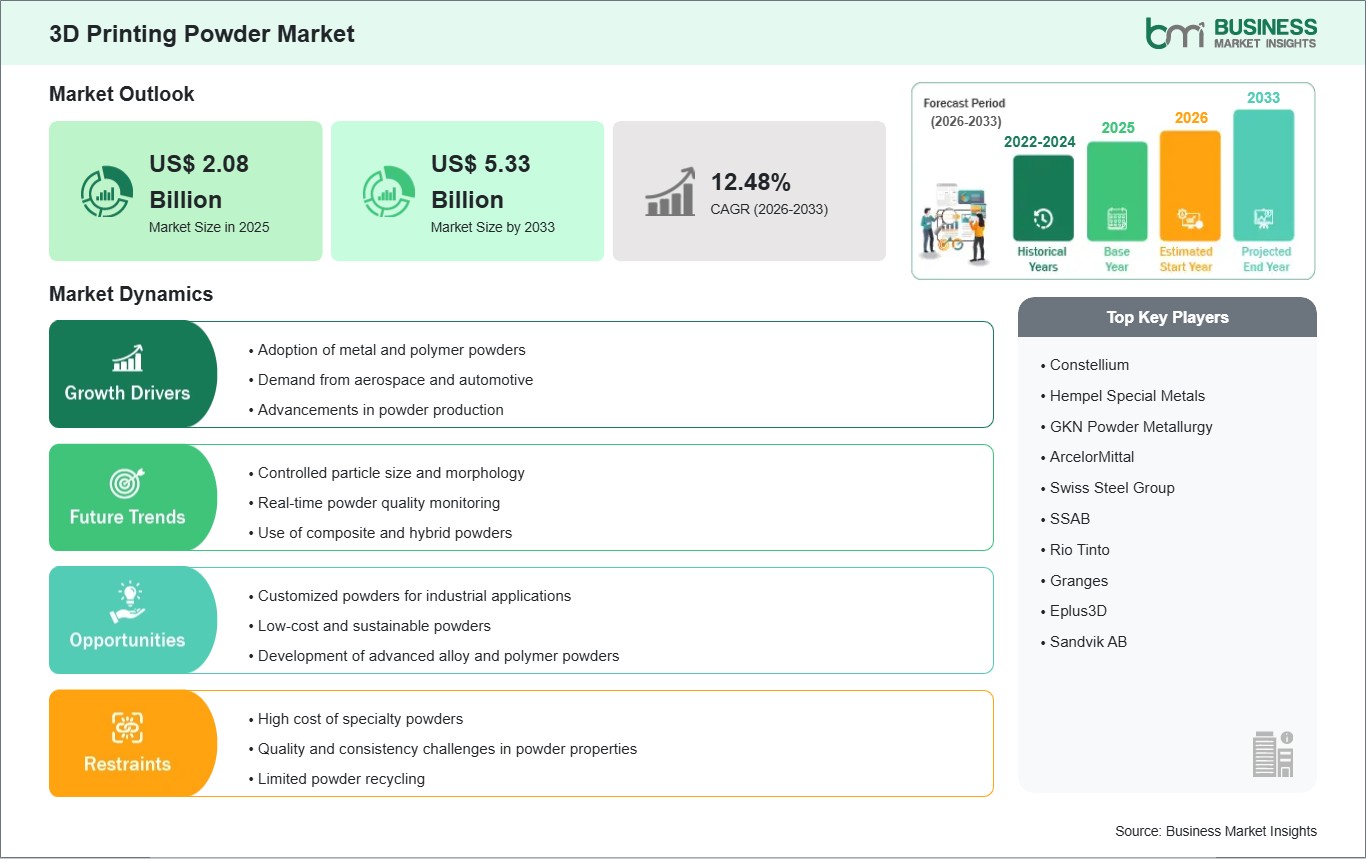
The 3D Printing Powder Market size is expected to reach US$ 5.33 Billion by 2033 from US$ 2.08 Billion in 2025. The market is estimated to record a CAGR of 12.48% from 2026 to 2033.
3D printing powder consists of fine materials used in additive manufacturing processes, especially in powder-based 3D printing technologies like selective laser sintering (SLS), direct metal laser sintering (DMLS), electron beam melting (EBM), and binder jetting. These 3D printing powders are made from metals, polymers, ceramics, or composites, depending up on mechanical properties, thermal resistance, surface finish, and specific application requirements. Metal powders, including stainless steel, titanium, aluminum, and cobalt-chrome, are often used in industrial, aerospace, and medical fields. Polymer powders, such as nylon, polyamide, and high-performance thermoplastics, are preferred for lightweight, durable, and complex shapes. Ceramics and composite powders are used for special applications that need high temperature or chemical resistance.
The 3D printing powder market is growing due to the rising use of additive manufacturing across industries for creating functional prototypes, tooling, and final parts. Trends like the demand for lightweight and strong components, increasing industrial automation, and improvements in 3D printing technologies and material formulations are driving this growth. The capability to create complex shapes, minimize waste, and speed up production cycles also promotes the wider use of 3D printing powders worldwide.

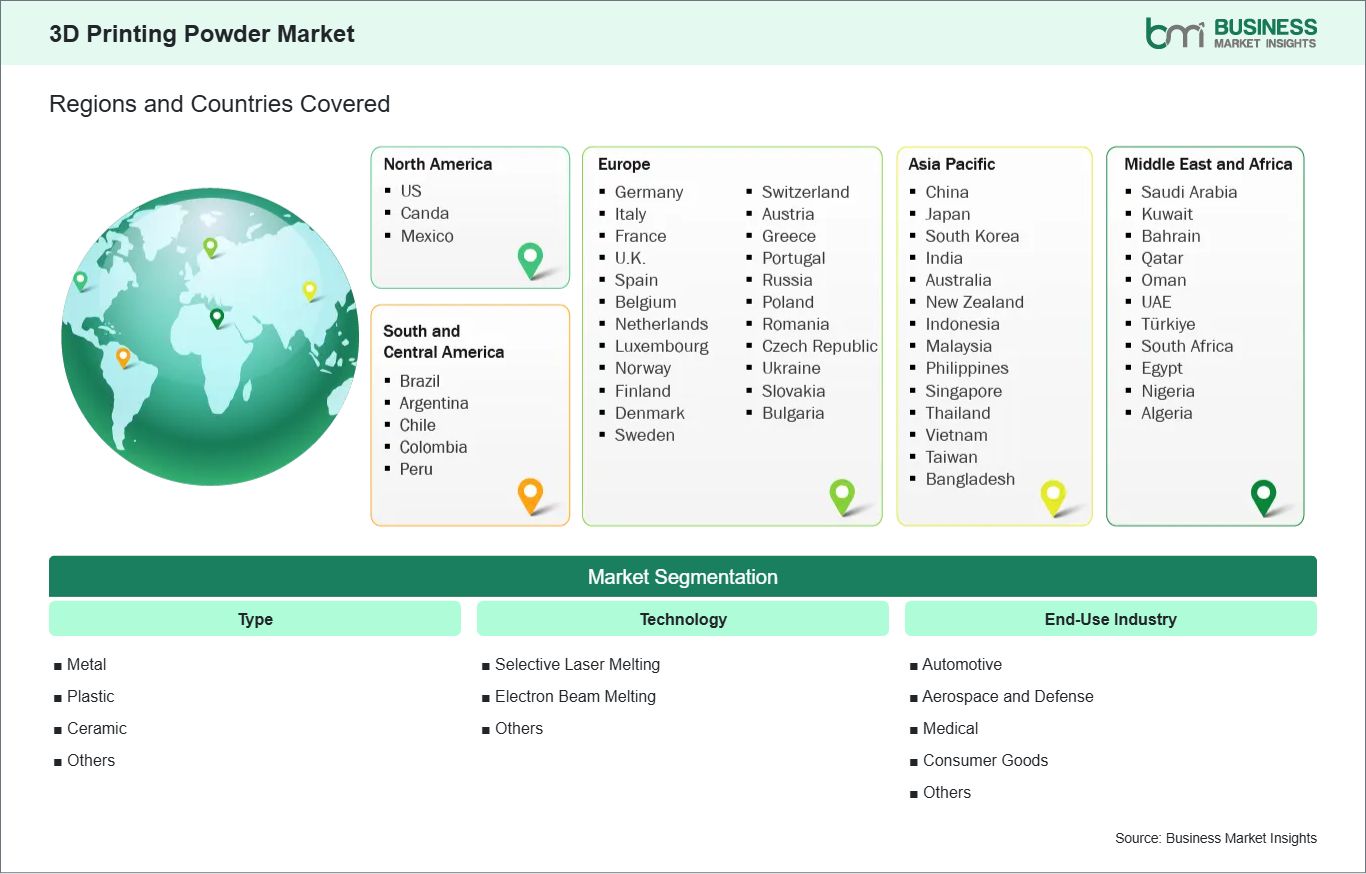
Key segments that contributed to the derivation of the 3D printing powder market analysis are type, form, technology, and end use industry.
The rising use of additive manufacturing for rapid prototyping and production in industries such as aerospace, automotive, medical, and defense, is accelerating the growth of the 3D printing powder market. Powder-based methods, including selective laser melting (SLM) and electron beam melting (EBM), enable manufacturers to create highly complex, lightweight, and durable parts that traditional methods struggle to achieve. Metal powders like titanium, aluminum, and stainless steel are especially sought after for key components because of their strength, resistance to corrosion, and stability under heat.
Additionally, improvements in material quality, consistency, and post-processing techniques have boosted trust in 3D printing powders for functional and end-use parts. The capacity to create detailed shapes, minimize material waste, and speed up prototyping and production helps boost efficiency and cut costs. As industries aim for innovation, lighter products, and high-performance solutions, powder-based 3D printing is driving significant market growth globally.
There is significant growth potential in the 3D printing powder market, especially in healthcare and medical fields. This growth is fueled by the rising demand for custom implants, prosthetics, surgical tools, and dental devices. Metal powders like titanium and cobalt-chrome are commonly used to create patient-specific orthopedic implants and dental restorations. Their biocompatibility, strength, and resistance to corrosion make them ideal for these applications.
Polymer powders, especially high-performance polyamides, are increasingly used for making lightweight, durable, and sterilizable surgical instruments and medical models. The capacity of 3D printing to provide personalized solutions helps lower surgical risks, improve patient outcomes, and support on-demand manufacturing. This ability is particularly beneficial in hospitals and specialized clinics.
Ongoing research into biocompatible ceramics and composite powders continues to broaden options for medical uses. Additionally, emerging markets with developing healthcare systems offer untapped opportunities for adopting additive manufacturing. As more regulatory approvals come through for 3D-printed medical devices and hospitals start integrating digital manufacturing, the healthcare sector stands out as a strong long-term growth area for 3D printing powders.

The 3D printing powder market demonstrates steady growth, with size and share analysis revealing evolving trends and competitive positioning among key players. The report further examines subsegments categorized within type, technology, and end-use industry, offering insights into their contribution to overall market performance.
In terms of technology, the selective laser melting segment dominated in 2025; it is largely driven by its precision, high-quality part production, and widespread adoption in industrial additive manufacturing for metals and high-performance components. By end-use industry, the aerospace and defense segment held a significant share in the market share in 2025 due to the demand for lightweight, high-strength, and complex components that meet stringent safety and performance standards in aircraft, defense equipment, and space applications.
| Report Attribute | Details |
|---|---|
| Market size in 2025 | US$ 2.08 Billion |
| Market Size by 2033 | US$ 5.33 Billion |
| Global CAGR (2026 - 2033) | 12.48% |
| Historical Data | 2022-2024 |
| Forecast period | 2026-2033 |
| Segments Covered | By Type
|
|
Regions and Countries Covered
| |
| North America | US, Canada, Mexico |
| Europe | Belgium, Austria, Finland, Denmark, Greece, Poland, Romania, Russia, Ukraine, Czech Republic, Slovakia, Bulgaria, Italy, Luxembourg, Germany, Switzerland, France, Netherlands, Norway, Portugal, Spain, Sweden, United Kingdom |
| Asia-Pacific | Australia, China, India, Japan, South Korea, Indonesia, Malaysia, Philippines, Singapore, Thailand, Vietnam, Bangladesh, New Zealand, Taiwan |
| South and Central America | Brazil, Argentina, Peru, Chile, Colombia |
| Middle East and Africa | Bahrain, Kuwait, Oman, Qatar, Saudi Arabia, United Arab Emirates, Turkiye, South Africa, Egypt, Algeria, Nigeria |
| Market leaders and key company profiles |
|
The " 3D Printing Powder Market Size and Forecast (2022–2033)" report provides a detailed analysis of the market covering below areas:
The geographical scope of the 3D printing powder market report is divided into five regions: North America, Asia Pacific, Europe, the Middle East & Africa, and South & Central America. The 3D printing powder market in the North America is expected to grow significantly during the forecast period.
This is due to its strong food processing and manufacturing industry, high consumption of processed and packaged foods, and solid demand from commercial and industrial users. The region has a mature food production system with reliable infrastructure. This setup allows for large-scale use of edible oils and fats in baked goods, candies, snacks, ready-to-eat meals, and frozen foods. The high consumer preference for convenient foods and products with a long shelf life continues to drive steady demand from food manufacturers.
Also, the presence of major multinational food companies and edible oil producers helps maintain consistent sourcing and stable supply chains. North America benefits from strong regulations that ensure product quality, safety, and clear labeling. This fosters trust in the market and encourages adoption. A growing awareness of nutrition and the availability of different oils, like vegetable, canola, soybean, and specialty oils, also support market strength. Additionally, ongoing innovation in formulations, such as low-trans-fat and functional oil blends, has broadened application areas. Together, these factors have made North America the leading regional market in 2024.

The 3D printing powder market is evaluated by gathering qualitative and quantitative data post-primary and secondary research, which includes important corporate publications, association data, and databases. A few of the key developments in the 3D printing powder market are:
The 3D Printing Powder Market is valued at US$ 2.08 Billion in 2025, it is projected to reach US$ 5.33 Billion by 2033.
As per our report 3D Printing Powder Market, the market size is valued at US$ 2.08 Billion in 2025, projecting it to reach US$ 5.33 Billion by 2033. This translates to a CAGR of approximately 12.48% during the forecast period.
The 3D Printing Powder Market report typically cover these key segments-
The historic period, base year, and forecast period can vary slightly depending on the specific market research report. However, for the 3D Printing Powder Market report:
The 3D Printing Powder Market is populated by several key players, each contributing to its growth and innovation. Some of the major players include:
The 3D Printing Powder Market report is valuable for diverse stakeholders, including:
Essentially, anyone involved in or considering involvement in the 3D Printing Powder Market value chain can benefit from the information contained in a comprehensive market report.
Please tell us your area of interest
(Market Segments/ Regions and Countries/ Companies)