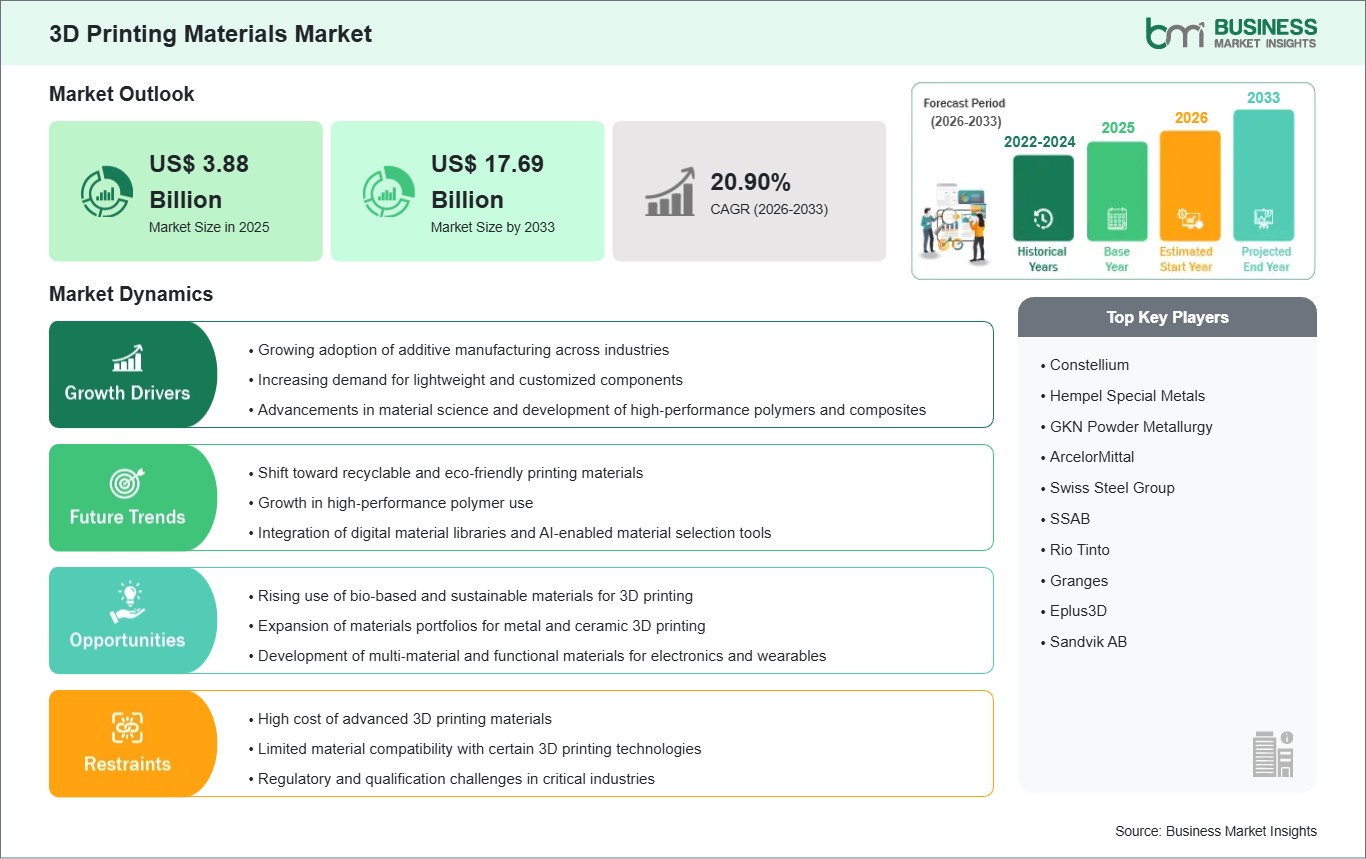
The 3D printing materials market size is expected to reach US$ 17.69 billion by 2033 from US$ 3.88 billion in 2025. The market is estimated to record a CAGR of 20.9% from 2026 to 2033.
3D printing materials are used in additive manufacturing to create three-dimensional objects layer by layer from digital designs. These materials come in different forms, such as filaments, powders, liquids, and pellets. They include a variety of types, including plastics, metals, ceramics, composites, and resins. Common plastics include ABS, PLA, nylon, and high-performance polymers. Metals such as titanium, aluminum, and stainless steel are used in industrial and aerospace applications. The choice of material depends on the needed mechanical strength, thermal resistance, surface finish, and intended use.
Manufacturers are turning to 3D printing to shorten lead times, enable quick prototyping, and create complex shapes that are challenging or expensive to make with traditional methods. Developments in material science have improved the performance, durability, and consistency of 3D printed parts, allowing them to be used in functional and end-use applications. The rising demand for customization, lightweight designs, and cost efficiency is driving market growth.

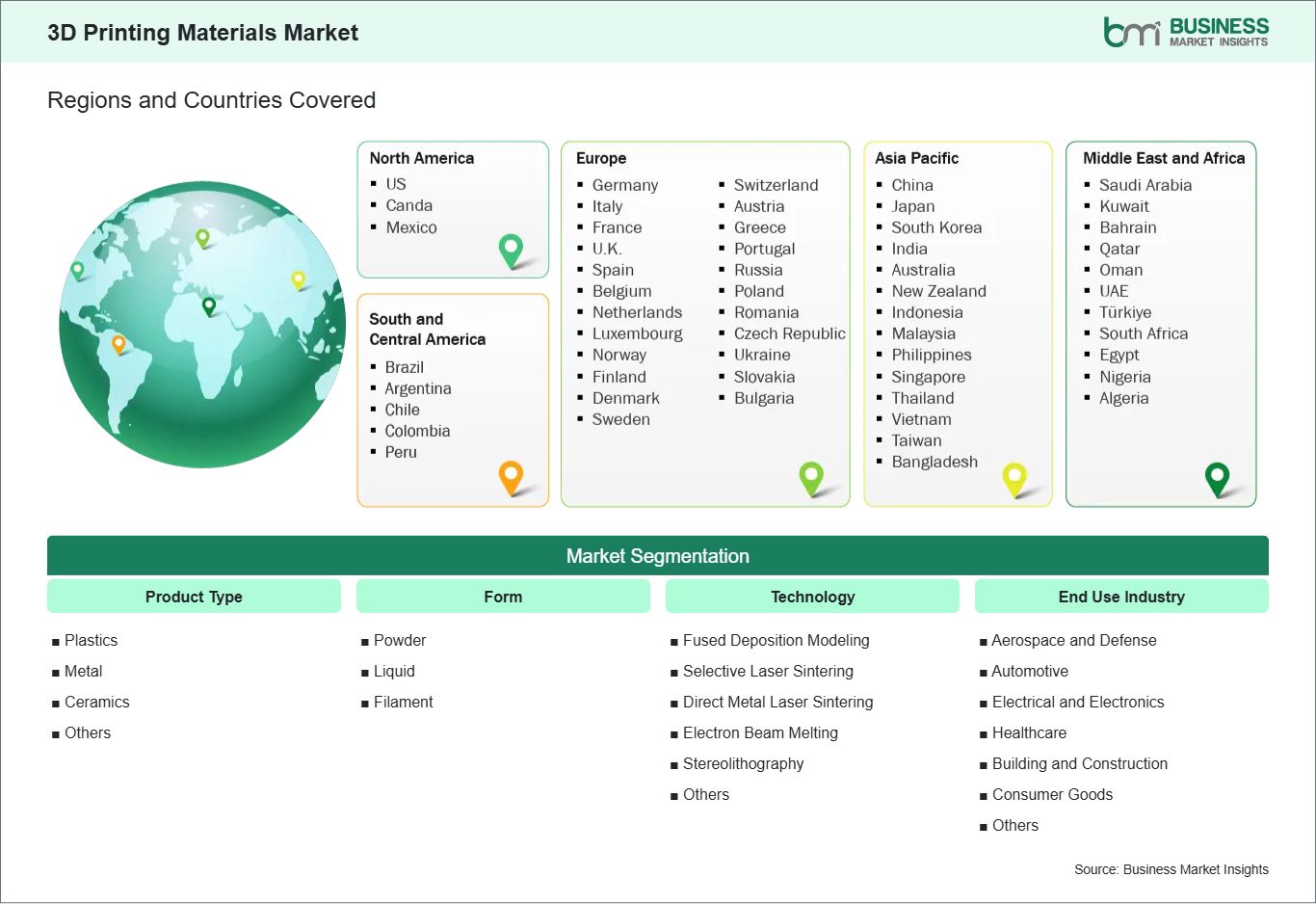
Key segments that contributed to the derivation of the 3D printing materials market analysis are product type, form, technology, and end use industry.
Companies in aerospace, automotive, healthcare, and consumer goods are using 3D printing to shorten product development cycles, cut production costs, and speed up time-to-market. High-quality 3D printing materials such as plastics, metals, and ceramics allow manufacturers to create functional prototypes, tooling, and even end-use parts with complex shapes that are challenging to achieve with traditional manufacturing.
The increased access to industrial-grade 3D printers and improvements in material formulations, including high-performance polymers and metal alloys, have boosted part strength, durability, and heat resistance, which encourages more companies to adopt the technology. The ability to produce customized, lightweight, and precise components helps increase efficiency and drives product innovation. As industries look for flexibility and efficiency while reducing material waste, the demand for 3D printing materials keeps growing, supporting the expansion of the global market.
A significant growth opportunity in the 3D printing materials market exists in the increasing use of additive manufacturing in healthcare and medical applications. High-performance polymers, biocompatible resins, and metal alloys make it possible to produce patient-specific implants, prosthetics, surgical instruments, and dental devices with great precision, durability, and sterilization resistance. 3D printing allows for customization for individual patients; this supports personalized medicine and minimally invasive procedures, which are becoming more popular worldwide.
Additionally, healthcare providers are using 3D printing to cut lead times, simplify surgical planning, and create on-demand medical parts, leading to better patient outcomes. Material innovations, such as bioresorbable polymers and high-strength metals, are making practical medical applications more viable. Emerging markets with developing healthcare systems offer more chances for adoption. As regulations and approvals for medical-grade 3D printing materials progress, the sector presents a solid, long-term opportunity for market growth, driven by the mix of digital manufacturing and personalized healthcare solutions.

The 3D printing materials market demonstrates consistent growth, with size and share analysis highlighting evolving trends and competitive dynamics among leading players. The report further examines subsegments categorized by product type, form, technology, and end-use industry, offering insights into their contribution to overall market performance.
For instance, the plastics subsegment under the product type segment holds a significant market share due to its versatility and wide adoption across industries. Materials such as Polylactic Acid (PLA), Acrylonitrile Butadiene Styrene (ABS), Thermoplastic Polyurethane (TPU), Polyether Ether Ketone (PEEK), Polypropylene, and Polyamides are widely used for prototyping, manufacturing functional parts, and producing consumer goods, underscoring the segment’s robust demand and contribution to overall market performance.
| Report Attribute | Details |
|---|---|
| Market size in 2025 | US$ 3.88 Billion |
| Market Size by 2033 | US$ 17.69 Billion |
| Global CAGR (2026 - 2033) | 20.90% |
| Historical Data | 2022-2024 |
| Forecast period | 2026-2033 |
| Segments Covered | By Product Type
|
|
Regions and Countries Covered
| |
| North America | US, Canada, Mexico |
| Europe | Belgium, Austria, Finland, Denmark, Greece, Poland, Romania, Russia, Ukraine, Czech Republic, Slovakia, Bulgaria, Italy, Luxembourg, Germany, Switzerland, France, Netherlands, Norway, Portugal, Spain, Sweden, United Kingdom |
| Asia-Pacific | Australia, China, India, Japan, South Korea, Indonesia, Malaysia, Philippines, Singapore, Thailand, Vietnam, Bangladesh, New Zealand, Taiwan |
| South and Central America | Brazil, Argentina, Peru, Chile, Colombia |
| Middle East and Africa | Bahrain, Kuwait, Oman, Qatar, Saudi Arabia, United Arab Emirates, Turkiye, South Africa, Egypt, Algeria, Nigeria |
| Market leaders and key company profiles |
|
The " 3D Printing Materials Market Size and Forecast (2022–2033)" report provides a detailed analysis of the market covering below areas:
The geographical scope of the 3D printing materials market report is divided into five regions: North America, Asia Pacific, Europe, the Middle East & Africa, and South & Central America.
The 3D printing materials market in North America is witnessing significant growth due to the strong industrial base and presence of key manufacturers of materials and 3D printers. The US and Canada have well-developed industries in aerospace, automotive, healthcare, and electronics, all of which use high-performance polymers, metals, and composites for prototyping, tooling, and end-use parts.
The sector benefits from significant investments in research and development, manufacturing, and Industry 4.0 initiatives. These have sped up the development and commercialization of new 3D printing materials. North America hosts several leading companies in 3D printing materials, such as Stratasys, 3D Systems, and Arkema. These companies provide a wide range of filaments, powders, and resins for industrial use. Supportive government policies, strong intellectual property protection, and collaboration between academia and industry boost technological progress. There is a rising demand for lightweight, durable, and customized components in the aerospace, healthcare, and defense sectors. This trend has strengthened North America's leading position in the global 3D printing materials market.

The 3D printing materials market is evaluated by gathering qualitative and quantitative data post-primary and secondary research, which includes important corporate publications, association data, and databases. A few of the key developments in the 3D printing materials market are:
The 3D Printing Materials Market is valued at US$ 3.88 Billion in 2025, it is projected to reach US$ 17.69 Billion by 2033.
As per our report 3D Printing Materials Market, the market size is valued at US$ 3.88 Billion in 2025, projecting it to reach US$ 17.69 Billion by 2033. This translates to a CAGR of approximately 20.90% during the forecast period.
The 3D Printing Materials Market report typically cover these key segments-
The historic period, base year, and forecast period can vary slightly depending on the specific market research report. However, for the 3D Printing Materials Market report:
The 3D Printing Materials Market is populated by several key players, each contributing to its growth and innovation. Some of the major players include:
The 3D Printing Materials Market report is valuable for diverse stakeholders, including:
Essentially, anyone involved in or considering involvement in the 3D Printing Materials Market value chain can benefit from the information contained in a comprehensive market report.
Please tell us your area of interest
(Market Segments/ Regions and Countries/ Companies)