Market Summary
Executive Summary and Global Market Analysis
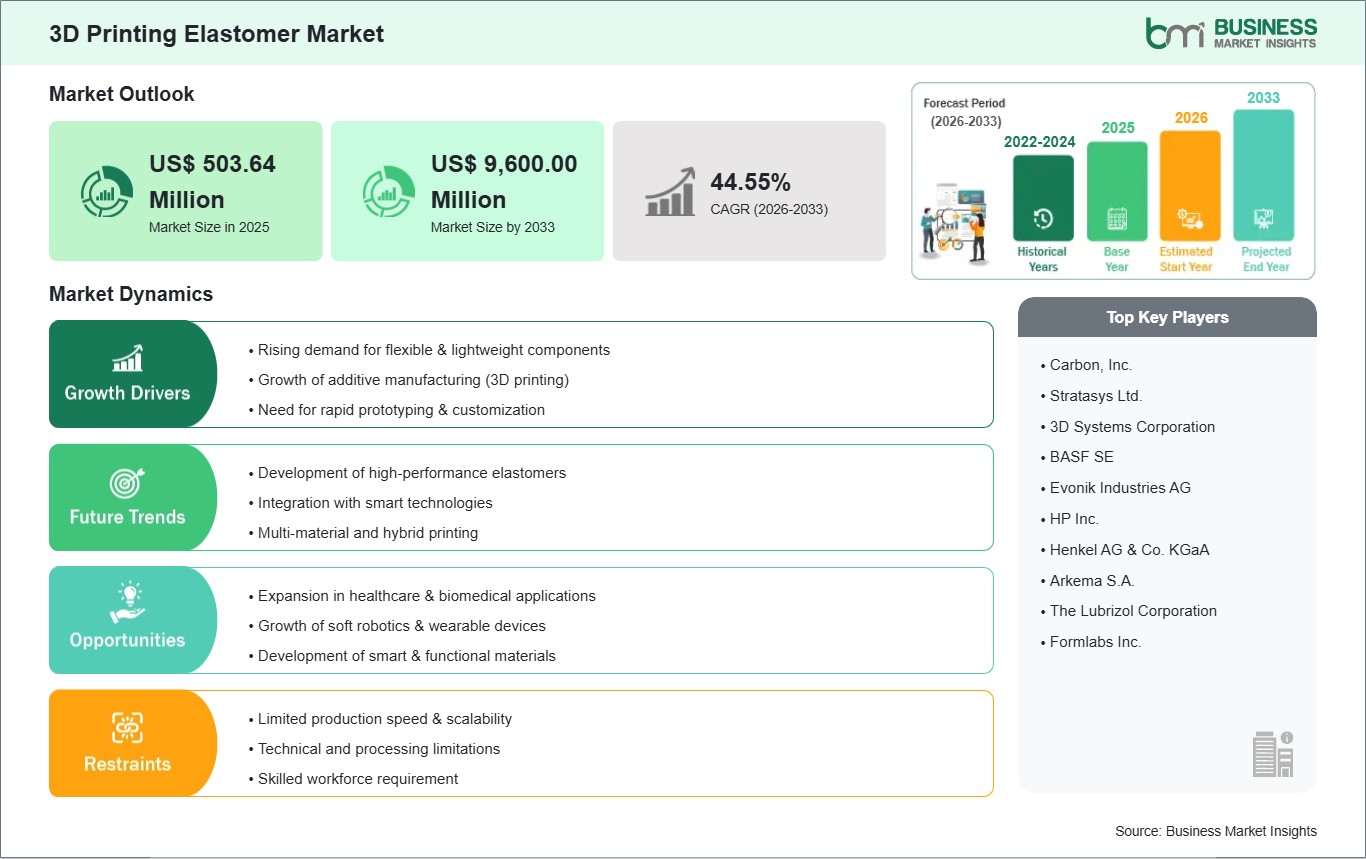
The global 3D printing elastomer market is evolving as a critical segment within the additive manufacturing ecosystem, driven by increasing demand for flexible, durable, and high-performance materials that can replicate the properties of traditional rubber while enabling complex geometries. Elastomers used in 3D printing, including thermoplastic polyurethanes and silicone-based materials, are gaining traction across industries such as automotive, healthcare, consumer goods, aerospace, and industrial manufacturing. These materials enable the production of components requiring elasticity, impact resistance, and fatigue durability, making them suitable for applications like seals, gaskets, wearables, cushioning elements, and soft-touch components. The growing shift toward rapid prototyping and on-demand manufacturing is a major driver, as elastomeric materials allow designers to test functional parts with real-world performance characteristics. Another key factor supporting market growth is the advancement of printing technologies such as material extrusion and powder bed fusion, which are increasingly compatible with flexible materials. Additionally, the rising interest in mass customization and lightweight product design is encouraging manufacturers to adopt elastomer-based additive solutions. However, the market faces certain constraints, including limitations in material consistency, slower printing speeds for flexible materials, and challenges in achieving uniform mechanical properties across printed parts. High material costs and limited availability of certified elastomer grades for critical applications also restrict broader adoption. Despite these challenges, ongoing material innovation and expanding application scope are positioning 3D printing elastomers as an essential component of next-generation manufacturing.
Segment Analysis
3D Printing Elastomer Market Segmentation
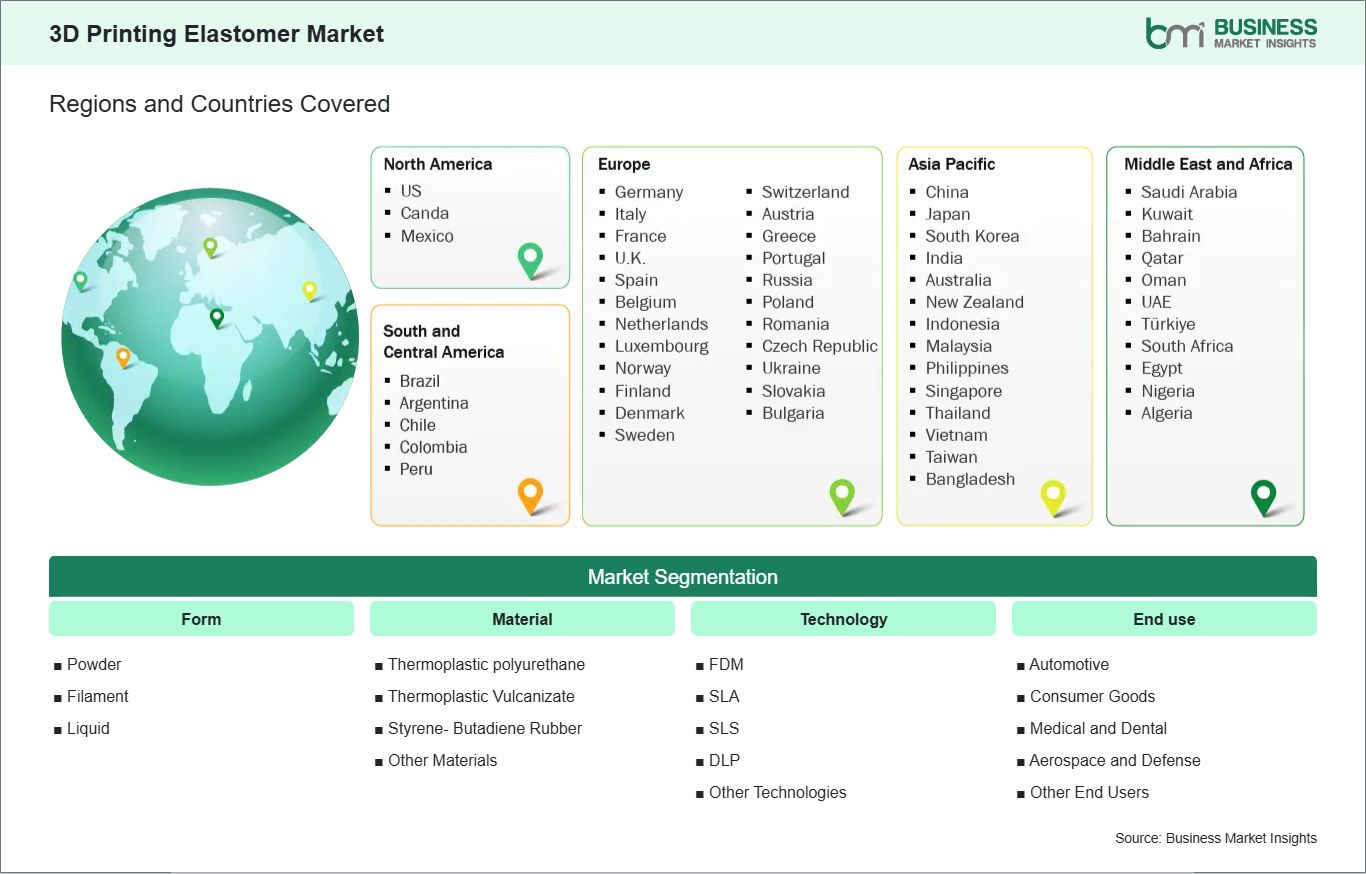
Key segments that contributed to the derivation of the 3D Printing Elastomer Market analysis are form, technology, material, and endues.
- By form, the 3D Printing Elastomer Market is segmented into powder, filament, and liquid. The liquid segment dominated the market in 2025.
- By technology, the 3D Printing Elastomer Market is segmented into FDM, SLA, SLS, DLP, and Others. The FDM (Fused Deposition Modeling segment dominated the market in 2025.
- By material, the 3D Printing Elastomer Market is segmented into thermoplastic polyurethane, thermoplastic vulcanizate, styrene- butadiene rubber, and others. The thermoplastic polyurethane (TPU) segment dominated the market in 2025.
- In terms of end use, the 3D Printing Elastomer Market is segmented into automotive, consumer goods, medical and dental, aerospace and defense, and others. The automotive segment dominated the market in 2025.
Market Forces
3D Printing Elastomer Market Drivers and Opportunities
Rising Demand for Flexible and Lightweight Components
The market for 3D food printing is becoming increasingly affected by the need for flexibility in formulation and structural customization. This allows for the development of light and customized food products with precise portion control. Unlike conventional food manufacturing techniques, 3D food printing allows for the layering of textures and hollow structures. This is particularly relevant for premium food products like confectionery and bakery products. Food brands in countries like Switzerland and Belgium are exploring new opportunities for creating delicate lattices and hollow structures for their premium food products.
In regions like North America and Western Europe, food-tech companies are using this opportunity to develop light and portable food products for niche markets. This is particularly relevant for regions where there is an increased need for light and portable food products for activities like aviation and space research. This is an example of how structural customization is becoming an important aspect of food products and how they contribute to additional benefits.
Additionally, the increased interest in personalized nutrition is also driving demand for flexible food structures that may be easily modified in composition and form. In Japan and South Korea, for instance, there is a focus on soft texture printed food for the elderly population, where a lightweight design enables easy consumption without compromising nutritional benefits. This flexible food structure is therefore creating a new opportunity for 3D food printing in the specialized segment.
Expansion in Healthcare and Biomedical Applications
Healthcare is also considered to be one of the important application domains of 3D food printing, especially in the field of clinical nutrition. Hospitals in countries like Germany, the Netherlands, and the US are using printed food to treat dysphagia, i.e., swallowing disorders, by creating food that is aesthetically pleasing and has the right texture.
The technology is also attracting interest within elderly care centers, particularly within aging countries such as Japan and Italy. The care centers are employing the use of 3D food printing to ensure the preparation of food products that are not only easy to digest but also resemble traditional food products. The advantage of standardizing food textures while maintaining traditional food shapes is a major advantage over traditional food products.
Outside of patient care, research centers are working on the relationship between food printing and biomedical sciences. Various universities and food-tech research centers within countries such as Scandinavia and Israel are working on the relationship between food printing and biomedical sciences. The research centers are working on the possibility of achieving nutrient layering and controlled release of supplements through food printing. This presents a possibility of highly targeted nutrition, where food products are designed to address a range of medical conditions and sports performance, further expanding the scope of 3D food printing.
Size and Share Analysis
3D Printing Elastomer Market Size and Share Analysis
The global 3D Printing Elastomer Market is experiencing steady growth, with market size and share analysis reflecting evolving treatment preferences and competitive dynamics among key players. The report evaluates important subsegments categorized within form, material, technology and end use highlighting their respective contributions to overall market performance.
By form, the liquid subsegment dominated the market in 2025 because it is widely used in advanced printing technologies such as SLA and DLP, which require photopolymer resins. Liquid elastomers offer better precision, smooth surface finish, and flexibility in producing complex geometries compared to powder and filament forms.
By material, the thermoplastic polyurethane (TPU) segment subsegment dominated the market in 2025 due to its excellent combination of flexibility, durability, abrasion resistance, and chemical stability.
By technology, the FDM (Fused Deposition Modeling subsegment dominated the market in 2025 because it is the most widely adopted and cost-effective 3D printing method. FDM systems are easy to operate, accessible, and compatible with commonly used elastomer materials like TPU in filament form.
By end use, the automotive subsegment dominated the market in 2025 due to the high demand for lightweight, flexible, and durable components such as seals, gaskets, interior parts, and vibration-dampening elements.
Report Coverage
3D Printing Elastomer Market Report Coverage and Deliverables
The "3D Printing Elastomer Market Size and Forecast (2022 - 2033)" report provides a detailed analysis of the market covering below areas:
- 3D Printing Elastomer Market size and forecast at the regional and country levels for segments covered under the scope
- 3D Printing Elastomer Market trends, as well as drivers, restraints, and opportunities
- 3D Printing Elastomer Market analysis covering key trends, regional framework, major players, regulations, and recent developments
- Industry landscape and competition analysis covering market concentration, heat map analysis, prominent players, and recent developments for the 3D Printing Elastomer Market.
- Detailed company profiles, including SWOT analysis
Geographic Insights
3D Printing Elastomer Market Geographic Insights
The geographical scope of the 3D Printing Elastomer Market report is divided into: North America, Asia Pacific, Europe, Middle East & Africa, and South & Central America. North America held the largest share in 2025.
North America dominates the global 3D printing elastomer market due to its strong technological foundation, early adoption of additive manufacturing, and well-established industrial base. The region is home to a wide network of advanced manufacturing companies, research institutions, and material developers that are actively driving innovation in elastomer-based 3D printing. A key factor contributing to regional leadership is the high demand for functional prototyping and end-use parts in industries such as aerospace, automotive, and medical devices, where flexibility and durability are critical performance requirements. The healthcare sector in North America plays a particularly important role, as 3D printing elastomers are increasingly used for customized medical devices, prosthetics, and wearable healthcare products that require patient-specific flexibility and comfort. Additionally, the region`s consumer goods industry is leveraging elastomer printing for product design, iteration and ergonomic enhancements. Another significant driver is the presence of a mature innovative ecosystem that supports collaboration between software developers, hardware manufacturers, and material scientists, accelerating the commercialization of new elastomer formulations. Furthermore, strong intellectual property frameworks and investment in advanced manufacturing technologies enable companies to scale innovations more efficiently. Overall, North America`s focus on high-performance applications, coupled with its leadership in additive manufacturing technologies, solidifies its dominant position in the global 3D printing elastomer market.
Industry Activity
Recent Developments
The 3D Printing Elastomer Market is evaluated by gathering qualitative and quantitative data post primary and secondary research, which includes important corporate publications, association data, and databases. A few of the key developments in the 3D Printing Elastomer Market are:
- In June 2023, BASF SE, announced that it had introduced a new TPU-based elastomer material for 3D printing, specifically engineered for demanding automotive applications such as seals and flexible connectors, supporting industrial adoption across European manufacturing hubs including Eastern Europe.
- In September 2023, Formlabs, announced the expansion of its elastomer material portfolio for additive manufacturing, enabling production of soft-touch consumer goods and medical devices, with distribution and adoption extending across European markets including Central and Eastern Europe.
- In 2024, BASF SE, announced continued advancement and showcasing of its flexible TPU-based 3D printing materials for industrial applications, targeting enhanced durability and sustainability in additive manufacturing processes used by European manufacturers, including those in Eastern Europe.
Trust & Transparency
Research Methodology
The market analysis combines proprietary research with secondary data from government agencies, company disclosures, regulatory filings, industry databases and expert interviews. Market estimates are validated through data triangulation, cross-market benchmarking and analyst
review.
View Full Research Methodology
Key Sources Referred:
World Health Organization (WHO)Organisation for Economic Cooperation and Development (OECD)The World Bank GroupWorldometerThe LancetInternational Bar AssociationInternational Trade Administration