Market Summary
Executive Summary and Global Market Analysis
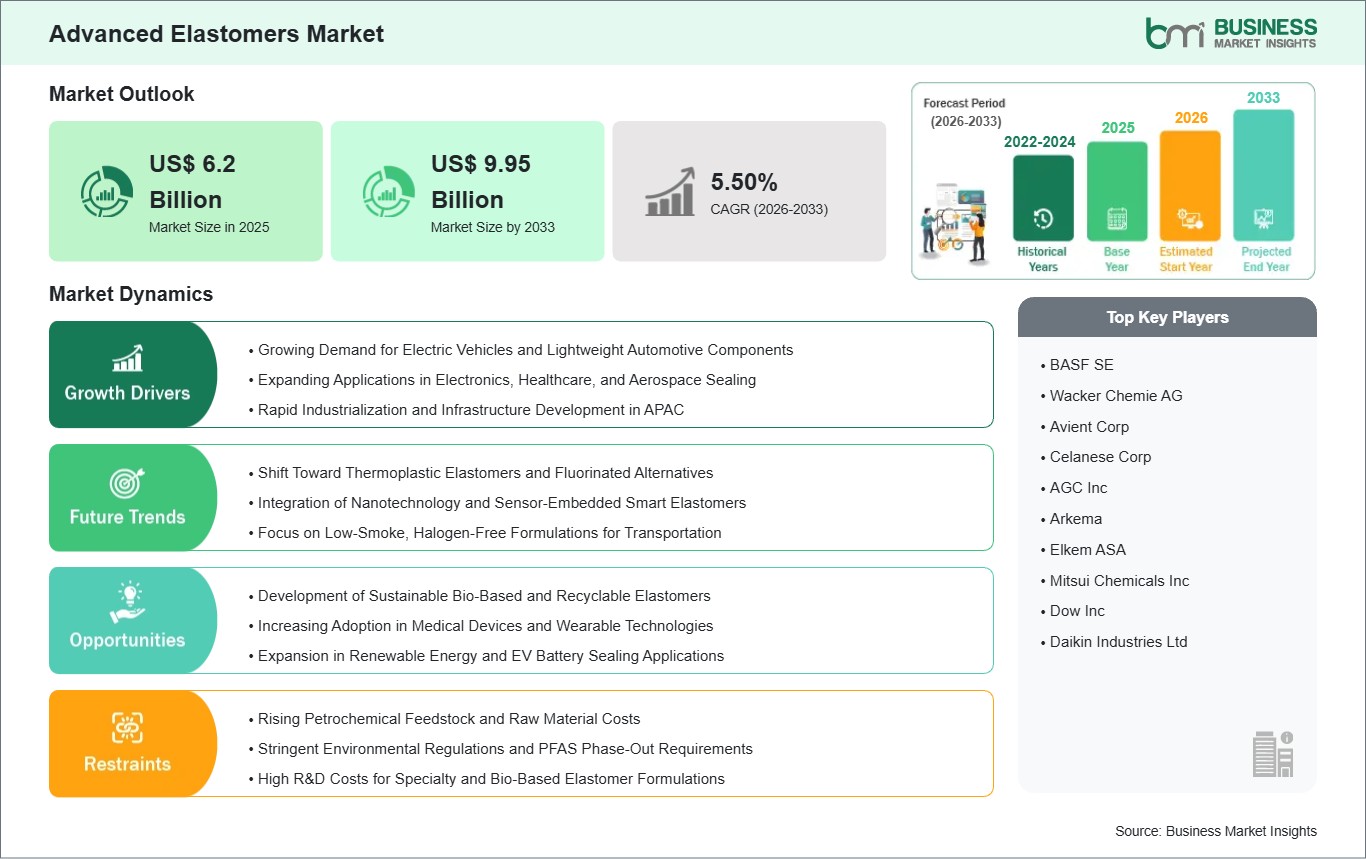
Advanced elastomers play an essential role in industrial production and product development, as they comply with great levels of elasticity, strength, and performance in diverse applications. These materials find a wide variety of applications in automotive, aerospace, electronics, construction, medical devices, and consumer products, where they are substituting traditional rubber and rigid plastics to possess a higher standard of mechanical properties and extended service life. Advanced elastomers deliver significant performance advantages, including superior elasticity, resistance to chemicals and weathering, effective vibration damping, enhanced thermal stability, and greater design flexibility. Their lightweight nature and ability to support complex geometries make them valuable across multiple industries. In automotive and transportation, they are widely used for seals, hoses, gaskets, and vibration‑control components. In electronics, they play a critical role in insulation, encapsulation, and impact protection. The construction sector relies on them for roofing systems, waterproofing solutions, and expansion joints. Additionally, their biocompatibility, flexibility, and comfort make them well-suited for medical devices and consumer products.
The main benefits of advanced elastomers are their steady performance under stress, long durability, easy processing, extreme temperature and chemical resistance, as well as adjusting the material properties with the help of advanced polymer engineering. Growth in the market is attributed to the increasing demand for light and fuel-consuming vehicles, the use of electric and electronic gadgets, the development of infrastructure, and an explosion in the popularity of high-performance materials used in automated production systems. Also, the global advanced elastomers market is growing rapidly because of ongoing innovation in thermoplastic elastomers, silicone elastomers, bio-based formulations, as well as the creation of sustainable and recyclable solutions.
However, the advanced elastomers market faces challenges such as fluctuations in the price of raw materials, complicated manufacturing, and the inability to perform under the most extreme operating conditions in some formulations. Specialty elastomers may be expensive and may not meet high cost conditions and regulations in sensitive economic sectors of the environment and regulations. In addition, the end users may complicate technical performance, and therefore, high accuracy of choice of materials and control of processing is usually necessary to achieve optimal performance. Despite these obstacles, there are major opportunities in the market as a result of the fast development of technologies, the growing popularity of sustainable material solutions, and the growing necessity of durable and high-performing parts in a variety of industries. The future development of the advanced elastomers market in the world is likely to be influenced by ongoing research and development programs, government programs that favor green manufacturing, and the gradual substitution of traditional materials with advanced elastomer solutions.
Segment Analysis
Advanced Elastomers Market Segmentation
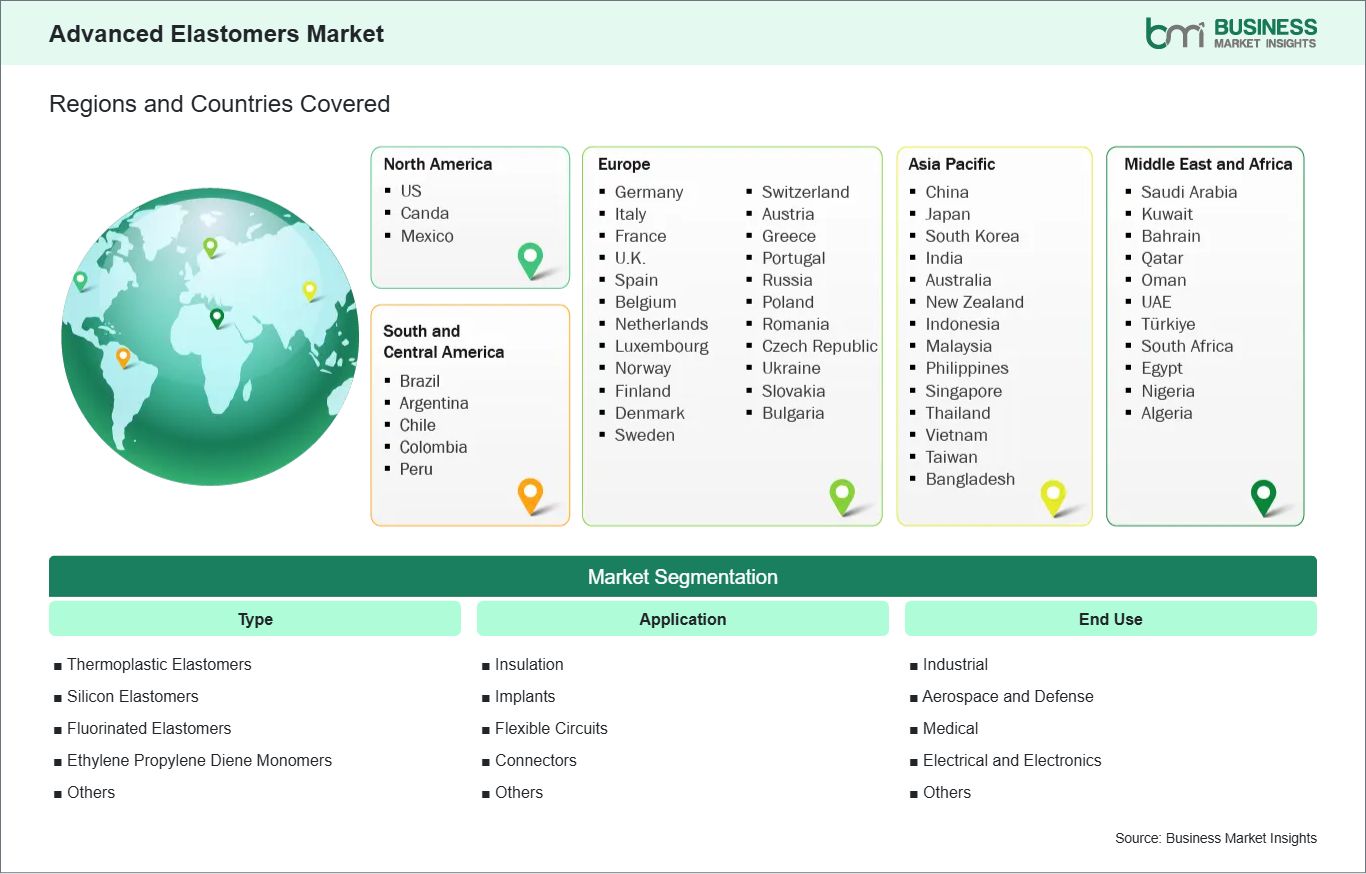
Key segments that contributed to the derivation of the advanced elastomers market analysis are type, application, and end use.
- By type, the advanced elastomers market is categorized into thermoplastic elastomers, silicon elastomers, fluorinated elastomers, ethylene propylene diene monomers (EPDM), and others. The thermoplastic elastomers segment dominated the market in 2025.
- By application, the market is segmented into insulation, implants, flexible circuits, connectors, and others. The insulation segment dominated the market in 2025.
- By end use, the advanced elastomers market is categorized into industrial, aerospace and defense, medical, electrical and electronics, and others. The industrial segment held the largest share of the market in 2025.
Market Forces
Advanced Elastomers Market Drivers and Opportunities
Rising Demand for Lightweight and High-Performance Materials
The automotive, aerospace, electronics, and construction sectors are increasingly demanding increased energy efficiency, emission reduction, and better product performance, thus increasing the rate of adoption of high-technology elastomers over traditional materials. The fierce regulations in the automotive industry and the transportation sector where people must cut down vehicle weight, and not compromising the safety of vehicles or their lifespan. To fulfill these requirements, advanced elastomers, which have better elasticity, thermal stability, chemical resistance, and vibration-damping characteristics, are being applied in seals, gaskets, hoses, belts, and parts used inside the cabin. Likewise, in the electronics and electrical field, the device miniaturization and the need to enhance the insulation and protection of the devices against heat, moisture, and mechanical damage are necessitating the elastomer usage.
Moreover, the growth of infrastructure and urbanization is driving construction application demand within the waterproofing membranes, expansion joints, and protective coating construction applications. High-performance elastomers are essential materials that deliver superior performance, durability in harsh operating environments, and support the development of innovative product designs. Their ability to enhance reliability and enable advanced engineering solutions makes them a strategic material of choice across industries, driving sustained market growth.
Growth of Sustainable and Bio-Based Elastomer Solutions
Governments, regulatory agencies, and final users are more concerned about the minimization of carbon footprints, waste reduction, and transitioning to environment-friendly materials. This has been a positive step towards manufacturers investing in the production of bio-based, recyclable, and low-emission elastomer solutions. The polymer science is also making it possible to develop elastomers based on renewable materials that have similar or even better performance than traditional petroleum-based products. The sustainable elastomers are finding their way in the automotive, consumer goods, medical, and construction markets, where environmental regulation and corporate sustainability are crucial purchasing considerations.
Moreover, the reuse and recyclability of elastomeric materials are introduced by the circular economy model, which is opening up new sources of innovations and differentiation among the market participants. With customers increasing focusing on green materials without compromising on performance, companies are competing to come up with sustainable elastomer technologies. This is likely to open up new market segments, consolidate demand in the long run, and generate robust growth avenues within the advanced elastomers market across the world.
Size and Share Analysis
Advanced Elastomers Market Size and Share Analysis
The Advanced Elastomers market demonstrates steady growth, with size and share analysis revealing evolving trends and competitive positioning among key players. The report further examines subsegments categorized within type, application, and end use, offering insights into their contribution to overall market performance.
Based on application, the insulation segment dominates the advanced elastomers market. Elastomers that are applied in insulation have high thermal stability, are more flexible, and are highly resistant to chemicals, weathering, and aging. Such properties render them suitable for used widely in the construction, automotive, aerospace, and electrical industries. Advanced elastomers are preferred because of their consistency in performance even in dire climatic conditions, superior vibration-damping capabilities, and long service life. These attributes make them a preferred choice for manufacturers seeking dependable, high-performance insulation solutions across a range of end-use applications.
Report Coverage
Advanced Elastomers Market Report Coverage and Deliverables
The " Advanced Elastomers Market Size and Forecast (2022–2033)" report provides a detailed analysis of the market covering below areas:
- Advanced Elastomers market size and forecast at global, regional, and country levels for all the key market segments covered under the scope
- Advanced Elastomers market trends, as well as market dynamics such as drivers, restraints, and key opportunities
- Advanced Elastomers market analysis covering key market trends, global and regional framework, major players, regulations, and recent market developments
- Industry landscape and competition analysis covering market concentration, heat map analysis, prominent players, and recent developments for the advanced elastomers market
- Detailed company profiles, including SWOT analysis
Geographic Insights
Advanced Elastomers Market Geographic Insights
The geographical scope of the Advanced Elastomers market report is divided into five regions: North America, Asia Pacific, Europe, Middle East & Africa, and South & Central America.
The Asia Pacific Advanced Elastomers Market is segmented into China, Japan, South Korea, India, Australia, New Zealand, Indonesia, Malaysia, the Philippines, Singapore, Thailand, Vietnam, Taiwan, Bangladesh, and the Rest of Asia Pacific. Asia Pacific represents a significant growth hub for advanced elastomers, driven by the rapid expansion of the automotive, construction, electronics, aerospace, and consumer goods industries. As these sectors evolve, the demand for materials offering thermal stability, chemical resistance, vibration-damping properties, and high flexibility continues to rise, positioning advanced elastomers as an increasingly preferred solution.
Additionally, accelerating urbanization, rising industrial activity, and a heightened emphasis on product quality and long-term durability are further propelling market growth. The region's growing focus on lightweight, energy-efficient, and sustainable materials also reinforces the adoption of advanced elastomers across multiple applications.
Industry Activity
Recent Developments
The Advanced Elastomers market is evaluated by gathering qualitative and quantitative data post-primary and secondary research, which includes important corporate publications, association data, and databases. A few of the key developments in the advanced elastomers market are:
- In January 2026, Trelleborg Group acquired Nexus Elastomer Molds GmbH, an Austrian company specializing in customized tooling solutions and automated manufacturing cells for liquid silicone rubber. The acquisition, finalized by Trelleborg Sealing Solutions, adds approximately US$ 17.39 million (SEK 160 million) in external sales as of June 2025. Trelleborg and Nexus have collaborated previously in development and production.
- In October 2025, Arkema introduced Luperox NeatCure, a groundbreaking product designed to enhance the curing process for polymers and elastomers. This innovation emphasizes responsible handling and improved efficiency, assisting customers in achieving their productivity and sustainability objectives.
Trust & Transparency
Research Methodology
The market analysis combines proprietary research with secondary data from government agencies, company disclosures, regulatory filings, industry databases and expert interviews. Market estimates are validated through data triangulation, cross-market benchmarking and analyst
review.
View Full Research Methodology
Key Sources Referred:
World Bank – Global Trade IndicatorsEuropean Chemicals AgencyInternational Council of Chemical AssociationsInternational Monetary Fund (IMF)World Trade Organization (WTO)International Trade Administration (ITA)Company WebsitesCompany Annual ReportsCompany Investor Presentations