Market Summary
Executive Summary and Global Market Analysis
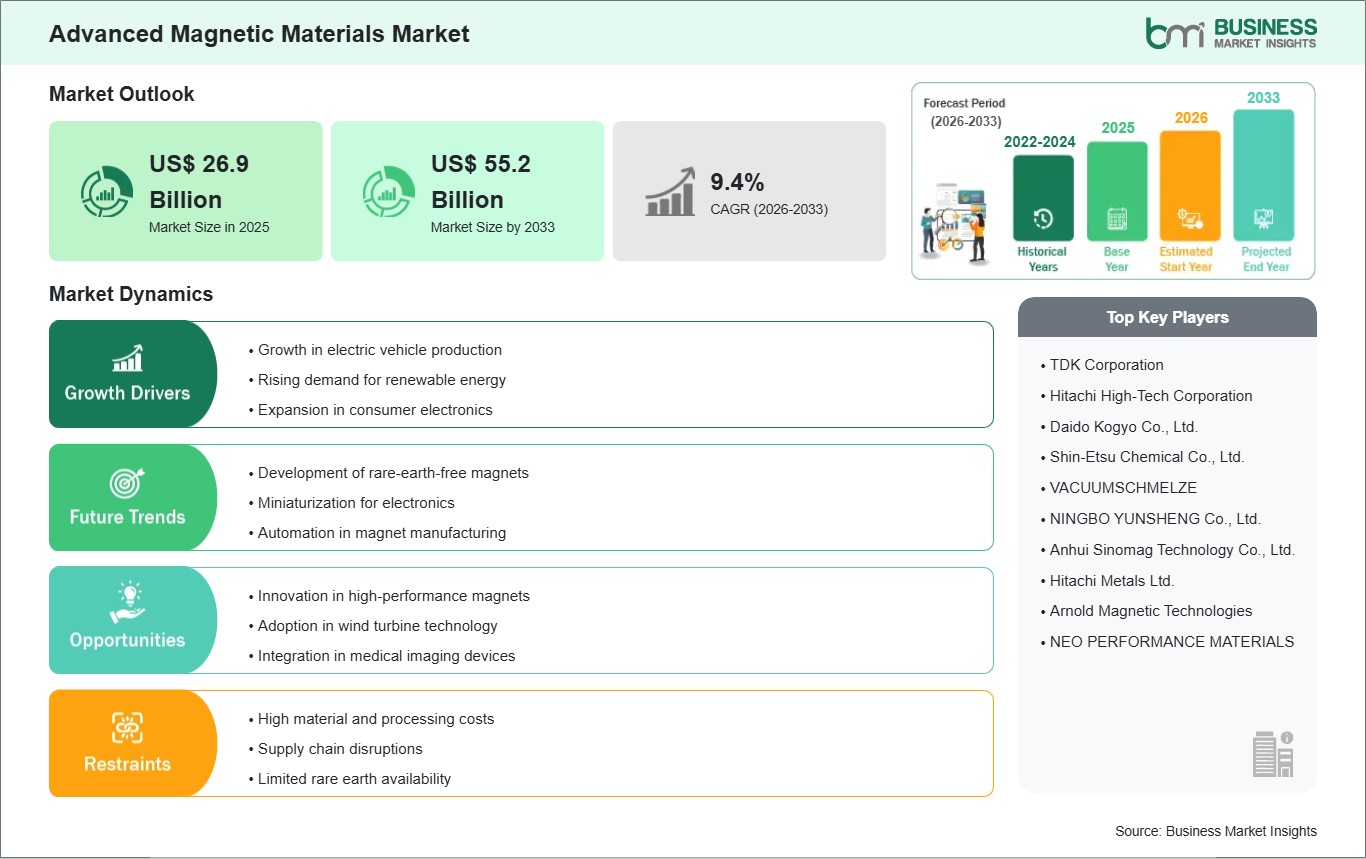
Advanced Magnetic Materials represent a critical class of engineered materials designed to deliver superior magnetic properties such as high coercivity, magnetic permeability, saturation, and thermal stability. These materials are foundational to several transformative trends, including the electrification of transportation, renewable energy adoption, and the miniaturization of electronic components. Their integration into motors, sensors, generators, and data storage systems underscores their strategic importance in modern and emerging technologies.
Despite their growing relevance, the market faces notable challenges. The reliance on rare-earth elements introduces supply chain vulnerabilities and cost pressures, while technical limitations such as energy losses in soft magnetic materials remain a concern. Additionally, high production and processing costs pose barriers to scalability. These factors collectively create a complex operating environment for manufacturers and end-users.
However, significant opportunities persist. The accelerating penetration of electric vehicles, expansion of renewable energy infrastructure, and advancements in consumer electronics continue to drive demand for high-performance magnetic solutions. Innovations in rare-earth-free alternatives and next-generation applications such as magnetic memory and spintronics further open lucrative pathways for growth. Companies that invest in material innovation and supply chain resilience are well-positioned to capitalize on these opportunities.
Segment Analysis
Advanced Magnetic Materials Market Segmentation
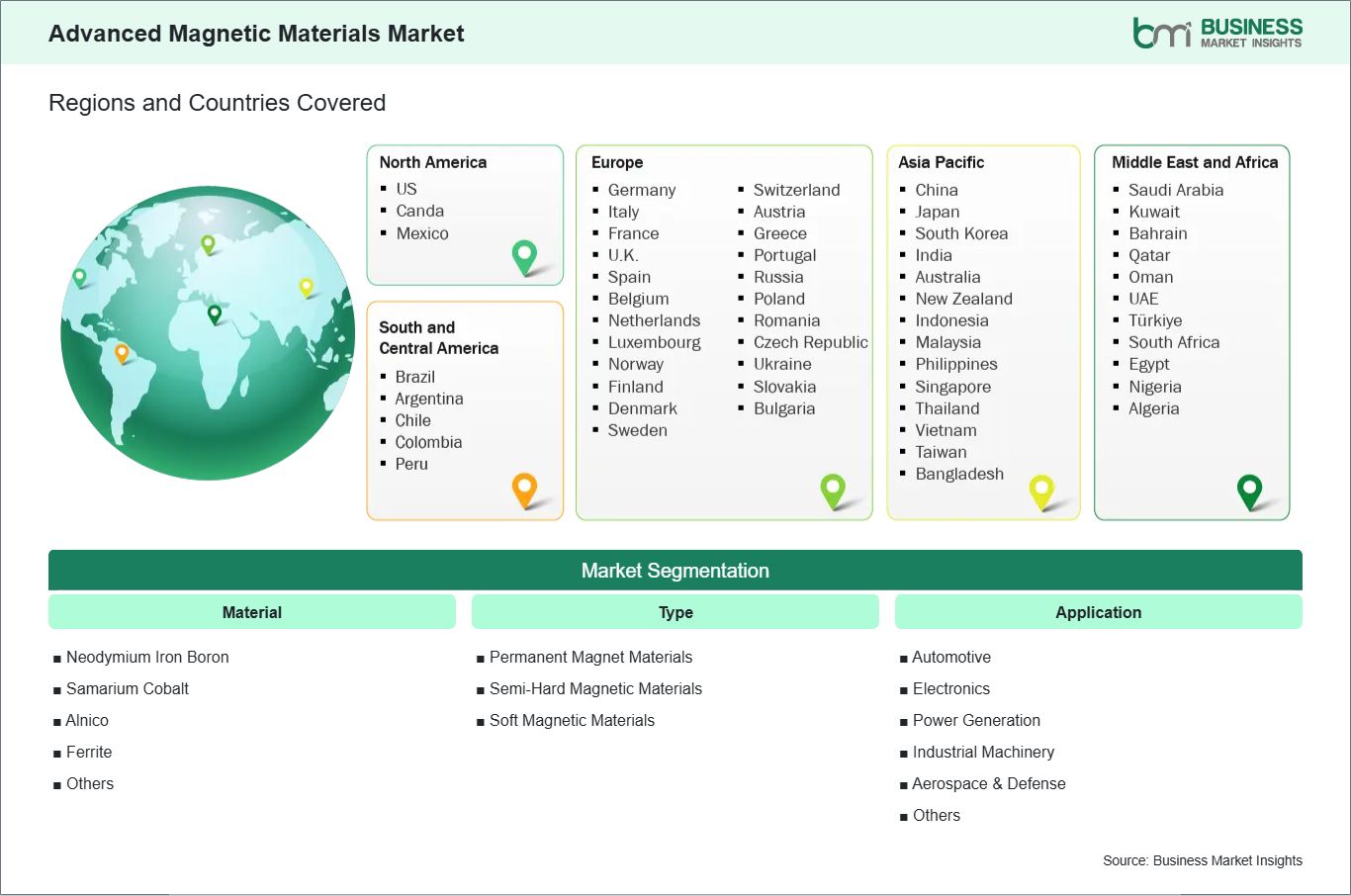
Key segments that contributed to the derivation of the Advanced Magnetic Materials market analysis are Material, Type, and Application.
- By Material, the market is segmented into Neodymium Iron Boron (NdFeB), Samarium Cobalt (SmCo), Alnico, Ferrite, and Others.
- By Type, the market is segmented into Permanent Magnet Materials, Semi-Hard Magnetic Materials, and Soft Magnetic Materials.
- By Application, the market is segmented into Automotive, Electronics, Power Generation, Industrial Machinery, Aerospace & Defense, and Others.
Market Forces
Advanced Magnetic Materials Market Drivers and Opportunities
Rapid Electrification and Energy Transition
The global transition toward electrification and sustainable energy systems is a primary factor driving the demand for advanced magnetic materials. In the Electric Vehicle (EV) sector, traction motors require compact, lightweight, and high-efficiency magnetic systems. Neodymium Iron Boron (NdFeB) permanent magnets are widely used due to their high energy density, enabling longer driving ranges and improved motor performance. The growing penetration of EVs across passenger and commercial vehicle segments continues to drive strong demand for high-performance magnets.
The expansion of renewable energy, particularly wind power, further supports market growth. Direct-drive wind turbines rely on large quantities of high-strength permanent magnets to maximize power generation efficiency and reduce mechanical complexity. Additionally, increasingly stringent government efficiency standards for motors, transformers, and power electronics are compelling manufacturers to adopt advanced soft and hard magnetic materials to reduce energy losses and improve overall system efficiency.
Technological Advancements and Miniaturization
Continuous innovation in material science and component design is creating new opportunities for advanced magnetic materials. The trend toward miniaturization in consumer electronics drives demand for extremely small and efficient magnetic components used in speakers, vibration motors, sensors, and camera actuators. Advanced micro-magnets enable thinner, lighter, and more powerful electronic devices.
Emerging applications in next-generation data storage and computing, such as Magnetic Random Access Memory (MRAM), rely on advanced magnetic films and spintronic technologies. These developments open new, high-value application areas within data centers and high-performance computing. At the same time, significant research efforts are focused on the development of rare-earth-free magnetic materials, including iron-nitride and manganese-based compounds. Successful commercialization of these alternatives presents a long-term opportunity to reduce dependence on vulnerable REE supply chains while maintaining competitive performance levels.
Size and Share Analysis
Advanced Magnetic Materials Market Size and Share Analysis
The Advanced Magnetic Materials Market demonstrates steady growth, with size and share analysis revealing evolving trends and competitive positioning among key players. The report further examines subsegments categorized within Material, Type, and Application, offering insights into their contribution to overall market performance.
For instance, in terms of type, Permanent Magnet Materials are critical for applications such as electric motors and generators. Soft Magnetic Materials are also essential for transformers and power electronics due to their low energy loss characteristics. Semi-Hard Magnetic Materials serve specialized roles in magnetic storage and sensing.
Report Coverage
Advanced Magnetic Materials Market Report Coverage and Deliverables
The "Advanced Magnetic Materials Market Size and Forecast (2022 - 2033)" report provides a detailed analysis of the market covering below areas:
- The Advanced Magnetic Materials Market size and forecast at global, regional, and country levels for all the key market segments covered under the scope.
- Advanced Magnetic Materials Market trends, as well as market dynamics such as drivers, restraints, and key opportunities.
- Advanced Magnetic Materials Market analysis covering key market trends, global and regional framework, major players, regulations, and recent market developments
- Industry landscape and competition analysis covering market concentration, heat map analysis, prominent players, and recent developments for the Advanced Magnetic Materials Market
- Detailed company profiles, including SWOT analysis
Geographic Insights
Advanced Magnetic Materials Market Geographic Insights
The geographical scope of the Advanced Magnetic Materials Market report is divided into five regions: North America, Europe, Asia Pacific, the Middle East & Africa, and South & Central America.
Each region demonstrates unique growth drivers shaped by industrial priorities, regulatory frameworks, and technological adoption trends. While Asia Pacific benefits from large-scale electronics manufacturing and renewable energy initiatives, North America and Europe emphasize electrification policies and rare-earth recycling strategies. Emerging regions are increasingly investing in energy diversification and infrastructure modernization, creating new opportunities for advanced magnetic material applications.
Report Guidance
Advanced Magnetic Materials Market Report Guidance
The report includes qualitative and quantitative data in the Advanced Magnetic Materials market across material, type, application, and geography.The report starts with the key takeaways (chapter 2), highlighting the key trends and outlook of the Advanced Magnetic Materials market.Chapter 3 includes the research methodology of the study.Chapter 4 further includes ecosystem analysis.Chapter 5 highlights the major industry dynamics in the Advanced Magnetic Materials market, including factors that are driving the market, prevailing deterrents, potential opportunities, as well as future trends. Impact analysis of these drivers and restraints is also covered in this section.Chapter 6 discusses the Advanced Magnetic Materials market scenario in terms of historical market revenues and forecast till the year 2033.Chapters 7 to 10 cover the Advanced Magnetic Materials market segments by material, type, application, and geography (including North America, Europe, Asia Pacific, the Middle East and Africa, and South and Central America). They cover the market volume, revenue forecast, and factors driving the market.Chapter 11 describes the competitive analysis along with the heat map analysis for the key players operating in the market.Chapter 12 describes the industry landscape analysis. It provides detailed descriptions of business activities such as market initiatives, new developments, mergers, and joint ventures globally, along with a competitive landscape.Chapter 13 provides detailed profiles of the major companies operating in the Advanced Magnetic Materials market. Companies have been profiled on the basis of their key facts, business descriptions, products and services, financial overview, SWOT analysis, and key developments.Chapter 14, i.e., the appendix, is inclusive of a brief overview of the company, a list of abbreviations, and a disclaimer.
Industry Activity
Recent Developments
The Advanced Magnetic Materials Market is evaluated by gathering qualitative and quantitative data post-primary and secondary research, which includes important corporate publications, association data, and databases. A few of the key developments in the Advanced Magnetic Materials Market are:
- In December 2025, Mulberry Industries, a Georgia-based vertically integrated manufacturer of high-performance permanent magnets and advanced electrical systems, and Ramaco Resources, (NASDAQ: METC, METCB) ("Ramaco") a leading developer of critical minerals and rare earth elements at its Brook Mine in Wyoming, announced that they have entered into a non-binding memorandum of understanding ("MOU") to negotiate an o?take partnership that will bolster America's domestic rare earth and permanent magnet supply chain.
- In August 2025, Permag™, the only US-based producer of samarium cobalt (SmCo) magnets, announced an aggressive expansion of its magnetic manufacturing capacity to ensure a continued secure, robust, and resilient domestic supply chain of critical magnetics.
Trust & Transparency
Research Methodology
The market analysis combines proprietary research with secondary data from government agencies, company disclosures, regulatory filings, industry databases and expert interviews. Market estimates are validated through data triangulation, cross-market benchmarking and analyst
review.
View Full Research Methodology
Key Sources Referred:
World Bank - Global Trade IndicatorsWorld Trade Organization (WTO)International Monetary Fund (IMF)International Trade Administration (ITA)Company WebsitesCompany Annual ReportsCompany Investor Presentations