Market Summary
Executive Summary and Global Market Analysis
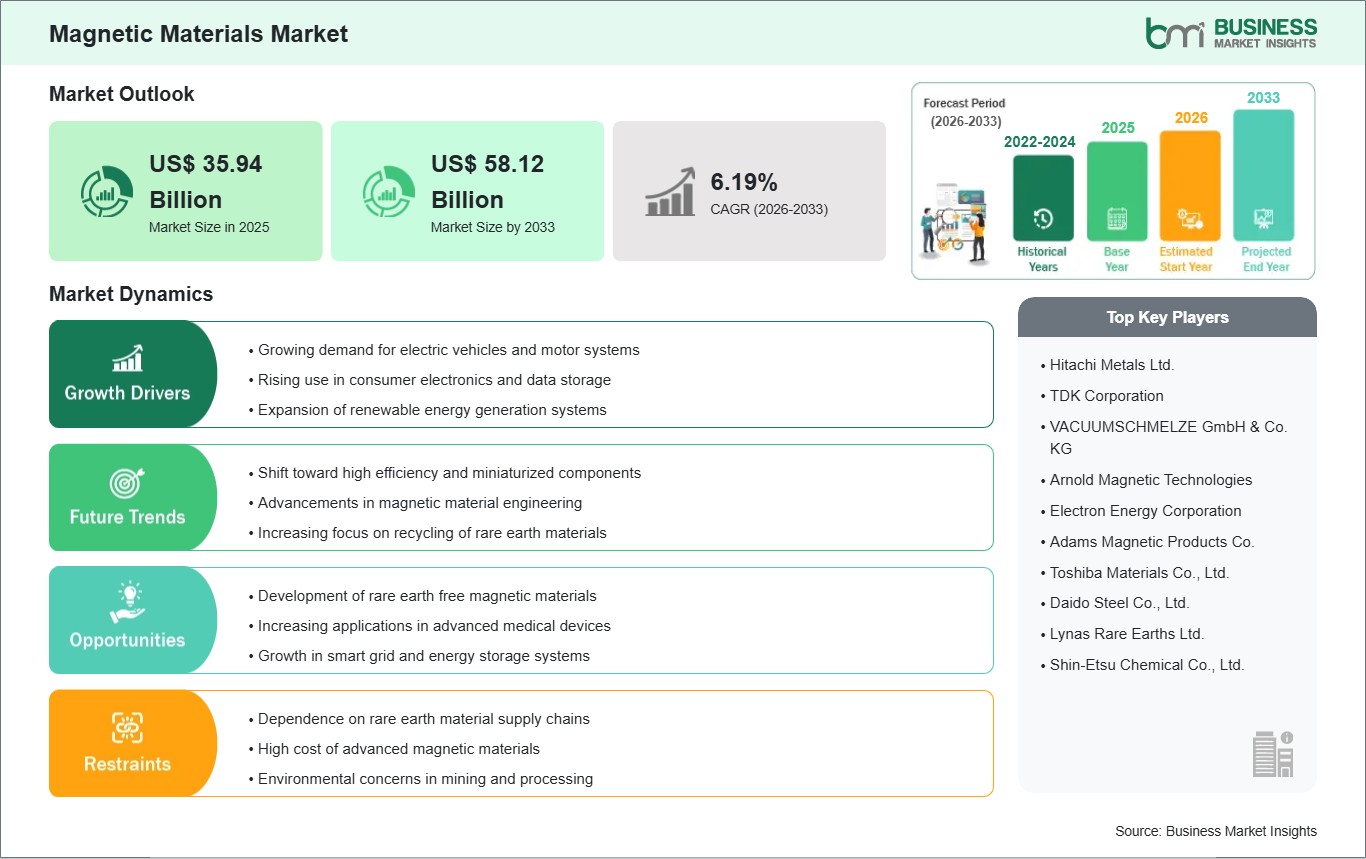
The market for magnetic materials is showing steady growth as the demand is rising in the automotive, electronics, and energy sectors. These materials are of critical importance in the efficient conversion of energy, storage of data, and motion control in modern technologies. The rise of electric vehicles and renewable energy is also showing significant growth in the market, as magnetic materials are of critical importance in motor drives and generators.
The market is classified in terms of type and application. The hard magnetic materials segment and the electronics segment have high market share. The advancements in the field of material science are improving the characteristics of magnetic materials. Though the raw materials' availability and the raw materials' costs are issues in the magnetic materials' market, the growth is fueled by the advancements in the field. The emphasis on sustainability and recycling is also influencing the magnetic materials market. The magnetic materials segment is expected to continue to be an important part in the development of advanced technologies.
Segment Analysis
Magnetic Materials Market Segmentation
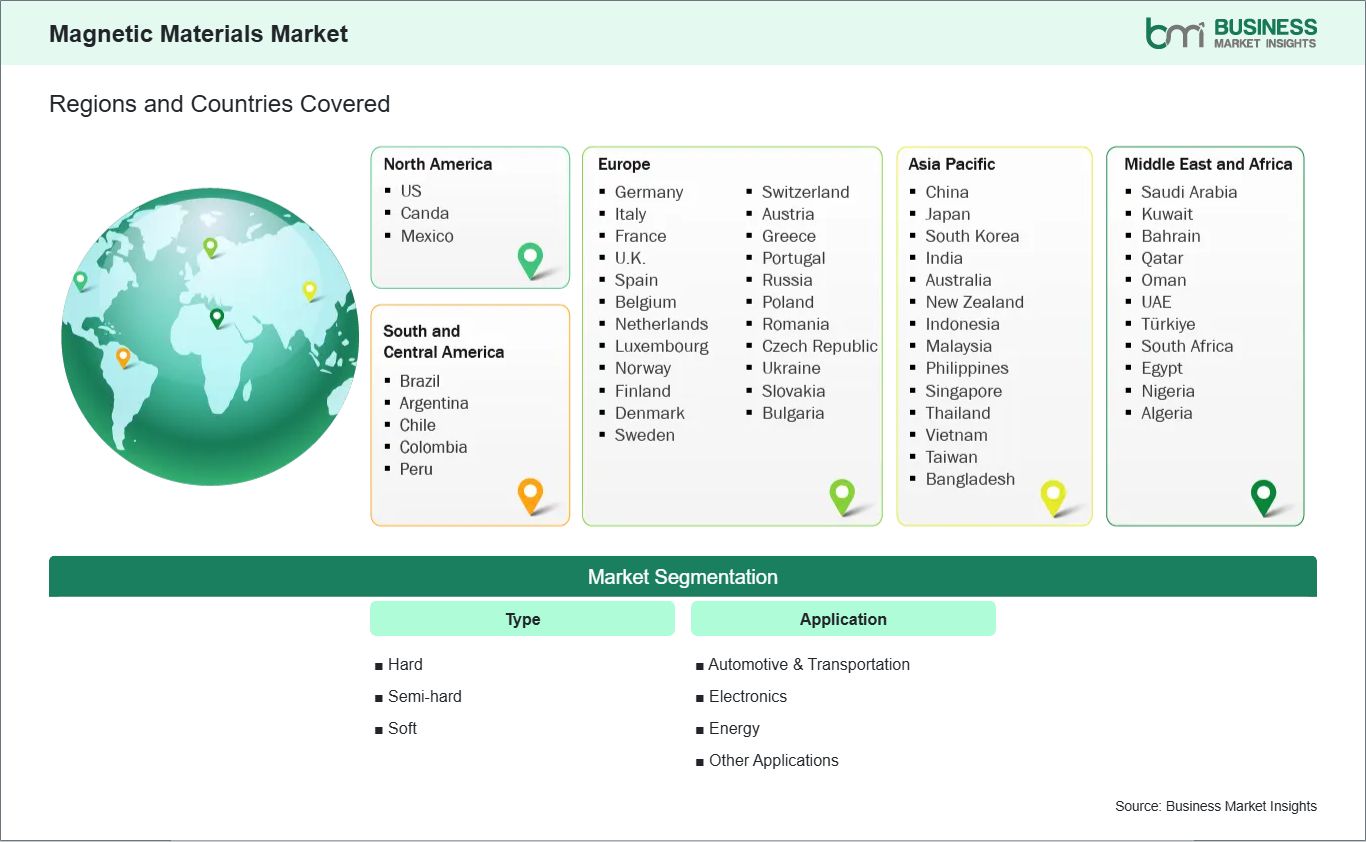
Key segments that contributed to the derivation of the Magnetic Materials market analysis are type and application.
- By type, the magnetic materials market is segmented into Hard, Semi-hard, and Soft. The Hard segment dominated the market in 2025.
- By application, the magnetic materials market is segmented into Automotive & Transportation, Electronics, Energy, and Other Applications. The Electronics segment dominated the market in 2025.
Market Forces
Magnetic Materials Market Drivers and Opportunities
Growing demand for electric vehicles and motor systems
The rising need for electric vehicles and motor systems is also an important factor in the growth of the magnetic materials market. This is because these materials are considered vital in ensuring efficient energy conversion. Magnetic materials, especially hard magnets, are used in various motor systems, including electric motors and generators. These materials are used due to their ability to sustain strong magnetic fields. In addition, the shift in the automotive industry towards electrified propulsion is also expected to boost the growth of the market. This is because efficient motor systems are required in these applications.
Moreover, electric vehicles make significant use of permanent magnet motor drives to ensure compact design and enhanced driving performance. The magnetic materials help in reducing energy loss and ensuring thermal stability, which is essential in optimizing vehicle range and reliability. Additionally, the rise of hybrid technologies and electric mobility in public transport and industrial sectors is expected to further support market demand. The constant innovations in motor drive technology and magnetic material composition are also expected to enhance performance while reducing material requirements. The increasing use of magnetic materials in future electric vehicle technologies is expected to sustain market demand in the years to come.
Development of rare earth free magnetic materials
The development of rare earth free magnetic materials presents a significant opportunity for the magnetic materials market, driven by the need to reduce dependency on limited and geopolitically sensitive resources. Traditional high-performance magnets often rely on rare earth elements, which can be expensive and subject to supply chain disruptions. This has encouraged research into alternative materials that can deliver comparable magnetic properties while offering greater availability and cost stability. Developing such materials can help manufacturers achieve more sustainable and resilient production processes.
Innovations in material science are enabling the exploration of new compositions and structures that enhance magnetic performance without relying on rare earth elements. These advancements are particularly important for industries such as automotive, electronics, and energy, where demand for magnetic materials is rapidly increasing. Rare earth free magnets also support environmental sustainability by reducing the impact of mining and processing activities associated with rare earth elements. As research progresses and commercial adoption increases, these materials are expected to open new growth avenues, offering cost-effective and environmentally friendly solutions for a wide range of applications in the magnetic materials market.
Size and Share Analysis
Magnetic Materials Market Size and Share Analysis
The global Magnetic Materials market is experiencing steady growth, with market size and share analysis reflecting evolving treatment preferences and competitive dynamics among key players. The report evaluates important subsegments categorized within type and application highlighting their respective contributions to overall market performance.
By type, the Hard subsegment dominated the market in 2025 due to its strong magnetic retention, high coercivity, and extensive use in permanent magnets for motors, sensors, and electronic devices requiring stable magnetic performance.
By application, the Electronics subsegment dominated the market in 2025 due to widespread use of magnetic materials in consumer electronics, data storage devices, and components such as transformers, inductors, and sensors supporting modern electronic systems.
Report Coverage
Magnetic Materials Market Report Coverage and Deliverables
The "Magnetic Materials Market Size and Forecast (2022 - 2033)" report provides a detailed analysis of the market covering below areas:
- Magnetic Materials market size and forecast at the regional and country levels for segments covered under the scope
- Magnetic Materials market trends, as well as drivers, restraints, and opportunities
- Magnetic Materials market analysis covering key trends, regional framework, major players, regulations, and recent developments
- Industry landscape and competition analysis covering market concentration, heat map analysis, prominent players, and recent developments for the Magnetic Materials market
- Detailed company profiles, including SWOT analysis
Geographic Insights
Magnetic Materials Market Geographic Insights
The geographical scope of the Magnetic Materials market report is divided into: North America, Asia Pacific, Europe, Middle East & Africa, and South & Central America. North America held the largest share in 2025.
North America dominates the magnetic materials market due to strong technological capabilities and high demand from advanced industries such as automotive, electronics, and energy. The region has a well-established manufacturing base and significant investment in research and development, supporting the adoption of innovative magnetic materials. Increasing focus on electric mobility and renewable energy projects is further driving demand in the region.
In addition, the presence of leading technology companies and growing emphasis on energy efficiency are contributing to market growth. The region is actively investing in the development of alternative magnetic materials and recycling technologies to reduce dependency on rare earth elements. Supportive regulatory frameworks and initiatives promoting sustainable energy solutions are also influencing market expansion. As demand for high-performance materials continues to rise, North America is expected to maintain its leading position in the global magnetic materials market.
Industry Activity
Recent Developments
The Magnetic Materials market is evaluated by gathering qualitative and quantitative data post primary and secondary research, which includes important corporate publications, association data, and databases. A few of the key developments in the Magnetic Materials market are:
- In April 2024, Hitachi Metals (now Proterial Ltd.), announced the development of high-performance neodymium magnets with reduced heavy rare earth content, aimed at improving sustainability and supply stability for EV motors and industrial applications.
- In October 2023, TDK Corporation, announced the expansion of its ferrite and magnetic materials production capacity to support growing demand from electric vehicles, renewable energy systems, and industrial electronics.
- In June 2023, VACUUMSCHMELZE (VAC), announced the commissioning of new production capacity for advanced magnetic materials in Germany, focusing on soft magnetic alloys used in energy-efficient transformers and e-mobility applications.
Trust & Transparency
Research Methodology
The market analysis combines proprietary research with secondary data from government agencies, company disclosures, regulatory filings, industry databases and expert interviews. Market estimates are validated through data triangulation, cross-market benchmarking and analyst
review.
View Full Research Methodology
Key Sources Referred:
American Chemistry Council (ACC)International Council of Chemical Associations (ICCA)European Chemical Industry Council (Cefic)China National Building Materials Group (CNBM)Indian Minerals & Granite Exporters Association (IMGEA)Japan Mining Industry Association (JMIA)Brazilian Mining Association (IBRAM)Gulf Petrochemicals and Chemicals Association (GPCA)Company WebsitesCompany Annual ReportsCompany Investor Presentations