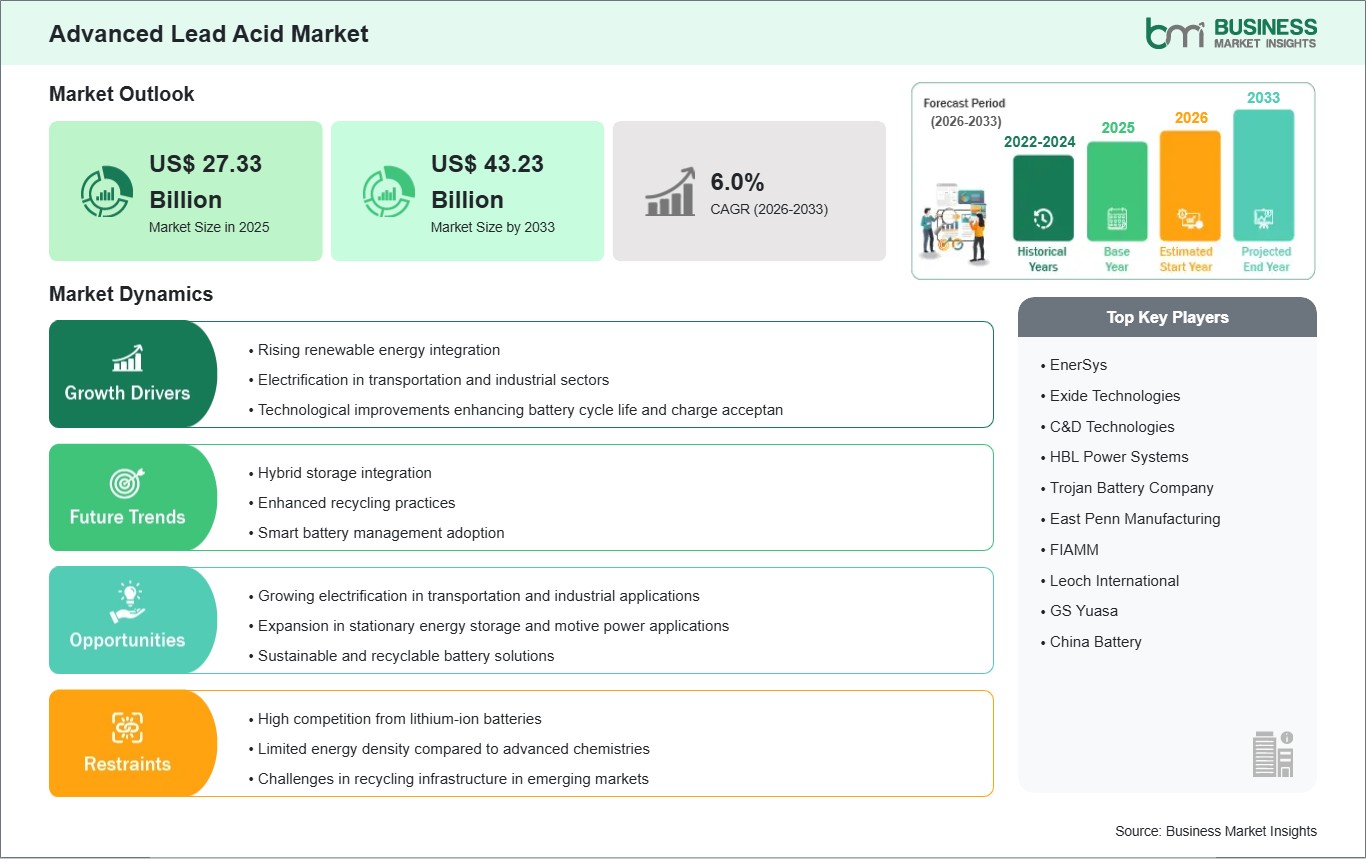
The Advanced Lead Acid Market size is expected to reach US$ 43.23 Billion by 2033 from US$ 27.33 Billion in 2025 .The market is estimated to record a CAGR of 6.0% from 2026 to 2033.
The global advanced lead acid battery market is witnessing significant growth driven by its established reliability, cost-effectiveness, and extensive use in critical energy storage applications. Valve Regulated Lead Acid (VRLA) batteries and flooded lead acid batteries continue to be preferred technologies due to their mature manufacturing processes, recyclability, and safety features.
Increasing demand from utility-scale renewable energy storage, uninterruptible power supply (UPS) systems, and transportation electrification drives market expansion. Advanced lead acid batteries provide a balance of affordability and performance for stationary and motive power applications, including forklifts, electric vehicles, and backup power. Technological improvements enhancing battery cycle life and charge acceptance further fuel adoption
Strategic collaborations, regional regulatory frameworks, and increasing grid modernization projects also influence competitive dynamics. As sustainability and energy transition accelerate globally, advanced lead acid batteries remain a critical, scalable energy storage solution for various industries.

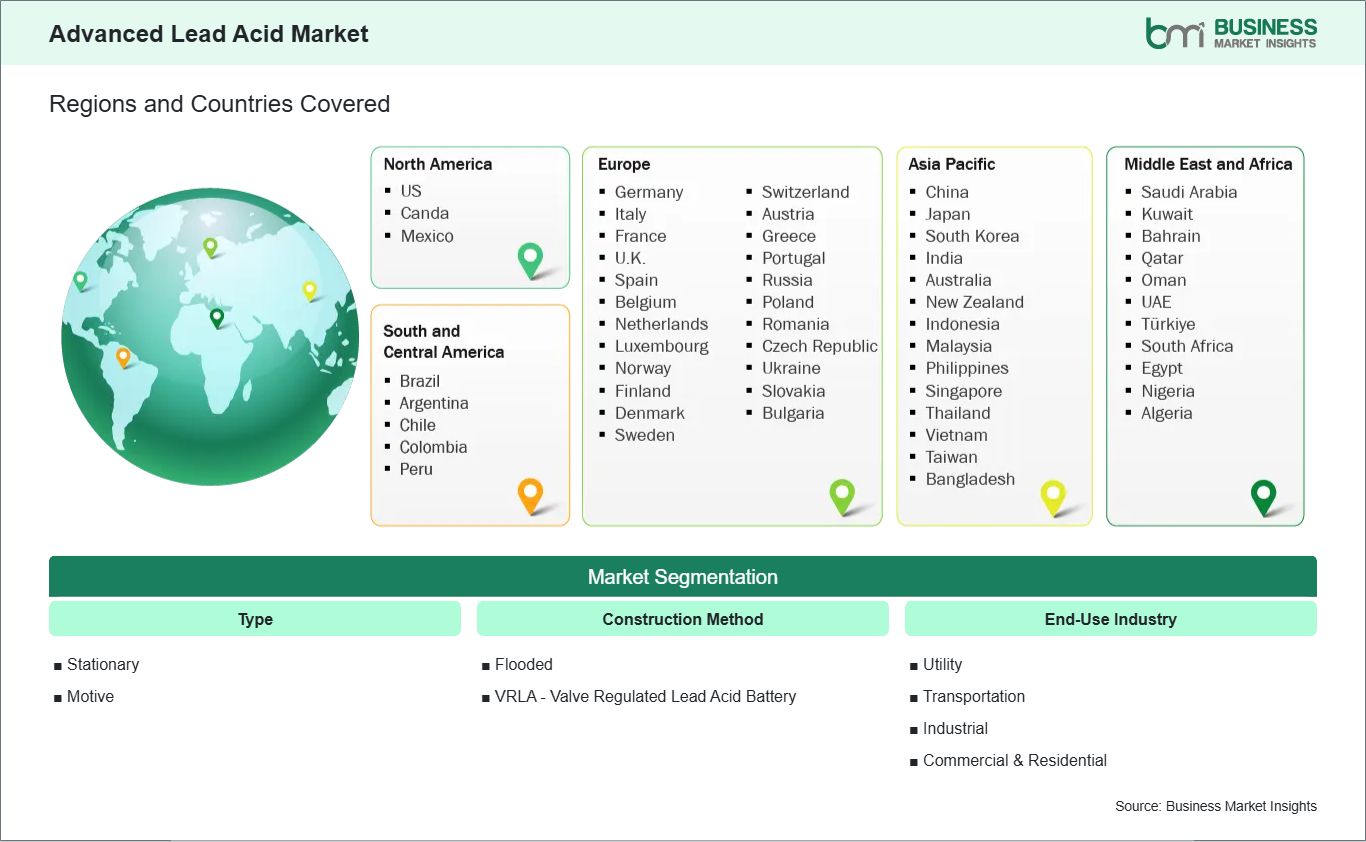
Key segments that contributed to the derivation of the advanced lead acid market analysis are type, construction method, and end-user.
The global push toward renewable energy adoption has created a strong demand for efficient and reliable energy storage solutions, with advanced lead‑acid batteries—particularly valve‑regulated lead‑acid (VRLA) types—playing a critical role. These batteries are widely used in stationary applications such as grid stabilization, peak load management, and backup power systems. Their proven technology, cost efficiency, and recyclability make them attractive for utilities and renewable energy developers seeking sustainable solutions. As solar and wind power capacity expands worldwide, the need for storage systems that can integrate seamlessly with intermittent energy sources has intensified. VRLA batteries provide dependable performance, ensuring that renewable energy can be stored and dispatched when needed, thereby enhancing grid reliability and supporting microgrid implementations. Government incentives and mandates for clean energy adoption further stimulate demand, encouraging utilities and businesses to invest in energy storage technologies. Technological advancements have significantly improved the performance of advanced lead‑acid batteries. Innovations in design have enhanced cycle life, charge acceptance, and tolerance to extreme temperatures, making them suitable for long‑duration stationary applications. Their recyclability also aligns with global sustainability goals, reducing environmental impact compared to other storage technologies.
As renewable energy integration accelerates, advanced lead‑acid batteries will remain a key enabler of modernized electrical grids. Their combination of affordability, reliability, and sustainability positions them as an essential component in the transition toward cleaner energy systems worldwide.
Electrification trends in transportation and industrial sectors are driving demand for advanced lead‑acid batteries, particularly in motive power applications. Forklifts, golf carts, and other industrial vehicles increasingly rely on these batteries as cost‑effective, robust, and safe power sources. Their ability to deliver consistent performance under demanding conditions supports operational efficiency while reducing emissions, aligning with environmental policies and cost‑control strategies in manufacturing and logistics industries.
In addition to industrial vehicles, advanced lead‑acid batteries are widely deployed in commercial and residential settings for backup power and off‑grid solutions. Rising energy security concerns and the need for reliable power in regions with unstable grids have accelerated adoption. These batteries provide dependable energy storage at a competitive cost, making them attractive for businesses and households alike.
Continuous product improvements are enhancing durability, reducing maintenance requirements, and lowering total cost of ownership. Advances in battery design have improved cycle life and resilience, ensuring longer service intervals and greater reliability. This makes advanced lead‑acid batteries particularly appealing for applications where safety, affordability, and proven performance are critical.
Together, these factors position advanced lead‑acid batteries as a cornerstone of electrification across diverse sectors. As industries and communities transition toward more sustainable and efficient energy solutions, the role of advanced lead‑acid batteries will continue to expand, supported by evolving technology, favorable regulatory frameworks, and increasing emphasis on sustainability.

The Advanced Lead Acid Market demonstrates steady growth, with size and share analysis highlighting evolving trends and competitive dynamics among key players. The report examines subsegments categorized within type, construction method, and end-user, offering insights into their contribution to overall market performance.
By type, the stationary subsegment dominated in 2025, driven by renewable energy and grid storage projects.
Based on construction method, the VRLA subsegment dominated in 2025, driven by its safety and maintenance advantages.
By end-user, the utility subsegment dominated in 2025, driven by increasing energy storage demand in utilities and telecom sectors.
| Report Attribute | Details |
|---|---|
| Market size in 2025 | US$ 27.33 Billion |
| Market Size by 2033 | US$ 43.23 Billion |
| Global CAGR (2026 - 2033) | 6.0% |
| Historical Data | 2022-2024 |
| Forecast period | 2026-2033 |
| Segments Covered | By Type
|
|
Regions and Countries Covered
| |
| North America | US, Canada, Mexico |
| Europe | Belgium, Austria, Finland, Denmark, Greece, Poland, Romania, Russia, Ukraine, Czech Republic, Slovakia, Bulgaria, Italy, Luxembourg, Germany, Switzerland, France, Netherlands, Norway, Portugal, Spain, Sweden, United Kingdom |
| Asia-Pacific | Australia, China, India, Japan, South Korea, Indonesia, Malaysia, Philippines, Singapore, Thailand, Vietnam, Bangladesh, New Zealand, Taiwan |
| South and Central America | Brazil, Argentina, Peru, Chile, Colombia |
| Middle East and Africa | Bahrain, Kuwait, Oman, Qatar, Saudi Arabia, United Arab Emirates, Turkiye, South Africa, Egypt, Algeria, Nigeria |
| Market leaders and key company profiles |
|
The "Advanced Lead Acid Market Size and Forecast (2022 - 2033)" report provides a detailed analysis of the market covering below areas:
The geographical scope of the Advanced Lead Acid Market report is divided into North America, Asia Pacific, Europe, Middle East & Africa, and South & Central America. North America held the largest share in 2025.
North America held the largest share of the advanced lead acid battery market in 2025, driven by robust renewable energy adoption, grid modernization initiatives, and mature transportation electrification efforts. The United States and Canada are significant markets for VRLA batteries, especially in telecom infrastructure, data centers, and utility-scale energy storage projects.
Strong government support through incentives and funding for clean energy and smart grid projects bolsters stationary battery demand. Additionally, the industrial sector in North America extensively uses advanced lead acid batteries in motive applications such as forklifts and automated guided vehicles, supported by increasing automation and sustainability goals.
Europe follows closely, with growing renewable capacity and regulatory emphasis on battery recycling and energy efficiency. Countries like Germany, the UK, and France lead in deploying VRLA batteries for grid support and backup power.
Asia Pacific is a rapidly growing market fueled by infrastructure development, rising industrialization, and expanding transportation electrification in China, India, Japan, and Southeast Asia. Despite challenges in recycling infrastructure, growing energy demand and government policies promote adoption.
Emerging markets in the Middle East & Africa and South & Central America show early-stage growth driven by infrastructure upgrades, utility electrification, and rising demand for reliable power backup solutions in commercial and residential sectors.

The Advanced Lead Acid Market is evaluated by gathering qualitative and quantitative data post primary and secondary research, which includes important corporate publications, association data, and databases. A few of the key developments in the advanced lead acid market are:
The Advanced Lead Acid Market is valued at US$ 27.33 Billion in 2025, it is projected to reach US$ 43.23 Billion by 2033.
As per our report Advanced Lead Acid Market, the market size is valued at US$ 27.33 Billion in 2025, projecting it to reach US$ 43.23 Billion by 2033. This translates to a CAGR of approximately 6.0% during the forecast period.
The Advanced Lead Acid Market report typically cover these key segments-
The historic period, base year, and forecast period can vary slightly depending on the specific market research report. However, for the Advanced Lead Acid Market report:
The Advanced Lead Acid Market is populated by several key players, each contributing to its growth and innovation. Some of the major players include:
The Advanced Lead Acid Market report is valuable for diverse stakeholders, including:
Essentially, anyone involved in or considering involvement in the Advanced Lead Acid Market value chain can benefit from the information contained in a comprehensive market report.
Please tell us your area of interest
(Market Segments/ Regions and Countries/ Companies)