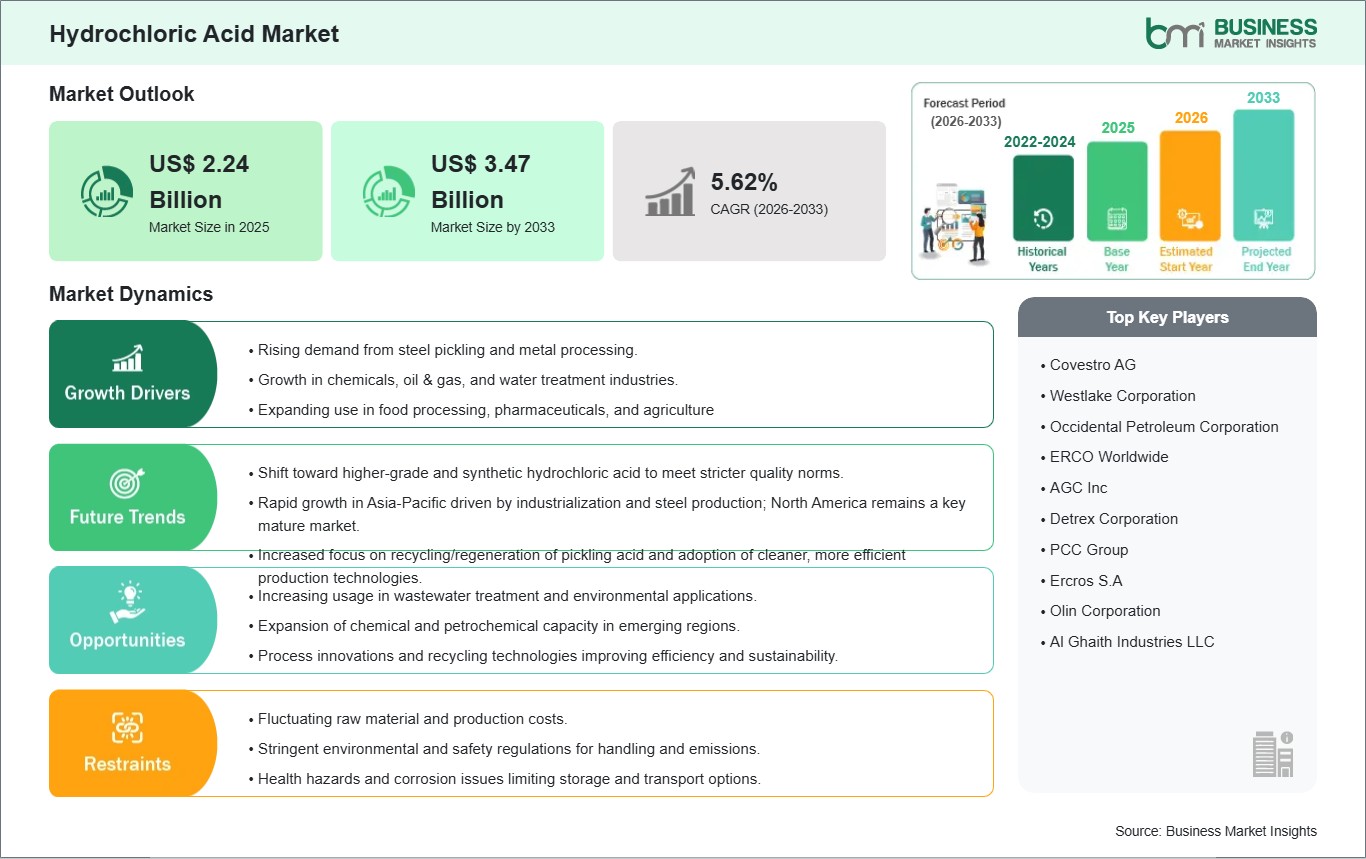
The Hydrochloric Acid Market size is expected to reach US$ 3.47 Billion by 2033 from US$ 2.24 Billion in 2025. The market is estimated to record a CAGR of 5.62% from 2026 to 2033.
Hydrochloric acid plays a vital role in the synthesis of chemicals, processing of metals, and treating of water, as it allows the synthesis of extremely important compounds such as PVC and fertilizers, effective rust removal, and accurate pH control worldwide. It is crucial to the chemicals, steel and metallurgy, oil and gas, food and beverage, pharmaceuticals, as well as water purification industries. The advantages of hydrochloric acid are that it is versatile, cost-effective, and more efficient in its uses, like pickling steel to achieve better life, oil well stimulation to increase recovery, and neutralization of wastewater without producing harmful by-products. The market is being motivated by the boom demand through infrastructure developments, growth in shale gas development, and the increasing demand for clean water and green chemicals. Developments such as on-site generation systems, membrane-cell electrolysis to save on energy, and new technologies in recycling battery leaching and removing PFAS are also more sustainable and perform better.
However, various factors can restrain the market growth, such as unstable raw material costs that are tied to the chlor-alkali cycles, heavy environmental laws on emissions and toxicity, and the risks of dealing with its corrosive nature. The industry is also sensitive to the disruption of geopolitical events and to supply chains due to economic downturns. Despite these factors, the market presents massive opportunities due to the growing use of green production means, fast industrialization in the Asia-Pacific region, and the emergence of high-purity grades in semiconductors and the recycling of electric vehicles. Even sustainable chemistry and circular economy programs will also be a fantastic investment, and they will facilitate the growth of the market.

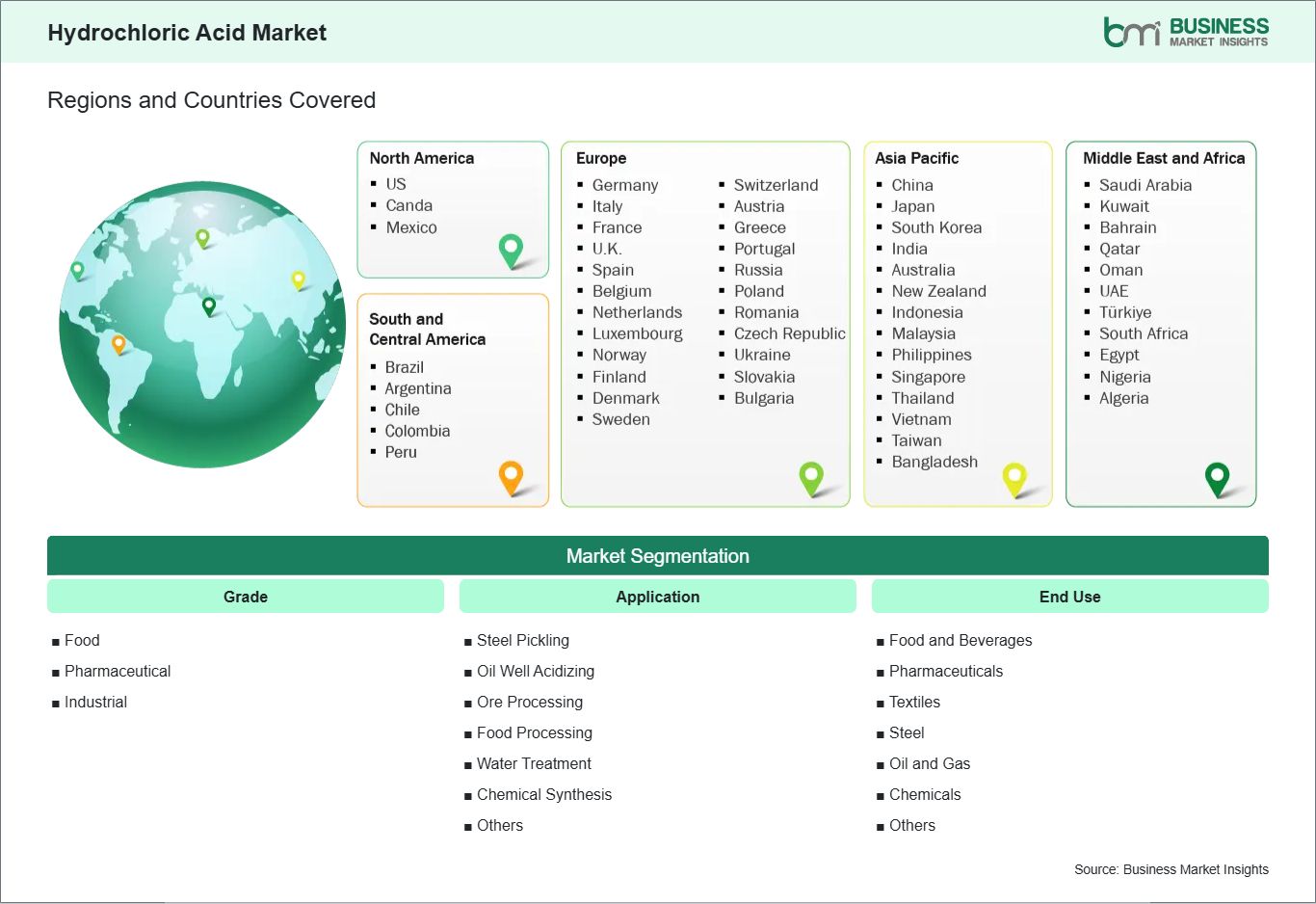
Key segments that contributed to the derivation of the Hydrochloric Acid market analysis are type and application.
Growing demand in the steel and metallurgy sector has turned out to be a key driver that has a positive effect on the hydrochloric acid market. As urbanization increased rapidly, new infrastructure projects and automotive industries were built, formulators wanted efficient, highly functional processes to clean and enhance surface quality, and hydrochloric acid was necessary to pickle and remove rust from metals.
The growth is linked to a booming residential construction, increasing volumes of automotive production, fast urban migration in Asia-Pacific, government incentives in green building, and infrastructure projects in North America and in the emerging markets in roads, bridges, and utilities. This strong steel and metallurgy growth is a direct contribution to the hydrochloric acid market growth, since the demands of pickling and surface treatment processes, which require effective hydrochloric acid to achieve high cleanliness and integrity in construction, automotive, and protective applications, are ever-increasing to meet building, automotive, and protective needs across the globe.
ArcelorMittal, POSCO Holdings Inc., and Tata Steel Limited, major giants in the steel and metallurgy industry, have not only expanded their operations in the global market but have also redefined the industry by focusing on low-emission regeneration systems with accelerated pickling. Hydrochloric acid, which is known to facilitate better processing time and corrosion efficiency in such systems, is better placed to respond to these innovation imperatives. Hydrochloric acid provides exact targeted dissolution of oxides, unlike traditional mechanical methods, which is crucial to the steel and metallurgy industry that relies upon high-throughput manufacturing that is sustainable.
The growth force in the market of hydrochloric acid has been the development of applications in PVC and fertilizers. Since the construction industry, agriculture, and chemicals industries require high-performance materials, the manufacturers are increasingly considering such versatile compounds that exhibit a high level of durability, scalability, and affordability, and hydrochloric acid is the key to the synthesis and the final product.
The compound formulation innovations, together with the growing end-use prospects in the piping, flooring, and nutrient manufacture, have led to the growth of the market prospects in the developed and emerging economies in the past few years. There are also high-strength products with high chemical resistance (water pipes, agricultural soils, industrial cables, and crop enhancers), which are primarily based upon PVC and fertilizer systems and use the accuracy and efficacy of hydrochloric acid. These resources are planned and put in place periodically. Their applications are very diverse, and this has necessitated the need to come up with quality solutions to acidification that are reliable and will ensure that the acidification is done in harsh environments.
Moreover, the material selection strategies of the world industries continue to develop in an attempt to make them more efficient and sustainable due to changes in regulations and technologies. As this development often comes with it is the necessity to have hydrochloric acid that allows low-emitting, high-speed formulations to enable complex and high-volume production across continents. The PVC hydrochloric acid as well as fertilizer systems are also likely to increase continuously, as the industries switch towards the lightweight and environmentally friendly to the environment designs and new manufacturing technologies.

| Report Attribute | Details |
|---|---|
| Market size in 2025 | US$ 2.24 Billion |
| Market Size by 2033 | US$ 3.47 Billion |
| Global CAGR (2026 - 2033) | 5.62% |
| Historical Data | 2022-2024 |
| Forecast period | 2026-2033 |
| Segments Covered | By Grade
|
|
Regions and Countries Covered
| |
| North America | US, Canada, Mexico |
| Europe | Belgium, Austria, Finland, Denmark, Greece, Poland, Romania, Russia, Ukraine, Czech Republic, Slovakia, Bulgaria, Italy, Luxembourg, Germany, Switzerland, France, Netherlands, Norway, Portugal, Spain, Sweden, United Kingdom |
| Asia-Pacific | Australia, China, India, Japan, South Korea, Indonesia, Malaysia, Philippines, Singapore, Thailand, Vietnam, Bangladesh, New Zealand, Taiwan |
| South and Central America | Brazil, Argentina, Peru, Chile, Colombia |
| Middle East and Africa | Bahrain, Kuwait, Oman, Qatar, Saudi Arabia, United Arab Emirates, Turkiye, South Africa, Egypt, Algeria, Nigeria |
| Market leaders and key company profiles |
|
The Hydrochloric Acid Market Size and Forecast (2022-2033) report provides a detailed analysis of the market covering below areas:
The geographical scope of the Hydrochloric Acid market report is divided into five regions: North America, Asia Pacific, Europe, Middle East & Africa, and South & Central America. The Hydrochloric Acid market in the Asia Pacific is expected to grow significantly during the forecast period.
The Asia-Pacific Hydrochloric Acid market is segmented into China, Japan, South Korea, India, Australia, New Zealand, Indonesia, Malaysia, the Philippines, Singapore, Thailand, Vietnam, Taiwan, Bangladesh, and the Rest of Asia. The Asia-Pacific market of hydrochloric acids has recorded a booming growth as a result of increased industrialization, growth in steel production, and increased chemical manufacturing processes. Other nations that are the most active in the growth and development include China and India, with high demand in steel pickling, water treatment, chemical processing, and oil and gas.
The implementation of modern technologies in production, such as continuous acid production and processes that are friendly to the environment, has improved efficiency in operations and minimized emissions and waste. The strategy to enhance supply chains and exports by increasing investment in chemical infrastructure, industrial parks, and regional trade agreements, e.g., RCEP. More so, the increased use of hydrochloric acid in food processing, pharmaceuticals, and other specialty industries is growing market demand. All these aspects, coupled with the modernization of production centres and the development of regional production capacity, are making Asia-Pacific a super hub in the hydrochloric acid market of the globe.

The Hydrochloric Acid market is evaluated by gathering qualitative and quantitative data post-primary and secondary research, which includes important corporate publications, association data, and databases. A few of the key developments in the Hydrochloric Acid market are:
The Hydrochloric Acid Market is valued at US$ 2.24 Billion in 2025, it is projected to reach US$ 3.47 Billion by 2033.
As per our report Hydrochloric Acid Market, the market size is valued at US$ 2.24 Billion in 2025, projecting it to reach US$ 3.47 Billion by 2033. This translates to a CAGR of approximately 5.62% during the forecast period.
The Hydrochloric Acid Market report typically cover these key segments-
The historic period, base year, and forecast period can vary slightly depending on the specific market research report. However, for the Hydrochloric Acid Market report:
The Hydrochloric Acid Market is populated by several key players, each contributing to its growth and innovation. Some of the major players include:
The Hydrochloric Acid Market report is valuable for diverse stakeholders, including:
Essentially, anyone involved in or considering involvement in the Hydrochloric Acid Market value chain can benefit from the information contained in a comprehensive market report.
Please tell us your area of interest
(Market Segments/ Regions and Countries/ Companies)