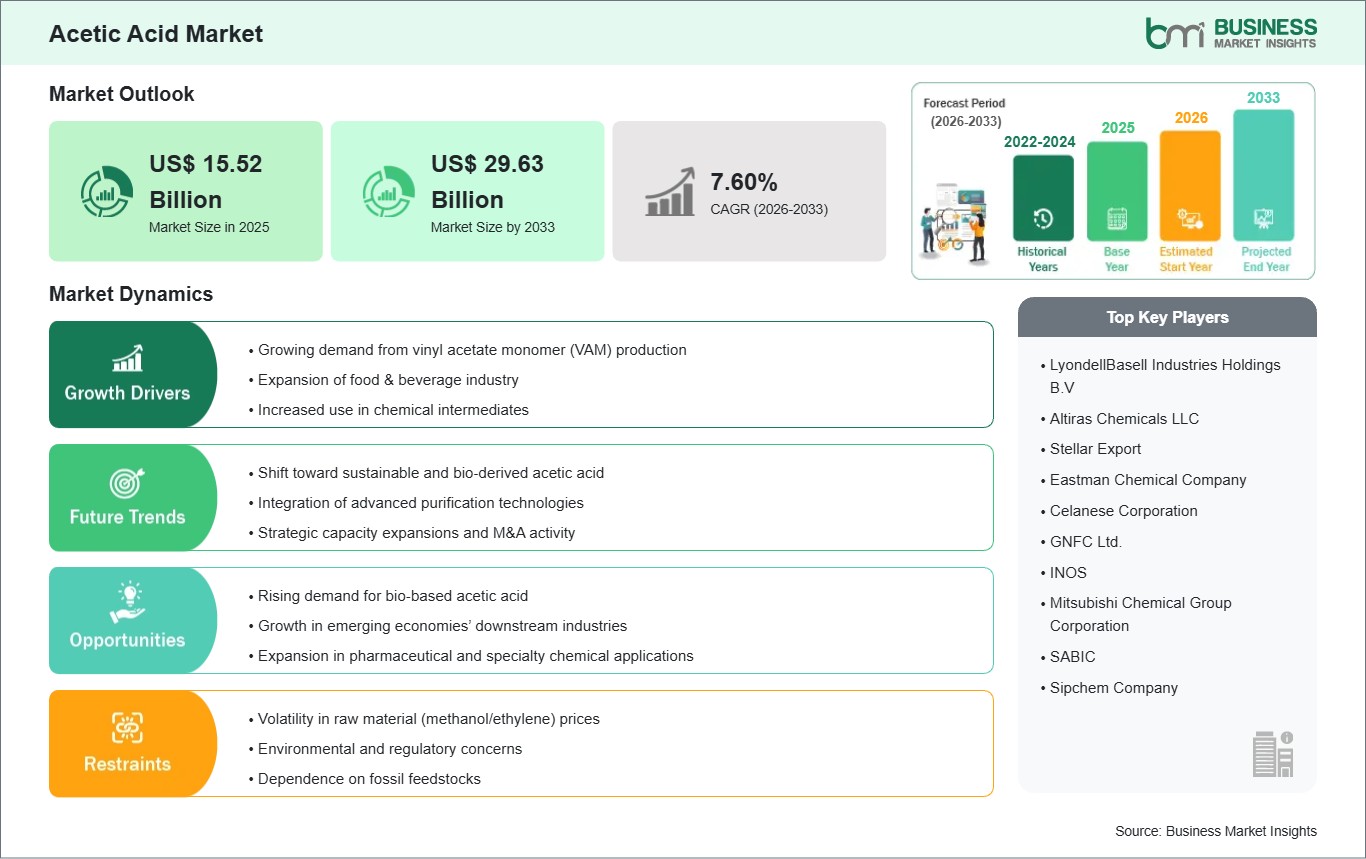
The acetic acid market size is expected to reach US$ 29.63 billion by 2033 from US$ 15.52 billion in 2025. The market is estimated to record a CAGR of 7.6% from 2026 to 2033.
Acetic acid is an essential raw material for producing vinyl acetate monomer (VAM), purified terephthalic acid (PTA), and acetic anhydride. Acetic acid supports the manufacturing of paints, coatings, synthetic fibers, and plastics. The rising demand for these products, especially in construction, packaging, and automotive sectors, helps drive market growth.
Moreover, the food & beverages industry uses acetic acid as a preservative and flavoring agent, which further boosts its steady consumption. The increase in industrialization and urbanization in developing countries, along with growing investments in chemical manufacturing facilities, has expanded production capacities and strengthened supply chains. Advances in production methods, such as methanol carbonylation and bio-based fermentation, are improving efficiency, lowering costs, and encouraging sustainable practices.
Additionally, the growing awareness of environmental sustainability and the shift toward green chemical processes are promoting the use of bio-derived acetic acid. This shift creates more opportunities for market growth and long-term expansion.

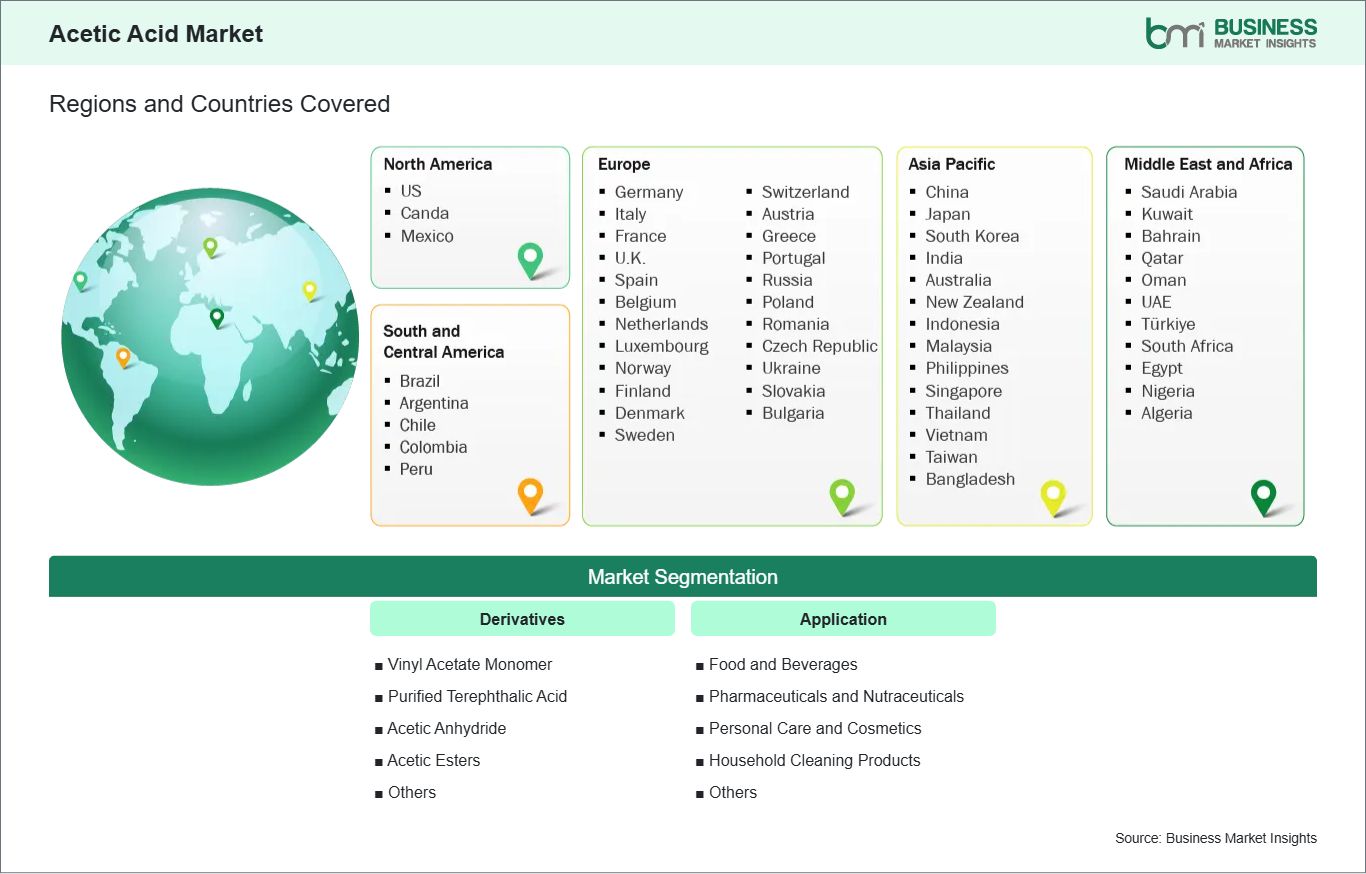
Key segments that contributed to the derivation of the acetic acid market analysis are derivatives and applications.
Acetic acid serves as a critical raw material across multiple downstream industries, including chemicals, textiles, plastics, and paints and coatings. It is essential for manufacturing key intermediates such as vinyl acetate monomer (VAM), purified terephthalic acid (PTA), and acetic anhydride. These compounds are used in producing adhesives, coatings, synthetic fibers, and packaging materials.
Growing demand for these end‑use products, supported by rapid industrialization, urban expansion, and growth in construction, automotive, and packaging sectors, continues to elevate the need for acetic acid. The food & beverages industry also contributes to consistent consumption, using acetic acid as a preservative and flavoring agent.
Additionally, strong industrial development in emerging markets, particularly in Asia Pacific, combined with increased production capacities, is further strengthening market momentum. Advancements in manufacturing technologies, including improved methanol carbonylation processes and more efficient catalysts, have enhanced yields and reduced production costs, making acetic acid more accessible and cost‑effective. Collectively, these factors underpin the sustained growth of the global acetic acid market.
Traditionally, acetic acid is made from the methanol carbonylation of fossil fuel-based feedstocks. However, growing environmental concerns and regulatory pressure to cut carbon emissions are pushing the use of bio-based alternatives. Bio-based acetic acid is made through microbial fermentation of renewable feedstocks like corn, sugarcane, and biomass. This method has a smaller environmental impact and supports circular economy goals.
The move toward sustainable chemical production matches global efforts to lessen reliance on petrochemicals and meet strict environmental standards. Industries such as packaging, food and beverages, and pharmaceuticals are increasingly looking for bio-based acetic acid to label their products as eco-friendly, which creates strong demand. Moreover, advancements in fermentation methods, better microbial strains, and downstream purification are making bio-based acetic acid production more cost-effective. As consumers increasingly prefer sustainable and green chemicals, the bio-based segment offers a promising path for market growth and long-term success.

The acetic acid market demonstrates steady growth, with size and share analysis revealing evolving trends and competitive positioning among key players. The report further examines subsegments categorized within derivatives and applications, offering insights into their contribution to overall market performance. By derivatives, the vinyl acetate monomer (VAM) segment held the largest market share in 2025 because of its wide use in adhesives, paints, coatings, and textile applications. This growth was driven by rapid industrialization and higher demand for construction and automotive materials. In terms of application, the food and beverages segment held the largest market share in 2025. This was supported by the common use of acetic acid as a preservative, flavoring agent, and pH regulator. There was also a rising consumer demand for processed and packaged food products.
| Report Attribute | Details |
|---|---|
| Market size in 2025 | US$ 15.52 Billion |
| Market Size by 2033 | US$ 29.63 Billion |
| Global CAGR (2026 - 2033) | 7.60% |
| Historical Data | 2022-2024 |
| Forecast period | 2026-2033 |
| Segments Covered | By Derivatives
|
|
Regions and Countries Covered
| |
| North America | US, Canada, Mexico |
| Europe | Belgium, Austria, Finland, Denmark, Greece, Poland, Romania, Russia, Ukraine, Czech Republic, Slovakia, Bulgaria, Italy, Luxembourg, Germany, Switzerland, France, Netherlands, Norway, Portugal, Spain, Sweden, United Kingdom |
| Asia-Pacific | Australia, China, India, Japan, South Korea, Indonesia, Malaysia, Philippines, Singapore, Thailand, Vietnam, Bangladesh, New Zealand, Taiwan |
| South and Central America | Brazil, Argentina, Peru, Chile, Colombia |
| Middle East and Africa | Bahrain, Kuwait, Oman, Qatar, Saudi Arabia, United Arab Emirates, Turkiye, South Africa, Egypt, Algeria, Nigeria |
| Market leaders and key company profiles |
|
The " Acetic Acid Market Size and Forecast (2022–2033)" report provides a detailed analysis of the market covering below areas:
The geographical scope of the acetic acid market report is divided into five regions: North America, Asia Pacific, Europe, the Middle East & Africa, and South & Central America. The acetic acid market in the Asia Pacific is expected to grow significantly during the forecast period.
This stems from high industrial activity, abundant raw materials, and rapidly growing end-use industries. Countries like China, India, and Japan have seen significant industrial growth in textiles, chemicals, paints and coatings, adhesives, and packaging. All of these industries rely heavily on acetic acid as a key raw material. The region has a strong chemical manufacturing infrastructure. Cost-effective production and readily available methanol feedstock support large-scale acetic acid production and supply.
Moreover, the expanding food & beverages industry in Asia Pacific drives steady demand for acetic acid, both as a preservative and a flavoring agent. Rising urbanization, increasing consumer spending, and the growth of sectors like automotive and construction further increase the need for downstream products such as purified terephthalic acid (PTA) and vinyl acetate monomer (VAM). Government initiatives that promote industrial growth, attract foreign investment, and modernize chemical plants also help develop the market. Together, these factors have made Asia Pacific the leader in the acetic acid market, owning the largest regional share globally.

The acetic acid market is evaluated by gathering qualitative and quantitative data post-primary and secondary research, which includes important corporate publications, association data, and databases. A few of the key developments in the acetic acid market are:
The Acetic Acid Market is valued at US$ 15.52 Billion in 2025, it is projected to reach US$ 29.63 Billion by 2033.
As per our report Acetic Acid Market, the market size is valued at US$ 15.52 Billion in 2025, projecting it to reach US$ 29.63 Billion by 2033. This translates to a CAGR of approximately 7.60% during the forecast period.
The Acetic Acid Market report typically cover these key segments-
The historic period, base year, and forecast period can vary slightly depending on the specific market research report. However, for the Acetic Acid Market report:
The Acetic Acid Market is populated by several key players, each contributing to its growth and innovation. Some of the major players include:
The Acetic Acid Market report is valuable for diverse stakeholders, including:
Essentially, anyone involved in or considering involvement in the Acetic Acid Market value chain can benefit from the information contained in a comprehensive market report.
Please tell us your area of interest
(Market Segments/ Regions and Countries/ Companies)