Market Summary
Executive Summary and Global Market Analysis
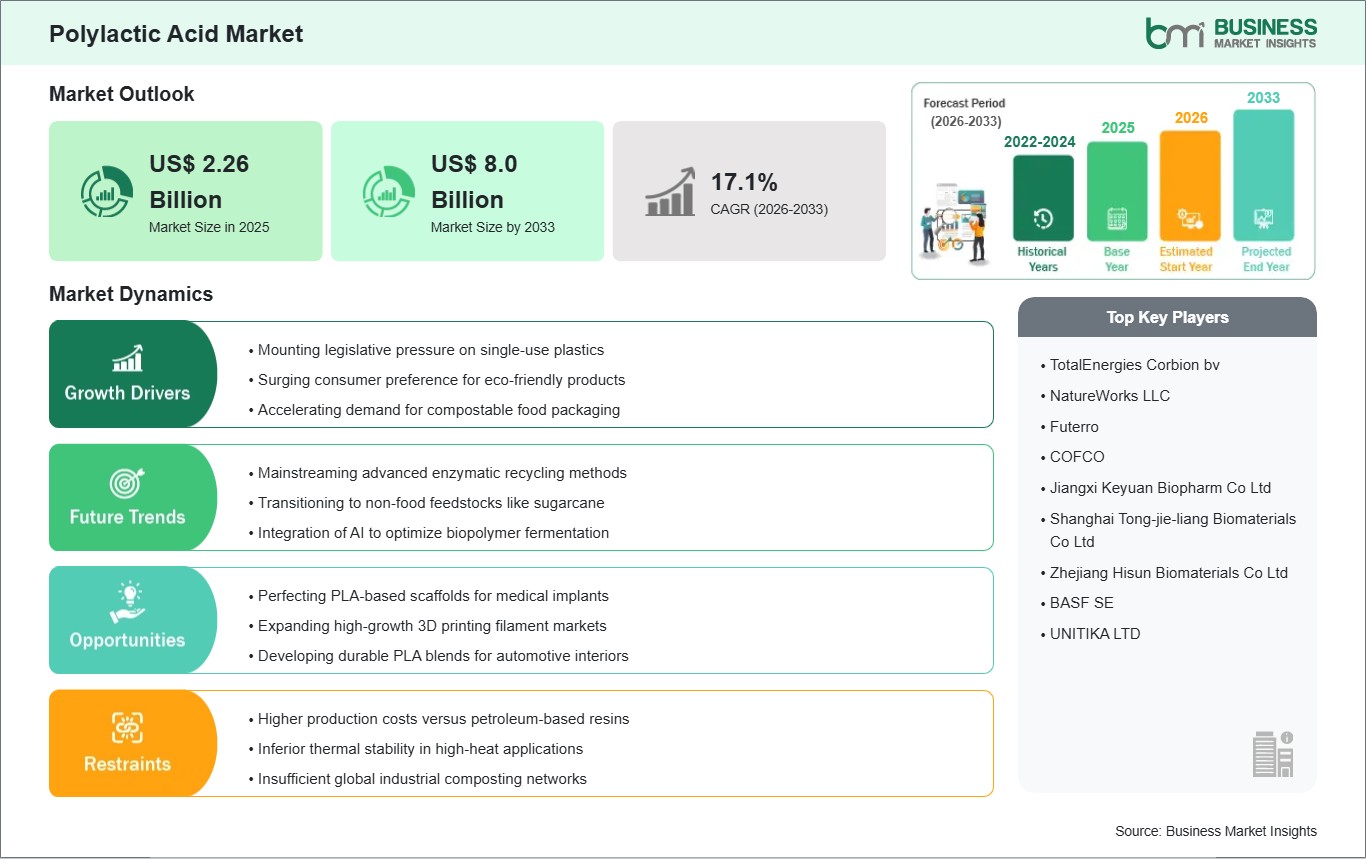
The Polylactic Acid (PLA) Market plays an important role as a leading bio-based and biodegradable polymer, offering a sustainable alternative to petroleum-based plastics. PLA is widely used in packaging, 3D printing, textiles, and biomedical applications. Its main benefits are that it comes from renewable resources like corn starch and sugarcane, has a lower carbon footprint, and can be composted in industrial settings. The market is growing due to strict global regulations on single-use plastics, rising consumer demand for eco-friendly products, and corporate sustainability goals. PLA’s flexibility, especially as a main material for 3D printing, also increases its demand.
There are some challenges holding back market growth. PLA often costs more to produce than traditional plastics like PE and PP, which can be a barrier. It also has some performance limits, such as lower heat resistance and mechanical strength, making it less suitable for high-temperature or high-stress uses. In addition, many regions lack enough industrial composting facilities, making disposal harder. Still, there are opportunities as new technologies improve PLA’s heat and barrier properties, and its use in medical applications like sutures and implants is expanding due to its biocompatibility. The Asia-Pacific region is witnessing strong growth, driven by government and consumer interest in green packaging. New closed-loop recycling methods for PLA are also expected to help the market grow.
Segment Analysis
Polylactic Acid Market Segmentation
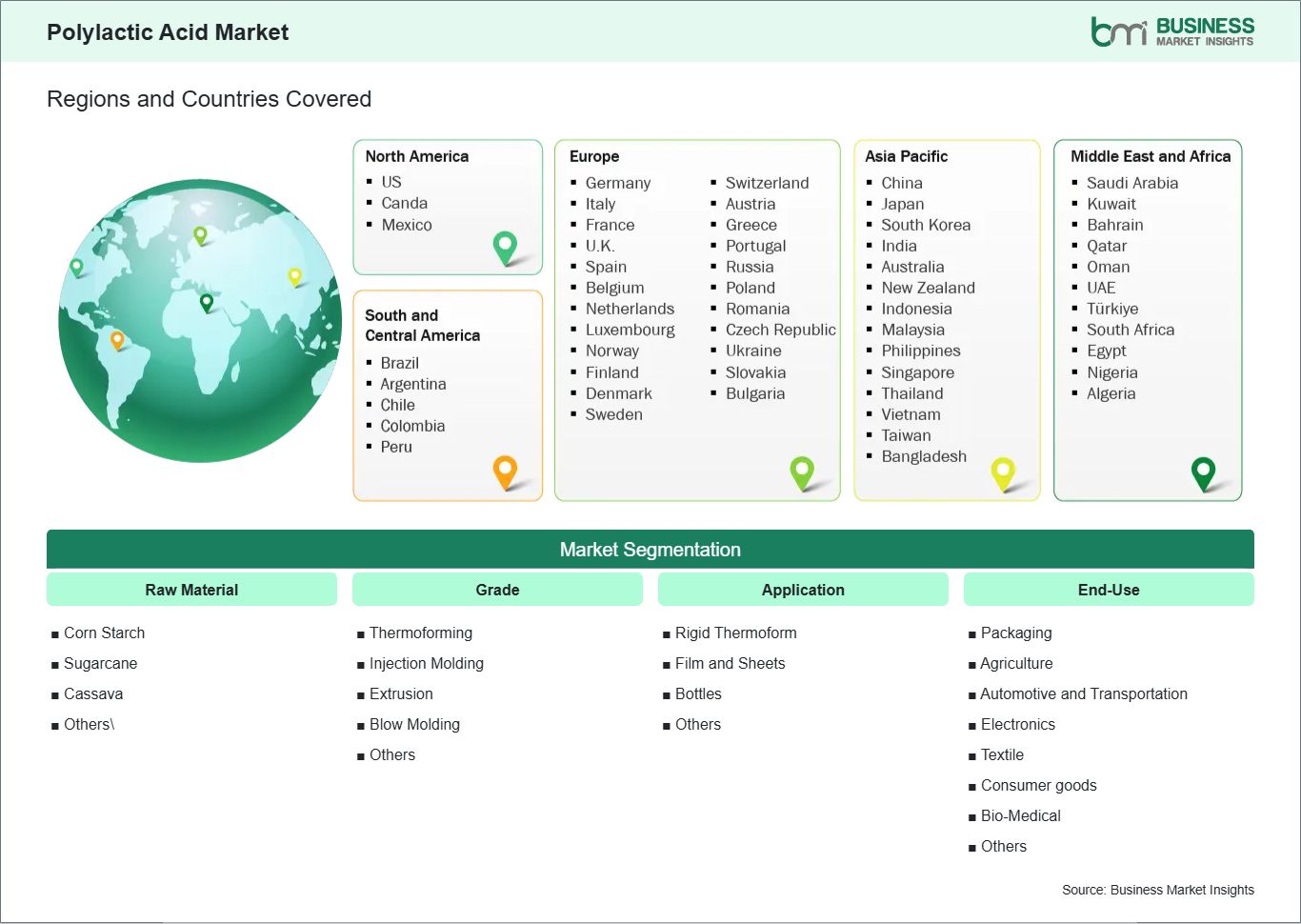
Key segments that contributed to the derivation of the Polylactic Acid Market analysis are raw material, grade, application, and end use.
- By Raw Material, the market is segmented into Corn Starch, Sugarcane, Cassava, and Others.
- By Grade, the market is segmented into Thermoforming, Injection Molding, Extrusion, Blow Molding, and Others.
- By Application, the market is segmented into Rigid Thermoform, Film and Sheets, Bottles, and Others.
- By End Use, the market is segmented into Packaging, Agriculture, Automotive and Transportation, Electronics, Textile, Consumer goods, Bio-Medical, and Others.
Market Forces
Polylactic Acid Market Drivers and Opportunities
Global Government Regulations
The primary driver for the Polylactic Acid (PLA) Market is the converging pressure from global government regulations and surging consumer preference for sustainable, biodegradable packaging and products. PLA, a thermoplastic derived from renewable resources like corn starch or sugarcane, is a leading commercially viable bioplastic.
Governments worldwide are implementing strict bans and phase-outs on single-use, petroleum-based plastics (e.g., straws, cutlery, certain bags), compelling industries to adopt compostable alternatives. Concurrently, increasing consumer awareness of environmental pollution, plastic waste, and carbon footprints is fundamentally shifting purchasing decisions toward eco-friendly brands. This powerful combination of mandatory policy change and voluntary consumer choice provides an essential, non-negotiable market for PLA, particularly in the massive food and beverage packaging sector.
High-Performance Applications
A significant and high-value opportunity for the market lies in the technological advancement of PLA for high-performance applications and the industry's focus on enhancing material circularity. Early PLA grades had limitations in heat resistance and mechanical strength, restricting their use.
Ongoing R&D is creating advanced PLA blends and composites with improved thermal stability and toughness, allowing them to penetrate challenging, high-value markets like automotive interiors, durable consumer goods, and specialized electronics. Crucially, the market is leveraging PLA's unique property as a bio-based polymer in the biomedical sector for applications such as dissolvable sutures, drug delivery systems, and tissue engineering scaffolds. Furthermore, massive investments in industrial composting infrastructure and chemical recycling technologies are working to solve the material's 'end-of-life' challenge, reinforcing the commitment to a closed-loop, circular economy for PLA.
Size and Share Analysis
Polylactic Acid Market Size and Share Analysis
The Polylactic Acid Market demonstrates steady growth, with size and share analysis revealing evolving trends and competitive positioning among key players. The report further examines subsegments categorized within raw material, grade, application, and end use, offering insights into their contribution to overall market performance.
For instance, Corn Starch is the predominant source for PLA, primarily processed into Extrusion grade pellets for Film and Sheets used in the Packaging sector. This segment is driven by the growing global demand for sustainable, biodegradable alternatives to traditional petroleum-based plastics.
PLA resins suitable for Injection Molding are widely adopted in the Bio-Medical sector for applications like surgical sutures and drug delivery systems. This high-value segment benefits from the material's excellent biocompatibility and its controlled degradation properties within the human body.
Report Coverage
Polylactic Acid Market Report Coverage and Deliverables
The "Polylactic Acid Market Size and Forecast (2022 - 2033)" report provides a detailed analysis of the market covering below areas:
- Polylactic Acid Market size and forecast at global, regional, and country levels for all the key market segments covered under the scope
- Polylactic Acid Market trends, as well as market dynamics such as drivers, restraints, and key opportunities
- Polylactic Acid Market analysis covering key market trends, global and regional framework, major players, regulations, and recent market developments
- Industry landscape and competition analysis covering market concentration, heat map analysis, prominent players, and recent developments for the Polylactic Acid Market
- Detailed company profiles, including SWOT analysis
Geographic Insights
Polylactic Acid Market Geographic Insights
The geographical scope of the Polylactic Acid Market report is divided into five regions: North America, Asia Pacific, Europe, the Middle East & Africa, and South & Central America.
The Asia-Pacific Polylactic Acid Market is segmented into China, Japan, South Korea, India, Australia, New Zealand, Indonesia, Malaysia, the Philippines, Singapore, Thailand, Vietnam, Taiwan, Bangladesh, and the Rest of Asia. The Asia-Pacific PLA market is driven by increasing consumer awareness regarding plastic pollution and the implementation of strict government bans on single-use plastics.
Growth is also supported by the expanding applications of PLA in textiles, biomedical devices (sutures and implants), and the production of 3D printing filaments. The region's high volume of bioplastics production and the availability of low-cost feedstock (sugarcane and corn starch) solidify Asia-Pacific as the critical global hub for PLA adoption and manufacturing.
Industry Activity
Recent Developments
The Polylactic Acid Market is evaluated by gathering qualitative and quantitative data post-primary and secondary research, which includes important corporate publications, association data, and databases. A few of the key developments in the Polylactic Acid Market are:
- In June 2025, TotalEnergies Corbion releases new Luminy® PLA life cycle assessment (LCA) results, highlighting major progress in low-carbon bioplastics. The newly published whitepaper and supporting materials reveal that Luminy® PLA delivers up to 85% lower carbon footprint than conventional plastics and can further reach carbon neutrality with 30% recycled content and even achieve a negative carbon footprint with 100% recycled PLA, when considering biogenic carbon.
- In March 2025, FLO Group and NatureWorks presented KEYGEA: The Ingeo-based compostable coffee pod set to revolutionize the North American Market. Ingeo™ Extend: An exceptional solution offering unprecedented manufacturing efficiency and faster biodegradability of BOPLA films.
Trust & Transparency
Research Methodology
The market analysis combines proprietary research with secondary data from government agencies, company disclosures, regulatory filings, industry databases and expert interviews. Market estimates are validated through data triangulation, cross-market benchmarking and analyst
review.
View Full Research Methodology
Key Sources Referred:
World Bank - Global Trade IndicatorsWorld Trade Organization (WTO)International Monetary Fund (IMF)International Trade Administration (ITA)Company WebsitesCompany Annual ReportsCompany Investor Presentations