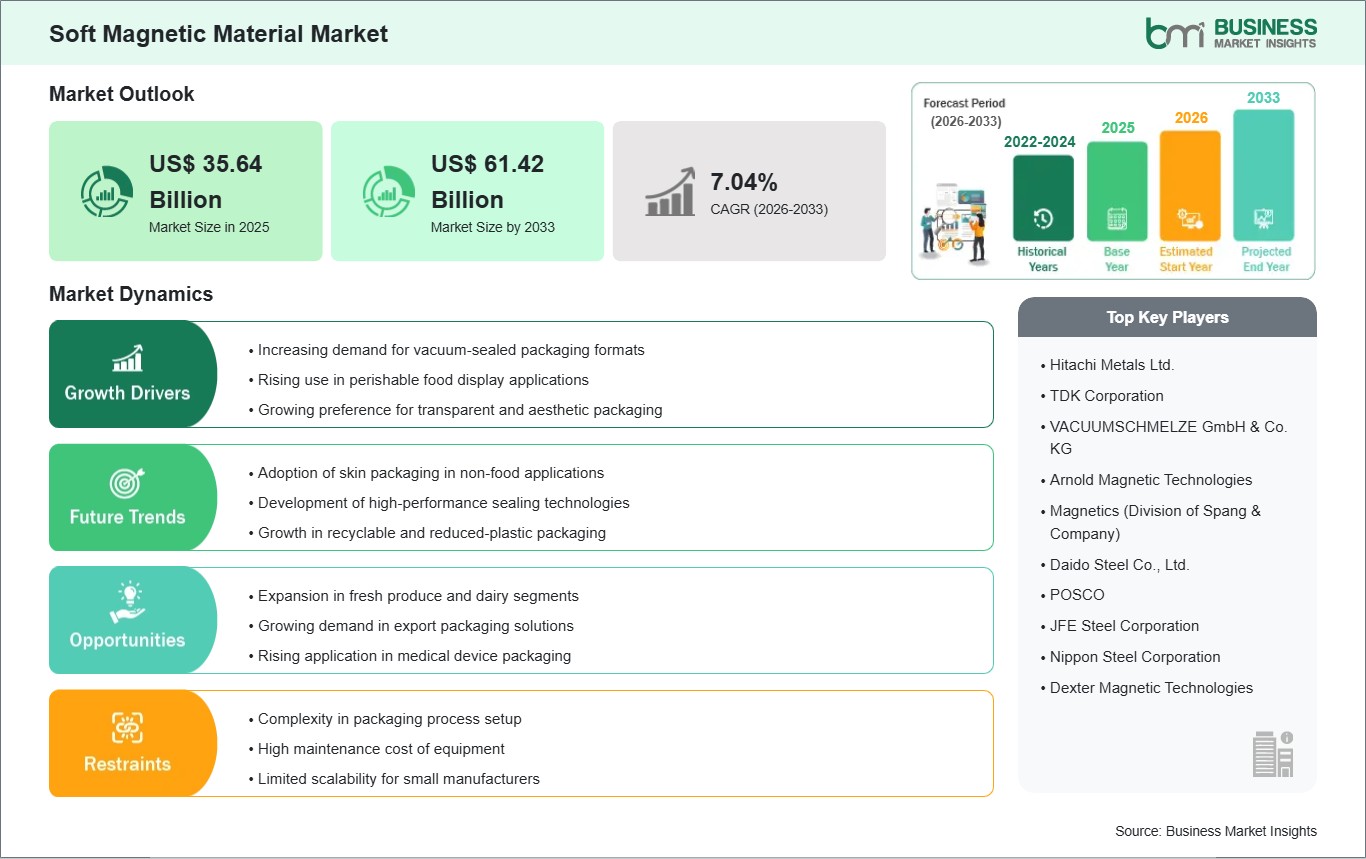
The Soft Magnetic Material Market size is expected to reach US$ 61.42 billion by 2033 from US$ 35.64 billion in 2025. The market is estimated to record a CAGR of 7.04% from 2026 to 2033.
The global soft magnetic materials market is growing steadily, and the growth is expected to continue as the rate of the electrification drive, energy efficiency, and electronics sophistication continues to gain momentum. The need for soft magnetic materials, characterized by their low coercivity and high permeability, is high in the production of transformers, electric motors, inductors, and electromagnetic shielding. The rise in the use of electric vehicles, renewable energy, and smart grid infrastructure is creating huge market growth opportunities, as these technologies require high energy conversion efficiency and minimum power loss. The growth rate of consumer electronics and industrial automation is also creating huge market growth opportunities on a global scale. Innovation in the field of material science, especially in the production of amorphous and nanocrystalline alloys, is helping in the improvement and miniaturization of the performance characteristics of modern devices. Manufacturers are also working towards the improvement of thermal stability and reduction of core losses to meet the stringent energy regulations set in the global market.
However, the market is also facing some restraints, such as the availability of raw materials, as well as the complexity in the manufacturing process, which is causing an increase in the production cost. The environmental issues are also affecting the market, but the global market is still moving ahead with high momentum.

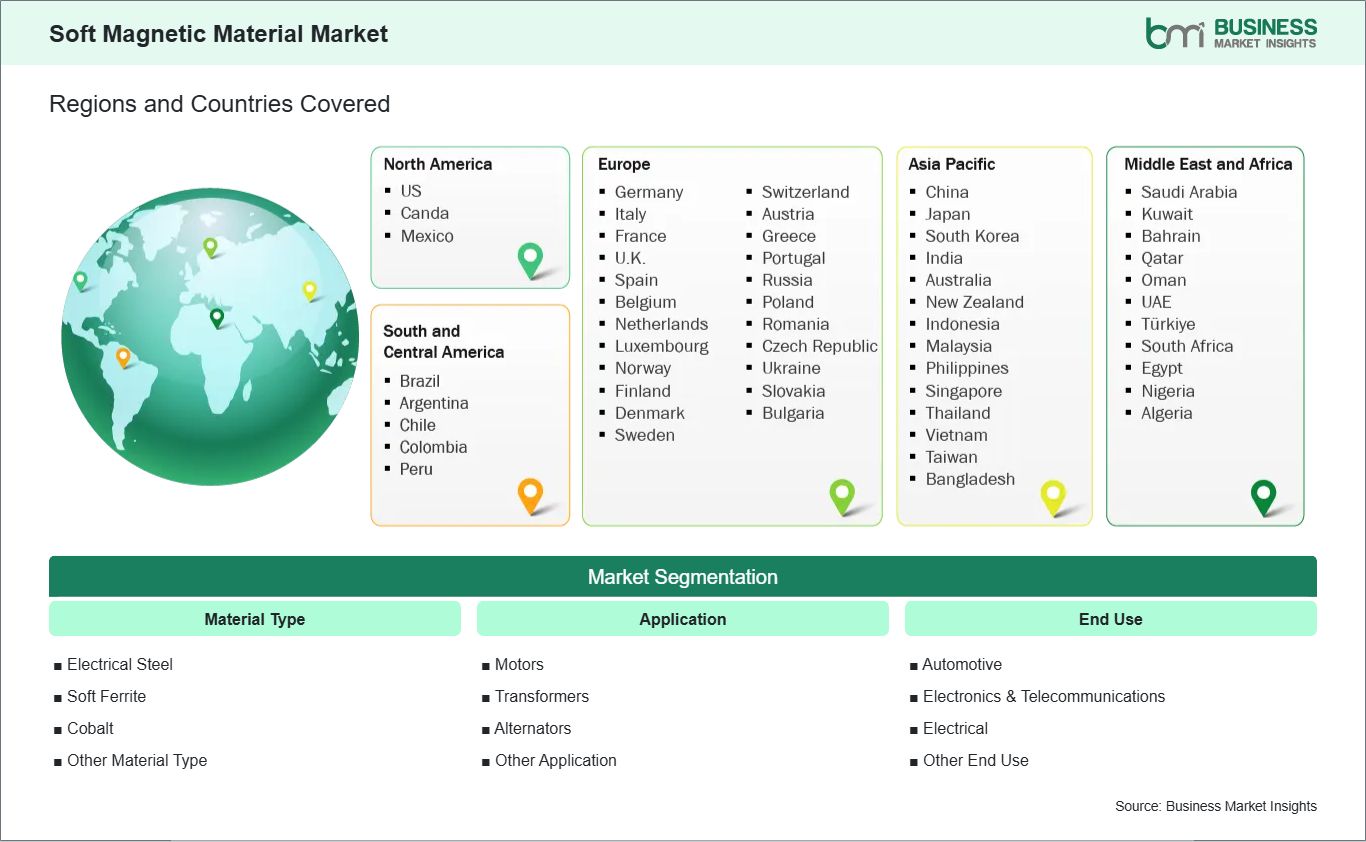
Key segments that contributed to the derivation of the soft magnetic material market analysis are material type, application, and end use.
The Western Europe soft magnetic materials market is witnessing growth due to the increasing adoption of vacuum-sealed packaging solutions. Even though soft magnetic materials are not directly involved in the packaging process, they are an integral part of the electric motor, transformer, and actuators, which are integral to the operation of the modern vacuum sealing machines. In countries such as Germany, Italy, and the Netherlands, the sophisticated manufacturers of packaging machines are increasingly using soft magnetic materials in the motor cores of electric machines to enhance the precision of the sealing operation.
In Germany, the country’s leading manufacturers of food packaging equipment are currently modernizing the vacuum packaging machines currently in use in the country’s meat, cheese, and ready meal products industry, which are being upgraded to ensure better performance in terms of energy efficiency and hygiene requirements. In these machines, high-performance, compact, and efficient soft magnetic components are required to ensure the proper operation of the machine in creating the required vacuum pressure.
In addition, the increasing demand for the use of vacuum-sealed food products in the retail and e-commerce industries in Western Europe has led to an increase in the requirements of the machines, further increasing the demand for soft magnetic materials. As the need for better performance in the operation of the machines continues, soft magnetic materials play an integral role in the operation of the machines, particularly in the creation of next-generation food packaging technologies.
The increasing demand for fresh produce and dairy product processing in Western Europe has led to an indirect, steady, and increasing demand for soft magnetic materials, particularly in relation to food product processing and cold chain equipment. Countries such as France, Denmark, and Spain have seen a surge in automated food product processing, packaging, and cold chain equipment. These facilities utilize food products, motors, compressors, and sensors, which use soft magnetic materials in order to ensure energy efficiency and operational reliability.
In France, there has been an increase in dairy product manufacturing facilities, including milk, yogurt, and cheese production plants. These facilities utilize various automated equipment, including motors, which use soft magnetic materials in order to ensure operational efficiency, speed, and reduced energy consumption. In Spain, there has been a surge in fresh produce sorting facilities, including fruits and vegetables, in Murcia and Andalusia. These facilities utilize motor-driven equipment, which relies on soft magnetic materials in order to ensure energy efficiency and operational reliability.
In Denmark and the Netherlands, advanced cold chain logistics for dairy and fresh produce utilize temperature-controlled storage and distribution systems powered by soft magnetic-enabled motors and transformers. These materials ensure lower heat losses, quieter operation, and longer service life for compressors and conveyor drives. As Western Europe continues to expand its fresh food and dairy supply chains, the demand for soft magnetic materials in machinery supporting processing, storage, and transport is expected to grow steadily, driven by both operational efficiency and sustainability goals.

The soft magnetic material market is experiencing steady growth, with market size and share analysis reflecting evolving treatment preferences and competitive dynamics among key players. The report evaluates important subsegments categorized within material type, application, and end use highlighting their respective contributions to overall market performance.
By material type, the electrical sheet subsegment dominated the Soft magnetic material market in 2025 because because it offers the best balance of high magnetic permeability, low core losses, and low cost, making it ideal for large‑scale applications such as motors and transformers. These properties help improve energy efficiency and reduce heat losses in rotating and static equipment, which is why manufacturers prefer it for mainstream industrial use.
Based on application, the motor subsegment dominated the soft magnetic material market in 2025 every electric motor from small fans to large industrial drives needs a magnetic core. Global electrification trends (more electric vehicles, automation, and industrial equipment) are increasing motor production rapidly. This volume demand outweighs that of transformers or alternators, especially as efficiency standards push manufacturers to use better magnetic cores.
In term of end use, the electrical & electronic subsegment dominated the soft magnetic material market in 2025 due to the rapid growth of electric vehicles (EVs) and hybrid vehicles. EV traction motors, onboard chargers, and power electronics all require significant amounts of soft magnetic materials. This surge is outpacing traditional electrical and electronics uses because every new electric car requires more magnetic material per vehicle than most consumer electronics produc
| Report Attribute | Details |
|---|---|
| Market size in 2025 | US$ 35.64 Billion |
| Market Size by 2033 | US$ 61.42 Billion |
| Global CAGR (2026 - 2033) | 7.04% |
| Historical Data | 2022-2024 |
| Forecast period | 2026-2033 |
| Segments Covered | By Material Type
|
|
Regions and Countries Covered
| |
| North America | US, Canada, Mexico |
| Europe | Belgium, Austria, Finland, Denmark, Greece, Poland, Romania, Russia, Ukraine, Czech Republic, Slovakia, Bulgaria, Italy, Luxembourg, Germany, Switzerland, France, Netherlands, Norway, Portugal, Spain, Sweden, United Kingdom |
| Asia-Pacific | Australia, China, India, Japan, South Korea, Indonesia, Malaysia, Philippines, Singapore, Thailand, Vietnam, Bangladesh, New Zealand, Taiwan |
| South and Central America | Brazil, Argentina, Peru, Chile, Colombia |
| Middle East and Africa | Bahrain, Kuwait, Oman, Qatar, Saudi Arabia, United Arab Emirates, Turkiye, South Africa, Egypt, Algeria, Nigeria |
| Market leaders and key company profiles |
|
The "Soft Magnetic Material Market Size and Forecast (2022 - 2033)" report provides a detailed analysis of the market covering below areas:
The geographical scope of the Soft magnetic material market report is divided into five regions: North America, Asia Pacific, Europe, Middle East & Africa, and South & Central America. The Soft magnetic material market in North America is expected to grow during the forecast period.
North America stands as a dominant region in the global soft magnetic materials market, driven by its strong technological ecosystem and early adoption of advanced energy solutions. The region benefits from a well-established electrical and electronics industry, along with a robust automotive sector that is rapidly transitioning toward electrification. The increasing integration of electric vehicles and hybrid systems has significantly elevated the demand for high-performance soft magnetic materials, particularly in motor cores and power electronics. The presence of leading manufacturers and research centers in the US and Canada ensures the development of innovations in next-generation materials like nanocrystalline and powder-based soft magnets. Moreover, the region’s focus on developing the infrastructure of the electrical sector is further boosting the demand for these materials. Wind and solar farms require efficient transformers and inductors, which are boosting the market’s growth prospects. Government policies on energy efficiency and emission reduction are also impacting the market and encouraging industries to use these materials. However, the dependency on imported raw materials and the high production costs are the major challenges faced by the region. Nevertheless, the region remains at the top of the global market due to its innovations and the demand and regulatory scenario.

The soft magnetic material market is evaluated by gathering qualitative and quantitative data post primary and secondary research, which includes important corporate publications, association data, and databases. A few of the key developments in the soft magnetic material market are:
The Soft Magnetic Material Market is valued at US$ 35.64 Billion in 2025, it is projected to reach US$ 61.42 Billion by 2033.
As per our report Soft Magnetic Material Market, the market size is valued at US$ 35.64 Billion in 2025, projecting it to reach US$ 61.42 Billion by 2033. This translates to a CAGR of approximately 7.04% during the forecast period.
The Soft Magnetic Material Market report typically cover these key segments-
The historic period, base year, and forecast period can vary slightly depending on the specific market research report. However, for the Soft Magnetic Material Market report:
The Soft Magnetic Material Market is populated by several key players, each contributing to its growth and innovation. Some of the major players include:
The Soft Magnetic Material Market report is valuable for diverse stakeholders, including:
Essentially, anyone involved in or considering involvement in the Soft Magnetic Material Market value chain can benefit from the information contained in a comprehensive market report.
Please tell us your area of interest
(Market Segments/ Regions and Countries/ Companies)