Market Summary
Executive Summary and Global Market Analysis
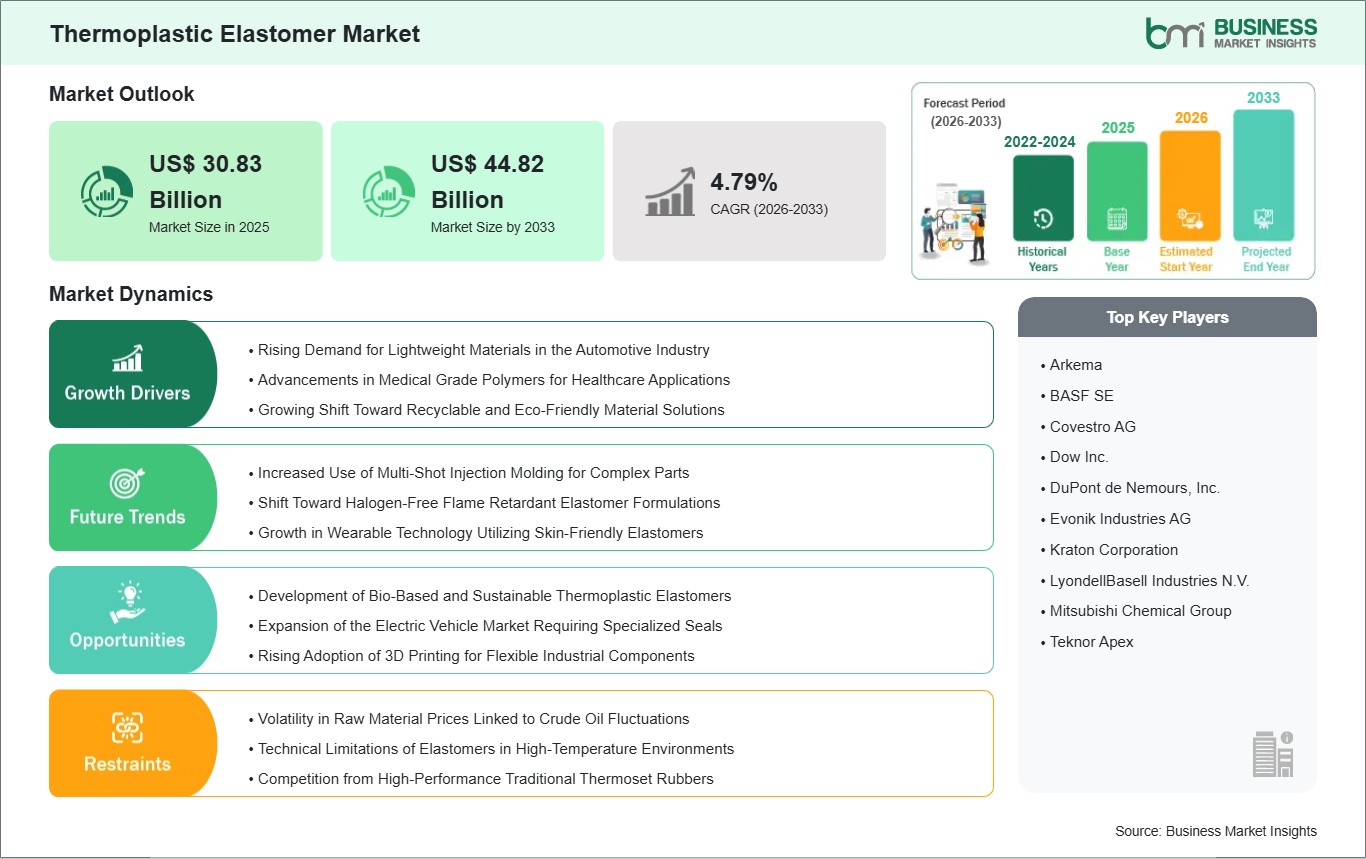
The world thermoplastic elastomer market is expanding at a rapid rate, as industries are moving from traditional rubber materials to more flexible materials that are easy to process. Thermoplastic elastomers have the performance properties of vulcanized rubber along with the processability of thermoplastics, enabling fast injection moldability and complete recyclability. The thermoplastic elastomer market is driven by the automobile industry`s demand for lightweight materials and the medical industry`s demand for flexible materials that are biocompatible. The ease of coloration and texture of these materials has also made them the preferred choice for the consumer electronics and goods industry, as these are important factors for the sale of modern gadgets and electronics.
The advancements in technology have also resulted in the development of special grades of compounding materials, which have improved properties of heat resistance and flame retardancy, thus opening new avenues in the electrical and industrial fields. Although there are certain drawbacks in the market due to the fluctuating prices of raw materials, the overall picture for this material is quite optimistic, especially because of its inherent sustainability. The regions that are currently showing maximum activity are North America and Asia Pacific, driven by heavy automotive production and an established electronics industry. As global industries are moving more towards efficiency and sustainability, the use of thermoplastic elastomers as a base material will only increase.
Segment Analysis
Thermoplastic Elastomer Market Segmentation
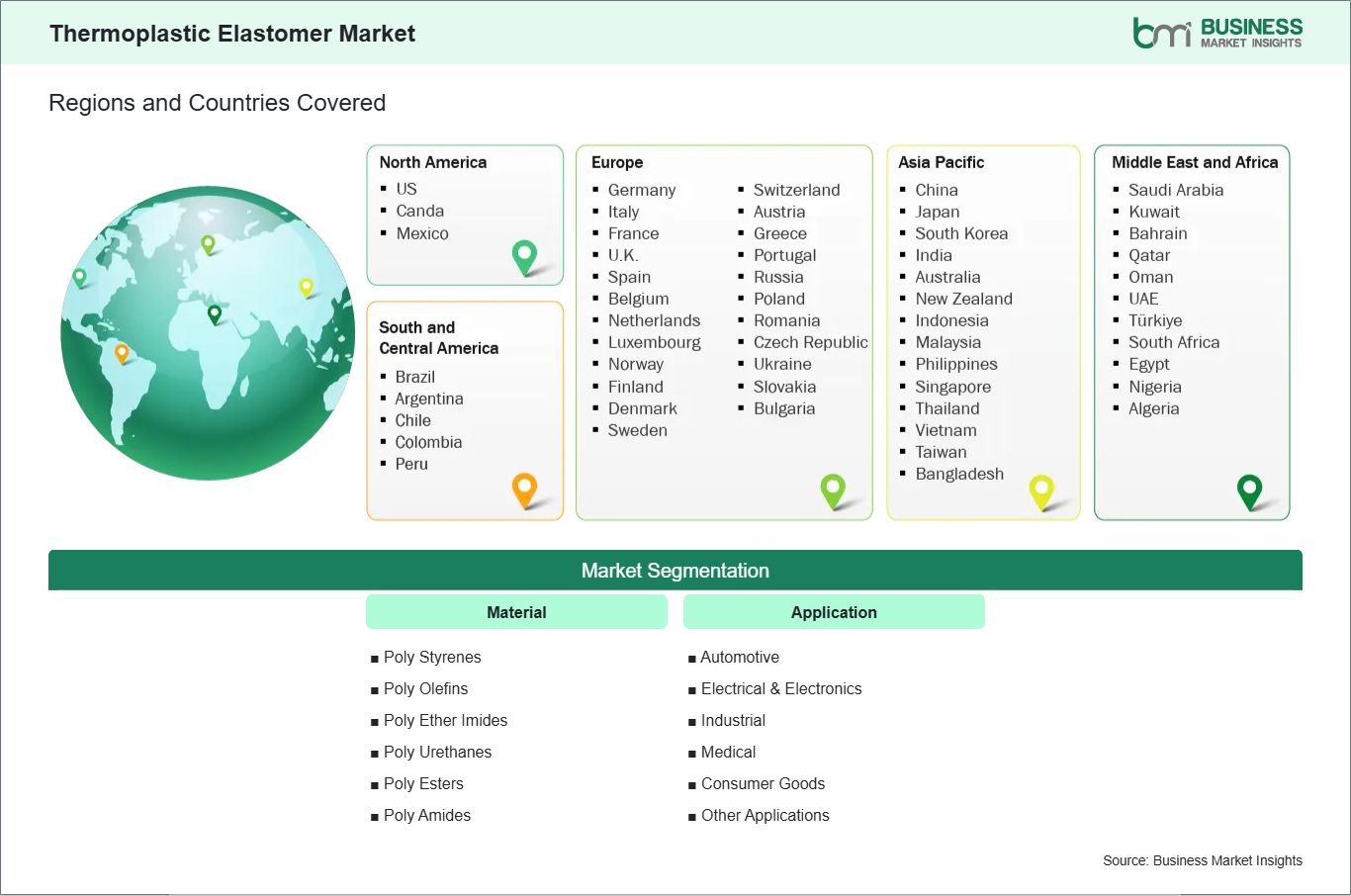
Key segments that contributed to the derivation of the Thermoplastic Elastomer market analysis are material and application.
- By material, the Thermoplastic Elastomer market is segmented into Poly Styrenes, Poly Olefins, Poly Ether Imides, Poly Urethanes, Poly Esters, and Poly Amides. The Poly Styrenes segment dominated the market in 2025.
- By application, the Thermoplastic Elastomer market is segmented into Automotive, Electrical & Electronics, Industrial, Medical, Consumer Goods, and Others. The Automotive segment dominated the market in 2025.
Market Forces
Thermoplastic Elastomer Market Drivers and Opportunities
Rising Demand for Lightweight Materials in the Automotive Industry
The automotive industry is currently undergoing a significant shift, as manufacturers are working to meet stringent fuel efficiency and emission requirements. Thermoplastic elastomers have been identified as key materials that can address the issue of replacing heavier traditional rubber and metal parts. By incorporating these materials into the overall automotive design, engineers are able to significantly reduce the overall curb weight of the vehicle without compromising integrity and safety. This is particularly important for electric cars, where every kilogram counts to increase the overall range of the automobile. The moldability of these materials into complex geometries also allows for part consolidation, thereby increasing the overall ease of production.
Apart from the reduction in weight, these materials also offer high durability and resistance to external factors such as UV rays and harsh weather conditions. These materials are commonly used in exterior components, which include window seals, as well as interior trims, thereby offering a high-quality finish as well as improved haptic feedback for consumers. The shift towards sustainable manufacturing also works in favor of these materials, as they are completely recyclable, unlike conventional vulcanized rubber. As the market shifts towards even more efficient and sustainable platforms, the use of high-performance elastomeric materials for vehicle components is expected to increase for all vehicle segments.
Development of Bio-Based and Sustainable Thermoplastic Elastomers
The push for environmental sustainability is fundamentally reshaping the material science landscape, leading to a surge in the development of bio-based thermoplastic elastomers. Historically, the market has been dependent on petrochemical-derived feedstocks, which are subject to price volatility and environmental concerns. New innovations are allowing manufacturers to produce high-performance elastomers from renewable sources like castor oil, corn starch, and other plant-based derivatives. These sustainable alternatives offer a reduced carbon footprint while maintaining the essential physical properties such as elasticity, chemical resistance, and ease of processing that industrial users require for demanding applications.
This transition toward green chemistry is particularly significant in the consumer goods and medical device sectors. Consumers are increasingly demanding products that align with their environmental values, pushing brands to adopt materials that are either biodegradable or easily recyclable within existing waste streams. In the medical field, bio-based elastomers provide a safe and biocompatible option for single-use devices and wearable health monitors. As production scales and the cost of bio-based resins becomes more competitive with traditional plastics, these sustainable materials will move from niche specialty applications to becoming the standard choice for global manufacturers seeking to enhance their corporate responsibility profiles.
Size and Share Analysis
Thermoplastic Elastomer Market Size and Share Analysis
The global Thermoplastic Elastomer market is experiencing steady growth, with market size and share analysis reflecting evolving treatment preferences and competitive dynamics among key players. The report evaluates important subsegments categorized within material and application highlighting their respective contributions to overall market performance.
By material, the Poly Styrenes subsegment dominated the market in 2025 due to its superior versatility and lower cost compared to other elastomers, making it the ideal choice for high-volume consumer goods, medical packaging, and soft-touch automotive interior components.
By application, the Automotive subsegment dominated the market in 2025 due to the rapid shift toward vehicle light weighting and the increased demand for high-performance seals, weather-stripping, and vibration-damping components that improve overall vehicle efficiency and passenger comfort.
Report Coverage
Thermoplastic Elastomer Market Report Coverage and Deliverables
The "Thermoplastic Elastomer Market Size and Forecast (2022 - 2033)" report provides a detailed analysis of the market covering below areas:
- Thermoplastic Elastomer market size and forecast at the regional and country levels for segments covered under the scope
- Thermoplastic Elastomer market trends, as well as drivers, restraints, and opportunities
- Thermoplastic Elastomer market analysis covering key trends, regional framework, major players, regulations, and recent developments
- Industry landscape and competition analysis covering market concentration, heat map analysis, prominent players, and recent developments for the Thermoplastic Elastomer market
- Detailed company profiles, including SWOT analysis
Geographic Insights
Thermoplastic Elastomer Market Geographic Insights
The geographical scope of the Thermoplastic Elastomer market report is divided into: North America, Asia Pacific, Europe, Middle East & Africa, and South & Central America. North America held the largest share in 2025.
North America stands as the leading region in the thermoplastic elastomer market, a position driven by its highly advanced automotive and healthcare sectors. The United States, in particular, has seen a massive shift toward the integration of high-performance elastomers in electric vehicle infrastructure and advanced medical devices. This dominance is supported by a strong concentration of global material science companies and research institutions that are focused on developing next-generation polymers with superior thermal and mechanical properties. The region's strict regulatory environment regarding vehicle emissions and material safety has also acted as a catalyst, forcing manufacturers to adopt recyclable and lightweight elastomeric solutions over traditional, less efficient alternatives.
In addition to industrial demand, the consumer electronics market in North America plays a significant role in regional growth. The demand for premium wearable devices, high-end sporting goods, and ergonomic tools has created a steady market for specialized styrenic and urethane-based elastomers. Furthermore, the region's focus on sustainable manufacturing and the circular economy has led to increased investment in recycling infrastructure for thermoplastic materials. This mature ecosystem, combined with a high level of technical expertise and a preference for localized, high-quality supply chains, ensures that North America remains at the forefront of the global market. As industrial automation increases, the region is well-positioned to leverage advanced molding technologies to maintain its competitive edge.
Industry Activity
Recent Developments
The Thermoplastic Elastomer market is evaluated by gathering qualitative and quantitative data post primary and secondary research, which includes important corporate publications, association data, and databases. A few of the key developments in the Thermoplastic Elastomer market are:
- In March 2025, Mitsui Chemicals, announced the expansion of its thermoplastic elastomer production capacity at its Osaka plant to meet increasing demand across Southeast Asia.
- In late 2025, Sinopec, announced the launch of a 250,000-ton per year thermoplastic elastomer project in Shanghai, focused on large-scale production of styrenic block copolymers.
- In April 2024, Lubrizol Corporation and Eastman Chemical Company, announced a collaboration to improve adhesion performance of TPEs over-molded onto Tritan™ copolyester, enhancing product performance and sustainability.
Trust & Transparency
Research Methodology
The market analysis combines proprietary research with secondary data from government agencies, company disclosures, regulatory filings, industry databases and expert interviews. Market estimates are validated through data triangulation, cross-market benchmarking and analyst
review.
View Full Research Methodology
Key Sources Referred:
American Chemistry Council (ACC)International Council of Chemical Associations (ICCA)European Chemical Industry Council (Cefic)China National Packaging Industry Association (CNPIA)Indian Institute of Packaging (IIP)Japan Packaging Institute (JPI)Gulf Petrochemicals and Chemicals Association (GPCA)Company WebsitesCompany Annual ReportsCompany Investor Presentations