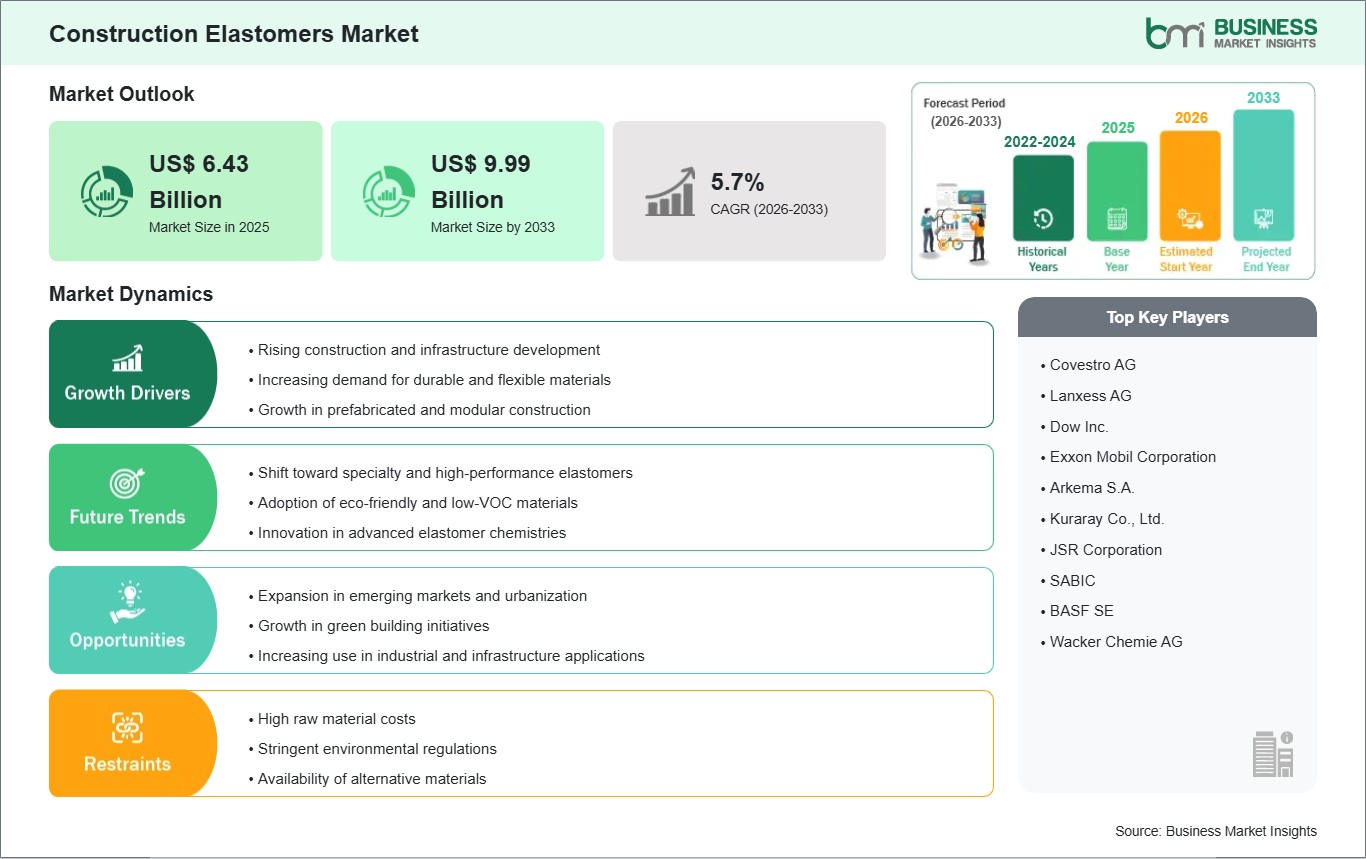
The Construction Elastomers Market size is expected to reach US$ 9.99 billion by 2033 from US$ 6.43 billion in 2025. The market is estimated to record a CAGR of 5.7% from 2026 to 2033.
The global construction elastomers market is expanding steadily, driven by increasing construction and infrastructure development worldwide. Elastomers are polymeric materials with elastic properties that make them ideal for applications such as sealants, gaskets, expansion joints, flooring, roofing membranes, and vibration isolation in buildings and infrastructure. Their flexibility, durability, and resistance to environmental stressors make them indispensable in modern construction practices.
Growth in urbanization, residential and commercial building projects, and infrastructure initiatives is fueling demand for construction elastomers. These materials offer long-term performance and structural integrity in challenging environments, making them crucial in both new constructions and renovation projects. Increasing emphasis on high-performance materials that can withstand extreme temperatures, UV radiation, and mechanical stress is further driving adoption.
Technological advancements in elastomer chemistries are creating opportunities for high-performance, durable, and sustainable materials. Thermoset and thermoplastic elastomers provide versatility in application, while specialty chemistries such as TPUs, EPDMs, and silicone elastomers cater to highly demanding construction and industrial requirements. Manufacturers are also innovating to meet environmental and regulatory requirements by developing low-VOC, recyclable, and eco-friendly elastomer solutions.
The market is further supported by growing awareness of sustainable construction practices. The use of eco-friendly elastomers is increasingly mandated in green building projects and infrastructure development. Overall, the market is expected to continue growing due to rising construction activities, technological innovations, and the need for durable and sustainable elastomer solutions.

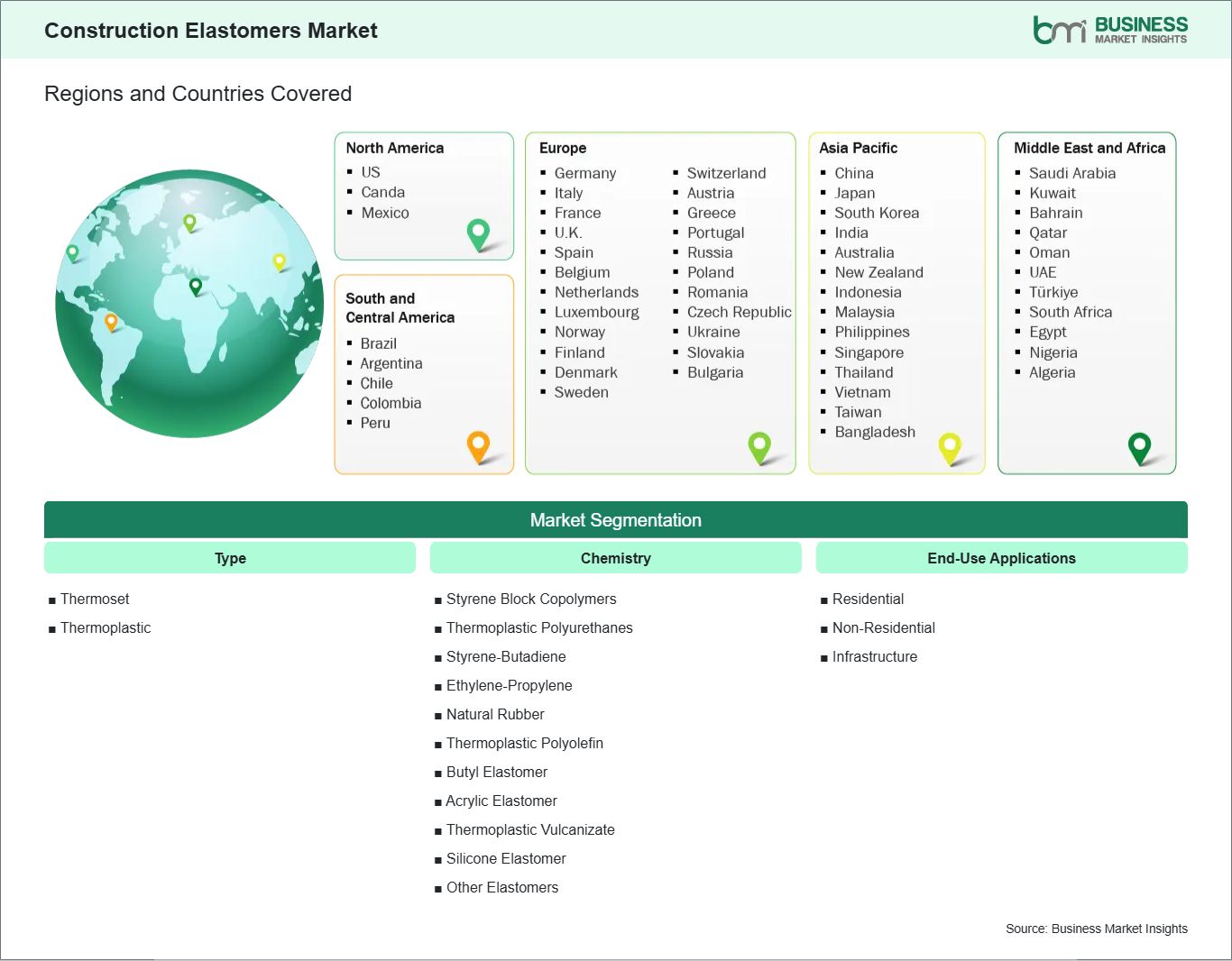
Key segments that contributed to the derivation of the construction elastomers market analysis are type and chemistry.
The global construction elastomer market is experiencing exceptional growth due to increased construction activity around the world, including residential, commercial, and infrastructure projects. Elastomers are essential components of modern-day constructions because they are flexible, resilient, and can withstand environmental aggressors. These materials are found primarily in the areas of sealants, expansion joints, roofing membranes, flooring systems, and vibration isolation. All of these applications require durable products that will last long-term and have the capability of being adaptable to changing conditions. The increased construction activity, especially in emerging markets, is driving up demand for elastomers because urban populations are growing as city limits expand and infrastructure developments increase. Rising disposable income has also led to increased demand for homes and the resultant boom in governments' investments in large-scale infrastructure projects such as highways, bridges, airports, and smart cities.
The application of elastomers in these types of structures contributes to improved performance and durability by providing resistance against all of the following: UV rays, heat, chemicals, and mechanical forces. In addition, elastomers will continue to be in greater demand due to the increasing use of prefabricated and modular building methods, as these construction techniques necessitate dependable bonding, sealing, and vibration-damping methods. The combination of urban growth, industrial growth, and infrastructure improvements will ensure that the future of elastomers is bright as they will continue to be integral materials used throughout the construction industry worldwide.
As demand increases, the construction elastomers market is also experiencing a trend toward specialty and sustainable materials. Specialty elastomers are designed for specific applications, such as silicone elastomers for use in high-temperature and weather-exposed environments; thermoplastic polyurethane (TPU) and ethylene-propylene-diene (EPDM) elastomers with superior mechanical properties and resistance to environmental degradation have also seen significant growth in demand due to their durability and performance characteristics. With more developers requesting long-lasting, durable products in their projects, these materials are becoming increasingly popular. Sustainability trends are also changing how the industry operates; manufacturers have begun developing new types of elastomers without volatile organic compounds (VOCs), recyclable elastomers, and elastomers made from bio-based raw materials to meet the green building standards established by governmental and industry bodies, thus creating new opportunities for manufacturers to sell their environmentally friendly solutions.
As industrial and commercial construction continues to grow in developing regions like Asia Pacific and Latin America, the demand for elastomers will continue to increase as developers seek to incorporate the most suitable materials to achieve maximum durability and performance in their projects. The synergy between special performance and sustainable materials is creating a new paradigm in the elastomer market that combines the best of both material types - functional performance and environmentally responsible behavior - to position elastomers as fundamental to modern construction practices and key to achieving the objectives of both durability and sustainability in infrastructure development.

The Construction Elastomers Market demonstrates steady growth, with size and share analysis highlighting evolving trends and competitive dynamics among key players. The report examines subsegments categorized within type and chemistry, offering insights into their contribution to overall market performance.
By product, the thermoset subsegment dominated the market in 2025, driven by its excellent durability, high-temperature resistance, and widespread use in roofing, sealants, and expansion joints.
By chemistry, the Ethylene-Propylene (EPM/EPDM) subsegment dominated the market in 2025, driven by its superior elasticity, UV and weather resistance, and suitability for diverse construction applications.
| Report Attribute | Details |
|---|---|
| Market size in 2025 | US$ 6.43 Billion |
| Market Size by 2033 | US$ 9.99 Billion |
| Global CAGR (2026 - 2033) | 5.7% |
| Historical Data | 2022-2024 |
| Forecast period | 2026-2033 |
| Segments Covered | By Type
|
|
Regions and Countries Covered
| |
| North America | US, Canada, Mexico |
| Europe | Belgium, Austria, Finland, Denmark, Greece, Poland, Romania, Russia, Ukraine, Czech Republic, Slovakia, Bulgaria, Italy, Luxembourg, Germany, Switzerland, France, Netherlands, Norway, Portugal, Spain, Sweden, United Kingdom |
| Asia-Pacific | Australia, China, India, Japan, South Korea, Indonesia, Malaysia, Philippines, Singapore, Thailand, Vietnam, Bangladesh, New Zealand, Taiwan |
| South and Central America | Brazil, Argentina, Peru, Chile, Colombia |
| Middle East and Africa | Bahrain, Kuwait, Oman, Qatar, Saudi Arabia, United Arab Emirates, Turkiye, South Africa, Egypt, Algeria, Nigeria |
| Market leaders and key company profiles |
|
The "Construction Elastomers Market Size and Forecast (2022 - 2033)" report provides a detailed analysis of the market covering below areas:
The geographical scope of the Construction Elastomers Market report is divided into North America, Asia Pacific, Europe, Middle East & Africa, and South & Central America. North America held the largest share in 2025.
North America dominates the construction elastomers market due to a mature construction industry, advanced manufacturing capabilities, and high adoption of high-performance elastomer solutions. The United States and Canada are leaders in the use of elastomers for sealing, vibration damping, roofing, and flooring applications. Stringent environmental regulations and growing green construction initiatives are further supporting the adoption of eco-friendly elastomers.
Europe is a mature market, characterized by advanced construction practices and strong sustainability mandates, particularly in countries like Germany, France, and the UK. The focus on long-lasting and energy-efficient building solutions is boosting demand for specialty elastomers.
Asia Pacific is the fastest-growing region due to rapid urbanization, industrialization, and infrastructure expansion in countries like China, India, and Southeast Asia. The region sees high demand for elastomers in large-scale residential, commercial, and industrial projects.
Emerging markets in Latin America and the Middle East & Africa are witnessing steady growth, driven by increasing infrastructure development and residential construction projects. However, regulatory and pricing constraints may affect market penetration in some countries.

The Construction Elastomers Market is evaluated by gathering qualitative and quantitative data post primary and secondary research, which includes important corporate publications, association data, and databases. A few of the key developments in the construction elastomers market are:
The Construction Elastomers Market is valued at US$ 6.43 Billion in 2025, it is projected to reach US$ 9.99 Billion by 2033.
As per our report Construction Elastomers Market, the market size is valued at US$ 6.43 Billion in 2025, projecting it to reach US$ 9.99 Billion by 2033. This translates to a CAGR of approximately 5.7% during the forecast period.
The Construction Elastomers Market report typically cover these key segments-
The historic period, base year, and forecast period can vary slightly depending on the specific market research report. However, for the Construction Elastomers Market report:
The Construction Elastomers Market is populated by several key players, each contributing to its growth and innovation. Some of the major players include:
The Construction Elastomers Market report is valuable for diverse stakeholders, including:
Essentially, anyone involved in or considering involvement in the Construction Elastomers Market value chain can benefit from the information contained in a comprehensive market report.
Please tell us your area of interest
(Market Segments/ Regions and Countries/ Companies)