Market Summary
Executive Summary and Global Market Analysis
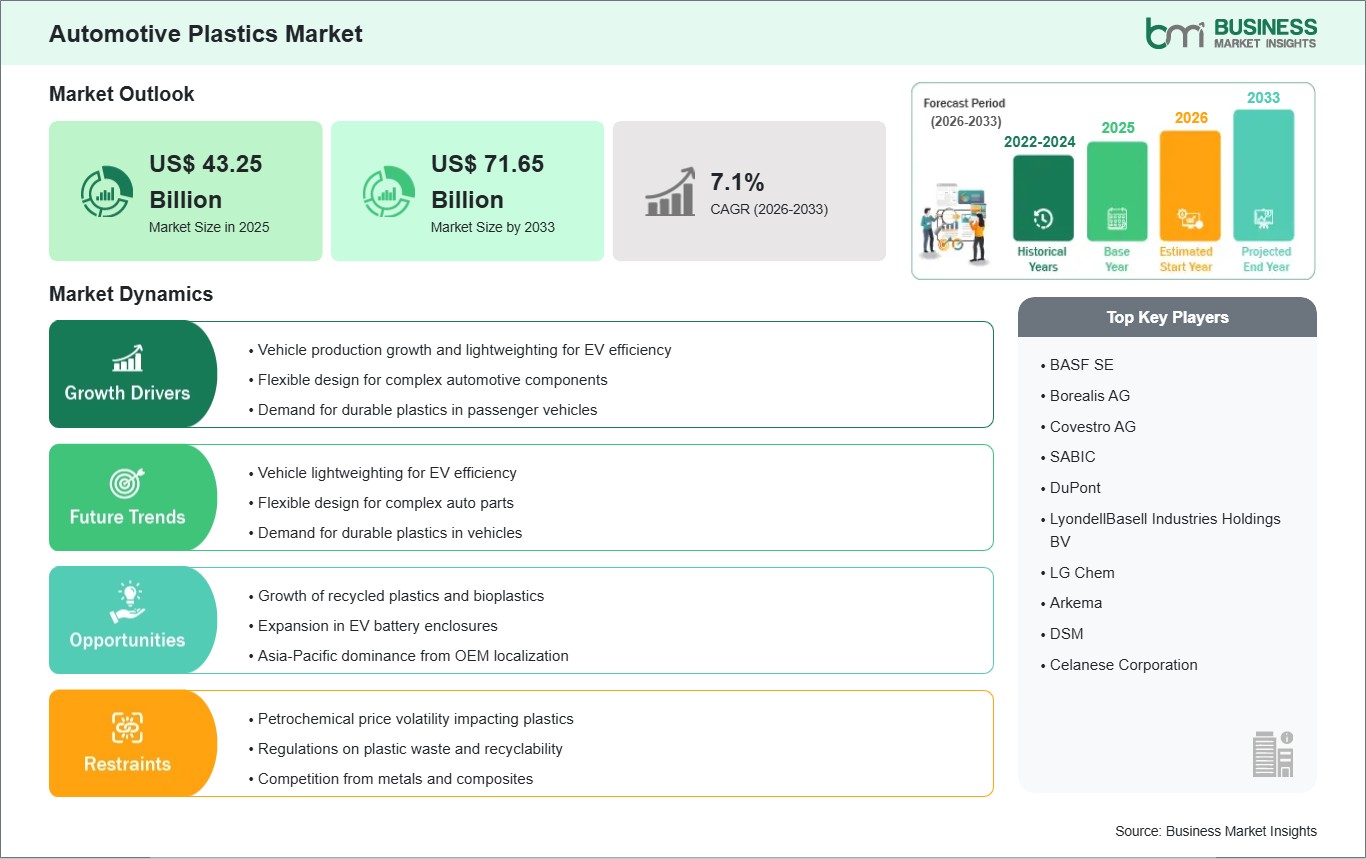
Automotive plastics are crucial for modern vehicle manufacturing. They help reduce weight, improve fuel efficiency, and enhance performance while ensuring safety and design flexibility. These materials are commonly used in the interiors, exteriors, engine components, and electrical systems of vehicles. They effectively contribute to lightweighting, noise reduction, and corrosion resistance. Automotive plastics also improve vehicle aerodynamics, provide impact protection, and offer design versatility.
Additionally, they help save costs, improve energy efficiency, and meet environmental regulations. Their benefits include durability, design flexibility, reduced emissions, and better overall vehicle performance. Market growth mainly comes from rising demand for lightweight vehicles, stricter fuel efficiency and emission standards, and the increasing popularity of electric and hybrid vehicles. Innovations in high-performance, reinforced, and recyclable plastics are also important.
However, the automotive plastics market has its challenges, such as changes in raw material prices can create uncertainty, just like performance limitations under extreme temperatures or stress. Higher costs may restrict adoption in some vehicle segments. Achieving optimal performance needs precise engineering and careful material selection. Despite these challenges, there are significant opportunities from technological advancements, sustainability efforts, and the growing demand for lightweight, energy-efficient vehicles. Future market trends will rely on research into biodegradable and high-strength polymers, increased support for eco-friendly materials, and the automotive industry's move toward advanced plastic-based solutions.
Segment Analysis
Automotive Plastics Market Segmentation
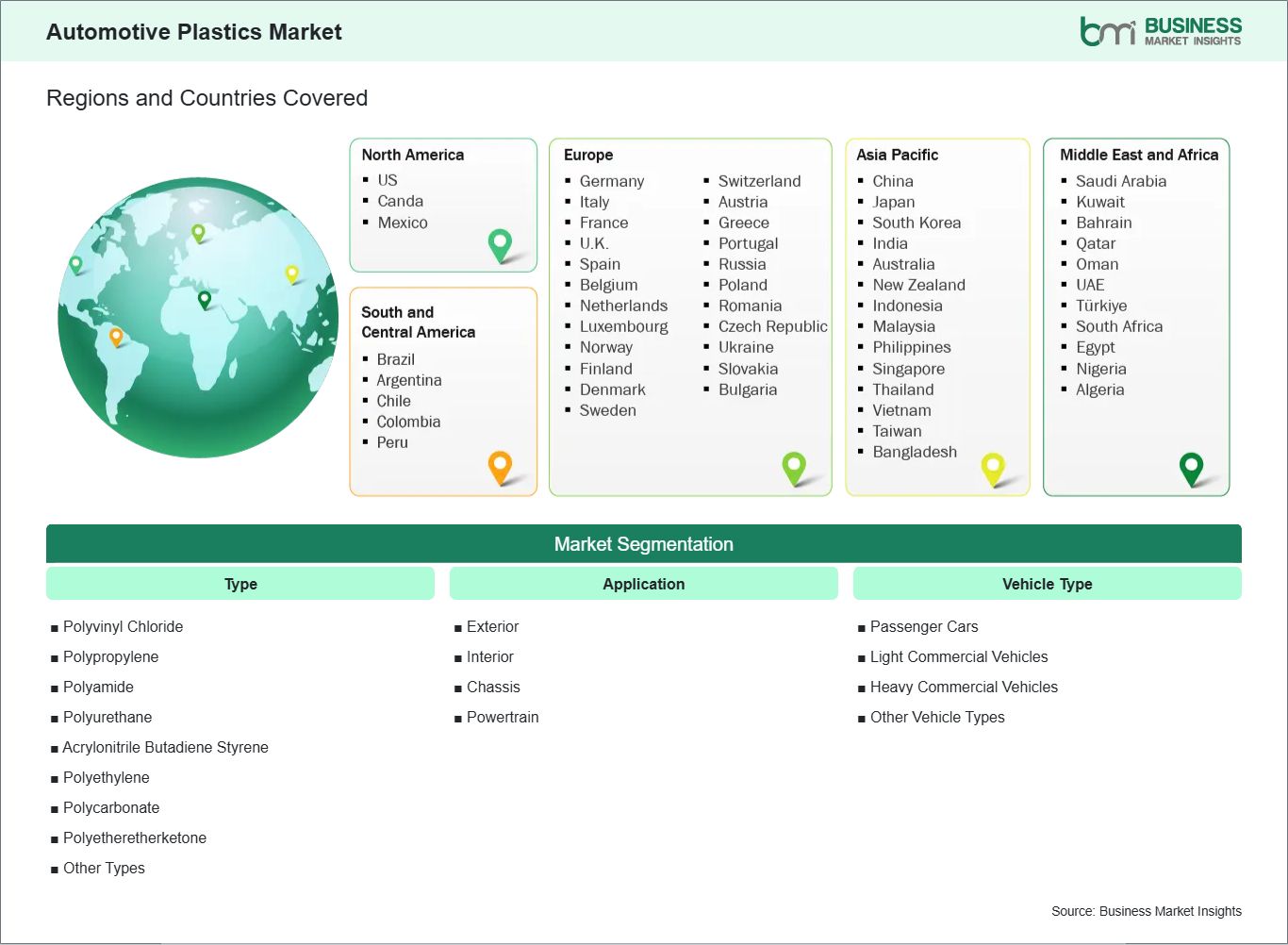
Key segments that contributed to the derivation of the automotive plastics market analysis are type, application, and vehicle type.
- By type, the automotive plastics market is segmented into polyvinyl chloride, polypropylene, polyamide, polyurethane, acrylonitrile butadiene styrene, polyethylene, polycarbonate, polyetheretherketone, and other types. The polypropylene segment dominated the market in 2025.
- By application, the market is categorized into exterior, interior, chassis, and powertrain. The interior segment dominated the market in 2025.
- By vehicle type, the automotive plastics market is segmented into passenger cars, light commercial vehicles, heavy commercial vehicles, and other vehicle types. The passenger cars segment dominated the market in 2025.
Market Forces
Automotive Plastics Market Drivers and Opportunities
Rising Demand for Lightweight and High-Performance Vehicle Components
Automakers are increasingly using advanced plastics to reduce vehicle weight, improve fuel efficiency, and meet stricter emission standards. Automotive plastics offer a cost-effective solution for enhancing durability, impact resistance, and design flexibility without major changes to production processes. They meet modern vehicle needs by providing consistent quality, easy manufacturing, and the ability to integrate complex designs. The shift toward electric and hybrid vehicles is speeding up innovation in polymer materials. Manufacturers are investing in research and development to create customized, high-performance plastics that meet changing safety, performance, and aesthetic standards. Technological adoption, regulatory incentives, and growing demand for lightweight, energy-efficient vehicles also drive market growth. The development of multifunctional plastics continues to create opportunities in interior, exterior, and structural components.
Focus on Sustainability and Regulatory Compliance
There is growing attention to recyclable, bio-based, and low-emission plastics. This trend shows the increasing pressure to lower environmental impact and follows global regulations. Recyclable polymers and thermoplastics help with end-of-life management, attract eco-conscious consumers, and support circular economic initiatives. Automotive plastics cut energy use in production, reduce vehicle emissions, and improve resource efficiency throughout the supply chain. The industry's interest in sustainable high-performance materials shows the push to combine innovation with ecological responsibility. Stricter emission standards, carbon reduction goals, and extended producer responsibility rules are driving the development of greener plastics. The emphasis on sustainability ensures that future vehicle designs meet environmental standards while keeping safety, efficiency, and durability intact. This positions automotive plastics as a vital part of eco-friendly and technologically advanced mobility solutions.
Size and Share Analysis
Automotive Plastics Market Size and Share Analysis
The Automotive Plastics market demonstrates steady growth, with size and share analysis revealing evolving trends and competitive positioning among key players. The report further examines subsegments categorized within type, application, and vehicle type, offering insights into their contribution to overall market performance.
Based on type, the polypropylene subsegment dominates the automotive plastics market. Polypropylene has excellent lightweight properties, chemical resistance, and is cost-effective. It also offers strong durability, impact resistance, and design versatility. These materials are commonly used in interior components, bumpers, trims, and exterior panels. Their reliable performance, flexibility, and simple manufacturing make them the preferred option for automakers looking for durable, affordable, and high-performance solutions for vehicle lightweighting, fuel efficiency, and improved safety.
Report Coverage
Automotive Plastics Market Report Coverage and Deliverables
The " Automotive Plastics Market Size and Forecast (2022–2033)" report provides a detailed analysis of the market covering below areas:
- Automotive Plastics market size and forecast at global, regional, and country levels for all the key market segments covered under the scope
- Automotive Plastics market trends, as well as market dynamics such as drivers, restraints, and key opportunities
- Automotive Plastics market analysis covering key market trends, global and regional framework, major players, regulations, and recent market developments
- Industry landscape and competition analysis covering market concentration, heat map analysis, prominent players, and recent developments for the automotive plastics market
- Detailed company profiles, including SWOT analysis
Geographic Insights
Automotive Plastics Market Geographic Insights
The geographical scope of the automotive plastics market report is divided into five regions: North America, Asia Pacific, Europe, the Middle East & Africa, and South & Central America. The Asia Pacific Automotive Plastics Market is segmented into China, Japan, South Korea, India, Australia, New Zealand, Indonesia, Malaysia, the Philippines, Singapore, Thailand, Vietnam, Taiwan, Bangladesh, and the Rest of Asia Pacific. Asia Pacific's fast automotive growth is fueled by rising vehicle production, increasing urbanization, and a growing middle-class population. This makes it an important area for expanding the automotive plastics market.
Market growth is supported by the need for lightweight, fuel-efficient, and affordable materials, along with stricter emission and safety rules. The region's high use of passenger cars, increasing electric and hybrid vehicle sales, and emphasis on improved manufacturing technologies reinforce Asia Pacific's position as a major consumer and innovator in automotive plastics globally.
Industry Activity
Recent Developments
The automotive plastics market is evaluated by gathering qualitative and quantitative data post-primary and secondary research, which includes important corporate publications, association data, and databases. A few of the key developments in the automotive plastics market are:
- In May 2025, Toyoda Gosei Co., Ltd. developed a recycling technology for high-quality plastic from end-of-life vehicles (ELV) to address the demand for recycled materials in the automotive sector. This innovation allows for the production of recycled plastic with performance equivalent to new material, even incorporating 50% ELV plastic. Collaborating with Isono Co., Ltd., Toyoda Gosei ensures quality raw materials and utilizes its material modification technology to meet automotive standards. The technology supports horizontal recycling in the same parts, contributing to a decarbonized circular economy and CO2 reduction, starting with models like the Toyota Camry.
- In July 2025, Toyota Tsusho Corporation announced the adoption of recycled plastic derived from Automotive Shredder Residue (ASR) for the first time in a Toyota vehicle, specifically for the front fender seal of the Crown "Sport" in Japan.
Trust & Transparency
Research Methodology
The market analysis combines proprietary research with secondary data from government agencies, company disclosures, regulatory filings, industry databases and expert interviews. Market estimates are validated through data triangulation, cross-market benchmarking and analyst
review.
View Full Research Methodology
Key Sources Referred:
World Bank – Global Trade IndicatorsEuropean Chemicals AgencyInternational Council of Chemical AssociationsInternational Monetary Fund (IMF)World Trade Organization (WTO)International Trade Administration (ITA)Company WebsitesCompany Annual ReportsCompany Investor Presentations