Market Summary
Executive Summary and Global Market Analysis
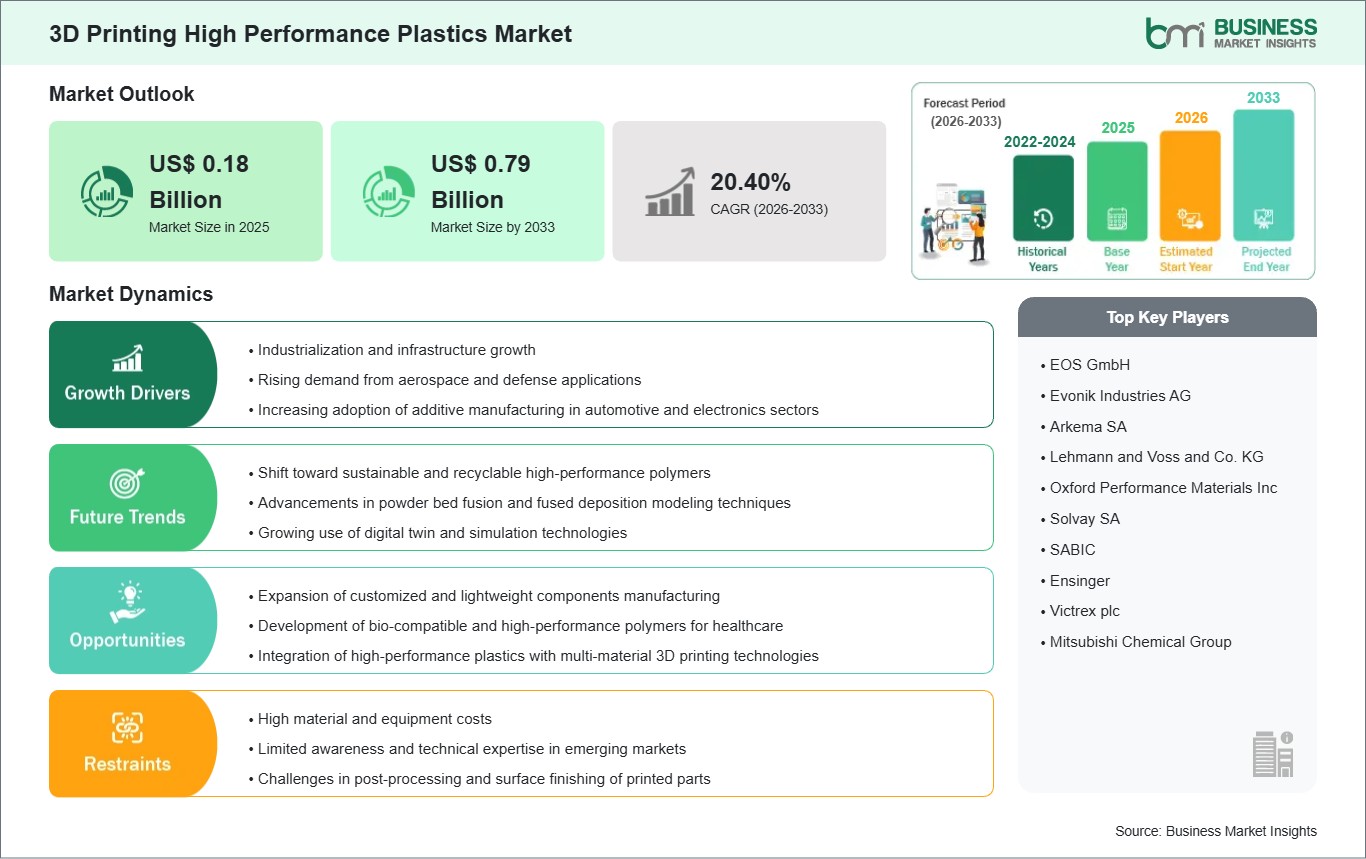
3D printing high-performance plastics are special polymer materials that provide better mechanical, thermal, and chemical properties than standard 3D printing plastics. Examples include polyether ether ketone (PEEK), polyetherimide (PEI/ULTEM), polyphenylsulfone (PPSU), polyamide-imide (PAI), and high-temperature nylons. These materials have high strength-to-weight ratios and excellent heat resistance. They are flame-retardant and highly resistant to chemicals and wear, which makes them suitable for tough industrial applications. Industries use them widely in aerospace, automotive, medical, oil and gas, and electronics for making functional end use parts, tooling, and lightweight components that can serve as substitutes for metal parts in some cases.
The demand for 3D printing high-performance plastics is growing as more companies adopt additive manufacturing for making production-grade components instead of just prototypes. Industries are seeking lightweight, durable materials to boost fuel efficiency, lower costs, and improve design flexibility. New developments in high-temperature 3D printers and better material formulations have enhanced processing abilities and reliability. The need for quick customization, shorter supply chains, and on-demand manufacturing also fuels demand, especially in high-value, low-volume applications.
Segment Analysis
3D Printing High Performance Plastics Market Segmentation
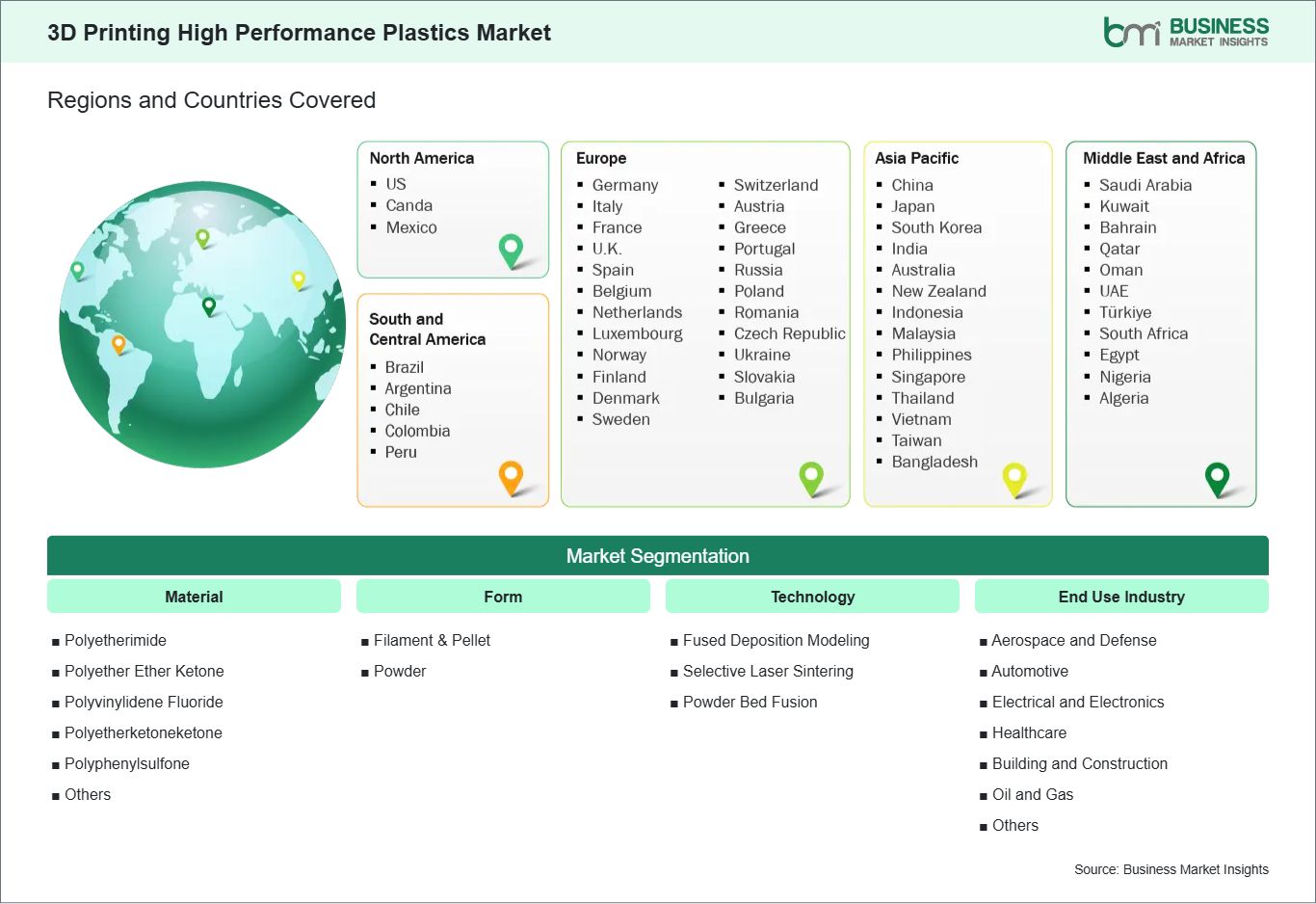
Key segments that contributed to the derivation of the 3D printing high-performance plastics market analysis are material, form, technology, and end use industry.
- By material, the market is segmented into polyetherimide (PEI), polyether ether ketone (PEEK), polyvinylidene fluoride (PVDF), polyetherketoneketone (PEKK), polyphenylsulfone (PPSU), and others. The PEEK segment accounted for the largest market share in 2025.
- By form, the market is divided into filament & pellet and powder. The filament & pellet segment held a larger share of the market in 2025.
- By technology, the market is categorized into fused deposition modeling (FDM), selective laser sintering (SLS), and powder bed fusion (PBF). The FDM segment dominated the market in 2025.
- By end use industry, the market is segmented into aerospace and defense, automotive, electrical and electronics, healthcare, building and construction, oil and gas, and others. The aerospace and defense segment accounted for the largest market share in 2025.
Market Forces
3D Printing High Performance Plastics Market Drivers and Opportunities
Increasing Adoption of Additive Manufacturing for End-Use Parts
Sectors such as aerospace, automotive, healthcare, and oil and gas are increasingly using 3D printing in their production workflows. They manufacture lightweight, complex, and strong parts that can handle extreme temperatures, mechanical stress, and harsh chemical conditions. High-performance plastics such as PEEK, PEI, and PPSU allow manufacturers to replace metal parts in some applications. This change leads to weight reduction, better fuel efficiency, and lower overall production costs.
Additive manufacturing offers design flexibility, part consolidation, and rapid iteration—factors that are challenging to achieve with traditional manufacturing methods. The rising availability of industrial-grade 3D printers that can withstand high-temperature materials, along with improvements in material quality and printing reliability, has increased their demand in the industry. As companies seek to improve efficiency, cut material waste, and shorten lead times, the demand for high-performance plastics in additive manufacturing continues to grow.
Expansion of High-Performance Plastics in Medical and Healthcare Applications
High-performance plastics provide biocompatibility, resistance to sterilization, and strong mechanical properties. These features make them ideal for medical devices, surgical tools, implants, and custom components for patients. The capability of 3D printing to create unique, complex shapes allows healthcare providers and device makers to produce tailored solutions such as implants and prosthetics that offer better functionality and comfort.
The rising focus on minimally invasive procedures and personalized medicine is driving the need for lightweight and precisely designed medical parts. Regulatory approvals for some high-performance polymers in medical applications have sped up their use. Emerging markets are investing in better healthcare infrastructure, increasing demand for affordable and quickly produced medical devices. As material innovation progresses and healthcare providers adopt digital manufacturing methods more widely, the medical sector shows strong potential for 3D printing high-performance plastics.
Size and Share Analysis
3D Printing High Performance Plastics Market Size and Share Analysis
The 3D printing high-performance plastics market demonstrates steady growth, with size and share analysis highlighting evolving trends and competitive dynamics among key players. The report further examines subsegments categorized by material, form, technology, and end use industry, offering insights into their contribution to overall market performance.
For instance, the aerospace and defense subsegment under the end-use industry category holds a significant market share due to the critical role of high-performance plastics in manufacturing lightweight, durable, and heat-resistant components. Materials such as PEEK and PEI are widely used for parts in aircraft interiors, engine components, and defense equipment, where mechanical strength and thermal stability are essential. The segment benefits from the growing adoption of additive manufacturing in aerospace applications to reduce production costs, improve design flexibility, and enable rapid prototyping.
Report Coverage
3D Printing High Performance Plastics Market Report Coverage and Deliverables
The " 3D Printing High Performance Plastics Market Size and Forecast (2022–2033)" report provides a detailed analysis of the market covering below areas:
- 3D printing high-performance plastics market size and forecast at global, regional, and country levels for all the key segments covered under the scope
- 3D printing high-performance plastics market trends, as well as market dynamics such as drivers, restraints, and key opportunities
- 3D printing high-performance plastics market analysis covering key market trends, global and regional framework, major players, regulations, and recent market developments
- Industry landscape and competition analysis covering market concentration, heat map analysis, prominent players, and recent developments for the 3D printing high-performance plastics market
- Detailed company profiles, including SWOT analysis
Geographic Insights
3D Printing High Performance Plastics Market Geographic Insights
The geographical scope of the 3D printing high-performance plastics market report is divided into five regions: North America, Asia Pacific, Europe, the Middle East & Africa, and South & Central America.
The 3D printing high-performance plastics market in APAC is growing significantly due to strong manufacturing capabilities, rapid industrialization, and growing use of manufacturing technologies in key economies such as China, Japan, South Korea, and India. The region is a major center for automotive, aerospace, electronics, and industrial manufacturing. These industries rely on high-performance plastics for lightweight, durable, and heat-resistant parts. Investments in Industry 4.0 initiatives and smart manufacturing have sped up the use of additive manufacturing in production processes, increasing the demand for 3D printing materials. A large number of polymer producers, 3D printer makers, and material suppliers help keep production costs low and improve material availability.
Government backing for manufacturing, research and development, and local production boosts market growth. The rising need for customized parts, shorter production times, and less dependence on traditional supply chains has pushed manufacturers to adopt 3D printing technologies.
Industry Activity
Recent Developments
The 3D printing high-performance plastics market is evaluated by gathering qualitative and quantitative data post-primary and secondary research, which includes important corporate publications, association data, and databases. A few of the key developments in the 3D printing high-performance plastics market are:
- In November 2025, Cubic Ink expanded its 3D printing materials portfolio by adding new resin-based products. The company also announced a partnership with SK Industriemodell to boost UV-curing resin production in the US. These changes increase Cubic Ink's material options for industrial use, improving capabilities for high-performance additive manufacturing.
- In November 2025, HP launched the HP IF 600HT industrial filament 3D printer. This printer features high-temperature polymer processing. HP also introduced HP 3D HR PA 11 Gen2 material, which allows for up to 80% powder reusability. This feature reduces the cost per part and the carbon footprint. These innovations promote more sustainable and efficient production of durable, high-performance polymer parts.
Trust & Transparency
Research Methodology
The market analysis combines proprietary research with secondary data from government agencies, company disclosures, regulatory filings, industry databases and expert interviews. Market estimates are validated through data triangulation, cross-market benchmarking and analyst
review.
View Full Research Methodology
Key Sources Referred:
World Bank – Global Trade IndicatorsWorld Trade Organization (WTO)International Monetary Fund (IMF)International Trade Administration (ITA)Company WebsitesCompany Annual ReportsCompany Investor PresentationsPhotopolymer Additive Manufacturing Alliance (PAMA)The National Additive Manufacturing Association (NAMA)Additive Manufacturing 3D Printing Group (ASME India)Global Alliance of Additive Manufacturing Associations (GAAMA)